Joshua Jelly-Schapiro on Harry Belafonte’s Extraordinary Art & Activism
In Conversation with Christian Barter and V.V. Ganeshananthan on Fiction/Non/Fiction
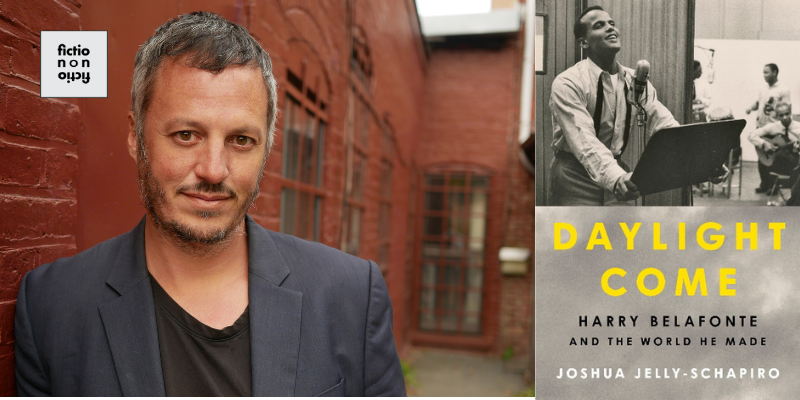
Non-fiction writer Joshua Jelly-Schapiro joins co-hosts V.V. Ganeshananthan and Christian Barter to talk about the life of performer and activist Harry Belafonte, who died in 2023. Jelly-Schapiro, the author of a new biography of Belafonte, considers the entertainer’s distinctive combination of mainstream appeal and radical politics. He notes how Belafonte’s vault to stardom and success with the first LP to sell a million copies, Calypso, positioned him to speak across racial lines in a segregated society. Jelly-Schapiro discusses Belafonte’s nation-changing impact on the Civil Rights Movement, and his unique position as the only member of Martin Luther King’s inner circle who could also be asked to guest-host The Tonight Show. He reflects on how Belafonte, the son of Jamaican immigrants who grew up between Harlem and his parents’ country, navigated the performance of authenticity. Jelly-Schapiro reads from his book, Daylight Come: Harry Belafonte and the World He Made.
To hear the full episode, subscribe through iTunes, Google Play, Stitcher, Spotify, or your favorite podcast app (include the forward slashes when searching). You can also listen by streaming from the player below. Check out video versions of our interviews on the Fiction/Non/Fiction Instagram account, the Fiction/Non/Fiction YouTube Channel, and our show website: https://www.fnfpodcast.net/ This podcast is produced by V.V. Ganeshananthan and Christian Barter.
Daylight Come: Harry Belafonte and the World He Made • Names of New York: Discovering the City’s Past, Present, and Future Through Its Place-Names • Island People: The Caribbean and the World • Nonstop Metropolis: A New York City Atlas with Rebecca Solnit • Pòtoprens: The Urban Artists of Port-au-Prince with Leah Gordon and Katelyne Alexis • Cuba Then, Cuba Now • Chris Ofili: Paradise Lost with Chris Ofili
Calypso • Island in the Sun • Buck and the Preacher • “We Are the World”
Others
Beetlejuice • Sing Your Song (2011) • Following Harry (2024)
EXCERPT FROM A CONVERSATION WITH JOSHUA JELLY-SCHAPIRO
V.V. Ganeshananthan: Belafonte was an extraordinary artist and activist. I’ve been wondering how much younger generations know about him, and what I myself might be missing in his history, and your book taught me so much. You first got really excited about him when you learned that his album Calypso was the first LP to sell a million copies. How did you find your way from that fact to starting this project and meeting him yourself?
Joshua Jelly-Schapiro: It’s a great question. My relationship to this subject and to Harry Belafonte began very early for me. I think, like many people whose parents were born after World War II, my mother, in particular, grew up with his music, so his records were certainly a part of my household growing up. I was around them and had an affinity and fondness for them. But then fast forward, I was in my 20s, and in graduate school out in Berkeley, working on a PhD dissertation on the Caribbean and the Caribbean’s influence on modern world culture. And I remember quite vividly discovering I was digging into examples of Caribbean music and folk culture that became popular in the U.S. and around the world that that conversation starts with Belfonte’s records in the 1950s. Of course, I knew that they were popular, I’d been around them, as I say, as a kid. But happening upon the fact that in 1956, this record, Calypso, which includes, you know, his best-known hits: “The Banana Boat Song” and “Jamaica Farewell” and others, that record became the first million-selling LP in history was an amazing fact to me.
I got to thinking how did that happen? First of all, this is pre-Civil Rights. This is in the era of segregation. Pop culture was still deeply segregated. How did this particular record and particular performer cross over and become such a touchstone of culture in the 1950s for everyone in the U.S. and then around the world? I’d been around the music for a long time, but happening upon that fact when I was in grad school trying to think about the influence of Caribbean culture on the world just struck me so, so deeply, and from there, and as you know from reading the book, it’s not only the fact of that record hitting in that way— which opens up all kinds of fascinating topics around history of the recording industry, of the long play record, of what people were trying to do with that medium at that time—but then also just the remarkable fact that what did Harry do with his resulting wealth and fame?
The short and simple answer to that is bankroll the Civil Rights movement, in a not incidental or casual way. Obviously, many other people were involved, but he was profoundly important to shaping and supporting social movements of the late ’50s and‘’60s, which really changed the country. And so it was an amazing sort of thing for me, in that space, studying what I was studying, to find out that fact, and then just pull on that string and think as far and as deeply as I could about his story.
Christian Barter: So going back to the beginning, you write about how he was at the American Negro theater where he started singing, and then started a restaurant where encounters with folk singers showed him, quoting from your book, “That he could make the folkies’ authenticity fetish an occasion for performance, applying to music the techniques of the method he’d studied at the dramatic workshop.” The way that you write about Harry’s relationship to people’s perceptions of authenticity, is really interesting, and obviously, it leaves open the question of real authenticity versus perceptions of authenticity. I wonder if you could talk about how you feel that played into him becoming a star, and where you see that authenticity and the perception thereof in the making of this star.
JJS: It’s an important tension in his life as a performer and an artist, because he was personally deeply invested in this idea of authenticity, of finding his authentic self, of uncovering his authentic history and the authentic history of his people. And then the idiom, or the genre, that he really excelled in and got over in is this idiom of folk music. What was really interesting, though, about Belafonte, is that he began his career, as you just mentioned, as an actor. He came back from a stint in the Navy during the war, landed back in New York, was working as a janitor and pushing carts, and was given a ticket to go see a play at the American Negro theater in Harlem. He fell in love with the theater at age 18, 19, 20, and went on to study acting at the workshop.
So, he was really trying to make it as an actor, but he was always this incredibly good-looking guy. This is a huge part of his story, and how he got over as a performer. He was also someone who could carry a tune. Singing was a lark initially. He started playing and singing in jazz clubs where he had friends, he loved bebop, and all those great musicians: Lester Young and Charlie Parker, Max Roach, these people he was around. So he started off playing, dabbling in jazz. But it didn’t really suit him. He loved the music, he didn’t love performing it and singing it.
How he kind of came to folk music was he was in Greenwich Village, he had this little hamburger shop called The Sage with some friends. He became quite enamored with and interested in the so-called folk revival, people like Pete Seeger and Woody Guthrie and Josh White who were creating this really dynamic scene there that was about the music of common people, and it was often allied to the labor movement. He was fascinated by that world. It fit his lefty politics as well.
But as you suggested, there’s a really interesting thing where he was an actor, who could carry a tune and was interested in folk music. What he did was take those songs and that tradition and turn them into this occasion for dynamic modern theater. As he was developing his act as a folk singer, he wasn’t sitting on a chair strumming a guitar. He couldn’t play guitar, so that wouldn’t have worked anyway. He stood up, and his styling was important to him. He was this incredibly striking guy, and he was quite transparent about this; he made the presentation of folk songs a glamorous, theatrical, dramatic thing. As a critic put it at that point, you know, Harry’s found the best role he could find, the role of a folk singer, right?
So absolutely, there’s an element of performance in that. He’s enacting a role. But he also cared deeply about the songs he was performing. He understood how performance and pop culture work in some intuitive way, but was also really interested in so-called authentic tradition and authentic music.
But there’s a whole bunch more we could say about. He caught a lot of flack at certain moments about “He’s not a real folk singer, an authentic folk singer,” and I think, as that quote you mentioned gestures toward, that’s always a very complicated and vexed conversation. Who’s to say what’s authentic at the end of the day, right? If someone is authentic to themselves and what they’re performing, and it touches people in a certain way, that’s authentic, too.
Transcribed by Otter.ai. Condensed and edited by Rebecca Kilroy. Photograph of Joshua Jelly-Schapiro by Mirissa Neff.

Fiction Non Fiction
Hosted by Whitney Terrell and V.V. Ganeshananthan, Fiction/Non/Fiction interprets current events through the lens of literature, and features conversations with writers of all stripes, from novelists and poets to journalists and essayists.