Josh Weil on the Necessity of Writing What Scares You
Follow the Fear. See Where It Leads.
This first appeared in Lit Hub’s Craft of Writing newsletter—sign up here.
Here are my terrors: First, monsters. Mostly the deep ocean variety, unfathomable, unseeable, likely lurking beneath me as I swim (okay, also in ponds: so murky!). Though the earliest kind I remember fearing was one called The Wendigo, a cannibalistic landbound creature out of Algonquin mythology who I encountered in an X-Men comic when I was maybe eight. I can still hear its howl—Wen-di-go!—bellowed in my big brother’s puberty-cracked voice, when, from his hiding place beneath my bed, he’d wake me into screaming.
I grew, my fears grew nearer to my heart: that I’d be bound to live a life alone, unfit to share it with another; that I might lose the bond my brother and I had always known; later, that I was failing as a father; to this day, that I won’t find a way to be fully present both for the characters I write and for my family. Also: snakes.
Write what scares you. Of all the craft lessons I’ve learned that remains the most important. Though when I first heard it—from my earliest mentor, the playwright Vincent Cardinal—I wasn’t yet mature enough to truly grasp it. Or maybe, at 20, watching my first play featured at a festival, my film school movies garner accolades, already dating the woman I would marry, I was too cocky. A blockage life would relieve me of in a few years. By 23 I’d have written three failed novels. By 24 I’d have abandoned film. By 25 I’d be divorced. A year later, living alone in a remote cabin, re-balancing the weight of a life that suddenly contained one instead of two people, I faced the greatest fear that I’d yet known: that my daily existence could carry no meaning to another being. That bit about a life containing one instead of two became a line in a story I’d write that year. Which became the first novella in a collection. Which would become the first book that I published.
To some extent I’d always sensed—as most writers must—that no matter how well-conceived a narrative might be, what would turn it from a story I needed to write to a story that needed me to write it would have to come from inside myself. But I don’t think it was until I wrote that novella alone in that cabin that I began consciously to turn toward my fears to find my subjects.
And that’s what I’m suggesting here. That when you sense a story, or glimpse a scene, or feel a character coming to life, you stop, step back, consider what in that might scare you most. So you can steer your work toward it. If you’re torn between ideas, choose the one you most dread facing. If you’re stuck, let that dread jolt you loose.
Then—and this is key for me—find a way to make it worse. Who might find that fear even more terrifying? There lies your character. Why? There lies the weight. Where might the wreckage carry most consequence? Your setting. What might this poor soul you’ve brought this all upon do to prevent it, fight it, try to survive it? Now there’s a story.
It’s one of the great gifts of writing fiction: from the safety of our desks, we bastards get to inflict upon our creations that which we’d never wish upon ourselves. But more than that, it’s vital to the craft: it’s what enlarges our fears from individual insecurities into compelling stories.
Sure, when I wrote that first novella I was facing my fear—A re-balancing of the weight of a life, I wrote, that suddenly contained one instead of two people—but I’d placed it upon a character who’d feel it worse in a situation that would grind it sharper: a man who’d lived all his life on an isolated beef farm with only his father, suddenly alone after his father’s suicide. That desperation to know one’s life might have an impact on another’s? It became his struggle to help not a human, but a steer. The stakes? His own ever-stronger tilt to take his own life. True, the book I wrote after is a novel about two brothers, bonded as children, who drift apart—but it’s set in an alternative Russia imagined out of fables, the brothers twins, the pressures wrenching them redoubled by the struggles of a post-Soviet world. Oh, and there’s a monster in it. Half sea-creature, half snake.
All of the dangers contained in writing what scares you pale compared to the greater one of doing anything else.
But what scared me most writing that book wasn’t any of that. It was the prose itself (the opening paragraph came to me as one long sentence: a twisting, thrashing, dash-and-semi-colon-studded 118 words) paired with the setting. Could I really pull off a novel in a half-imagined Russia? Could I ask the reader to wade through writing that dense? I wrote the sentence. Then tried to put the idea away. But it kept clawing at me. Because another way your writing can scare you—maybe should scare you—is in some aspect of the craft itself. I’ve struggled with how to portray the passage of time, so wrote a novella that forced me to face it. I’ve been flummoxed by tone—how to write humor?—so for more than decade have returned to the same farcical story, over and over, finding new ways to fail.
These challenges of craft can’t replace grounding a story in your core fears, but they can add to it. Each danger you embrace deepens your commitment to the piece, proves you’ve got skin in the game. I’ve come to see each wrapping of risk—artistic around the personal—as a kind of layering of heft, compiling of weight, that helps give a story substance. Maybe that’s why my most recent novel both grapples all at once with many of the fears I’d spread out over my earlier work and tackles them through a structure that unnerved me (interwoven narratives working at opposing paces and tones) in a voice that shook me (first person unspooling from a neuro-divergent mind) on a subject I knew would unearth an even deeper unease: the crimes the country that helped make me had committed upon native peoples and the natural world.
That last points to one of the dangers inherent in this approach: What if you’re right to fear something? What if you’re not able to address it well enough, can’t get it right? What if you tackle your greatest fears but fail to do them justice? Or, perhaps most dangerous, what if you get so caught up in facing them that you forget to set them inside a story, start to treat characters as ways to get at your own concerns, wind up writing self-therapy? In graduate school I did just that, wrote a novel not merely rooted in my fears, but with an agenda, as if the purpose of the book was to demonstrate that I could face them.
But all of the dangers contained in writing what scares you pale compared to the greater one of doing anything else. For any of us to turn our gaze away, to waste our time on work that isn’t wrestling with what’s most urgent for us, to diminish the import our stories should hold, deny our characters the impact they deserve, to do anything other than put our most vulnerable selves out there as openly as we can: for an artist there’s nothing more terrifying than that. Sometimes my long-ago mentor would say it another way: if what you’re writing doesn’t scare you, it’s probably not worth writing.
So ask yourself: Does what I’m working on now scare me? What part scares me most? What challenge of craft, or aspect of a character? What turn in the narrative might worsen that fright? Be brave. Dive in. Draw your goggles down over your eyes. Take a deep breath. The water is dark beneath. There are monsters down there. Meet them where they wait.
___________________________________________
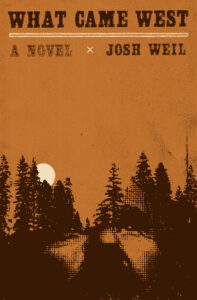
What Came West by Josh Weil is available via Doubleday.

Josh Weil
Josh Weil is the author of the novel The Great Glass Sea, the novella collection The New Valley, and the story collection The Age of Perpetual Light. He is a Fulbright Fellow and has been awarded the Dayton Literary Peace Prize, the Sue Kaufman Prize for First Fiction from the American Academy of Arts and Letters, a “5 Under 35” award from the National Book Foundation, the California Book Award, and a Pushcart Prize. For the past dozen years he has called Sierra Nevada of Northern California home.