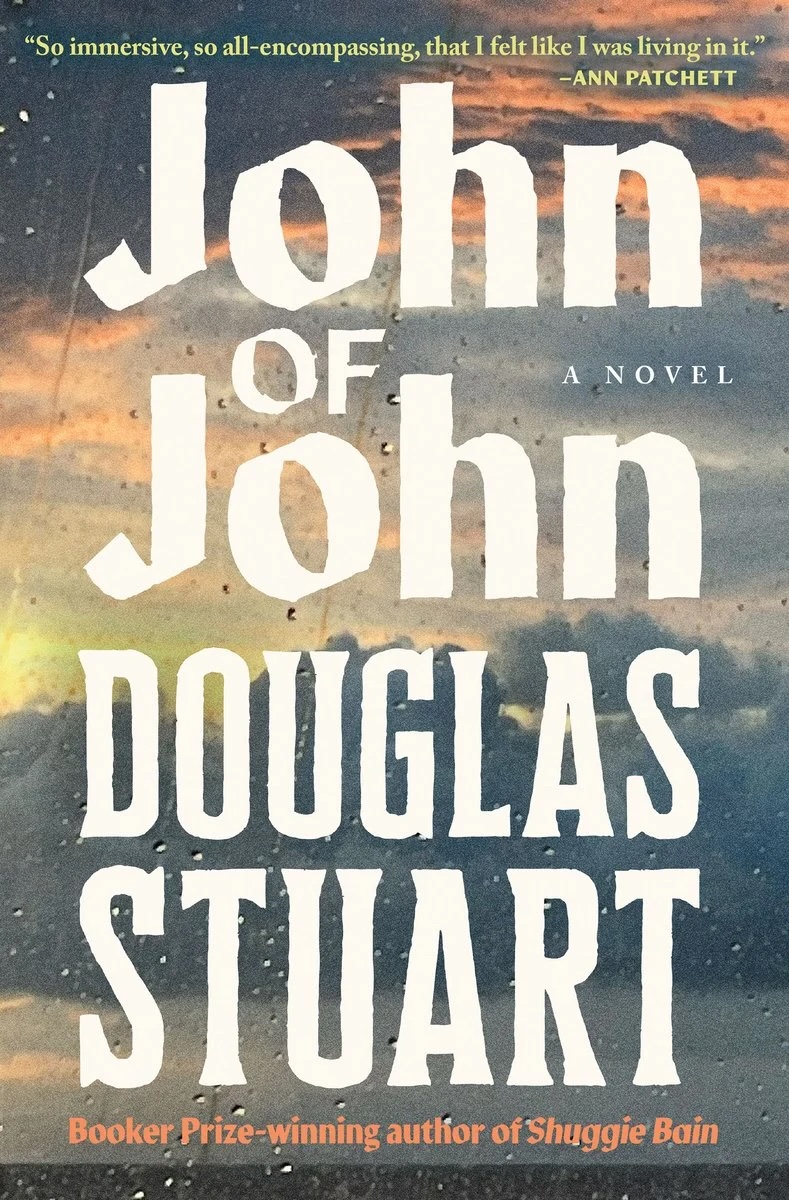
Her feet were as purple as calf liver. That’s what his father had said before he hung up. Cal had been standing in the red phone box at the bottom of the Meadows, watching the rugby players stretch on the lush green grass. Their white shorts clung to their haunches, and in the soft smirr the cloth became sheer and he could see the elasticated lines of their briefs. He was only half-listening as his father read from the New Testament.
His father had never been fond of small talk. This gave their telephone calls the feeling of a service line, like when you dialled the Speaking Clock and then reset your watch to it. When Cal mentioned this to his father, the truth of it made his father laugh, for John Macleod believed the spirit was indeed in need of constant calibration, and Cal made his calibrations every Wednesday at 6 p.m. prompt and twice again on the Sabbath.
He couldn’t afford the long-distance call to the isles so they developed a signalling system where he would call home at the agreed-upon hour, wait for three pips, and then hang up. His father would immediately call back. This required turning up early and pretending to talk to someone so no passer-by could block the telephone.
It had taken some time to find the perfect place to worship, a solitary phone box that wasn’t back-to-back with another. When his father precented the psalm, the expectation was Cal would sing it back to him in Gaelic with the full power of his belief. But when a particularly handsome man would stroll past he would cringe and lower his voice and, without fail, John would ask him why he was wavering. It was mortifying to deal with the glances of passing strangers. For this reason, he spent a good portion of their time together with his eyes closed or with his back turned to the path. He found he did his best singing while his fingers searched the calling cards left by the prostitutes and masseuses.
For all that, he liked the Meadows. The rolling fields helped slow his mind. It was one of the few spaces where the city took a breath, and he found it helped match the rhythm of his thoughts to his father’s unhurried talk. He knew his father was staring out at the sea.
“Ciamar a tha thu an-diugh?” his father asked in Gaelic. And how are you today?
“Fine. And you?”
“Not bad. Upright. All praise to God.”
Their conversation was always censored, missing the things they couldn’t talk about. Cal never mentioned he had nowhere to live. He never said that since graduating he had been abusing the charity of his classmates, surfing from one settee to the next, waiting for them to leave for work so he could forage like a wood mouse, taking just enough food to sate his hunger but never so much as to get caught. He never mentioned how he dripped dry after a shower, or how he studied the tideline of a milk bottle so he could replace what he took with tap water, or how he wandered the Edinburgh suburbs of an evening so his friends wouldn’t feel the burden of feeding him.
He didn’t mention that he had found work with a band of Albanian women cleaning the sick-splattered toilets of Negociants and the Rose Street pub. Or how when he went to collect his first wage packet, they’d deducted half of it for cleaning supplies and another seven pound fifty for storing the mops and pails. Or how when he’d confronted them, they’d told him to take it up with their burly, hirsute husbands if he thought the charges unfair. And he certainly had not told his father how he hadn’t had the courage to do that.
He absolutely didn’t mention that he spent more nights than he wanted to with a gentle Welshman who, when Cal fucked him, liked to lie on his belly with his arms pinned beneath himself, his hands clasped in some devotional gesture of helplessness. If he were ever to tell his father that, he was certain those would be the last words they would ever share.
“There are so many pigeons here and they are not a bit afraid.” With so much that could never be said, he tried to buoy along the first part of their conversation, and like a person treading water, there was always a slight edge of desperation to his talk. Throughout the week he carried a piece of scrap paper with him and jotted down subjects that would fill the time. He took the paper from his pocket and studied the list. His father must have thought him empty-headed, because he seemed to be fascinated by all sorts of uninteresting things.
“I saw a lot of red cars today.” He winced, remembering he had said this on a previous call. He placed a strand of hair in his mouth and sucked the rain from it.
It was a relief when the small talk ended and the prayer began, then all Cal had to do was receive the Word and murmur his assent at the end. John was softly spoken and as the precentor of their church he had developed a fine singing voice. When he read the Gaelic scripture, the damning words always transformed into something lyrical, beautiful, incantatory.
“A bhràithre, ma tha neach air bith air a ghlacadh ann an euceart sam bith . . .” he began. “Brethren, if anyone is caught in wrongdoing, you who are spiritual should bring him back in the spirit of gentleness. Watch yourself, lest you also be tempted.”
For the past few weeks his mind had been stuck on Galatians, running backwards and forwards over the need for brotherly correction. It could be like that with his father: a particular book could come on him like a season and take hold of him for months.
At the end of their prayers, John led them in song. He precented the line, singing it first, and then Cal – three hundred miles away and watching rugby players grapple in the soft rain – sang it back to him with as much devotion as he could muster.
After the singing the men lapsed into a stilted small talk again. His father had never been to the capital and Cal had learnt not to talk too much about Edinburgh, or else the next sermon would focus on all manner of sin. If Cal asked him about the sheep, or the weaving, or the weather, he received the same answer, for what good was passing remark on something that never changed. “It’s fine. It’ll be better tomorrow. God willing.”
So it was significant when John mentioned Cal’s grandmother and the purpling of her feet. Cal could picture the calf-liver colour immediately, how it could be purple and grey and cream at the very same time, both dead and grotesquely alive. He could picture swollen feet that were mottled and fatty-looking, blood blooming and fulminating underneath a cloudy skin.
“Calf liver? Are you sure?” Even as he asked it, he knew he hadn’t needed to. They had spent their lives weaving cloth, holding the weft up to the light to check the consistency. Between them, all talk about colour was considered and accurate.
“It’s that exact shade,” said John. “It’s not just her feet. Her heart isn’t good and she complains about her circulation. She’s limping, slowing down. And she’s more addled than usual. She tells me she talks to the sheep.”
“She’s always done that.”
“Now she claims they’re talking back.” John made a small clicking noise. “Your mother’s mother is not my responsibility, John-Calum. We’ve discussed this.”
“I know. But why can’t she go live with my mam?”
There was a dead silence that made Cal fear they had been disconnected.
“Hello. Dad. Are you there?”
“Yes?” said John. “I’m here. Do you expect a response to every stupid question?” There was another pause. “Your grandmother says that this is her home and this is where she’ll end her days. She sees no reason to leave.”
Cal suppressed a desire to provoke him. He wanted to ask why his mother couldn’t return home, why couldn’t she care for her own mother and spare him the burden of returning, but the question would only cause a fight, so he swallowed it and said nothing.
“It’s time,” said John finally and with all the certainty of a man who knew the exact timing of any job to be done. “You’ve had your fun.”
__________________________________
From John of John © 2026 by Douglas Stuart. Reprinted with the permission of the publisher, Grove Press, an imprint of Grove Atlantic, Inc. All rights reserved.