Jessica Lopez Lyman on the History of State Violence in Minnesota
In Conversation with Whitney Terrell and V.V. Ganeshananthan on Fiction/Non/Fiction
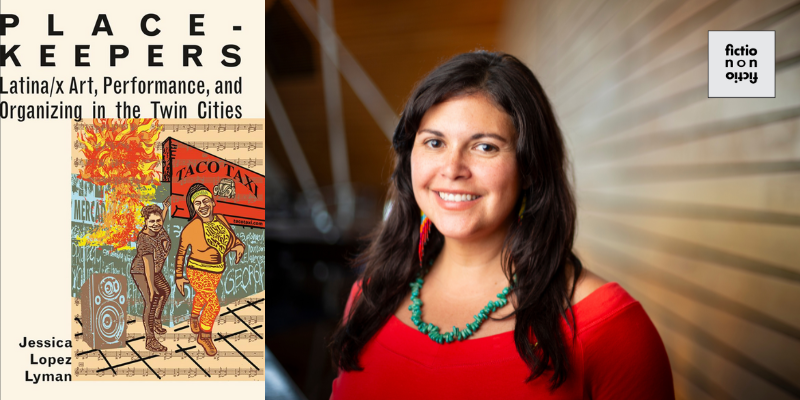
Interdisciplinary performance artist and Xicana feminist scholar Jessica Lopez Lyman joins co-hosts Whitney Terrell and V.V. Ganeshananthan to talk about Minnesota’s history with state violence and local resistance to it, as well as ICE’s intensified presence in recent weeks. Lopez Lyman, the author of a new book, Place-Keepers: Latina/x Art, Performance, and Organizing in the Twin Cities, discusses immigration in Minnesota and how the increased ICE presence is affecting immigrant and BIPOC communities. Lopez Lyman speaks about the January 7 death of Renee Nicole Good, a white woman and legal observer who was shot and killed by an ICE officer, and compares the current situation to the time following police officer Derek Chauvin’s murder of George Floyd in 2020. She notes the pervasiveness of the harm wrought by ICE’s presence throughout Minnesota, a state with a romanticized, pastoral, and sometimes inaccurately homogenous image. She considers the importance of mutual aid, community care, and legal observers, and explains the term “movidas,” which refers to subversive knowledge and “small, hidden actions that are not public protests, that are really foundational for creating larger social movements.” She reads from Place-Keepers.
To hear the full episode, subscribe through iTunes, Google Play, Stitcher, Spotify, or your favorite podcast app (include the forward slashes when searching). You can also listen by streaming from the player below. Check out video versions of our interviews on the Fiction/Non/Fiction Instagram account, the Fiction/Non/Fiction YouTube Channel, and our show website: https://www.fnfpodcast.net/ This podcast is produced by V.V. Ganeshananthan and Whitney Terrell.
Place-Keepers: Latina/x Art, Performance, and Organizing in the Twin Cities
Others:
One State, Two Very Different Views of Minneapolis The New York Times • Gloria Anzaldúa • Audre Lorde • Little House on the Prairie by Laura Ingalls Wilder • Maria Isa • “Video shows woman dragged from car by ICE agents in Minneapolis as she tells them she’s autistic” CBC News • “Family of man killed by off-duty ICE agent in LA demands charges: ‘The ache will never go away’” The Guardian • NYTPitchbot- Jan. 15, 2026 • “Native Americans are being swept up by ICE in Minneapolis, tribes say”– The Washington Post • “The killing of Daunte Wright and trial of Kimberly Potter” 2021 MPR News • “The murder of George Floyd” 2020 MPR News • “The death of Philando Castile and the trial of Jeronimo Yanez” 2016 MPR News • “Right-wing, anti-Islam protest draws large group of counter demonstrators” MPR News •“The Miracle of Minneapolis” 2015 The Atlantic • “AMERICAN SCENE: Minnesota: A State That Works” 1973 TIME
EXCERPT FROM A CONVERSATION WITH JESSICA LOPEZ LYMAN
Whitney Terrell: I’m trying to figure out, and would love to toss around this idea, Why is Trump focusing on Minneapolis? Right? This city, as you point out, is inaccurately famous for being racially pure. You point to The Mary Tyler Moore Show and other bits of important national media that have this myth of the pure Minneapolis. And secondly, why has he found pushback in Minnesota and not, say, in Chicago?
Jessica Lopez Lyman: That’s a great question. In the intro of my book, I talk about why Minnesota, oftentimes, becomes the beacon for moral value and the way that the United States believes itself to be. What I mean by that is that when we look at education, for example, in the 1970s there was a whole educational reform that took place in the state, which we refer to as the Minnesota Miracle. It’s also a reference to a different hockey experience, but for this case, we’re talking about education. It paved the way for how other state governments were distributing taxpayer property dollars and trying to reconfigure very segregated and discriminatory education systems. So, Minnesota gets uplifted for this. Minnesota is the number one contributor to arts per resident. We give more arts funding than any other state because of the Clearwater Legacy Grant that we have. So, the arts and cultures are very rich here, which is a huge focus for a lot of the work that I write about in Placekeepers.
Most recently, we have also passed very progressive legislation. In 2023, we became a trans refuge state. There was only one other state in the nation, New Mexico, that did this. What this means is that we believe that families, parents who know their children, should be able to get gender affirming care by medical doctors, and medical doctors should not be harmed for giving that care. We also were very much aligned with the reproductive justice movement and ensuring that people were able to have access to abortions. And then also in 2023, we passed the K-12 Ethnic Studies Bill. I know that this one isn’t as talked about as heavily in a lot of the rhetoric, but I think it’s also a very important bill, because what it is asking our K 12 educators to do is to incorporate, not just in social studies standards, but to incorporate entire lessons and standards around ethnic studies. Again, I want to be clear, I’m an ethnic studies professor. Many people do not understand what we do in the discipline of our field, but we are a field that uses theory to talk about liberation for all in its simplest terms, and that’s what we want our K-12 students to understand: who they are, where they come from, how they can be in solidarity with others, so that we can build a better world for everyone.
These are some of the reasons why I think we are being targeted. The last thing I’ll say is that we are practicing a lot of principles that perhaps have been labeled democratic socialist or socialist. For example, we provide free lunch for all public school students. That’s something we started during the pandemic. I have school-aged children. I have to say, as a parent, it’s great to know that if we don’t get lunch packed and out the door on time, it is available to them. So, this is a reason why we are under attack. I also think, as somebody who studies climate justice, we have to really understand the resources that we have in this state. Minnesota has more shoreline than anywhere else in the nation—more than California, more than along the coast—if you add up all of our lakes and rivers. We also hold 1/5 of the world’s fresh water. Our indigenous tribes, we have 11 federally recognized tribes, although there are many more different indigenous communities here that are not federally recognized. They are the people that have been stewards of this land for eons, and they are the people that are fighting for climate justice right now and ensuring that our resources for fresh water will be maintained, because we all need water for life. Looking at the water as a resource as well as the minerals we have on the Iron Range are some things that we aren’t talking enough about but I think that resources that we hold in the state are, long term, something the federal government plans to seize. I think we need to have more explicit conversations about that as well.
VVG: That’s so helpful, because the quick line on “Why Minneapolis?” nationwide is sort of like this is a Tim Walz revenge project. I’m sure that’s a factor, but I don’t know that it’s the only factor. I also want to mention that I’m reading about members of federally recognized tribes being involved in encounters with ICE and being detained by ICE, so that is also going on. The leaders of some tribes have been issuing extraordinarily powerful statements about the harm that ICE is doing. We’ll point to some of that in our show notes, so that our listeners can see those resources. I found it really helpful to read those.
Whitney Terrell: Also, the imagery that’s coming out of DHS, these pictures of white people in pastoral settings and Little House on the Prairie which, as you point out, is set in Minnesota. The administration wants to co-opt that pure Minnesota idea as their policy. And they need to actually scratch out the reality of what Minnesota actually is, which is much more complicated. Does that seem crazy?
JLL: The national project of maintaining the white nuclear family, which has really been taken up in the 1940s as a way for certain political groups to organize, is able to find a lot of historical references in Minnesota that fit that narrative. I remember as a third grader, we all read Laura Ingalls Wilder’s books. We all had to go practice being pioneers. It was fun to learn how to make butter but, looking back as an adult with a critical lens, seeing how settler colonialism as a structure continues to be reproduced through this Midwestern pastoralism, is something that is very provocative and very useful for the administration.
The other thing I want to mention is I’ve seen several DHS recruitment or promotional materials very much leaning into the ideology of manifest destiny, of recovering a lost land, of “preservation,” of what they believe to be an ideal American history. When we’re looking to figure out different narratives, being able to unearth the histories of people who have been in this land for generations and who have considered Minnesota their home, who consider themselves and the artists I interview to be Minnesotanos and Minnesotanas, it’s a very important narrative to disrupt how the federal government is trying to usurp our state.
VVG: So this is a show about literature in the news, and some friends and I have been reading this article that was in the New York Times “One State, Two Very Different Views of Minneapolis.” This is the reporting version of Laura Ingalls Wilder. It’s a story about the rural-urban divide, but really it’s a story about this Minnesota pastoral idea, and it’s not being particularly critical of it.
WT: The New York Times doing a shitty job of reporting on the Midwest.
VVG: I know, shocking. There’s also a Twitter account called New York Times Pitch Bot, which had a hilarious take on this, which was “We’d like to know what’s going on so we talked to three members of the Aryan Nation in Coeur d’Alene.” I don’t usually like to rag on reporters. I was a reporter, it’s hard work, and the people who are doing it, I’m so grateful for them. And also, this piece of “color reporting” was just so terrible.
WT: A.G. Sulzberger, the publisher, lived in Kansas City for six years as a reporter. I got to know him when he was living here, and he has family from Kansas, so he himself is not unfamiliar with the Midwest, but many of the reporters are unfortunately.
VVG: There are definitely people who are not parachuters, who are going to write about this, who are writing about this, and I really appreciate that, but this particular piece of writing was a real example of what we’re talking about, in real time, appearing as reportage in the nation’s “paper of record.”
JLL: It’s important to see how the narrative continuously plays out. In the Intro, I talk about this TIME article that was published in 1973 about the governor calling Minnesota “The Good Place.” We see it reproduced in 2015 with the Atlantic article where they talk about Minneapolis as “The Miracle City.” And now we’re seeing it play out again in the article that you just referenced. I do want to say though, on the ground, what’s actually happening is that we’re focused on Minneapolis, particularly South and North Minneapolis and areas of St. Paul but our suburban areas are also being infiltrated. They are also under attack, and in a lot of ways, what’s very hard is that those communities are more isolated from resources. Then in the rural area, we’re seeing reports from Detroit Lakes, from other parts of northern Minnesota, where ICE are also. I want to make sure that you know, your listeners, that we’re really aware that this is a pervasive invasion that’s happening statewide. I’m so eager to talk to more people in the suburbs and in rural Minnesota who are organizing and creating mutual aid and resisting, because what they’re doing there is different. I think it’s very important that those of us that live in the city are connecting with them and learning from them as well.
Transcribed by Otter.ai. Condensed and edited by Rebecca Kilroy.

Fiction Non Fiction
Hosted by Whitney Terrell and V.V. Ganeshananthan, Fiction/Non/Fiction interprets current events through the lens of literature, and features conversations with writers of all stripes, from novelists and poets to journalists and essayists.