Jesse Jackson Loved Us—Sometimes Before We Loved Ourselves
Steven W. Thrasher on Jackson’s legacy of support for LGBTQ rights and HIV/AIDS prevention
“Before they came for us, and woke, and us, and power, they came for Jesse Jackson,” Kiese Laymon, the author of Heavy and How to Slowly Kill Yourself and Others in America, wrote just hours after the news broke that Jesse Jackson had joined the ancestors. “And they came for Jesse Jackson because he loved us in word, deed and policy.”
The “us” Rev. Jackson loved obviously included Black Americans first. But “us” also included poor people, disabled Americans and—before any other national politician did so—gay Americans.
In fact, more than 40 years before our current anti-gay and anti-trans hell, the first speech supporting gay rights at a national political convention was delivered by Rev. Jackson himself at the Democratic National Convention in 1984. Unlike Barack Obama, who would tepidly support us a dozen years after that by telling the Windy City Times that he was for same-sex marriage (only to deny he’d ever said that when he ran for president in 2008, and not publicly support it again until Joe Biden forced the issue in 2012), Jesse has been there for LGBTQ people consistently for four decades, especially regarding the crisis of HIV/AIDS.
In the week since Rev. Jackson died, I have not been able to stop thinking about Kiese’s story of the time “Jesse came to my house when I was a child,” when his friends “hid in my room because the fear of actually seeing a man who loved you before he knew you was too much.”
I keep thinking about how, as a child, I knew Rev. Jackson loved me for being Black. But now, looking back, I can see that he also loved me for being gay, just as he loved me for being “illegitimate.”
And he loved my gayness and my “illegitimacy” not just before he knew me, but before I knew myself.
He loved my gay bastard ass before I could love it myself.
*
I was ten years old in 1987 when I gave my first speech about an “Afro American” for Black History Month in Mrs. Steele’s class at Sierra Linda School. I choose as my subject the Rev. Jesse Jackson. I won the classroom and school speech contests, before going on to the district competition.
I remember little about the third time I gave the speech except that I was embarrassed to come in third place, that I referred to Rev. Jackson’s teenage mother, and that I ended the speech saying “If I could ever meet him, I’d say, ‘Thank you, Jesse.’”
I knew Jesse was a container of my own father’s hopes and dreams in racist Reagan’s America.
This would have happened the year before Rev. Jackson’s 1988 run for the presidency, when my father—like so many Black Americans and true progressives—was hoping Jackson would earn the distinction a (far more conservative) Barack Obama would achieve decades later. The first Black president would have far less commitment to Jesse’s fight making sure, as Kiese put it, “that the land would one day be free” and the “wages earned would one day be shared.”
I knew Jesse was a container of my own father’s hopes and dreams in racist Reagan’s America. They were both Black men born during World War II with similar dispositions, similar political dreams and—as the writer Damon Young made me realize—similarly beautiful thighs. When Damon wrote of a beautiful black and white photograph floating around social media last week that it was “my favorite picture of reverend jackson. maybe my favorite picture of niggas hooping. definitely my favorite picture of niggas’ thighs,” I could not have agreed more.
Those thighs—playing basketball. Muscular and strong. And jumping unapologetically towards justice and joy.
I delivered my fifth-grade speech knowing about the Rainbow Coalition and Jackson’s own oratory in 1984, but I did not understand myself as gay boy then. As I have mourned Jackson, it has been healing and beautiful, as an adult gay man, to revisit his pro-LGBTQ speeches.
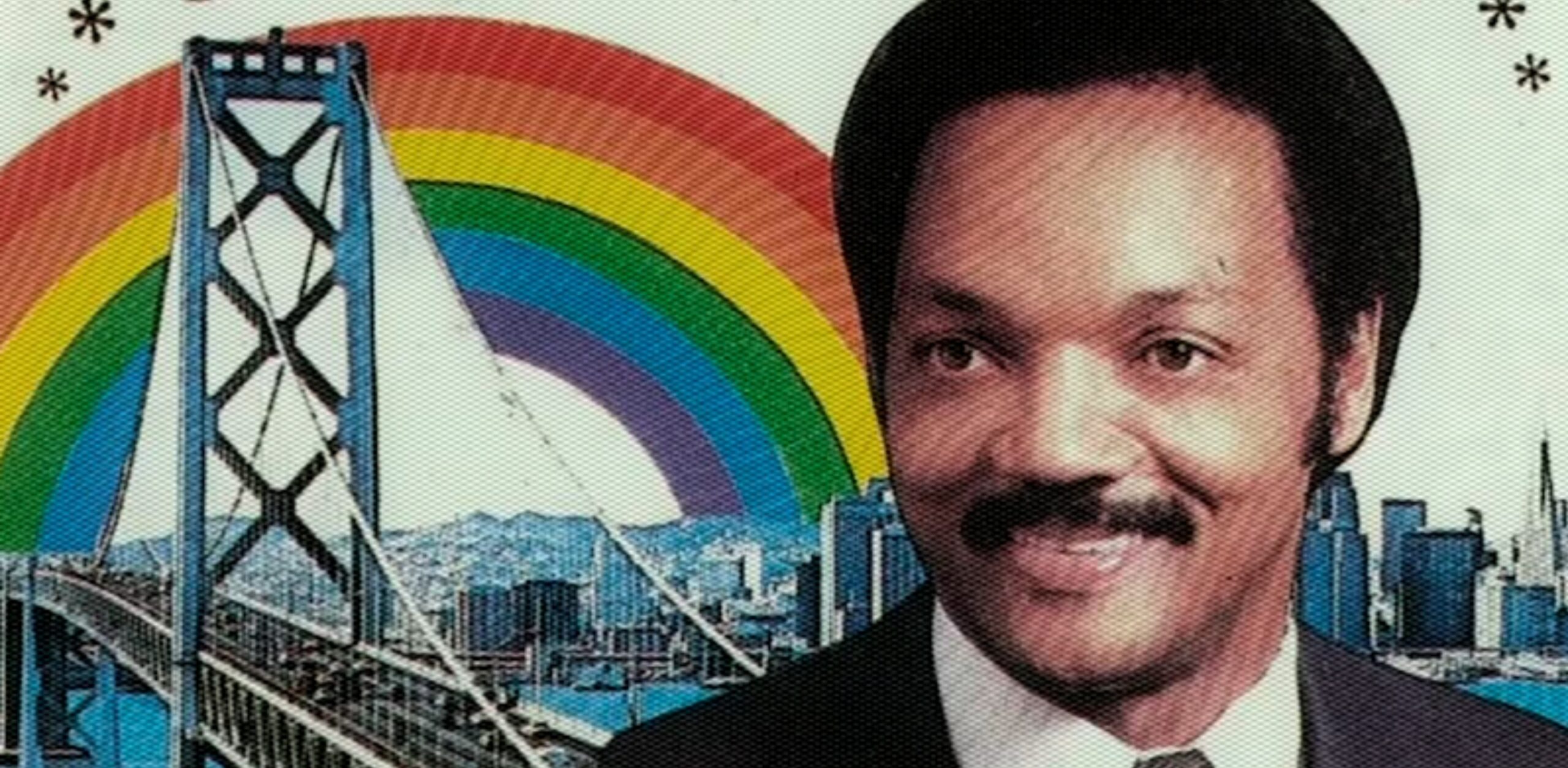
On July 18, 1984, Jesse Jackson addressed the Democratic National Convention. It was in San Francisco, the epicenter of the AIDS crisis, at a time and place when a new disease was laying waste to a widely despised community.
“My constituency,” the Reverend declared, “is the desperate, the damned, the disinherited, the disrespected, and the despised.” He claimed the mantle of his mentor, Rev. Martin Luther King, whom he stood with on the balcony of the Loraine Motel in April 1968, just hours before King was killed. That moment is not historically significant just because of its proximity to King’s assassination, but because the young Jackson was standing by his mentor despite King’s deep unpopularity at the time (across racial lines). King was widely despised not just for his opposition to the war in Vietnam, but for his Poor People’s Campaign, through which he wanted to bring together a multiracial coalition of the poor to create a shanty town on the National Mall.
Jackson shared in King’s economic vision, one which dangerously threatened capitalism, and he espoused it in that speech in 1984. The speech frequently refers to “The Rainbow.” In contemporary society, most people equate the rainbow as being a symbol of gay rights; but that didn’t begin until the late 1970s, when Gilbert Baker created the first gay pride flag. The rainbow has a much longer Black political etymology, beginning with Fred Hampton’s original Rainbow coalition, which was formed in 1969, shortly before his death. Jackson formed Operation PUSH in 1971, which he informally called a “Rainbow Coalition” from the beginning (in a nod to the recently assassinated Hampton) and formally changed the name to the Rainbow/PUSH Coalition in 1984.
“The Rainbow Coalition includes Asian Americans, now being killed in our streets,” he said. “The Rainbow is making room for the young America” and was “making room for small farmers disabled veterans.“ In a signature example of how he’d use inversion of clauses to elegantly make a point, Jackson preached that “the disabled have their handicap revealed and their genius concealed; while the able-bodied have their genius revealed and their disability concealed,” and ended that movement of his rhetorical symphony by saying “I would rather have Roosevelt in a wheelchair than Reagan on a horse.”
But it was when he said “The Rainbow includes lesbians and gays. No American citizen ought be denied equal protection from the law,” that LGBTQ history history was made. No one had ever evoked rights for our community at a national convention before. Imploring the Democrats not to “leave anybody out,” Jesse preached “The white, the Hispanic, the black, the Arab, the Jew, the woman, the native American, the small farmer, the businessperson, the environmentalist, the peace activist, the young, the old, the lesbian, the gay, and the disabled make up the American quilt.”
While I surely did not clock the gay line as a kid in 1984, one person remarked on Bluesky to me, “I remember this. As a gay kid a few years away from coming out, I remember feeling okay about being gay for the first time.”
Long before white gay activists were fighting for Black rights, Jesse was fighting for gay rights.
Meanwhile, as he gave his speech, “I was outside on the street,” a young John Birdsall, the future author of the 2025 book What Is Queer Food?, noted. He added that Rev. Jackson was the “only candidate to show up in the street to cheer the LGBT march outside the convention center.”
It was not the only time Jackson showed up for gay people or people with AIDS, nor for a group of people society despises the most: Black people with AIDS. Posting op-eds he wrote about AIDS across three decades—along with a beautiful photo of Jackson addressing “10,000 Protesters Demand[ing] Help for People With AIDS in 1992—ACT UP New York noted last week that Jackson “always saw the humanity in people with AIDS, even when many did not. He called us in, when others counted us out.”
This is part of what has annoyed me so much when know-nothing white gays ignorantly bemoan “Black homophobia” (most famously, when Dan Savage wrote his still-up blog post “Black Homophobia,” which blamed Obama voters for the passage of anti-gay Prop 8, even though the proposition passed by more votes than there were Black voters). Long before white gay activists were fighting for Black rights, Jesse was fighting for gay rights.
“Before they came for us, and woke, and us, and power,” and before they came for LGBTQ people as they have been these recent years, “they came for Jesse Jackson. And they came for Jesse Jackson because he loved us in word, deed and policy.”
*
They say you should never meet your heroes, but I got to meet Jackson twice, and it was not at all bad.
The first time was thrilling, actually. I was reporting in Ferguson in 2014, in the wake of the killing of Michael Brown. I just happened to be reporting on a march when there Rev. Jackson was, in full stride, right in front of me and doing what he did best. I got to interview him very briefly, but he gave me a banger of a quote in response to some vandalism which had happened during the Ferguson uprising: “The real looting is legal looting. People don’t have their fair share of police jobs, fire jobs, accounting work, legal work. That’s looting. The looting by night should not take place, but neither should the accepted level of legal looting. And that must stop.”
The lead-up to the second time was more thrilling and expected, even if the interview ended up being slightly disappointing. This time, I got to sit down for an hour with him in the PUSH/Rainbow headquarters in Chicago in 2015 for the Guardian’s weekly “G2” print interview. But Rev. Jackson was taciturn that day, and greatly resisted answering personal questions (such as what it felt like having an incarcerated son as the prison abolition movement grew in strength). His answer felt rote and canned. He’d also recently received a Parkinson’s disease diagnosis and may not have been having a great day.
Still, it was an amazing experience, and I finally got to deliver the “Thank you” my 10-year-old speechgiving self had wanted to deliver. At the time, I wish I had known to ask him about his decades of principled activism on Palestine, and to thank him for how his trailblazing on that issue would bring me comfort in the future.
Of course, I didn’t yet know. But Jesse knew.
He loved us before he knew us—before we knew what would happen to us.
*
When I was ten, I think I chose to write that speech about Jesse Jackson because my father loved Jesse and I loved my father (despite how many years it took me to understand him) and they reminded me of each other.
It’s not just that they were Black men with political anger and beautiful basketball playing thighs.
It was that, in 2001, Jesse admitted that while he was married to his wife, he’d had a child with another woman.
Jesse refusing to retreat from public life in shame meant the world to me. He stayed. He worked. He loved. He showed that imperfect men are still perfect vessels for trying, however imperfectly, to bring the kingdom of heaven to earth.
My father also had a child via an extramarital affair. That child was me. And it’s far harder to come out as a “bastard love child” than it is to come out as gay.
Getting ahead of the story before it was broken, Jackson wrote, “This is no time for evasions, denials or alibis. I fully accept responsibility and I am truly sorry for my actions.”
Being a sister-from-another-mister or brother-from-another-mother is not unusual; when Jesse was born, his own father had been married to a woman who was not his mother. My dad’s dad had children with women other than his wife, I think.
But being rendered “illegitimate” from birth is one of the worst stigmas anyone can endure.
Still, Jesse being open about in 2001 gave my father and me some space to talk about the circumstances of my birth a little more before he died just two years later, in 2003.
And Jesse refusing to retreat from public life in shame meant the world to me. He stayed. He worked. He loved. He showed that imperfect men are still perfect vessels for trying, however imperfectly, to bring the kingdom of heaven to earth.
Jesse loved us the way the Lord loved Jeremiah when he told him that “Before I formed you in the womb I knew you, before you were born I set you apart.”
Jesse loved Black people when white people (and Black overseers) hated us.
Jesse loved gays when Republicans and the Clintons despised us.
Jesse loved bastards because he was one and he fathered one—and the Reverend helped teach at least one (me) that it is a sin to think of yourself as in any way illegitimate, unworthy, or anything less than holy.
He was, as Kiese wrote, “a regal, round cheek beauty of a man” who “loved us and he knew we were beautiful,” even when we did not. He was a man who “loved you before he knew you.”
Who loved us before we even knew or accepted ourselves.

Steven W. Thrasher
Steven W. Thrasher, PhD, CPT, a journalist, social epidemiologist, and cultural critic, holds the Daniel Renberg chair at the Medill School of Journalism, and is on the faculty of Northwestern University’s Institute of Sexual and Gender Minority Health and Wellbeing. A former writer for the Village Voice, Scientific American and the Guardian, Thrasher is the author of the critically acclaimed book The Viral Underclass: The Human Toll When Inequality and Disease Collide. [Photo by C.S. Muncy]