Jayne Anne Phillips on Chronicling Her West Virginia Upbringing and Writer’s Journey
Jane Ciabattari Talks to the Author of Small Town Girls
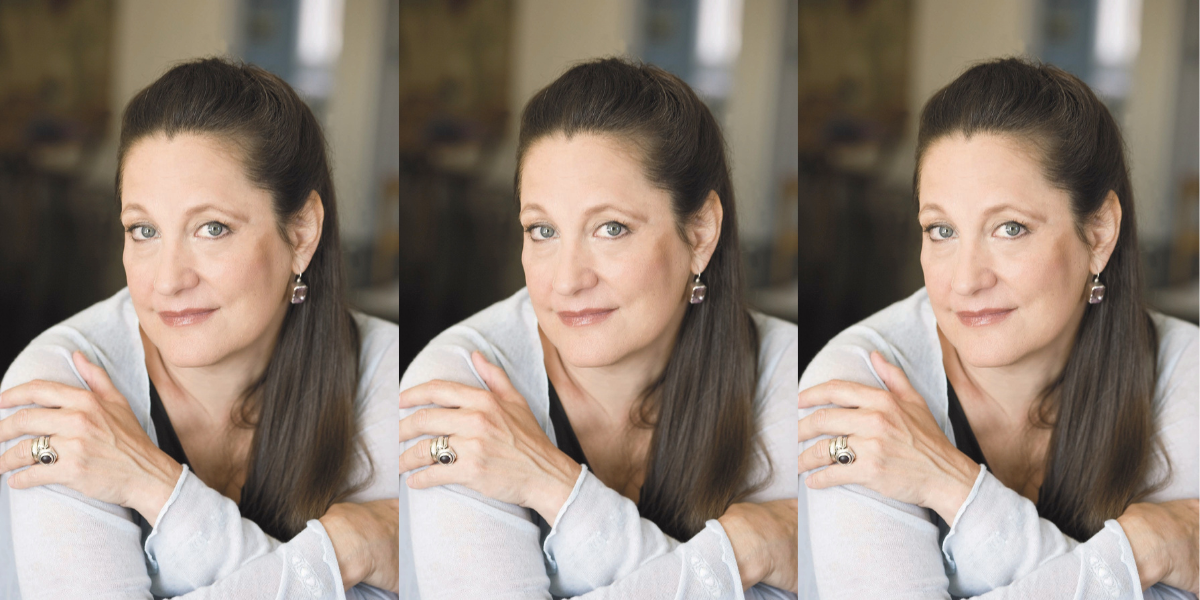
Jayne Anne Phillips is one of the most culturally relevant, revelatory writers of our time. She first drew attention with the shocking and distinctive stories in Black Tickets (“Her stories are tickets indeed—to a series of lush, violent, elegiac and sexually charged worlds, with no easy path back to the turnstiles,” wrote Dwight Garner in the New York Times Book Review). Her trilogy of war novels—Machine Dreams (Vietnam), Lark and Termite (the Korean War), a finalist for the National Book Critics Circle fiction award and the Pulitzer Prize award-winning Night Watch (the Civil War)—solidified her place as a literary icon. In our Lit Hub conversation about Night Watch, she calls the Civil War era a prelude to our own turbulent times. “Night Watch is about the post-apocalyptic world of the Civil War years, the tribal divisions, the search for scarce resources, a specific family fallen apart and struggling to survive.”
Now, for the first time, she’s written about her “real” life, in a series of essays specific to her own upbringing in small-town Appalachia and literary life experience, yet thematically spacious enough to feel familiar to each reader. What compelled you to write this memoir in essays? I asked her. “I’ve never written a book as myself, in a first-person voice—a nonfiction book, a memoir not only of childhood and family, but of those American decades in which I first became myself,” she explained.
I was too young to understand the 1950s, yet the ambiance of that time permeated my first perceptions. The 1960s rocked the world and continued to haunt and inspire us as failure and ideal, more or less forever. I became a writer and a young adult in the 1970s and began the rest of my life. Those decades are known only to a diminishing few of us now; I wanted to make them real as experience and sensory detail. Small Town Girls is also a memoir of what I’ve loved, of what I’ve chosen or witnessed or lost. We are surely defined by what we love, and by the sorrows we learn to accept. ‘Every thing is every thing,’ as they say, time is circular, the dimensions of past, present, future, exist simultaneously. This book is meant to be read as a novel, from first page to last, but regardless, the pieces emerge and resonate with one another in an arc that begins with generational predestination and ends in transformation.
Tragedy, both personal and public, hurts because we love and lose. Small Town Girls references two shootings, a reference to the gun violence that’s a staple of American life, now more than ever. Yet the through-line of this book is surely the resilience of human beings, the mystery of death, and an absolutely necessary sense of presence beyond ourselves. I suppose that knowledge of presence is my “religion,” atmospheric in the natural world, and in the rituals of churches, funerals, family vigils, evoked in Small Town Girls. That search for presence, meaning, is our responsibility as individuals, more than ever, in this time we’re living in, when Government seems bent on destroying us. Language, literature, examined memory, connection, are the only defense.
*
Jane Ciabattari: How did the structure of the book evolve? (You credit your agent, Lynn Nesbit, with picking Small Town Girls out of a much longer manuscript.) Which stories did you write first? And last?
Jayne Anne Phillips: The structure is thematic. These are the things and people I’ve written about all my writing life (I don’t even remember which came first), yet as I fashioned the individual essays to lead the reader from one to another, the pieces themselves were changed and edited to illuminate one another and comprise Small Town Girls. A lot of big city girls from all walks of life grew up in small towns, and I think a lot of them left with a firm sense of themselves; a lot of them stayed, and helped those towns survive, even thrive.
There’s risk in remembering, deleting sentiment and hope and finding an inclusive truth that is bigger than specific lives and includes us all.
Women connected by place, generations of family, and plenty of ambition and desire, are a force. Matriarchy is a force that protects and defends, a force blunted and downgraded at every turn. What survives, despite that fact? Writers write to stop the truth from vanishing.
JC: You begin with personal essays about growing up in small-town West Virginia, your childhood adventures, memories of your father, brothers, and mother (that mid-century beauty parlor where you were “initiated into womanhood as it existed in our town”!). Did you draw from diaries and journals for the details in these essays? What other research was involved?
JAP: I’ve never written diaries or journals. I wish I’d kept a journal while traveling, and during that hitch-hiking trip from Hyannis to Anaheim CA (Disneyland) and back, when I was nineteen. But it’s as though I write only under intense pressure, when I’m alone, and words are too precious and singular to waste on simply thinking or musing or keeping track of events. It’s as though I only have a certain number of words and I can’t waste them on anything but the real thing, a phrase that comes up in this book more than once. Writing, for me, is a kind of reverse meditation that focuses on detail and language rather than mindfulness or peace.
Writing is certainly intense mindfulness, but writing heads into the maelstrom, the flood, the hurricane, the flames, the clear wet sky. In the words of Small Town Girls, the writer engages “some version of a private, non-artist self- the smaller self who stands always at the threshold of writing, like a person in a doorway who knows better than to enter the room.” Memory is research, because we forget so much, and one recovered detail leads to another. And there’s risk in remembering, deleting sentiment and hope and finding an inclusive truth that is bigger than specific lives and includes us all.
JC: Your opening story, “Hometown,” describes the Main Streets and shops of Buckhannon, West Virginia, at mid-century. You distill its idiosyncratic history: a town founded by the Pringle brothers, who deserted the English forces in 1761 during the French and Indian War, lived off the land for three years, and discovered, as you write, “Wilderness is freedom.” That, plus both sides of your family helped settle Western Virginia “when the land was still a territory.” You also cover the “bad old days” of the Civil War, when West Virginia seceded from Virginia to stand for the Union. How complicated was the research for this opening essay?
JAP: I would say that the research for “Hometown” was less like research and more like lived life, and what I simply absorbed as a child and teenager. Every kid in WV during that time took West Virginia History in school in, maybe, sixth grade, but the facts seemed much deeper and held so much more meaning for me as an adult. It’s so extraordinary and miraculous to conceive of this nation as a wilderness so vast and undisturbed that one could leave a war simply by penetrating the wilderness further, or, in the 1930’s of my novel, Quiet Dell, cross state lines to outrun a crime. “Paradise Lost—West Virginia” involved research that took me deeper and deeper into the past of the geological marvel of this “exotic,” unknown place that is not “north” or “south” but somehow embodies both. The family story that intertwines for centuries with this land, this place, is researched and discovered in the writing, and so not lost, yet the land itself is largely lost, to industry, exploitation, greed. Words guard what is left and call back the glorious beginning.
JC: Did the wars that were part of your hometown’s origins influence your choice to write your war trilogy?
JAP: Yes, absolutely. All of us who were alive in those times saw and experienced these wars. Vietnam of course was the crucible of my generation, and the influence of that war led me to write about two wars of the past, WWII, and the Civil War. Night Watch required years of research, as 1864-1874 was so far from my own experience. These wars were watershed historical events, turning points, political and soulful fires in the American psyche, but when the populace of a country is cut off from its war machine by the institution of a “volunteer” military force, the power of war to change a nation is subsumed and shaded—witness the war in Afghanistan, twenty years (2001-2021, six months longer than the Vietnam War), and Iraq, eight years (2003-2011). We all know that an “all-volunteer” military force was a smart political move by those who wage wars, and that those volunteers are likely motivated by what they don’t have—stable families, financial security, higher education. They weigh the risks and join up.
JC: When did you first hear of the feud between the Hatfields and the McCoys in the post-Civil War Appalachian Mountains, which you compare to Shakespeare’s Montagues and Capulets “in fair Verona?” What sort of research into the feud, especially the “economic and cultural pressures” that fueled it, was involved in writing this essay, which reaches all the way forward to 2003, when sixty Hatfield-McCoy descendants declared an official truce?
JAP: Every Appalachian kid knows of the feud, and Americans generally might know of the story as a punch line, a joke, but when you look closely at a story, penetrate beyond gossip and the all-too-human tendency to condescend, the joke or stereotype reverses and opens into an insightful reflection of a history, and the political realities of a time.
Tribal feuds writ large are endemic in our own time; they take over countries that engage in warfare and destroy thousands of lives. The Hatfield-McCoy feud is a complex story related the power of owning land when land was the only power, with its own love story at the center. The core of the story is the desertion and betrayal of Roseanna McCoy by all concerned. The outcast Roseanna and her short-lived child, seen in the Hatfield/McCoy myth as collateral damage, is actually the sorrow, the imploding, falling green hills tsunami of grief that enfolds them all and foretold their end.
JC: You write about your journey as a writer—beginning with breaking free from your hometown, college, grad school at the Iowa Writers’ Workshop, travels abroad. When you look back, do you see specific inspiration points for your early stories, especially Black Tickets, your first book, published when you were 26?
JAP: You know, I could probably pinpoint where I was when I wrote each one of the stories in Black Tickets. My first small press limited edition book, Sweethearts (Truck Press, Carrboro NC) came out the summer before grad school, so all those one-page pieces, some of which appeared in Black Tickets, pre-date Iowa. I wrote “El Paso” in my hometown, because I needed a full length story for my MFA applications, though the sense of the place actually happened on a rooftop in Denver—I had never been to El Paso, but Denver has that wild hot feel to it on an eighty-six degree day. I remember showing “Lechery” to a friend on a train from New Haven to NYC, though the story’s emotional locus was West Virginia: Though I have no money I must give myself what I need. I wrote “Mamasita” in a friend’s apartment in New York, looking out the window at a woman striding on, conquering the street below.
“What It Takes to Keep A Young Girl Alive” is based on a summer waitress job at Cedar Point, and I have to say, it’s all true; I was just writing the facts. “Strangers In The Night,” “Slave,” “Accidents,” “Happy,” are a kind of emotional shorthand, a pilgrim’s progress; When she lay down with the man she loved and didn’t, the man opened and opened. Inside him an acrobat tumbled over death. And walked thin wires with nothing above or below. She cried, he was so beautiful in his scarlet tights and face the size of a dime. I wrote to figure it out, understand, know, for myself, for my soul: Our souls were clean, but the grass didn’t grow.* It’s almost impossible to express the power of language, the way that metaphor can state at once the truth and endless variations of a truth; the sound and sensuality and ghostly loving power of words has always been my instructor and my comfort.
* Van Morrison’s “Streets of Arklow:” from Veedon Fleece
JC: I was fascinated with your essays on writers you admire, like Stephen Crane and Breece D’J Pancake, whose dozen stories—“the only stories written in just this way, from inside the minds of protagonists coming of age in the mountains of an Appalachian world closed to others”—you called “no less than an American Dubliners.” How did you discover the points in which his life and yours intersected?
JAP: Before I wrote about him from the standpoint of my present life, I read everything available about Breece Pancake, and looked at the timing of the facts. I’ve read his stories many times over the years, but the crucial first connection was in April of 1978, in Iowa City. I received a letter informing me that I was accepted as a Fellow at the Fine Arts Work Center in Provincetown MA, and the letter stated the names of the others in my cohort. “Breece D’J Pancake” was one of them. The fortunate young writers and artists on that list were gifted an eight-month residency in this gorgeous coastal Massachusetts town, more like a village in the winter months, especially back then. I knew of Breece because of the publication of “Trilobites” in the Atlantic the year before.
But Breece would not live and work in Provincetown because his acceptance letter arrived just a few days after his April 8th suicide in Virginia. I don’t recall how I heard about his death, but, like Breece, I had applied for teaching jobs, and miraculously, got one, at Humboldt State University in Arcata, CA. Likely the approaching publication of my first book, Black Tickets (Sept. 28, 1979), had to do with the job offer, but I was so impressed by the idea of a tenure-track job that I turned down the residency at FAWC. I lived in Trinidad, with a view of the bay and the Pacific, in a cement block house with a wood stove for heat, and realized a few months into my 3/2 course load that I liked teaching, but was no longer writing. I applied again to FAWC, was accepted for an 1980-81 residency, took a leave from the job, and began work on my first novel in Provincetown.
I was finishing Machine Dreams in Boston, teaching at BU, when The Stories of Breece D’J Pancake was published in 1983. Reading his stories, finally in print as a volume, brought home, again, the tragedy of his death. A tragedy must be recognized and mourned, but his stories need to be read and celebrated. The fact that this work survives is an exhilarating triumph. When I think about Breece Pancake’s stories, I think about Helen Pancake, his mother, who lost her son but dedicated herself to making sure his book was published. Born in Hurricane, WV, she died at ninety-one in 2014.
JC: You write movingly about caring for your mother in her last days, noting that “Mothering is a cradle-to-grave proposition.” Your final scenes with her are in your home, not hers; you are her caretaker, while also preparing to birth and mother your first child. (Its exploration of life and death brought to mind your novel MotherKind.) Your perspective as an adult is clear, forgiving, direct; did the fact you were reconnected, living together again, foster that?
JAP: We were always very close, despite any physical distance, but the three years of her illness surely tested us. Too ill to live alone any longer, she moved in with us when I was seven months pregnant, and it was absolutely wrenching to lose her day-by-day while caring for an infant; she died when my first son was nine months old. She was so happy to hold and rock him. But by the last months, when I brought my baby to her (as I did almost every day), she thought he was her first grandson, my older brother’s son.
It’s also true that the beauty of a place, a time, becomes clarified with distance and loss.
She was beginning to enter an after world in which memories were mixed up and the present was not quite real. I couldn’t write about her or that time for many years, and began working on MotherKind a decade after her death; it took that long to begin to approach all that happened. I remember feeling, in the initial traumatic event and first months after, that I had lost my mother, and more devastating, I’d lost my relationship with my mother, that the past, as well as the present, was gone, that my always-present consciousness of our intimate, partnering, mother-daughter, unconditionally loving, co-existence was gone. And that was devastating. She, the whole of her life, came back to me slowly, and then what was between us began to sift through or emerge, like the greening of a burnt field. Writing the several pieces in Small Town Girls that refer to her was part of that process.
We who take care of loved ones through their last years, months, days, always fail. We can’t save them, and there is the mourning of them, and the mourning of who we were before we lost them. Now we’re different, deeper, and it takes time to feel what’s lost come alive again in memory, to feel really so close to that memory that memory becomes an ineffable presence, a delicate, living thing like a scent or a fragment of a dream.
JC: “But my mother’s death…is not like death in the movies,” you write in your final essay, in which you explore Roger Corman’s “opulent versions of Poe,” including his “Premature Burial,” which you saw at your hometown movie theater on Kanawha Street as a girl. Watching that film comes back to your mind as you care for your mother during her final days. At what point did you write this essay?
JAP: Oh, not so long ago. A really wonderful anthology called The Movie That Changed My Life asked me for a contribution. There are other movies that changed my life, or led to realizations that became part of my life—but my mother’s death felt premature, and writing about that movie, experiencing it as a pre-adolescent girl with other girls, when everyone in my nuclear family was alive, opened the images of that dark, Gothic fairy tale of a film, and interlaced them with the secrets I knew but didn’t say to myself.
We all know things in our souls as children. James Agee speaks of this as the time in which “I was so well-disguised to myself as a child.” If we translate “the child is father to the man” (Wordsworth, 1802, “My Heart Leaps Up”) to “the child is mother to the woman,” we see the girl as a mother and woman, all of it simultaneous. With women, mothering is not restricted to one’s own blood child; it’s the central strength of women’s friendships, women’s marriages and love affairs, and women who are artists of any kind must mother themselves and their work, stealing time to make it, defending the force that through the green fuse…
JC: Your dedication is “For all the small town girls: those who left, and those who stayed.” Do you ever wish you had stayed? Or, do you feel, as you write, “born and raised in West Virginia, you can never truly leave”? Do you have a sense you stayed in your imagination, your memories, all the inspiration your hometown has had for your fiction over the years?
JAP: I could not have stayed, though I admire those who did—they are running the town, and the town is thriving. The last time I went home, my friends went with me to the graveyard on a day so stormy that our umbrellas blew inside out. And they showed me the area down by the tracks where a new park with a bandstand and gazebo will be built and landscaped. Joyce’s “exile and cunning” comes to mind, and the fact that, so intimately connected to a place, one cannot think as a writer inside one’s origins, or I couldn’t. And it’s also true that the beauty of a place, a time, becomes clarified with distance and loss. Clarified butter “has a clear, golden appearance and rich, intense flavor, and doesn’t burn at high temperatures.” Joni Mitchell’s song, “Big Yellow Taxi,”comes to mind—Don’t it always seem to go/ that you don’t know what you’ve got till it’s gone.
JC: What are you working on now/next? Will you continue to write nonfiction as well as fiction?
JAP: The whole process of Small Town Girls brought to mind, for me, so much that I haven’t written about—that is, things that really happened, worlds that really were. I do want to write more nonfiction, but in my own way. Right now, I’m working on a screenplay for a limited TV series of my novel, Quiet Dell, which is both an individual and collaborative experience. Quiet Dell is about death, death, death and death, in a lost time, with so many aspects of dark Gothic fairy tale—that were actually true. I didn’t make up the names of those places or characters—Sheriff Grimm, lawyer A. E. Law, the Gore Hotel, a dog named Duty (his name will serve to instruct). There is almost a paranormal aspect to the story, and I suppose Annabel is the embodiment of that—it’s both a true crime and ghost story.
And I have the title of my next book, fiction or nonfiction. I love that the whole of the book, in this period of time, is just that phrase.
__________________________________
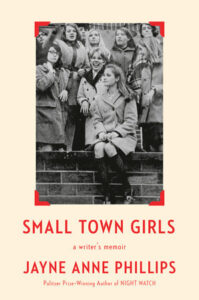
Small Town Girls: a writer’s memoir by Jayne Anne Phillips is available from Alfred A. Knopf, an imprint of Knopf Doubleday Publishing Group, a division of Penguin Random House, LLC.

Jane Ciabattari
Jane Ciabattari, author of the short story collection Stealing the Fire, is a former National Book Critics Circle president (currently on the Advisory Board ) and a member of the Writers Grotto and Page Street. Her reviews, interviews and cultural criticism have appeared in NPR, BBC Culture, the New York Times Book Review, the Guardian, Bookforum, Paris Review, the Washington Post, Boston Globe, and the Los Angeles Times, among other publications.