James Baldwin‘s Lessons For Black Gay Rights Activists
C. Riley Snorton and Darius Bost on How History Bestowed an Identity on Baldwin that He Never Claimed Himself
Race relations in the United States underwent a transformation as a result of the Second World War, a fight against racism and for democracy abroad. The war created a boom in urban industry, fueling the second Great Migration of Southern Black people to the urban North and West. African American migrants often faced racial discrimination and violence when trying to secure a federal job.
In June 1941, A. Philip Randolph, then president of the Brotherhood of Sleeping Car Porters, a predominantly Black labor union, met with Eleanor Roosevelt and members of the Roosevelt administration about racial discrimination against African Americans. Randolph and other Black leaders pledged to bring tens of thousands of Blacks to the White House to protest if the president did not do something to end it.
Shortly after this meeting, President Franklin D. Roosevelt issued Executive Order 8802 prohibiting discrimination in the defense industry. Black service members who fought for their country during WWII still faced racial segregation and discrimination in the military and back in the US after they returned home. The treatment they received at home after serving in a war against white supremacy highlighted the nation’s contradictory ideals.
In 1948, President Truman addressed the ongoing civil rights concerns of Blacks by issuing Executive Order 9981, desegregating the US Armed Forces. These executive orders paved the way for a more expansive civil rights agenda led by everyday African Americans, especially those who faced Jim Crow segregation in the South.
The most monumental event of the movement was the August 1963 March on Washington for Jobs and Freedom.
Several significant events brought the plight of African American Southerners to the national and international spotlight. In 1954, the US Supreme Court ordered the desegregation of public schools in Brown v. Board of Education. State and local law-enforcement officials refused to adhere to the law. The Little Rock Nine in Arkansas faced a white mob and the National Guard when they tried to attend Central High School in 1957. President Dwight D. Eisenhower had to send federal troops to escort the students to and from school.
In 1955, white men lynched fourteen-year-old Emmett Till while he was visiting his relatives in Mississippi. The Chicago-born teenager’s death brought attention to the violence of anti-black racism. His mother, Mamie Till-Mobley, insisted on an open casket funeral and published the photograph of his mangled body in nationally distributed newspapers and magazines.
That same year, the arrest of Rosa Parks launched the Montgomery Bus Boycott, a yearlong mass, nonviolent protest against segregation on public transportation. Organized by the Montgomery Improvement Association and its president, Martin Luther King Jr., the boycott paved the way for other mass protests in the South. Eventually, it led to the Supreme Court ruling that segregated seating on buses was unconstitutional.
In 1960, four college students staged a sit-in at Woolworth’s lunch counter in Greensboro, North Carolina. Hundreds joined their peaceful resistance, compelling Woolworth to desegregate its lunch counter after six months of protest. Widespread media coverage of the event brought increased national attention to the Civil Rights Movement.
In 1961, thirteen Black and white Freedom Riders brought international attention to the movement when they embarked on a tour of the South to protest segregated bus terminals. Met with police and mob violence at every turn and facing arrest, the protesters eventually received federal support from President John F. Kennedy’s administration. The Kennedy administration pressured the Interstate Commerce Commission to desegregate interstate transit terminals.
The most monumental event of the movement was the August 1963 March on Washington for Jobs and Freedom. The march brought an estimated 250,000 people to the National Mall to advance the cause of civil rights, during which the Reverend Dr. Martin Luther King Jr. gave his famous “I Have a Dream” speech. In 1964, activists won a significant victory in the passing of the Civil Rights Act, which prohibited the application of Jim Crow laws-outlawing segregation in businesses and public places, barring discrimination in employment and federally funded programs, and strengthening voting rights.
Until then, Black Americans had no choice but to do everything in their power to change their fate, regardless of the risk of violence.
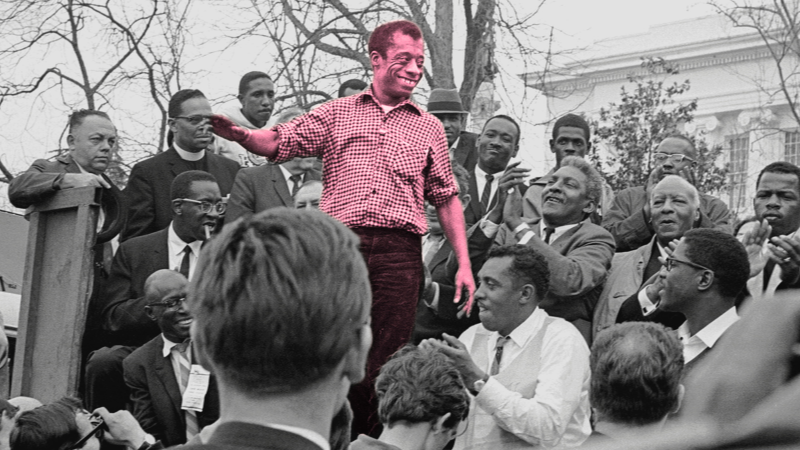
Queer intellectuals were at the forefront of the struggle for civil rights. In May 1963, just months before the march, James Baldwin, Lorraine Hansberry, and Bayard Rustin, among others, met with then attorney general Robert Kennedy at his home in New York City. According to historian Kevin Mumford, the meeting was partly prompted by Baldwin’s essay “Letter from a Region in My Mind,” published in the New Yorker.
The essay asked the impossible of white Americans: to acknowledge that the “color” of Du Bois’s color line was a cultural invention used to maintain their dominance. Racial ideology had so infused US cultural institutions that “color” now appeared to be a human reality rather than a political one. Once white Americans had let go of this political reality—and ultimately their power-they finally would be able to face the horrors committed under their dominance and fully realize their humanity. Until then, Black Americans had no choice but to do everything in their power to change their fate, regardless of the risk of violence.
After reading the piece, Attorney General Kennedy invited Baldwin and others to a meeting in order to get new ideas about how to deal with the issues facing Black Americans. Young civil rights activist and Freedom Rider Jerome Smith attended the meeting. Having faced harsh police brutality during the Freedom Ride, Smith embodied the need for stronger federal protections for civil rights demonstrators.
However, Baldwin was clear that he did not identify as gay or as a member of the gay community.
Smith’s harsh words to the attorney general served as a strong indictment of the federal government for its failure to protect African American citizens, and they received the support of Baldwin and Hansberry. Because of Baldwin, Hansberry, and Rustin’s presence at the meeting, historian Kevin Mumford designated this moment as the beginning of modern Black gay activism.
Mumford’s claim permits us to speculate about James Baldwin’s role in early Black gay rights activism, though Baldwin did not identify as gay. Born in 1924 in Harlem, Baldwin has been taken up as a Black gay historical icon because he was “out” as same-sex desiring in the 1950s, because of the queer subtext of his first novel, Go Tell It on the Mountain (1953), and because of the overt homoerotic themes of his second novel, Giovanni’s Room (1956), which received backlash after its publication. His later fiction also explored queer themes.
However, Baldwin was clear that he did not identify as gay or as a member of the gay community. Even as Giovanni’s Room is widely hailed as a gay novel, Baldwin viewed the homosexual themes of the novel as merely a vehicle through which to address more profound questions about the human condition. Baldwin considered sexual preference to be an intensely private matter and regarded himself as “remote” from the “phenomenon” of gay identity and rights.
When asked by interviewer Richard Goldstein in 1984 about the political import of coming out of the closet, Baldwin did not initially know what this phrase meant. After Goldstein explained it to him, Baldwin expressed his belief that one day the term homosexual would no longer be relevant. Gay rights activists identified themselves as a sexual minority group to which rights should be extended. Baldwin thought embracing gay identity as a minority status meant confirming the majority’s view of homosexuality as inferior.
These slurs referenced a convenient other on which white, straight men could project their fantasies of deviance.
Though Baldwin did not identify as a Black gay man, he did see race and sexuality as intertwined. He viewed the overlapping systems of racism and homophobia as negatively affecting society as a whole. This view was evident in his thinking about both the “nigger” and “faggot” as cultural “inventions.” He reasoned that white, heterosexual men created these terms to secure their sense of selfhood and dominance.
These slurs referenced a convenient other on which white, straight men could project their fantasies of deviance. In the interview with Goldstein, Baldwin stated, “I know from my own experience that the macho men-truck drivers, cops, football players-these people are far more complex than they want to realize. That’s why I call them infantile. They have needs which, for them, are literally inexpressible. They don’t dare look into the mirror. And that is why they need faggots. They’ve created faggots in order to act out a sexual fantasy on the body of another man and not take any responsibility for it.”
Baldwin also spoke at a hearing before a New York State commission on teaching African American history in public schools. He discussed how teaching African American history was bound up with the way American history was taught. “Anyone who is black is taught, as my generation was taught, that Negroes are not a civilization or culture, and that we came out of the jungle and were saved by the missionary.”
Baldwin thought such racist pedagogy left Black children without a sense of identity. “If he sees in fact on the one hand no past and really no present and certainly no future, then you have created what the American public likes to think of, in the younger generation, as the nigger we invent and the nigger they invent. What has happened is that you destroy the child from the cradle.”
Taken together, Baldwin’s primary lesson for the modern Black gay rights activist was one of caution: It was not the Black gay community that was the social problem, nor was it their responsibility to change American hearts and minds about racism and heterosexism.
We should also turn Baldwin’s mirror toward us, for bestowing on him an identity he refused to claim.
The problem was American society’s need for a scapegoat to avoid a broader interrogation of its own history and values. For Baldwin, ‘coming out” did not resonate because American history had been written such that Black people were forced to perpetually “[come] out of the jungle” and serve their role as the “nigger” with no civilization or culture and in need of white men’s salvation.
Baldwin’s statement about Black people being perpetually forced to “come out of the jungle” speaks to the issue of outing that we have identified as a problem facing African Americans throughout the twentieth century. White segregationists and liberals have outed Black people as deviant to maintain their claims to normalcy and socioeconomic dominance.
Black elites and everyday citizens have projected deviance onto the bodies of gender and sexual minorities and the poor as scapegoats for broader cultural anxieties about Black folks’ moral worthiness for citizenship. Baldwin refused to play this role for white, heterosexual society and instead turned his critical gaze back on white heterosexuals, forcing them to look in the mirror.
Forcing people out of the closet is not exclusive to those who seek to enforce Euro-American norms of gender and sexuality. The Black queer historian, striving to combat a history of marginalization, also faces this problem.
As discussed in the second chapter, one principal issue in doing Black queer history is that we must place identity labels on historical figures who understood gender and sexuality differently from how it is presently defined. We also categorize these figures as LGBTQ and gender nonconforming when they did not self-identify as such. James Baldwin offers an example of this.
Despite his rejection of gay identity, many have hailed him as a hero for the cause of gay rights. Baldwin turned the mirror toward white and straight men because he did not want to be the body on which they projected their fantasies of racial deviance and sexual immorality. We should also turn Baldwin’s mirror toward us, for bestowing on him an identity he refused to claim.
__________________________________
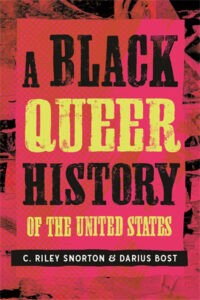
From A Black Queer History of the United States. Used with the permission of the publisher, Beacon Press. Copyright © 2026 by C. Riley Snorton and Darius Bost

C. Riley Snorton and Darius Bost
C. Riley Snorton is professor of English Language and Comparative Literature at Columbia University and the author of Nobody Is Supposed to Know: Black Sexuality on the Down Low and Black on Both Sides: A Racial History of Trans Identity, which won numerous awards, including the Lambda Literary Award for Transgender Nonfiction, the Sylvia Rivera Award in Transgender Studies from the Center for Lesbian and Gay Studies, and an honorable mention from the American Library Association Stonewall Book Award Committee. Darius Bost is associate professor of Black Studies and Gender & Women’s Studies at the University of Illinois-Chicago. Bost is the author of the award-winning book, Evidence of Being: The Black Gay Cultural Renaissance and The Politics of Violence.