Is This the Most Literary Video Game of All Time?
Josh Lambert on Meredith Gran’s Perfect Tides: Station to Station
The best way I can describe Meredith Gran’s recently released video game Perfect Tides: Station to Station—or at least the best way I can describe it to people who read contemporary literature—is that it feels like a version Elif Batuman’s novels The Idiot and Either/Or that you can step inside of. Batuman’s novels offer the exquisite discomfort of gazing inside the head of an anxious, perspicacious, self-serious millennial college student as she flails around campus and makes bad decisions. Gran insists that you do all the flailing yourself.
Gran started out making comics. As a student at the School of the Visual Arts in the first years of the millennium, she already had an audience; she apologized in 2004 and 2005 about not updating her series “Skirting Danger” as she worked on finals and her undergraduate animation thesis. In her twenties, she was a member of the Pizza Island collective in Brooklyn, with BoJack Horseman’s Lisa Hanawalt and Sarah Glidden of How to Understand Israel in 60 Days or Less; during those years, Gran was writing and drawing Octopus Pie, a comic series that ran from 2007 to 2017 and has lately been collected in a gorgeous box set. She turned to making interactive games not as an escape from the slice-of-life storytelling she had been doing in comics, but as a way of deepening her practice. As she put it, games offer “a means of not only viewing, but immersing oneself in the thoughts, feelings, sacred objects and desires of the protagonist.”
With the release of Station to Station, it has become clear that Gran is creating one of the most expansive, technically complex, and affecting autofictions of our time. If you haven’t played a video game since Tetris or Mario Kart, and if you assume a game could never make you feel the way an excellent novel does, Station to Station was made for you. Or, since I can assume you’re a reader or writer or both, let me put it this way: Station to Station is a video game in which your most consequential decision might be whether you choose to read Susan Sontag’s Against Interpretation, bell hooks’ All About Love, or The Odyssey.
As in the best autofictions, Gran has articulated a whole universe, anchored in the perspective of one individual.
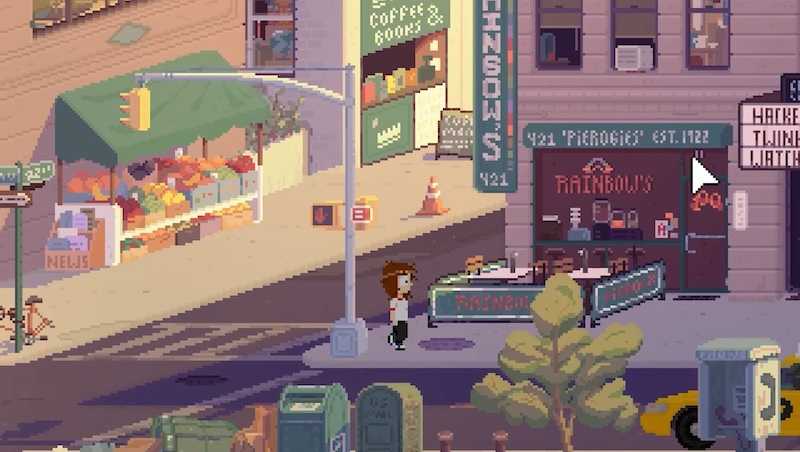
At the end of Gran’s first game, Perfect Tides (2022), her protagonist, Mara Whitefish, is 16, and spending less time on online fanfic forums and more time outside. In one memorable sequence, she takes mushrooms with her friend Lily and sneaks into an abandoned hotel to trip out on the graffiti and silently ponder her father’s death. In the sequel, Station to Station, we meet up with Mara a few years later in the middle of her first year of college. She’s a student at an art college in downtown New York (think SVA, but here called “SUCS”). Over about eight hours of playtime, you spend a year as Mara, broken up into four seasons. In each season, you have a few days during which you may or may not have time to read, as well as writing assignments to complete, classes and parties to attend, and choices to make.
As in the first Perfect Tides, Station to Station does not offer character customization or wild, free-wheeling narrative options. No matter what you do, you are still Mara, a very anxious, talkative, occasionally brash and sometimes insightful young woman, and you’re still going to have most of the same relationships and conversations. The main thing your choices dictate, here, is whether Mara is any good as a writer.
The way this works is unlike any game I’ve played (the closest analogue is the beloved Estonian RPG Disco Elysium). As you move through the world as Mara, you can talk to people about many topics—movies, sex, or death, or any of the people in your life. Occasionally a conversation, or something you read, will deepen your thinking on a topic, in a visualized, quantified way: inside Mara’s brain, number go up. The stronger Mara’s grasp on a topic, the more useful the topic will be when she deploys it in a writing assignment. As in real life, you have limited time to read, and since the game takes place in the early 2000s, you can write only when you have access to an iMac at the library, a friend’s laptop, or a PC at home.
This reading and writing system distinguishes Gran’s approach to storytelling from the way a similar autobiographical narrative could be conveyed in a novel, graphic novel, or film. One thing video games can do that other media forms cannot is give the reader the opportunity to try, fail, feel frustrated, and then try again. In my first playthrough of Station to Station, I absolutely sucked at the writing that Mara has to do. I read the wrong books in the wrong order. I got behind on my assignments and submitted half-baked essays to my boss and to my teachers.
When given an opportunity to share creative work with some cool older writers, all I could manage was mumbling out something confused and self-defeating. When I reached the end of Mara’s story, I felt both elated by Gran’s artistic and narrative achievements and utterly ashamed, alone at my desk, that I had fucked up the writing assignments so badly. Novels and films don’t make me feel that way—personally responsible for what happens in them—and, of course, I immediately restarted, determined to do better.
As innovative as her medium is, it’s even more impressive that Gran doesn’t use it to tell a story we can find elsewhere. Station to Station offers a detailed, insightful account of what it was like to be a poor Jewish kid in college in post-9/11 New York. A recent study suggests we rarely see poor Jews on television or in movies, and many of the successful Jewish novelists of the 21st century that you’ve heard of grew up rich. But in the Perfect Tides games, Mara’s mom is struggling financially in the wake of her husband’s death, and as a college student, Mara scrambles for resources. A gameplay challenge at one point in Station to Station is to locate a filling dinner for $1.50; on another occasion, the way to progress is to have Mara brush her teeth at a train station water fountain. One of her friends, an annoyingly upbeat rich kid named Theo, treats her to some pot and then dumplings at a fictionalized Veselka, and Mara worries about what she owes him for it.
Station and Station builds on the history of narrative video games, providing a model for the future of the form.
As a wide-ranging exploration of a young person coming of age as a millennial Jew in New York City in 2003, the game offers other, refreshing perspectives. At one point Theo asks Mara if she’s going to take a free “Bestowal” trip to “the Holy Land” that’s offered to Jewish students and Mara demurs: aren’t those trips “sort of creepy. Like… propaganda-y”? “And they don’t show you the conflict, like, at all.” This conversation takes place two years before the founding of the BDS movement, and long before Jewish groups like IfNotNow started protesting Birthright, but Mara’s already skeptical about the idea of being flown to some homeland she’s never cared about.
The game’s interests in politics, per se, mostly orbit around anarchism—one of the books Mara can read is Mikhail Bakunin’s God and the State—but Mara also intuits that when her mother and grandmother get on her case about her boyfriend not being Jewish, there’s something antiquated, or possibly racist, about it. Still, Jewishness matters to Mara, as it links her to her dad’s memory and to moments of wonder. “I’m not even really that Jewish,” Mara tells Theo, and he replies, inevitably but wisely, “What a Jewish thing to say.” At one climactic moment in the story, Mara sneaks out onto the pre-renovated Highline, drinks in the wild beauty of ungentrified, wintry Manhattan, and says, just, “Dayenu.”
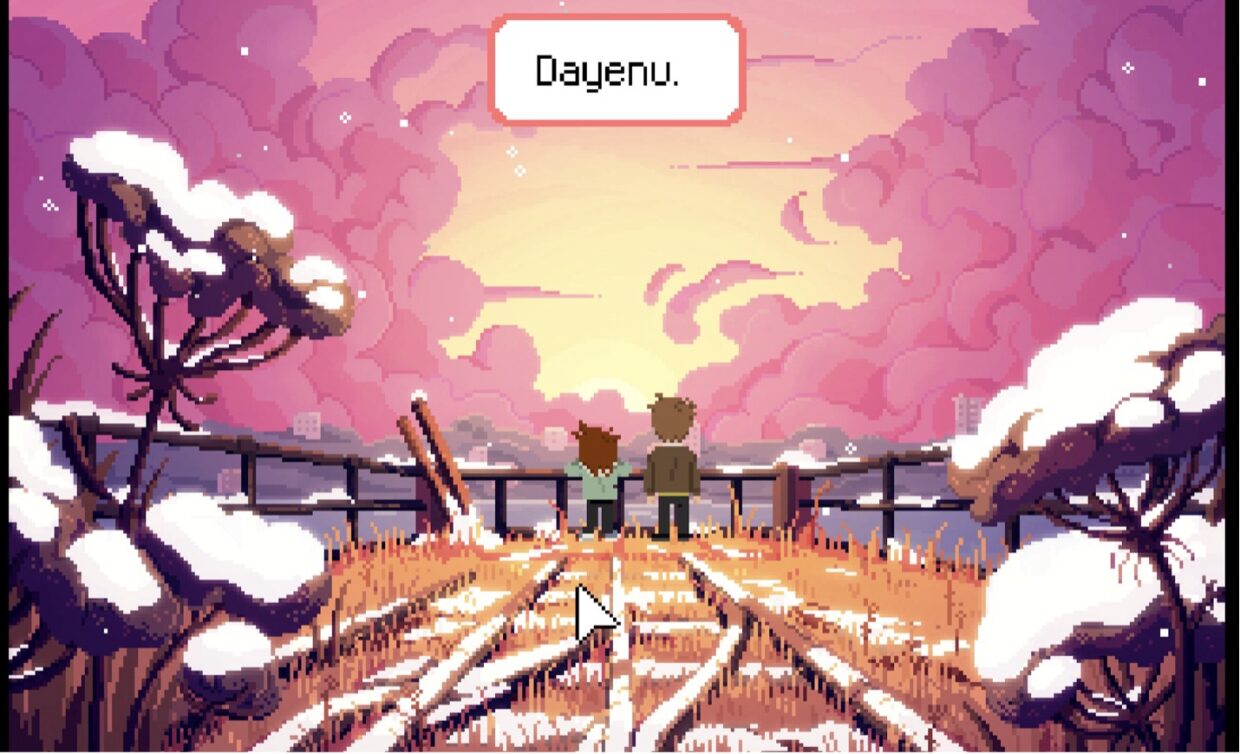
There’s much more that’s fascinating and deeply specific in Station to Station’s story. Gran packs the game with precise, grounded reflections on perennial themes—above all, the question of how much of one’s self-worth should be determined by the way other people think about you—as well as issues specific to the game’s setting in 2003, like the vibes of early internet culture, online indie music reviews, or the George W. Bush presidency. It’s a story filled with heartbreak and sadness, but bursting with so much of the joy of that era, too: alcohol, pot, impromptu bathroom piercings, mosh pits, dive bar karaoke, and swimming holes.
Part of the game’s wild, unbounded energy surely comes from Gran’s extraordinary commitment to the project: to create Station to Station, she not only wrote hundreds of thousands of words, she also drew and animated dozens of characters and scenes, layering in puzzles, background details, and secret interactions—almost entirely by herself, with collaborators contributing music, art, and coding support. As in the best autofictions, she has articulated a whole universe, anchored in the perspective of one individual.
In a review of Gran’s first game a couple years ago, I compared her work to Art Spiegelman’s Maus and Alison Bechdel’s Fun Home: those are the virtuosic graphic novels that, in my experience, can best teach highbrow skeptics just how powerful the medium can be. Station and Station succeeds even more in this regard, building on the history of narrative video games and providing a model for the future of the form. It’s exciting that some game critics have been noticing and celebrating it. But the audience I hope might find its way to Gran’s work now aren’t gamers pining for stronger narratives, the ones who put Consume Me and Despelote on their top ten lists last year. The people I want to play Station to Station are readers of contemporary fiction who don’t believe that a video game can challenge and delight them.

Josh Lambert
Josh Lambert is the Sophia Moses Robison Professor of Jewish Studies and English at Wellesley College. His most recent book was The Literary Mafia.