Is Bridgerton’s Diversity More Than Just Window Dressing?
Patricia Matthew Considers the Fourth Season of the Netflix Series
In the sixth episode of Bridgerton’s third season, Lady Danbury (Adjoa Andoh) and her brother Lord Marcus Anderson (Daniel Francis) have a fraught and tender confrontation. She has been furious with him from the moment he shows up at one of the series’ many gloriously staged balls. At first her anger seems to be because she knows his rakish history and is worried that the attention he is paying to her best friend Lady Violet Bridgerton (Ruth Gemmell) will end in scandal and heartache. But viewers learn that alongside concern for her friend and her general disapproval of sexual licentiousness, her rage is because he thwarted her attempts to escape her father’s plan to marry her off to the cruel Lord Danbury.
At first glance (or blush if you’re Lady Bridgerton), Lord Anderson seems another piece of eye candy, but this scene is important for a number of reasons. Lady Danbury and her brother are among the older set of the ton (Regency high society), but in front of one another he is a little brother seeking forgiveness from his big sister. All of his charisma is on display not in service of seduction but for the purpose of repair and is a constant in the steamy series: the familial ties that bind. He asks her, and by extension the audience, to see him not as the strapping sexy man but a confused little boy. He is a black baby brother asking his big sister to understand the choice he made. Lord Anderson’s vulnerability and tenderness expressed to another Black character stands out in a series where Black men, in power, are depicted as cruel.
Of course, the world is full of Black men with this exact, irresistible combination of strength and vulnerability, but it has been mostly missing from Bridgerton. Regé-Jean Page’s Simon Basset in the first season character gets close, but, as his character does in the novels, he disappears after his season, in which his primary purpose was to inspire lust while eating ice cream. Where the Bridgerton men get to struggle with the trials of second sons, and all the white women are afforded a depth of emotion (even terrible Cressida) that makes them sympathetic, Black male characterization has been missing. Will Mondrich (Martins Imhangbe) come close, especially his partnership with his Alice (Emma Naomi), but they have been working their way into the ton.
The characterization of Lady Danbury’s cruel husband, whom we meet in Queen Charlotte: A Bridgerton Story, didn’t sit right with me. I interpreted it as a way to establish that his cruelty physically distorted him, but the portrayal was shockingly grotesque. Performed by the handsome actor Cyril Nyri, his characterization evoked Julius Soubise, an enslaved man brought to England as a “gift” and depicted by the Printmaker William Austin in the etching “The Duchess of Queensberry Playing at Foils with her Favorite Lap Dog Mungo.” It was a relief, then, to meet two Black men in the third season who are kind and depicted as three-dimensional characters and to see their character arcs reach into the fourth.
Along with the introverted Lord Kilmartin (Victor Alli), the last two seasons have given us characters whose interiority is legible to the audience We see them not as stoic wounded men whom women are encouraged to love despite their roughness and arrogance, but as self-possessed men enough at ease with themselves to be vulnerable with the women they love. In both seasons, these lovely Black men are depicted reveling in the strength of Black women even as viewers see them navigate their way towards romantic happiness
Alongside noting each season’s nod to diversity, there has been a steady critique of what the series glosses over, particularly the oppressive, often violent hierarchies, masked by fashion and sentiment.
These depictions, and their performances, add depth to the series’ embrace of multicultural, diverse casting. The series’ narratives are set by Julia Quinn and concretized by her fans. In an earlier time, before readers fell in love with historical romance novels by Adriana Herrera, Beverly Jenkins, Courtney Milan, and Vanessa Riley, I might have noted that we are stuck in narratives scripted by white women and their imaginations. And, indeed, Quinn’s stories probably are more marketable for a television audience. Within that script, however the showrunners seem to be having a multi-cultural ball and enjoying a range of sexual desire and expression. It has made watching the seasons fun and exasperating at once.
*
We can see Bridgerton’s diversity in a few ways. The consistent image is that while all of the characters in the main families are white, one needn’t be white, thin, or heteronormative to be part of that world. The diverse casting of main characters works in different registers. The series has people of color in major and minor roles. Viewers see race and ethnicity, and in some instances, the characters they watch see it too. Anthony Bridgerton (Jonathan Bailey) knows his wife Kathani Sharma (Simone Ashley) is from India (even if the geography of the country is mangled in season). Lady Danbury points to the history of slavery that the series would have us believe has been repaired by the Black ton. With Sophie Baek (Yerin Ha), viewers see a woman of color, but no one in the series seems to notice that she is not white. Benedick’s colorblindness has inspired justified humor as he considers that all the debutants, even the Black ones, might be his mystery woman.
The rituals surrounding the release of a new season of Bridgerton or Bridgerton-related stories are familiar by now to fans and cultural critics. For fans, the excitement isn’t simply about who will be cast in roles that live in their imagination due to the wild popularity of the source material; there is also curiosity and a deep investment in what new kind of diversity Chris Van Dussen will bring to the Bridgerton Universe. While the Bridgertons are all white, and indeed there is no indication that Quinn’s universe includes people of color, they can be found all over the series. The extras are a happy mix of different races, physical abilities, ethnicities, and sizes.
For cultural historians and critics, each new Bridgerton season has been an opportunity to educate the public about the series’ accuracy or lack of it and a reason, a very good reason I might add, to explain to its audience the exploitative practices that makes the life of the ton possible. Alongside noting each season’s nod to diversity, there has been a steady critique of what the series glosses over, particularly the oppressive, often violent hierarchies, masked by fashion and sentiment.
Part of this has been a reaction to the seductive multi-cultural, diverse fantasy the show offers and the fact that Shonda Rhimes is one of the few Black women at the helm of a powerful production company. A call for verisimilitude increases in direct relation to how the world understands a culture or cultural moment. It’s important to note, however, that the series is not reflecting history but the audience’s fantasies about it, one that wants to believe that the powers of class can ameliorate, if not entirely mitigate, the powers of racial constructions. The problem, of course, is that it is impossible to attain this wealth without exploitation.
I’m sympathetic to these frustrations. At the moment, I’m writing a scholarly monograph that examines the gendered and racialized hierarchies concretized in material culture, portraiture, and literature circulating in the final decades or Britain’s abolitionist project. It will require us to reconsider how we view white women’s participation in the movement.
When I prepared my recent Penguin Deluxe editions of Jane Austen’s Pride and Prejudice and Northanger Abbey, I worked carefully through how to contextualize them in a history that new readers might not understand as part of Austen’s world. I also understand the mixed response sparked by having historical figures and moments represented in popular culture. In this season, Eloise Bridgerton (Claudia Jessie Peyton) and Sophy discuss Maria Edgeworth, a nineteenth-century writer whose writing promoted the importance of women’s education. It’s a moment for the two young women to bond.
While I was pleasantly surprised to hear the name of a thinker I study and teach mentioned in popular culture, I wondered if the writers know that Edgeworth’s thinking about race and slavery was problematic. Even though she included an interracial marriage in the first edition of her novel Belinda, Edgeworth argued for amelioration not abolition, and wrote a short story about white fantasies of cultivating Black submission called “The Grateful Negro.” It’s as terrible as the title suggests. I still paused over the detail and imagined an Edgeworth expert explaining who she is to an audience interested in Eloise’s notions about marriage and women’s rights.
A nuanced narrative of racial history is not Shondaland’s ministry, and I think we could argue that it never has been. Shondaland is interested in power, class mobility, and the intensity of female friendships.
The criticisms have almost always made sense to me, and pushing for more is our job as fans and cultural critics. But ultimately, the series is anchored in Quinn’s choices—its white central family, its heterosexual unions. It represents a range of emotions and desire. Bendedick’s bisexuality and the intense connection between Eloise and Penelope; that may be sapphic but is also recognizable as a deep bond many women share. And Franceseca’s bourgeoning desire for John Stirling’s cheeky, irresistible cousin, a man in the novel but a woman (Masali Baduza) in the series promises to push the novels firmly out of heterosexual pairings.
*
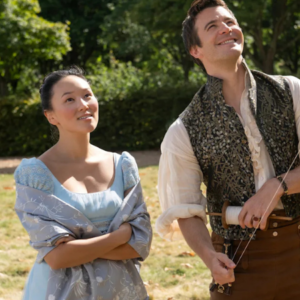
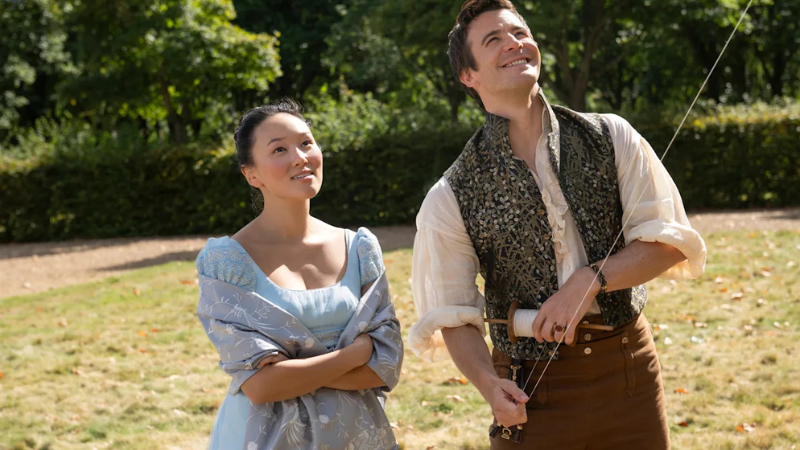
There is much to say about this season beyond the pleasure of watching Lord Anderson and Lord Stirling live and love among the ton. Quinn is an Austen fan, and it shows, but Bridgerton’s fourth season pays more attention to the servants, to those living below the stairs, than Austen ever would. Yarin Ha’s Sophie is not a housemaid, but her friends are, and this season’s stories brings those below stairs into somewhat sharper focus, seeking love, and, in the case of the Featherington’s housekeeper Mrs. Varley (Lorraine Ashbourne), higher pay. Like most of the series’ royal fantasy, the agency of servants is exaggerated. But Ha’s portrayal is excellent. She gracefully walks a line between disgruntled and hardworking. This is not a happy-in-her-station Cinderella. While this is partly because her father is an earl, the other part of her background honors the fact that her mother was a housemaid.
Luke Thompson as Bendict Bridgerton wears his sexual charm playfully, making his earnest declaration to all the more appealing. The character’s frustrations about being a second son have to run alongside the actor’s challenge of being the third Bridgerton man to declare his love amidst a fraught Gordian Knot of complications. It’s worth noting that his bisexuality inspired the glorious Heated Rivalry. However, a nuanced narrative of racial history is not Shondaland’s ministry, and I think we could argue that it never has been.
Shondaland is interested in power, class mobility, and the intensity of female friendships. In fact, the most powerful relationship in the series is between Andoh and Golda Rosheuvel’s Queen Charlotte (who seems to have augmented the Black-Don’t-Crack-legend be aging backwards) sitting together for the last time before Andoh returns to her homeland (in real life Andoh, a renowned Shakespearean actor and director, will be the inaugural resident for the Folger Shakespeare Library’s Director’s Residency). A company helmed by a Black woman and her vision serving lewks and representation is important.
Perhaps we should aim our ire at PBS/BBC. We don’t need another monarch melodrama. I promise. When the first season of Bridgerton was released, historians made the case that histories featuring Black people who were actually in power was more important and could be more entertaining than yet another glossy show about British aristocrats. I think that’s true. However, Shondaland, even with its diverse writers and directors, probably isn’t the right fit for such an enterprise. But these Black men it has given us, even if only for a short time in some cases, are a promise that the series still has interesting representations to offer viewers.

Patricia A. Matthew
Patricia A. Matthew (introduction) is an English professor who teaches courses on eighteenth and nineteenth-century British literature and culture at Montclair State University. A specialist in the history of the novel, she writes about a range of topics for scholars and the general public. Her work has been published in academic journals, and she has written about Jane Austen, Bridgerton, and Sanditon for The Atlantic, The Times Literary Supplement, and Slate. The editor of the Oxford University Press Series “Race and Nineteenth-Century Literature and Culture,” she is a regular lecturer for the Jane Austen Society of North America, she is currently writing a book on sugar, abolition, and material culture.