Is Alien Life Hiding in Plain Sight, Right Here in Our Solar System?
Dr. Sarah Alam Malik Considers the Prospect of Planetary Worlds Beyond Earth
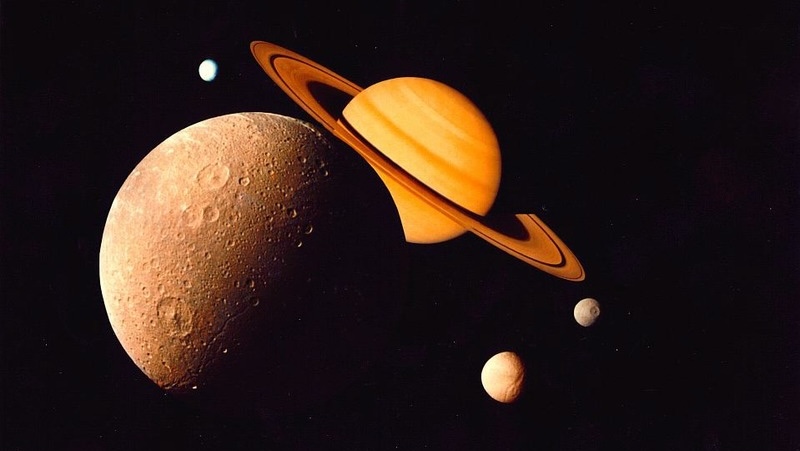
The grandeur of Saturn is stunning to behold when viewed through a telescope. Possibly the most iconic and easily identifiable member of our solar system, this “ringed planet” has a volume equivalent to 760 Earths and such astonishingly low density that the planet could even float on water. Until two decades ago, few missions had visited Saturn, although Pioneer 11 and the Voyager probes briefly flew by and gave us some stunning imagery and reconnaissance to identify particular areas of interest.
It wasn’t until 2004 that the dedicated space probe Cassini arrived at the planet. After a seven-year journey to reach Saturn, Cassini spent the next thirteen years there, circling the planet almost 300 times and revealing in exquisite detail its dazzling wonders, like the raging storms on the planet’s northern hemisphere, housing a giant hurricane twenty times larger than anything seen on Earth. But the most dramatic and astonishing discovery from the Cassini mission came after data from the space probe revealed surprising details about Saturn’s moons, Titan and Enceladus. These breakthroughs shattered our preconceived ideas about the places we thought were interesting for supporting life.
Not only can potential habitats for life exist very far from the warmth of a star, hidden in deep underground oceans heated by tidal forces, but planets orbiting stars are not the only places.
When Voyager 1 sailed past Saturn’s moon Titan in 1980, what it saw was an impenetrably thick, hazy atmosphere that was completely obscuring the surface. But the atmosphere had an interesting composition. It consisted of mostly nitrogen, with small traces of methane and ethane, and thus not entirely dissimilar to our own atmosphere. This hinted that interesting chemistry might be taking place below and marked Titan as a high priority for future exploration, a place we must return to.
More than two decades later, Cassini arrived at Titan with a precious cargo—the Huygens probe—specifically designed to penetrate the moon’s opaque atmosphere and parachute down to the surface. After separating from Cassini, Huygens cruised solo for around three weeks to reach Titan and, once there, deployed its parachute for the two-and-a-half-hour descent. As it soared through the atmosphere, Huygens gathered extensive data on its temperature, chemical composition, wind speeds and pressure, and despite being buffeted by 400 kilometer-per-hour winds, touched down on the surface to become the very first probe to land on another moon in the outer solar system. Although not expected to survive landing on an unknown terrain, it continued transmitting data for several hours after touchdown.
The images sent back from Huygens showed a landscape that was strangely familiar—a flat, sandy plain littered with rounded pebbles and bathed in the dim orange light filtering through Titan’s dense atmosphere. Most notably, the terrain showed unmistakable signs of liquid erosion, with deep gullies and drainage networks sculpting the surface—it was a world that had been shaped by flowing liquids. But with a surface temperature of -180 degrees Celsius, this liquid could most certainly not be water.
After conducting more than one hundred close fly-bys of Titan, Cassini confirmed that vast seas existed at its North Pole, filled not with water but with liquid methane. Although methane exists predominantly in gas form on Earth, the cold temperatures on Titan allow it to flow in its liquid state. The vast volume of liquid hydrocarbons—specifically methane and ethane—present in Titan’s lakes and seas dwarf that of all Earth’s oil and gas reserves combined by at least a hundred times, although they are likely to have emerged from processes very different from those that form terrestrial fossil fuels.
On Titan, methane plays the role that water plays on Earth. Methane clouds gather beneath its orange-hued skies, sending torrents of methane rain; rivers flow down from mountain tops, carving their way across the moon’s icy terrain, pooling into vast lakes and seas near its poles. With stable liquid on the surface, Earth-like weather patterns and an organic-rich atmosphere, it’s the most uncannily Earth-like of all the celestial bodies we’ve encountered.
Cassini’s radar has even hinted at the possibility of a subsurface ocean of salty liquid water concealed beneath a thick icy crust that is many kilometers deep. This mix of familiar and alien features has raised the inevitable question: could life exist on Titan? In the extremely cold, methane-rich environment, life as we know it would face tremendous obstacles: for one, the chemical compounds essential for cell membranes would be frozen solid. Life would have to be based on fundamentally different chemicals, perhaps using methane as a solvent instead of water. Still, Titan’s prebiotic conditions are not dissimilar to those thought to have been the catalyst for kick-starting life on Earth. As such, this moon has become a laboratory for investigating the parameters of life as we know it and life as we don’t. The surprising discovery awaiting us below the thicket of its atmosphere has quashed the notion that worlds far from the Sun are unpromising destinations in the search for life-supporting environments.
The icy globe of Enceladus provided another shocking revelation. One of Saturn’s moons and only a tenth the size of Titan, Enceladus has a pristine white exterior that reflects almost all the light from the Sun, making it the most reflective body in our solar system. When Cassini was asked to fly by Enceladus, it was evident from the very first image it captured that some interesting geology was at work in its southern polar region. Closer fly-bys showed the sheer nature and extent of this phenomenon. Enceladus was spewing massive jets of fine icy particles and water vapor hundreds of kilometers into space, some of which were thrown into orbit around Saturn forming one of its rings—the wispy E-ring—while the rest were raining back on the surface and coating Enceladus like a fresh coat of snow, preserving its reflective brilliance.
These exploding geysers suggest that beneath the thick shell of ice is an extensive liquid ocean, and that, deep within the interior of the moon, intense heat and energy are being generated and thrusting water with such force as to create this spectacular phenomenon. At such vast distances from the Sun, we were expecting frozen kingdoms, yet this extraordinary moon is producing enough heat to keep water in its liquid state and prevent it from freezing. How was it doing this? The extensive data Cassini collected has shed more light.
As a miniature moon orbiting a massive planet, Enceladus experiences the immense pull of Saturn’s gravity, and, as with the tides in our oceans, this gravitational tug causes the moon to stretch and deform as it orbits. The tidal friction then generates heat within the moon. This tidal heating is further amplified by a gravitational resonance with another of Saturn’s moons, Dione. We’ve also learned that Enceladus probably has a highly porous core, and this allows cold water from the subsurface ocean to seep deep into the moon’s interior, where it interacts with the rocks and absorbs heat, helping to sustain Enceladus’s thermal activity.
While there are no apparently advanced life forms, no irrigation network of canals and no signs of an alien civilization, there is often more than meets the eye.
This internal heat, in turn, creates hydrothermal vents on the ocean floor, releasing hot, mineral-rich water. Similar to those found on Earth, these vents spew heated water that rises and eventually erupts through enormous tiger-stripe fissures in the icy crust, creating the spectacular plumes that Cassini observed. Cassini even flew through the plumes, sampling their composition and finding organic molecules and salts, thus strengthening the case that Enceladus’s ocean contains some key ingredients for life as we know it. This startling discovery has positioned what had seemed to be a small, unassuming ball of snow as a leading contender in the search for life beyond Earth.
Where we were previously limiting ourselves to the Goldilocks zone around middle-aged stars as the most likely place for habitability, these findings have compelled us to significantly widen that window. Not only can potential habitats for life exist very far from the warmth of a star, hidden in deep underground oceans heated by tidal forces, but planets orbiting stars are not the only places; their moons are also viable candidates.
Having spent thirteen years giving us exclusive and in-depth coverage of the world of Saturn and its moons, Cassini eventually ran out of the fuel that was primarily used to adjust its course. To avoid any undesirable consequences, a decision was made to execute a controlled end to Cassini’s mission. As one of the longest and most successful endeavors in the history of space exploration, Cassini’s grand finale was also a spectacular affair.
Diving nearly two dozen times through the narrow gap between Saturn and its innermost rings, the probe beamed back incredible images and valuable data on the material composition of the rings to help us understand their origins. After the last dive came the final plunge; Cassini was programmed to head straight for Saturn and intentionally plough into the gas giant.
On 15 September 2017, Cassini made its final, fateful descent into Saturn’s atmosphere. As it plummeted into the planet, Cassini continued to gather extensive data, sampling the atmosphere’s composition and measuring the planet’s gravitational and magnetic fields with unprecedented precision. The probe transmitted this information back to Earth until the increasing atmospheric pressure overwhelmed its ability to keep its antenna pointing to its home planet. Eventually, contact was lost and the probe fell silent. Cassini had been vaporized in Saturn’s atmosphere, a dramatic but deliberate manuever to avoid the unlikely scenario that it may instead collide with one of Saturn’s moons. That these icy worlds could potentially support life made this a necessary precaution, so that contamination from Earth-borne microbes that might have lingered on the probe would not inadvertently compromise future investigations. For a probe that had spent its operational lifespan dedicated to the Saturn system, it was a poignant and fitting end.
Cassini’s groundbreaking findings at Enceladus have sparked a fascination with these enigmatic “ocean worlds.” Europa, one of Jupiter’s four largest moons, is strikingly similar to Enceladus. Beneath Europa’s icy exterior lies a global ocean of salty water, potentially holding more liquid than all of Earth’s oceans combined. This vast ocean is shielded by an incredibly dense sheet of ice, frozen harder than granite and possibly tens of kilometers thick. Like Enceladus, Europa experiences powerful tidal forces from its host planet, Jupiter, and this gravitational tug-of-war generates internal heat, keeping the ocean liquid and potentially powering hydrothermal vents on the ocean floor. These vents could provide the energy and chemical building blocks necessary to support life, making Europa another prime candidate.
Our probes have circled and landed on many worlds within our reach and shown that, while there are no apparently advanced life forms, no irrigation network of canals and no signs of an alien civilization, there is often more than meets the eye. The worlds we previously thought to be desolate and dry, so far removed from the life-giving power of the sun as to be inertly frozen and hostile spheres, may not be quite so barren. We have found that conditions conducive to the emergence of life may be lurking deep within their interiors, and thus microbial life may be hidden from our view, thriving in a “dark biosphere.”
Future missions will reveal whether life has indeed found a way on worlds that, superficially, appear so unforgiving. As we extend our reach into the solar system, we are getting ever closer to answering the question: does life exist elsewhere in our cosmic neighborhood, or has it been a phenomenon exclusive to this third planet from the Sun?
____________________________

From A Brief History of the Universe (And Our Place in It) by Dr. Sarah Alam Malik. Copyright © 2026 by Sarah Alam Malik. Reprinted with permission of William Morrow Books, a division of HarperCollins Publishers.

Sarah Alam Malik
Dr. Sarah Alam Malik is an internationally recognized expert on dark matter, whose work on large-scale experiments like the Large Hadron Collider has placed her at the cutting edge of exploring the universe’s mysteries and the sophisticated technologies that enable us to probe its fundamental laws. Dr. Malik is a graduate of Oxford University and University College London and was awarded the prestigious Royal Society University Research Fellowship.