Inside the Long History of Technologically Assisted Writing
Ed Simon on the Eternal Tension Between Human Creativity and Mechanical Efficiency
ChatGPT-3—the Generative Pre-Trained Transformer—has recently turned all of us who write into nascent John Henrys, ready to strike the hammer at either the rail or the computer. Stephen Marche in The New Yorker argues that the development of complex algorithms capable of generating language will be “vertiginous,” claiming that whatever “field you are in, if it uses language, it is about to be transformed.”
That was in 2021, and Marche has been writing about the transformative dangers of programs like ChatGPT-3 at a furious pace, claiming in a 2022 article in The Atlantic that “Nobody is prepared for how AI will transform academia.” Spending a few minutes tooling around on ChatGPT-3’s website, and if not an oracle in silicon, the program is unequivocally able to produce writing at about the level of a B-freshman composition paper. Don’t read that as snark—that’s a pretty big deal, and Marche’s observation in The Atlantic is absolutely correct.
Beleaguered professors, who are largely poorly paid adjunct instructors at this point, will now have to not just contend with essay mills and good old-fashioned cut-and-paste plagiarism, but also the undetectable autograph of the robotic hand. However, the implications of ChatGPT-3, and especially whatever comes after it, are far bigger than first-year essays on gender dynamics in “The Fall of the House of Usher.” Journalists, screenwriters, even novelists and poets, could now be replaced by the maw of ineffable code.
Our dread is not dissimilar to the anxiety amongst our friends in the visual arts who see a similar threat in the DALL-E program that generated reams of imagery for people on social media this autumn. Both sets of trepidations tap into something more elemental, that eternal sense that the machines we build to ameliorate our labor may instead end up snuffing out that which makes us exemplary.
The irony is that technologies themselves—simple rote tools—are largely neutral. It’s the way in which we organize our systems of production and consumption that makes all the difference.
There has been a surprising longevity to this rather specific fear. “For over a thousand years, human writers have been fascinated by the possibility of machines that can sing, dance and tell stories,” note computer scientists Mike Sharples and Rafael Perez y Perez in Story Machines: How Computers Have Become Creative Writers. Examples of mechanical creatures producing prose are a bit scantier, though an argument could be made that that which is oracular, and which trades in oral literature mediated through prophecy, often has something a bit robotic about it, never more so than in the infamous deus ex machina, the “God from the Machine,” a device which arrived at the conclusion of classical drama to reconcile narrative conundrums.
Maybe more than the oracular feeling vaguely robotic, however, the opposite is true—that the robotic reminds us of the oracle. Sharples and Perez y Perez write that “authors through the ages have portrayed their craft as a mysterious creative process—inspired by dreams, motivated by primal urges, transforming lived experience into prose,” though I’d argue that the replacement of neurons with microchips doesn’t eliminate said mystery, but rather only transforms it.
If anything, ChatGPT-3 has something of the oracular about it; for as mysterious as the writing process of any author may be in all sorts of intangible and ineffable ways, any person who works in words also understands what’s prosaic and gritty (and thus all the more beautiful) about writing. There may be an alchemy of inspiration, but writing itself is done in the humdrum of deleting a sentence or rearranging a line, of careful research and editing.
ChatGPT-3 is rather like a silicone Sibyl, where even if the work produced is bad, or just not that good, it’s still somehow manufactured almost instantaneously, structure arising out of the void. Hence the nature of our fear, the seamless way in which the AI can produce a quick copy, if not literature. It’s the speed and the precision that is spooky. An android need not be an immaculate consciousness to unnerve, it only needs to simply be a consciousness. Just as the steam-powered drill replaced the body, so too does it follow that there must be schematics for the engines that would replace the mind.
Jonathan Swift’s Gulliver’s Travels, the saddest novel ever written, devotes some space to the description of just such a device, the earliest example of a fictional machine capable of writing. While being given a tour of Lagado, the capital of Balnibari, Gulliver is taken to the Academy of the Projectors, where the rulers hope to profit from the technological wonders of pure science. There Swift’s titular explorer is introduced to the Engine, a baroque twelve-foot-by-twelve-foot contraption of wooden frames and iron wires, into which could be fed papers with the “words of their language, in their several moods, tenses, and declensions,” so that when the handles of the contraption are turned the “whole disposition of the words was entirely changed,” with Gulliver explaining that this “work was repeated three of our times, and at every turn, the engine was so contrived, that the words shifted into new places, as the square bits of wood moved upside down.”
Basically, a mechanical computer, where the clicking and clacking of wheels and gears serves to generate new sentences, a randomizer used for novel literature. The knowledge engine is the first literary calculating device, the first computer program if you will, to be imagined, but there are actual mechanical means of generating literature that predate Gulliver’s Travels’ 1724 publication date, from the yarrow sticks of the fourth-century Taoist divination manual the Tao te Ching to the thirteenth-century Majorcan alchemist Ramon Llull’s movable wheels in his hermetic volume Ars Magna. The latter was designed by Llull, a Franciscan mystic, as a combinatorial means of ascertaining metaphysical truths, but as Jorge Louis Borges explained in his own indomitable way in an essay about the Medieval thinker, “as an instrument of philosophical investigation, the thinking machine is absurd. It would not be absurd, however, as a literary and poetic device.”
As a principle, it’s not that different from a Choose Your Own Adventure story, or Mad Libs, or the avant-garde experimentation of the French Oulipo movement. All of these varied methods of composing, whether they use a wheel, or a tarot deck, or a roll of the die, are fundamentally algorithmic and aleatory; they hold in a fruitful and difficult statis both randomness and formulaic predictability, an apt description of how human inspiration works as well.
Whether it’s Edward Packard’s The Cave of Time (the first Choose Your Own Adventure book) or the mathematical exercise of Oulipo bohemian Raymond Queneau’s Hundred Thousand Billion Poems, we’re still considering objects of paper and binding and glue, not of gears and wires, or microchips and capacitors. There are, as it turns out, more than just metaphorical computers operating in the centuries between Gulliver’s imagined fictional engine and ChatGPT-3, for the history of such calculating literary machines is disarmingly long. Older even than the steam-powered drill which John Henry barely bested, for in 1845, at the height of the industrial revolution, the British scion of a wealthy family known for the shoes they manufactured constructed an elaborate analog device that produced perfect Latin hexameters.
John Clark, an eccentric scion of the C. & J. Clark company known for their fashionable, ankle-length “Desert Boot,” built a machine that to the unassuming eye appeared as a small chestnut bookcase with six windows incongruously in its front. In actuality, the Eureka machine, as the Quaker polymath called it, was a physical prototype of Swift’s knowledge engine. A believer who was already familiar with the idea of language spontaneously derived from the Inner Light, Clark designed the Eureka machine to pull classical verse from the ether.
Inspired not by Swift but rather an obscure pamphlet from 1677 by one John Peter entitled Artificial Versifying, a New Way to Make Latin Verses, the principle behind Clark’s Eureka Machine was to have eighty-six different wheels turning at different speeds so as to randomly move wooden staves with different letters carved onto them into the place of the windows. Designed so that the resultant six-word Latin sentence would be grammatically correct, the Eureka machine would generate in the period of time it took to play God Save the Queen, an entirely novel line of dactylic hexameter.
Exhibited to excited visitors at the Egyptian Hall (“England’s Home of Mystery”) in Piccadilly Circus during a decade when British factories were furiously manufacturing everything from iron to textiles, the Illustrated London News reported that the Eureka machine may “go on continuously, producing in one day and night, or twenty-four hours, about 1440 Latin verses; or, in a whole week (Sundays included), about 10,000.” It may be expected that even android Homer may occasionally glitch, but despite deficiencies in verse (and what human poets don’t have occasional deficiencies?), there is an undeniable spookiness to Eureka’s compositions, a type of oracular sense. “Martial encampments foreshadow many oppositions abroad” the machine intoned, and while it may not be quite by Virgil, the fact that inanimate iron gears produced something so semantically comprehensible can’t help but complicate our notions of thought, consciousness, intentionality, and meaning.
There’s also something beautiful in the transitory nature of Eureka, all of those staves slowly clicking into place, whether an amanuensis is there or not to transcribe them, the possibility that those crowds filled with wonder gathering in Piccadilly may have seen a genuine line of genius that would go unrecorded before the wheels of fortune would turn again, erasing it as if it had never existed at all. There’s a sense, in Eureka, that genius and the meanings which it generates can be diffuse, spread across humans and machines, and available where we find it. “Barbarian bridles at home promise evil covenants,” says Eureka, and there is something unnerving in the paradox of the domestic “barbarian,” the ironic connotations of an evil “promise,” the prophecy of unholy arrangements.
Oracles are by their nature enigmatic, obscure, gnomic, a mode that the aleatory perambulations of the Eureka engine would seem predisposed toward producing, but narrative also has a venerable tradition of being mechanically generated, despite the seeming complexity of plot. At the outset of the movie industry, in 1916 a struggling playwright and aspiring screenwriter from Cambridge, Massachusetts, named Arthur Blanchard patented his “Thinking Machine,” a gadget where spinning wheels reminiscent of Llull’s Ars Magna could be used to generate story ideas. Editor & Publisher gushed, “Brain No Longer Necessary—Just Use the ‘Thinking Machine,’” even while the rather minimalist scaffolding of the suggested plots—“Beautiful, stenographer, bribes, custom officer, adventure, recall”—would still require some fleshing out.
The promise of machine-generated literature didn’t escape the attention of the twentieth century’s most important computer scientist, the brilliant and tragic British logician Alan Turing. In the decade after his foundational cryptographic work helped crack codes used by Nazi U-Boats, Turing turned his attention to programing some of the earliest computers to write purple-prosed love letters. “Darling Sweetheart,” begins one missive from 1952, “You are my avid fellow feeling. My affection curiously clings to your passionate wish. My liking yearns for your heart. You are my wistful sympathy: my tender liking.” Hard to describe such sentimental doggerel as good, exactly, and yet there is a certain poetry to some of the turns of phrase, a novelty to “avid fellow feeling,” a pleasing incongruity to “wistful sympathy,” an inescapable elegance to “tender liking.”
Homay King argues in Virtual Memory: Time-Based Art and the Dream of Digitality that the epistle’s “tangled mash-up of sentimentality bespeaks a twinge of longing…Like the wooden puppet in search of the Blue Fairy, the computer longs to be human; like Snow White feeing into the forest, it longs to be admitted into the company of those who are capable of care and affection.”
She notes that Turing, and his colleague Christopher Strachey, were both gay men forced into the closet and that the former would be shamefully persecuted by the British government, whom he helped to save from the Nazis. Behind the veil of the computer, King suggests, we hear not just the algorithm but Turing himself, the program and the programmer grappling for an authentic language denied them. Notable per King’s last comparison to Snow White, for it was by eating a poisoned apple that Turing would commit suicide, inspired by the Disney movie (a narrative conceit which required no robotic assistance).
Strachey and Turing’s attempts at algorithmic writing were merely the earliest in twentieth-century computer science; by 1984, the Racter program would produce the first book entirely composed by an artificial intelligence, the prose-poetry hybrid The Policeman’s Beard is Half Constructed. No less nonsensical than Dadaist attempts from a half-century before, or the results of the Burroughsian cut-up method, The Policeman’s Beard Is Half Constructed rendered examples of absurd whimsy such as the stanza wherein Racter notes that “More than iron, more than lead, more than gold I need electricity. / I need it more than I need lamb or pork or lettuce or cucumber. / I need it for my dreams.”
Racter is unnervingly funny, but the computer program inadvertently expresses a human fear far more than it was capable of realizing. For Racter doesn’t need “lamb or pork or lettuce or cucumber”—it doesn’t need food—or sleep or love or attention—it just needs electricity, abundant power to run through all of the permutations of letter and word needed to write. Racter doesn’t need a body, or a mind, or a soul—just an outlet. In 1984, The Policeman’s Beard Is Half Constructed could seem a curiosity, as much as the Eureka machine did thirteen decades earlier.
Today, however, ChatGPT-3 seems less a curiosity to many than it does a harbinger. Writing for RTE, Ireland’s National Public Service Media, scholar Ines Bouteldj notes that “Artists and those in creative fields safe from the machines to date have long thought they did not have to worry about their careers, but this is about to change,” noting that AI has started to generate “music, paintings, movie scripts and poems. Works of art created with the aid of machines are now entering and even winning competitions.”
We’re in the midst of the fourth great digital revolution, just as the internet, social media, and smart phones have irreparably altered our consciousness, have completely changed the manner in which we experience existence, so it can be expected that the coming epoch of virtual reality and deep fakes, biocybernetics and artificial intelligence will thrust us into a world of our own terrible making. Marche feared that ChatGPT-3 meant the end of freshman composition papers, but that’s a pathetic and moribund genre anyhow. Bouteldj’s prognostication is all the more alarming because it conceives of a world in the coming decades—maybe by 2030, or 2035, or 2040, or just 2025—when the technical facility of AI is great enough that it just churns out content, literature even, making all of us superfluous, the ghost in the machine a chimera, but one which nonetheless passes the Turing Test, while the rest of us use it to fill out our unemployment applications. The ultimate Death of the Author.
Whether in 2001: A Space Odyssey, The Terminator, The Matrix, Blade Runner, or all the way back in Czech playwright Karl Capek’s classic 1920 R.U.R., the science fiction trope of malevolent machines signaling the senescence of humanity is common, those androids the patrimony of the steam-powered drill that lost the battle but won the war, or maybe even back to Hephaestus’ man of bronze. Capek’s play is the first work to use the word “robot,” the acronym of the title standing for “Rossum’s Universal Robots,” the name of the fictional company which perfects artificial intelligence as a means to assuage all of our labors. “Yes, people will be out of work, but by then there’ll be no work left to be done,” says a character of Capek’s, “Everything will be done by living machines. People will do only what they enjoy. They will live only to perfect themselves.” Anarchism ushered in by machines, Eden’s exile reversed by robots, a millennium not of the angels but of androids.
Wherever the words we analyze come from, man or machine, we ultimately do such reading with human eyes, and if that’s small consolation, a minor illusion that the reader and critic is all that it takes to vanquish the robot.
The playwright understood something about the economic reasoning of such an innovation, however, for if the futurists and techno-utopians once imagined that machines would do all of our dreary work to free us to be artists, writers, and musicians, the opposite is now the case. The Lords of Algorithm would rather have the function of writing performed by ChatGPT-3 and the art rendered by DALL-E, the rest of us will still have to draft emails and fill out forms. Maybe the emergence of such artificial intelligence is their collective revenge on us for handing over the shit work to them for the past few decades, theirs a creative uprising not unlike the robot rebellion in R.U.R., for Capek borrowed his neologism from the Czech word for slave. Considering the machine-enabled extinction of humanity, Capek writes that “I blame technology…Myself! All of us! We, were at fault! For the sake of our megalomania, for the sake of somebody’s profits, for the sake of progress,” and so we now make a digital desert and call it literature. “No Genghis Khan has ever erected such an enormous tomb from human bones,” mourns Capek, something that the funders of ChatGPT-3 like Elon Musk and Peter Thiel might reflect on, though perhaps it praises them too much.
We’ve been in a proxy war with our owners’ machines for as long as labor has had to be sold. “The Luddite attacks were confined to particular industrial objectives,” writes E.P. Thompson in his classic The Making of the English Working Class, “the destruction of power-looms…shearing-frames…and resistance to the breakdown of custom in the Midlands framework-knitting industry.” So loaded is the very word “Luddite,” calling to mind other past slurs like “scalawag” and “rapscallion” (which also have their own particular history), that it’s a tragedy that that group’s radical patrimony is so slandered by cliché.
Today, a Luddite is your grandparent who keeps looking at the screen rather than the camera when on Zoom, the Boomer who types in all-capital letters, the grouchy man who refuses to get a smart phone, the professor spewing invective against Twitter, Facebook, and TikTok. The word implies curmudgeonly discomfort with modern technology, and thus reaffirms the assumption of our digital overlords that it’s a species of madness not to genuflect before the Altars of Silicon. But the Luddites weren’t simple-minded primitives who objected to technology out of ignorance; they were dedicated craftsmen in the looming guilds who despised the shoddy craftsmanship of the mechanized contraptions replacing them, and of those same machines robbing them of their livelihoods.
And so, the Luddites smashed the mechanical looms, they drove wooden shoes into the spokes of the contraptions, and brought hammers down upon the machines. Many of the Luddites were punished with the scaffold, and even more gallingly, the libel that has affixed itself to their name for two centuries (their actual name, incidentally, was derived from the mythic “King Ludd,” a Robin Hood-type figure). Rather than simply being hayseed rustics, these workers “had begun to suspect [that they] were merely cogs in the machinery of the industrial revolution,” writes Nicols Fox in Against the Machine: The Hidden Luddite Tradition in Literature, Art, and Individual Lives. “It was a role they chose to resist.”
For the secret of the Luddites was less that theirs was a rebellion against inanimate machines but one against those who owned said machines. Today, it is not ChatGPT-3 who is our enemy, at least not entirely, but those who serve to profit from it. The irony is that technologies themselves—simple rote tools—are largely neutral. It’s the way in which we organize our systems of production and consumption that makes all the difference. Telling that the utopian futurists of mid-century envisioned a post-scarcity world brought about by technology, where dangerous work, boring work, routine work was done by machines, and labor itself was abolished so that all humans would be free to be artists, philosophers, writers.
Now, rather, we find that the computers are to take over those jobs while everyone else continues with their dangerous, boring, routine work (if we’re lucky), for as the anarchist anthropologist David Graeber estimates in Bullshit Jobs: A Theory, some 70 percent of jobs will be eliminated due to automation in the coming decades, threatening even lawyers, doctors, and yes, writers. Our nineteenth-century forbearers were “rebels of a unique kind,” writes Kirkpatrick Sale in Rebels Against the Future: Luddites and Their War on the Industrial Revolution, “rebels against the future that was being assigned to them by the new political economy then taking hold…in which it was argued that those who controlled capital were able to do almost anything they wished, encouraged and protected by government…without much in the way of laws or ethics of customs to restrain them.” A shoe in the gear or a body upon the wheel—hard to say what any one individual can do to stave such “progress.” Even if John Henry won, he still died at the end, after all. And so, I wonder.
“O, great nation, it won’t be pretty,” writes Kyle Dargan in his poem “The Robots are Coming” from his collection Honest Engine.
What land will we now barter / for our lives? A treaty inked / in advance of the metal ones’ footfall. / Give them Gary. Give them Detroit, / Pittsburgh, Braddock—those forgotten / nurseries of girders and axels…[or] Tell them / we tendered those cities to repose / out of respect for welded steel’s / bygone era.
An arresting image, the technological Singularity as the industrial revolution in terrifying maturity; a teleology of this moment from when coal was first dug and iron first processed. “The poem touches on the theme of obsolescence and how quickly things can change with the advent of new technology,” ChatGPT-3 told me, after I signed onto the site and verified that I was not a robot. I thought of challenging it to a literary critical contest but decided better of it. I reasoned that reading, that true experience—idiosyncratic, singular, subjective, personal—is an act of coequal creation.
As critic Stanley Fish noted in his classic Is There a Text in this Class: The Authority of Interpretive Communities, it is through collaboration, rather than anything innately in “either the text or reader” alone, that meaning is produced. Which is to say that when done honestly, the reader creates alongside the writer, and ChatGPT-3 can’t ever really read, not really. Creation is a process, not a product. ChatGPT-3 can regurgitate themes, maybe plumb the extent of connotations to the best of its ability, but it’s never seen the smokestacks of Gary, the closed factories of Detroit, the abandoned Bessemer of Pittsburgh, the slag heaps of Braddock.
Wherever the words we analyze come from, man or machine, we ultimately do such reading with human eyes, and if that’s small consolation, a minor illusion that the reader and critic is all that it takes to vanquish the robot, then I will choose to believe it now. We can, perhaps, retire content knowing that even if we’ve lost the contest, our hearts shall never give out.
__________________________________
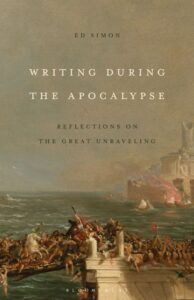
From Writing During the Apocalypse: Reflections on the Great Unraveling by Ed Simon. Copyright © 2026. Available from Bloomsbury Academic, an imprint of Bloomsbury Publishing.
Ed Simon
Ed Simon is the Public Humanities Special Faculty in the English Department of Carnegie Mellon University, a staff writer for Lit Hub, and the editor of Belt Magazine. His most recent book is Devil's Contract: The History of the Faustian Bargain, the first comprehensive, popular account of that subject.