In the Parlors of Black Bibliophiles: How Arturo Schomburg Built a Library and Made History
Dr. Laura E. Helton on the Story of a Great American Book Collector
They were “Damned Old Fools on Books.” That’s what the Philadelphia bibliophile William Carl Bolivar told Arturo Schomburg, his younger counterpart in New York, as the two men exchanged book lists, shared tips on where to hunt down rare titles, and bragged about their latest finds. Bolivar’s remark was a cheeky nod to the proverbial “gentle madness” of book collectors, but neither man took his avocation lightly. Both saw the building of Black libraries, in Schomburg’s words, as “powder with which to fight our enemies.”
Arturo Schomburg, the most famous bibliophile of the African diaspora, was born in Puerto Rico in 1874 and migrated at age seventeen to New York City. He participated in revolutionary anticolonial movements in the 1890s, founded the Negro Society for Historical Research in the 1910s, and became a leading figure of the Harlem Renaissance in the 1920s. Through these decades, he amassed a remarkable collection of 4,600 books, works of art, manuscripts, and pamphlets that spanned five centuries of Black history in more than a hundred languages. That collection, acquired by the New York Public Library in 1926, laid the foundation for the Schomburg Center for Research in Black Culture—one of the largest research institutions of its kind in the world.
By 1926, Schomburg’s collection no longer fit in his family’s modest rowhouse, where books had overtaken every room and were even stacked on top of the piano.
Though Schomburg’s name alone graces this Harlem landmark, he defied the stereotype of a lone, eccentric collector content with the company of his books. Schomburg built his library as part of a vibrant world of self-taught bookmen—first among the expatriate Puerto Rican and Cuban revolutionaries fighting for independence from Spain, and then among the literary-minded Black nationalists who shaped the New Negro Movement. He collected poetry with the fiery journalist and “race man” John Edward Bruce.
On lunch breaks from his mailroom job at a Wall Street bank, he poked around the bookstalls of Lower Manhattan and then returned to his typewriter to fire off reports to Bolivar. When weekends rolled around, Schomburg rode the subway to Brooklyn with Charles Martin, a Moravian minister from Saint Kitts, to scour second-hand shops. He went on a pilgrimage with his friend John W. Cromwell, a teacher in Washington, D.C., to rescue manuscripts from a hayloft. In such company, Schomburg spent his life in pursuit of material to illuminate Black history and culture, from sixteenth-century geographies of Africa to the contemporary poets of the Harlem Renaissance.
By 1926, Schomburg’s collection no longer fit in his family’s modest rowhouse, where books had overtaken every room and were even stacked on top of the piano. His library needed a new home, and in a transaction that would cement his fame as a Harlem Renaissance celebrity, he sold his books and art to the New York Public Library for ten thousand dollars. The price was far less than what he had paid for the materials, but the sale of the collecation captured the logic of the Renaissance: a rebirth inspired by the recovery of a treasured past. Schomburg’s materials were added to the new Department of Negro Literature and History at the 135th Street branch library in Harlem—the first such collection in a public institution in the United States. The sale transformed the branch—already a hub of Harlem’s creative and intellectual life—into a global destination for the study of the African diaspora.
In an era known as the “nadir” of American race relations because of escalating anti-black violence—and when few libraries or learned societies admitted Black readers—bibliophiles met the moment by turning their private parlors into public spaces.
Schomburg’s collection inspired an efflorescence of collecting at historically Black colleges and universities and at branch libraries serving Black communities. By the mid-1940s, special collections devoted to the study of Black life could be found in Los Angeles, Nashville, Detroit, and beyond. They provided refuge and resources for generations of thinkers and creators, from Margaret Walker, who found encouragement as a young poet at the Hall Branch Library on Chicago’s South Side, to James Baldwin, who reportedly once said that the Schomburg Collection, which he visited weekly as a child, gave him a “connection to life.”
These were the first Black libraries in public, but they weren’t the first collections to serve Black publics. In the decades before Schomburg’s collection arrived at the New York Public Library, he and other collectors opened their storehouses to the community. In an era known as the “nadir” of American race relations because of escalating anti-black violence—and when few libraries or learned societies admitted Black readers—bibliophiles met the moment by turning their private parlors into public spaces.
Thus, when W. E. B. Du Bois began research for The Philadelphia Negro, which would be published in 1899, he went to the home of William Henry Dorsey, who had transformed the second floor of his house into an art gallery and library that included hundreds of scrapbooks documenting Black life. And when the writer Alice Dunbar-Nelson was compiling Masterpieces of Negro Eloquence, a 1914 anthology commemorating the fiftieth anniversary of the Emancipation Proclamation, she traveled from Delaware to New York to consult the private collections of Schomburg, Charles Martin, and John Edward Bruce.
The homes of Schomburg, Dorsey, and other collectors were important sites of Black intellectual culture: salon-like spaces for the bookish crowd. Until now, however, it has been hard to picture them.
Schomburg relished such visits. Known as a generous host, he loved to invite friends and travelers to his home. “The library has a few easy chairs so that you can drop in and feel at home,” he wrote to the scholar Alain Locke in 1916. The novelist Eric Walrond stopped by Schomburg’s Brooklyn house in 1922 and called it “hallowed ground.” He marveled at the “sitting room that exudes a classic odor,” filled with books and adorned with portraits of an Ethiopian princess, the composer Le Chevalier de Saint-Georges, and the band master John Fraser. “It is easy to appreciate why writers and artists, poets and anthologists, of both races, flock to the unpretentious little dusty-brown house on Kosciusko Street,” he wrote.
The homes of Schomburg, Dorsey, and other collectors were important sites of Black intellectual culture: salon-like spaces for the bookish crowd. Until now, however, it has been hard to picture them. Only a handful of drawings and descriptions survive to document the private spaces that facilitated what Fred Moten and Stefano Harney term “Black study,” or intellectual convenings that are collective, informal, and dissident. There is a single drawing of the small museum in Dorsey’s Philadelphia home; a handful of snapshots of the Harlem studio of collector, scrapbook maker, and dandy Alexander Gumby; and one grainy photograph of the library of Ella Elbert, featured in The Crisis magazine in 1920. There is no known image of the interior of Schomburg’s Brooklyn home.
But at long last, a recently-resurfaced photograph has provided us with a more detailed look into the world of these early Black bibliophiles—a world at once elegantly studious and defiantly oppositional. Upon first glance, the room looks like a typical parlor of its era, clinging to the vestiges of late Victorian décor that were quickly fading from fashion. Note, for example, the heavy draperies and their tassels, the busy floral wallpapers, the stalks of hydrangeas that flank the mantelpiece, and the art and finery covering every surface.
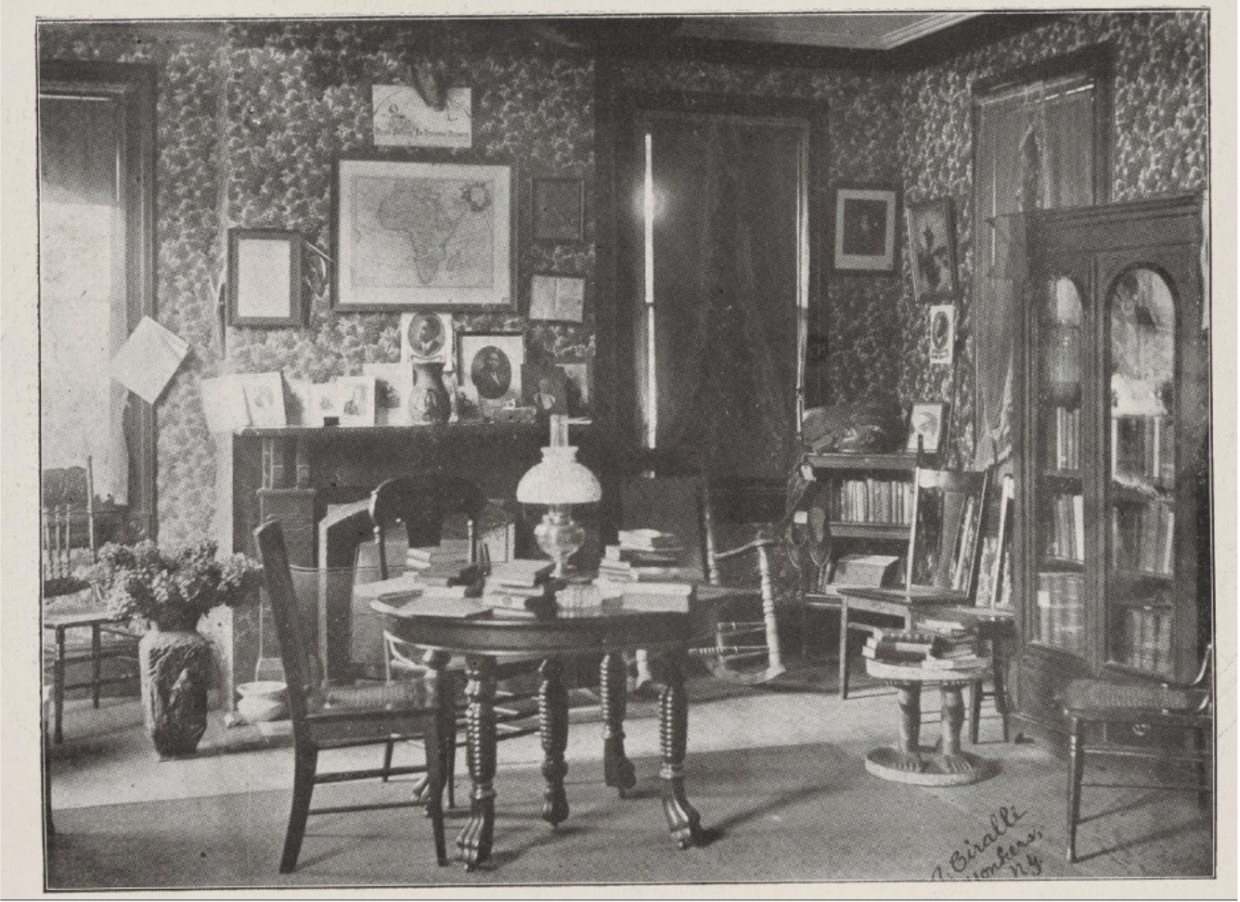 Meeting room and library of the Negro Society for Historical Research, circa 1912, at the home of John and Florence Bruce, Yonkers, New York. Photograph by A. Ciralli. (The African Times and Orient Review, Christmas Annual 1912, Manuscripts Archives and Rare Books Division, Schomburg Center for Research in Black Culture)
Yet a closer look reveals telling details that distinguish this space from similar middle-class interiors of the era. Above the fireplace hangs an eighteenth-century map of Africa by the French cartographer Guillaume de l’Isle—the first engraving to accurately depict the continent’s coordinates. Crowded on the mantel below the map are portraits and silhouettes of Black icons, among them the Liberian theologian Alexander Crummell and the British composer Samuel Coleridge-Taylor. In the back corner of the room is a Yoruba Gelede mask and other Nigerian artifacts. In glass-fronted bookshelves along the wall, on a carved West African stool in the foreground, and atop the claw foot table at the center of the room, were books: piles and stacks and rows of books. This is the quintessential parlor of a Black bibliophile, a space designed to “teach, enlighten, and instruct our people in Negro history and achievement.”
Welcome to Sunny Slope farm, the home of Florence Bruce and her husband, John Edward Bruce, whose fierce prose earned him the nickname “Bruce Grit.” In the Bruces’ cottage, situated on a sixty-acre estate near Yonkers, New York, the newly-formed Negro Society for Historical Research opened its collection to the public for the first time. On May 30, 1911, visitors found “beautifully arranged in the spacious parlor” a selection of the books and manuscripts gathered by the Society’s founders, including works by Phillis Wheatley, Sojourner Truth, Frances Harper, and the Underground Railroad conductor William Still.
The living room—like its more formal predecessors, the parlor and sitting room—is a space at once sacred and theatrical, where “we see black imagination made visual, a private space that inevitably reverberates against the garish public images usually out of our control.”
This photograph is a rare look into what the poet Elizabeth Alexander calls the “Black interior.” Inspired by the objects carefully arranged in her mother’s living room, Alexander argues that “artful arrangement divines power.” The living room—like its more formal predecessors, the parlor and sitting room—is a space at once sacred and theatrical, Alexander continues, where “we see black imagination made visual, a private space that inevitably reverberates against the garish public images usually out of our control.”
Those who gathered in this space represent the diasporic networks of self-taught thinkers who shaped Black ideas in the years before the Renaissance. John Edward Bruce, born in Maryland and a survivor of slavery, was the eldest of the group and the galvanizing force behind the Negro Society for Historical Research. He and Schomburg were joined by co-founders William Wesley Weeks, a musician from British Guiana; the visual artist William Ernest Braxton; and David B. Fulton, a journalist who chronicled the infamous white supremacist insurrection that ushered in decades of Jim Crow rule in Wilmington, North Carolina. Josephine Holmes, a teacher involved with the Harriet Tubman Club, and Mary E. Butler, a dressmaker, joined the Society and hosted its first lawn party in 1911, where the only known portrait of the group was likely taken.
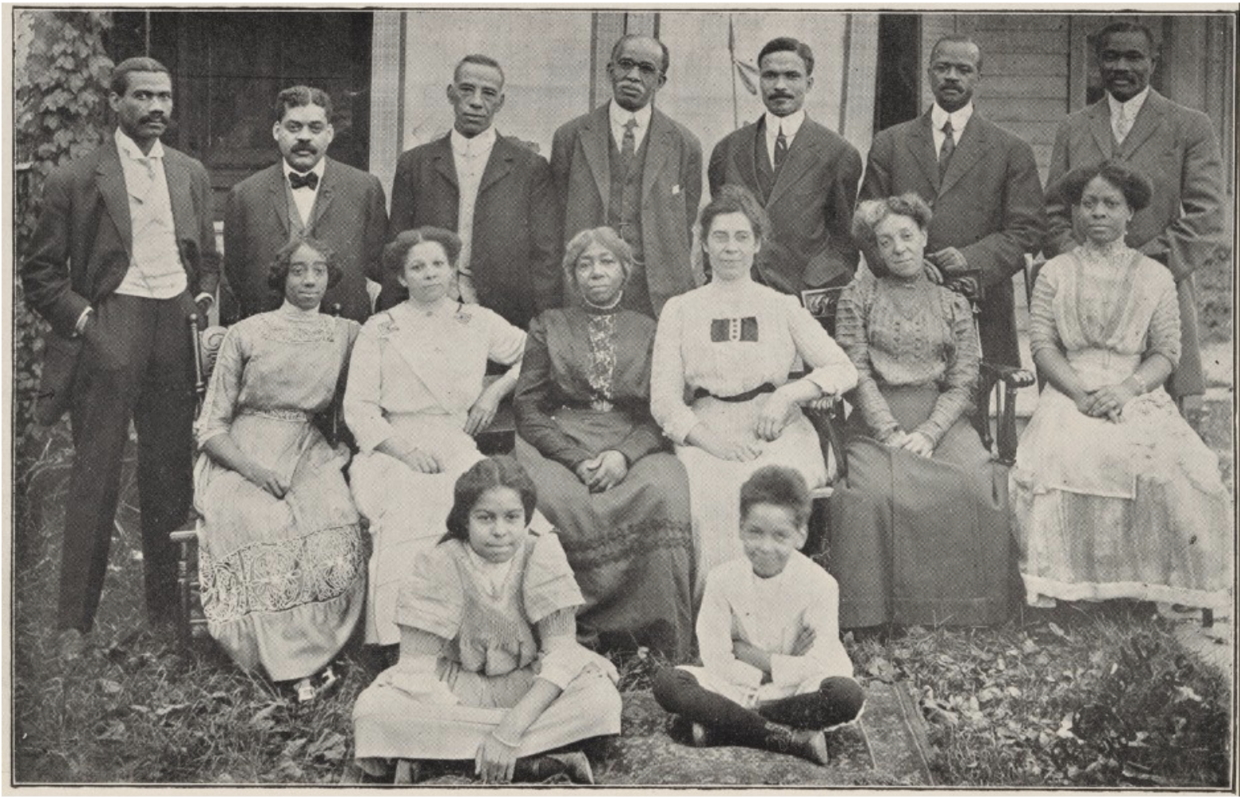 The Negro Society for Historical Research gathered in Yonkers, New York, circa 1911. Sitters identified in original caption as: Back row (left to right)-William Wesley Weekes, A. A. Schomburg, James A. Stephens, John E. Bruce, James B. Clarke, David B. Fulton, and an unidentified man; Middle row, seated–Mrs. Holmes, Mrs. McKelson [possibly Veronica Nickelson], Mrs. Mary F. Jones, Mrs. Mary Butler, Mrs. Florence Bruce, and Miss Goins; and Front row– Cecile and Willie Butler. (The African Times and Orient Review, Christmas annual 1912, Manuscripts, Archives and Rare Books Division, Schomburg Center for Research in Black Culture)This portrait and the photograph of the Society’s parlor library were published in 1912 in The African Times and Orient Review. A London-based monthly “devoted to the interests of the colored races of the world,” it was an apt vehicle for announcing the debut of the Society, which welcomed corresponding members from across the diaspora. Alain Locke was particularly struck by the cosmopolitan membership of the Negro Society for Historical Research: “Africans, American Negroes, Negroes from all the Antilles composed it,” he wrote admiringly. The magazine’s editor, Black internationalist Duse Mohamed Ali, signed Schomburg’s copy of the magazine in English and Arabic.
After 1912, these photographs from Sunny Slope Farm slipped out of view. Despite growing interest in Schomburg’s story and in Black print culture more broadly, they were not reprinted or discussed after their initial appearance—perhaps because so few original copies of the magazine have survived. The microfilm (and now digital) versions available to researchers, while sufficient for reading text, all but obliterate the vibrancy of the accompanying photographs.
For the past decade, a team of scholars, librarians, and archivists have used bibliographical clues—including inscriptions and bookplates—to piece back together a record of Schomburg’s groundbreaking collection.
For the first time in more than a century, this pair of photographs is being republished, with their stunning details preserved, in Black Studies on 135th Street: The Founding and Future of the Schomburg Collection, which commemorates the centennial of the New York Public Library’s acquisition of Arturo Schomburg’s collection. The photographs will also appear in the Schomburg Center’s upcoming exhibition, “To Uncover and Reveal to the World: Arturo Schomburg’s Library.”
While Schomburg’s contributions are widely celebrated, many details of his collection have been surprisingly little known. No surviving documentation fully itemized the materials that Schomburg sold to the New York Public Library. For the past decade, a team of scholars, librarians, and archivists have used bibliographical clues—including inscriptions and bookplates—to piece back together a record of this groundbreaking collection. Black Studies on 135th Street features a bibliography of this rediscovered library. “To Uncover and Reveal to the World” transforms the gallery into a space inspired by the parlor of the Negro Society for Historical Research.
Schomburg’s dedication to collecting represents an enduring tradition of resistance to the forces that censor, sanitize, and constrain stories about the past.
Even as they look backward, these centennial productions are, like Schomburg himself, attuned to the urgency of history-telling in the present.
In our current moment, when federal agencies as well as some states and universities are narrowing the scope of what counts as American history, Schomburg’s dedication to collecting represents an enduring tradition of resistance to the forces that censor, sanitize, and constrain stories about the past.
Schomburg grew up in a world that was often hostile to Black knowledge. In an oft-told story, he said that when he was a child in Puerto Rico, a teacher told him that “the Negro has no history.” The Spanish colonial government banned the work of revolutionary Afro-Cuban poet Rafael Serra, so Schomburg had to read it secretly—“under darkness,” as he recalled. He came of age at the height of segregation in the U.S., where some ten million African Americans were barred from their hometown libraries. Schomburg spent his life defying these prohibitions and erasures. Every book or portrait he acquired was one more piece of what he called “vindicating evidences” of Black humanity and achievement.
Preserving Black history was an embattled pursuit, but as the photograph of Sunny Slope Farm suggests, it also entailed camaraderie and exuberance. After Locke joined Schomburg and the Negro Society for Historical Research in this parlor, he never forgot the experience. Decades later he recalled being “initiated to the joys of musty but precious books and all the leisurely delights of the true antiquary—hearty dinners, good wines, a crackling hearth fire, intimate anecdotes, [and] the history that only connoisseurs know, since so much of it can never be written.” In the sumptuousness of the bibliophile’s parlor, studying Black history occasioned reverent, joyous gatherings. The work of teaching history and creating archives is as urgent now as it was a century ago. May it also be as communal and as grand.
__________________________________________________________
Black Studies on 135th Street: The Founding and Future of the Schomburg Collection, edited by Barrye Brown, Laura E. Helton, and Vanessa K. Valdés, will be published by Yale University Press on April 21, 2026. “To Uncover and Reveal to the World: Arturo Schomburg’s Library,” guest curated by Helton, will open in the Latimer Gallery at the Schomburg Center for Research in Black Culture on May 7, 2026.

Laura E. Helton
Laura E. Helton is a historian and curator who writes about collections and how they shape our world. She is the author of the award-winning Scattered and Fugitive Things: How Black Collectors Created Archives and Remade History (Columbia University Press, 2024) and co-editor of Black Studies on 135th Street: The Founding and Future of the Schomburg Collection (Yale University Press, 2026). She teaches literary history, archival studies, and public humanities at the University of Delaware.