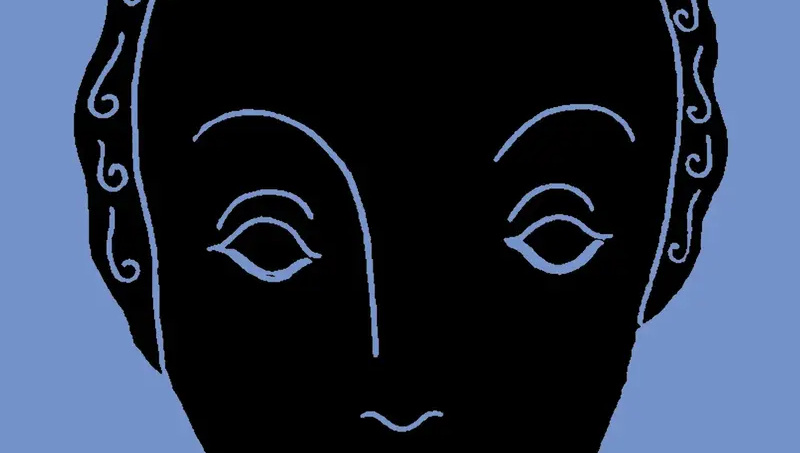
In Pursuit of Genius In Troubling Times: On Philip Owens’s Picture of Nobody
Allen Bratton Considers the Timelessness of the Artist's Struggle For Relevance and Survival
Philip Owens is buried in a war cemetery near Athens, Greece. The Commonwealth War Graves Commission records him as having died on the tenth of June, 1945, aged forty-four, a sergeant in the British Intelligence Corps, the son of John and Lucie Owens and the husband of Mary Evelyn Owens, of Tadworth, Surrey. This is the fullest biography of Owens that can be found. He never attained fame or fortune.
Along with a handful of poems and translations, he published two works of fiction in his lifetime: a 1930 novella of the European café scene, Hobohemians, and a novel, Picture of Nobody, published by Jonathan Cape in 1936 and soon forgotten amidst the Second World War. The time is right to bring this novel back. Picture of Nobody is a feat of tragicomedy—a cynical, satirical alternate history in which the great Shakespeare, transposed into the early twentieth century, must suffer all the indignities of thwarted ambition that Owens did.
In this weird world, twenty-first-century readers will recognize aspects of their own: the triumph of commerce over art, the suppression of potential by circumstance, the struggle to pursue one’s vocation through political and economic disaster. The protagonist’s dilemma is one that any writer today is likely to share: I must go on—how can I make it possible to go on?
If a true age of genius is one in which any artist might work unfettered by circumstance, that age hasn’t come to exist.
Like the mirror world of a Shakespearean play-within-a-play, Picture of Nobody undoes the hierarchies of the English literary canon, collecting the shards of History and with them constructing a recursive, fragmentary impression of England’s past and present. The protagonist is one ‘Will Shakespere,’ an impoverished poet supported by his lover and eventual wife, Anne. Shakespere’s first break comes when his old friend Richard Field, head of a small press producing exquisitely-bound books in very limited numbers, offers to publish his long narrative poem, Venus and Adonis.
Our world’s Shakespeare numbered Queen Elizabeth I among his patrons; Owens’s Shakespere must contend instead with the Hon. Elizabeth Tidder, an eccentric patron of the arts keen to discover whether he might be sexually “intermediate,” “like all the great poets.” These variations on historical personages are tossed in with a delightfully unpredictable all-star ensemble of Shakespearean characters. Rosencrantz is the tastemaker who moulds Shakespere into one of his discoveries, while Guildenstern is the literary agent who convinces him to turn his psychological play-in-verse Amleth into a thriller titled Murder in an Orchard. The clown Launcelot Gobbo becomes the novel’s editor, who tells Shakespere to tone down the sex and make the ending less cynical.
Shakespere’s foil is an amoral opportunist who begins the novel as Captain John Oldcastle, an alcoholic small-time landlord, and by the end has reinvented himself as Sir John Falstaff, an advertising executive and newspaper columnist with fascist sympathies. Owens’s Oldcastle does not exactly match his model, the rascally fat knight Falstaff of the Henriad, but neither did the Henriad’s Falstaff match his model, an associate of King Henry V who in 1414 led an ill-fated rebellion against the crown and the Catholic church. The real John Oldcastle was tried, condemned, and executed; the Henriad’s Falstaff wastes away offstage, rejected by the king who was once his friend. Owens’s Oldcastle comes to serve as Shakespere’s chief patron, though he also takes Shakespere’s mistress, the secretary Mary Sonnett, as his wife.
The most important thing Owens borrows from Shakespeare is not any one character or narrative, but a mode of adaptation. Fidelity to established fact or interpretation is irrelevant. What is not useful to the writer is discarded. What is left is reshaped as radically as the writer desires, employed to suit artistic aims and material circumstances which may have been unimaginable in its original context. Picture of Nobody embodies the contradiction of modernism: following the famous edict to “make it new” led the modernists right back up the line of inheritance. Ezra Pound reworked Dante, who reworked Virgil, who reworked the Iliad. Owens reworked Shakespeare, who reworked Holinshed, who reworked medieval chronicles. There is nothing new under the sun.
Owens further complicates his approach with a setting technologically identical to the interwar years—there are cars, trains, and movie theaters—but artistically displaced. Rather than revering Shakespeare and Spenser, the characters look back to a golden age of literature represented by lightly refashioned contemporaries of Owens. Chief among them is George Bernard Shaw as ‘Shawe,’ the leader of “that race of gigantic poets, the Shavians.” Some figures will be easily recognizable to readers of the 2020s—T.S. Eliot, for instance, as “Eliott, the simplest of them all, whose ballads sold in every market place”—and some less so. ‘Dellamare’ is Walter de la Mare; ‘Jo Squirr’ is J. C. Squire; John Masefield’s name appears as-is. This is not to say that these writers are suggested to be the Shakespeares of their time. Rather, Owens depicts the veneration of the Shavians with a satirical sharpness that undermines their supposed genius.
At a literary lunch, a character recites lines from Shawe—”Gallant Bulgarians with their flashing eyes / Came thundering like an avalanche to scatter,” which are indeed versified lines from Bernard Shaw’s Arms and the Man—and Shakespere responds, “Shawe wrote a lot of drivel.” Owens creates a world in which English literature circles back into itself, in which William Shakespeare must work in the shadow of a playwright who in fact worked in Shakespeare’s shadow. The effect is to disturb the reader’s own understanding of time. If the past could have been different, surely the future is not foretold. Yet if such different histories could lead to such similar circumstances, perhaps there are points at which all possibilities converge.
According to Owens’s correspondence, the publication of Picture of Nobody was delayed by the publisher’s insistence that the novel required an introduction, despite the difficulty of finding an author to write one. J.B. Priestley was busy; Eric Linklater refused. A preface was eventually supplied by L.A.G. Strong, an English author of Irish heritage who, like de la Mare, Masefield and Squire, enjoyed a popularity in life that has not persisted posthumously. Owens doesn’t say why an introduction was thought necessary, but one might guess that an endorsement from an established author was meant to compensate for the disadvantages shared by Owens and his protagonist—the lack of money with which to purchase publicity, the disconnection from literary circles formed as much by affinity of class as of artistry.
It seems apropos that I’m fulfilling a similar function with this foreword, having gained my own notability, such as it is, with another novelistic reimagining of Shakespeare, the publication of which was enabled by the endorsement of an established author. I can only hope that my own work will someday be reissued with a foreword by an author not yet born.
Strong’s preface begins by asking, “Is the age in which we live peculiarly hostile to genius?” During my education, the interwar period in Europe was represented as a renaissance, a cultural rebirth that swept away the staid moralism of the previous century and established an era of artistic invention which kept pace with technological development. Names like Beckett, Eliot, Joyce and Woolf are spoken, now, with the same reverence as Shakespeare, Marlowe and Spenser. Everywhere I look, people are lamenting the anti-intellectualism of the twenty-first century, the brainrot, the profit motive, the cannibalistic mimeticism of culture after the end of culture. So it feels strange to read Strong’s suggestion that the twentieth century proved especially hostile to genius “because of its mechanization, its standardized living, its mass production.”
But any contemporary ideal of modernism is as much a fantasy of the past as the twentieth-century ideal of the Renaissance. If a true age of genius is one in which any artist might work unfettered by circumstance, that age hasn’t come to exist. The greatest threat to Owens’s Shakespere comes not from any quality particular to the twentieth century, but from the age-old oppression of poverty, which history transforms in its specifics without ever destroying completely.
The novel begins with Shakespere waking in a cold, dilapidated bedsit, making a fire out of scraps of rubbish because he has no coal. He receives a letter from Anne containing a ten-shilling note and must immediately give up six shillings to Oldcastle, his landlord, for rent. Invited to lunch at a pub with a group of writers and publishers who are all much better-off than him, he worries about how much it will cost him to stand his rounds. His advance for Venus and Adonis, paid on delivery of the manuscript, is ten pounds, and Anne arrives in London with another ten pounds, plus the willingness to cook and keep house for him. (“‘Twenty pound! That’s three months’ work,’ said Shakespere with some exaggeration.”)
But Venus and Adonis sells poorly, attracting little critical notice save for a short review by the prominent novelist Robert Green that misspells Shakespere’s name and describes his work as “the daydreaming of a young man bent on teaching his grandmother to suck eggs.” His precedent, of course, is the Elizabethan pamphleteer Robert Greene, who is now mostly remembered for having written of William Shakespeare as an “upstart Crow, beautified with our feathers, that with his Tygers hart wrapt in a Players hyde, supposes he is as well able to bombast out a blanke verse as the best of you.”
When the economic crash referred to as ‘the Slump’ sets in, the masses join Shakespere in unemployment, and he loses even the secret pleasure of being set apart from ordinary people by living the role of the starving artist. Field tells Shakespere that he would love to publish his next work, but his press is going bankrupt. Anne, like her historical counterpart, falls unexpectedly pregnant. Shakespere is horrified. He blames her for failing to bring off a home abortion; he cries to her that he can’t possibly work now. He characterizes poverty—”having not enough to take the most necessary precautions”—as a ‘protean enemy’ which has “suborned the poet’s last follower.”
Given how radically Owens alters his sources, it’s meaningful to see which details of William Shakespeare’s early adulthood are transferred to Owens’s protagonist: the lack of a career and financial resources, the unprofitable attempts at poetry, the slightly scandalous marriage necessitated by pregnancy. In Shakespeare’s biography, these difficulties are softened by their context; we only know about them because of Shakespeare’s eventual success. Owens forces us to endure the suffering, the humiliation of persisting in one’s pursuits without the reassurance that it will all work out in the end. He shows us that the combination of ambition and poverty produces cruelty much more readily than art: pregnancy may have made a traitor of his only follower, but it was Shakespere who made a follower of his wife.
The struggle of the unknown writer to eke out a living is also the subject of Owens’s novella, Hobohemians: A Study of Luxurious Poverty (‘luxurious’ here is more in the sense of ‘lecherous’ than ‘opulent’). It was published by the Mandrake Press, which was founded in London in 1929 and shut down for lack of money in 1930. In a letter to his friend, the Romanian-American writer Peter Neagoe, to whom the novel is dedicated, Owens writes that Hobohemians “was written in a week, under the most distressing circumstances, in order to obtain quick money.”
Like a story that begins with a writer staring at a blank page, the novel follows a young Englishman living in Europe, whose ambitions are suffocated both by the daily necessities of obtaining food and shelter and by his entanglements with a cast of similarly impoverished and morally compromised artists. His world is unpleasant, exhausting, artistically dead—far from the fantasies of interwar bohemianism made famous by writers like Hemingway, who claimed that he “learned to understand Cezanne much better…when [he] was hungry.” For contemporary readers, these fantasies are supported by the knowledge that those struggling young people would someday come to be known as geniuses. Their hunger seems worthwhile; it must have been what they needed to transform into figures of myth.
The correspondence between Owens and Neagoe makes it difficult to sustain such illusions. Owens praises Neagoe’s new book, but writes that he wasn’t able to find it stocked even by “the most progressive bookshops” in London. He frets that he can’t afford to buy reviews, or even the periodicals in which he hopes to publish. He circulates a nine-point manifesto/rulebook for the ‘Roof Club’, a sort of crowdfunding endeavor which asks subscribers to send Owens half a crown each week (about five pounds today) to enable him to continue writing poetry—which is to say, keep a roof over his head:
No artist can work if every week is a struggle to improvise the rent, if his energy goes into that rather than in his work. In less hard times he can pay his way by part-time jobs such as journalistic and secretarial work, but now these are unobtainable.
Later, Owens tells Neagoe to forget about the idea. It’s embarrassing to be a ‘sponger,’ and he and his wife are scraping by: “Molly has now got an easy part-time job which just fetches in the rent. I have two or three books ready when a publisher is, and I am hoping to get some odd ghosting work from The Bodley Head.” He goes on to ask if he might do some work for Neagoe in exchange for three hundred francs. When Picture of Nobody is picked up by Jonathan Cape—an established publisher, unlike Mandrake—Owens relates the tedious practicalities of finding someone to write an introduction and trying to sell the American rights. He suggests that his new connections at Cape might be able to help get Neagoe published in the UK, though Cape had turned Neagoe down before. Owens is painfully aware that publishing relies on social connections, and those connections require money: “Poverty which is a great restrainer of the social touches by which so much is done in English literary life has kept me very busy in the expedient of living.”
Writing is like praying while doubting your faith. You hope against hope that it will come to mean something, even if you aren’t alive to see it and you know it will all disappear someday anyway.
An interpretation of an account like this will depend on whether the writer has become esteemed in the reader’s own time. If yes, the reluctant publishers and dismissive critics are revealed as fools, their vision too limited to recognize the worth of the work in front of them. The naysayers’ philistinism can be taken as an indication that current publishers and critics must be, if anything, more misguided. It allows the reader to believe both that genius is never understood in its own time and that genius only existed in the glorious past, before people got as stupid and uncultured as they are now. But if a writer dies hungry and obscure, and remains obscure in death, the reader is faced with uncertainty. If this writer has been dead for however many years and hasn’t yet found recognition, does that prove their work was never good to begin with? To accept the alternative—that a person could write well, die unknown, and remain unknown—is to profess a lack of faith in the processes of culture by which genius is produced.
In his preface, Leonard Strong concludes that Owens’s Shakespere is not a genius. “Our age prevents Shakespeare, not only from gaining recognition, but from being himself,” Strong writes. “The hero of this story is not Shakespeare, but any poet of to-day.” Yet Shakespere’s poetry is, actually, Shakespeare’s poetry. A middling review of Shakespere’s Venus and Adonis, which judges that “there is not much distinction in the poem as a whole,” quotes the lines:
Lo! here the audacious lark weary of rest
From his moist cabinet mounts up,
Mounts up on high, mounts into the morning.
What worth would those lines have, Owens asks, if William Shakespeare hadn’t lived exactly as he had, and the subsequent centuries of reproduction and veneration hadn’t happened exactly as they did? Very little, Strong guesses. Though Elizabethan theatre was as commercial as the publishing industry of the twentieth century, we are to understand that Murder in an Orchard lacks the genius of Hamlet, while Shakespere’s biography of King Henry IV lacks the genius of Henry IV Parts One and Two. Owens’s Shakespere does die before producing an oeuvre as extensive as the original Shakespeare’s, but Strong’s argument is not that Shakespere’s life is cut short before he can fulfill his promise, it is that “he cannot even inherit his own genius: the air does not blow, the milk does not run that could nourish it.” So Strong must be suggesting that text in and of itself cannot be genius; that in order to be genius, a text must emerge into the correct time, be authored by the correct person under the correct circumstances, become part of the correct tradition. This may be true. What’s left unsaid is that if time creates genius, time will also do away with it. Shakespeare may have lasted this long—well, four hundred years is nothing to eternity.
For a writer, this is a terrible thing to come to understand. Almost everything is out of your control: time and place of birth, family, upbringing, the economy, war, death, your own legacy. Writing is like praying while doubting your faith. You hope against hope that it will come to mean something, even if you aren’t alive to see it and you know it will all disappear someday anyway. At the end of Hobohemians, the protagonist announces he’s giving up café life, saying, “An artist must work.” For him, this may very well be one of those bursts of ambition that dissolve again into complacency. But Owens’s Shakespere does work. By the end of Picture of Nobody, war seems inevitable: “Things were bad. War, war, war! ‘I don’t know what it is all coming to,’ he had repeated for the third time.”
Still, the final chapter opens on Shakespere working uninterrupted for a week. When Falstaff rouses him in the middle of the night, telling him that war has broken out and they must get away from London, Shakespere leaves with an attaché case full of his poems. I imagine Owens dying with that same determination. Offer yourself up, and let time make of you what it will.
__________________________________
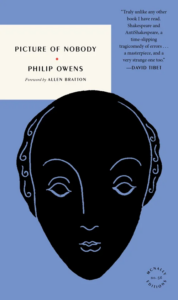
Excerpted from Allen Bratton’s foreword to Picture of Nobody by Philip Owens, published by McNally Editions. Copyright © 2026 by Allen Bratton. All rights reserved.

Allen Bratton
Allen Bratton is the author of the novel Henry Henry. His short stories have appeared in the Sewanee Review and Granta. He holds an MA in English Language and Literatures, having written a thesis on medieval English kingship. He lives in Dublin, Ireland.