In Praise of the Old WASP Elite (Because Dignified Hypocrisy is Better Than Garish Cruelty)
In Which Robert Leleux Reads an Alarming Number of Biographies About Rich, White Americans
Lately, I’ve found myself pining for the old WASP elite. Do admit, we used to have a better class of rich people.
I mean, you’d never have seen Paul Mellon prancing around a stage in Wisconsin with a block of cheese on his head, as Mr. Musk did. You wouldn’t have caught Nelson Rockefeller wearing a blue suit at a pope’s funeral, as President Trump did. And it’s difficult to imagine Barbara Bush hawking “exclusive,” patriotically themed, gold-plated pendants on her website, as Mrs. Trump does.
And look, I’m not saying these WASPs were without their foibles. They enjoyed a cocktail; they made ill-advised sartorial choices; they indulged in peccadilloes. After all, Nelson Rockefeller did die in the throes of, well, let’s call it Liebestod, with a woman who was not Happy. But you cannot tell me that their era of private indiscretion (I mean, let’s hear it for private indiscretions!) wasn’t superior to the Access Hollywood horror through which we’re living.
If the past ten years have taught me anything, it’s that dowdy is better than tacky, and Kennebunkport is better than Mar-a-Lago (at least in its post-Marjorie Merriweather Post iteration), and hypocrisy is better than an open contempt for decency. (In fact, I’ve come to think rather highly of hypocrisy; to believe it is, if not a virtue, then pretty damn close. There’s a lot to be said for making a false show of goodness. In fact, it’s the next best thing to actual goodness.)
Anyway, I was quite mean, at the time, about these often ridiculous people—the Mellons, the Rockefellers, the Bushes, etc.—but I was wrong. As it turns out, there was something worse than the high-hatting blue-blood establishment. As it turns out, given the fact the revolution didn’t arrive, we used to have it pretty good. As a tribe, such lordly folk possessed a cool eye and a steady hand; they deeply valued public service and civic-mindedness and preparations for posterity. Or at least they pretended to.
And look, I get it. I’m waxing nostalgic about people who embodied white privilege, with all its attendant frightfulness. I know that almost any argument I make about the superiority of our past oligarchs is rife with offensive, even racist holes. To reassure you that I am aware of the consistent indecency of our American leadership, may I make passing reference to the egregious “personal” behaviors of, for starters, Presidents Jefferson, Jackson, and Cleveland. And to the abject awfulness of such robber barons as Misters Carnegie, Gould, and Frick.
I myself am a gay WASP (Leleux is my married name), though not an haute one, from Houston, where the George H.W. Bushes are still held in a rather high esteem, and I’m certain this fact (heaven forfend) dips my recollections in rose water, as my grandmother might have said.
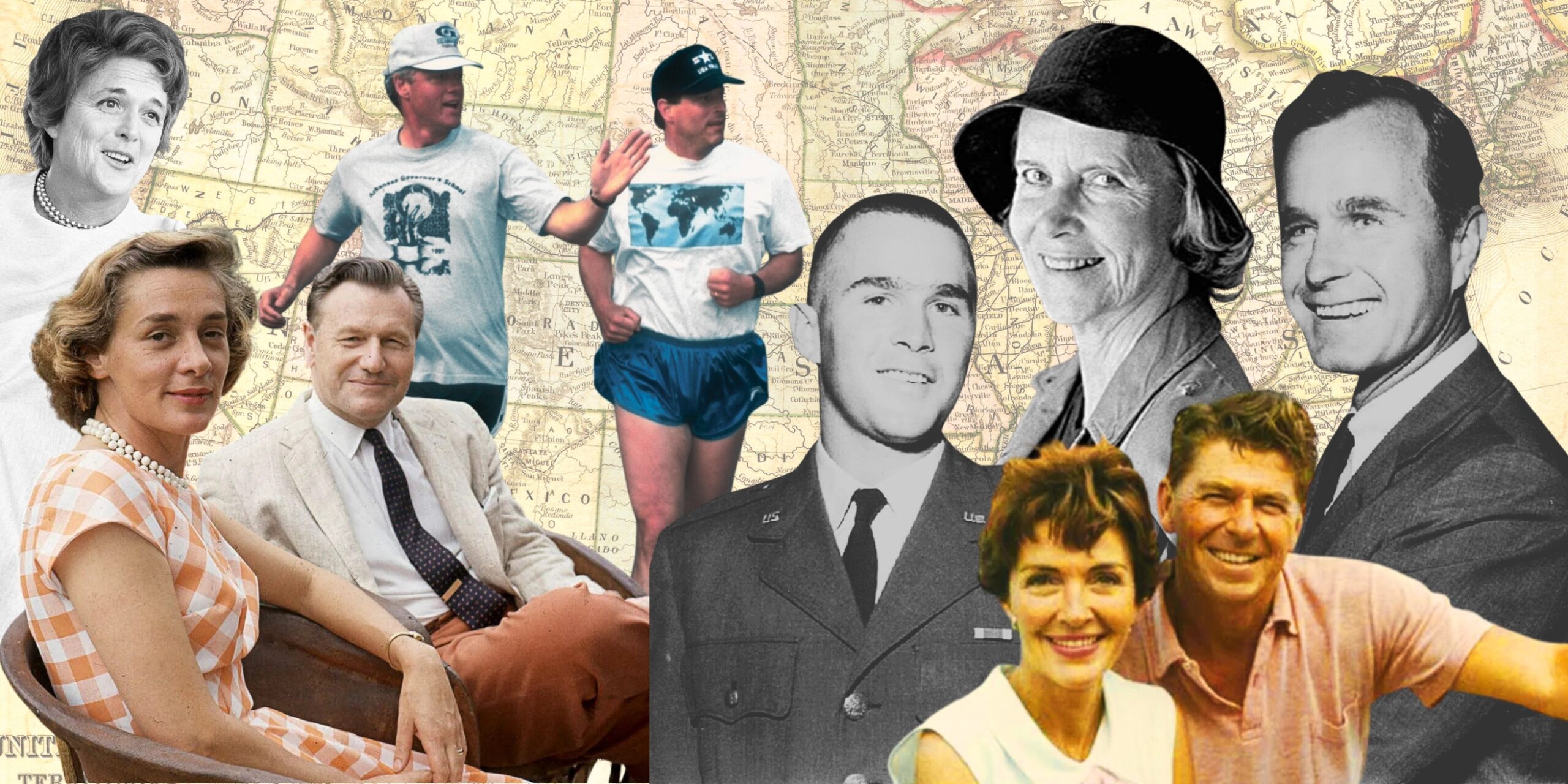
But I suppose all I’m saying is, if we had to have white privilege, it was better found in Greenwich. I guess all I mean is, things have never been tackier. (And as my grandmother also might have said, there’s nothing more tacky than tacky.) Things did used to be better, and not that long ago. To illustrate this, I direct you no further than to the WASPs of the middle-to-late twentieth century, the sons and grandsons of the great robber barons, those born in the 1920s-ish who came of age during the Second World War-ish.
One may draw an unbroken line from the disclosure of the manner of Mr. Clinton’s underwear to the upcoming UFC wrestling match to be held on the White House lawn.
Anyway, such thoughts have been prompted by a recent and somewhat compulsive reading jag of WASP biographies and memoirs, a jag pursued out of a desire to answer the question: When, exactly, did it all start to go to hell? Possible answers include Watergate, the Reagan Revolution, and the ascendence of cable news, reality television, and the internet. But I’ve come to believe—in part due to Jon Meacham’s Destiny and Power: The American Odyssey of George Herbert Walker Bush and Susan Page’s The Matriarch: Barbara Bush and the Making of an American Dynasty—that the irrevocable decline in public standards really began with the passing away of the WASPs, which I date to (and I truly hate to say this, because my politics are, you know, vaguely liberal and affirmative) the election of President William Jefferson Clinton, the last politician I actually liked, on November 3rd, 1992.
In other words, on the date of the final political defeat of the first President Bush, a man I don’t much enjoy, who did such revolting things as appoint Clarence Thomas to the Supreme Court and hire Roger Ailes (Roger Ailes!) as his image consultant. The campaign that resulted in this election, as Meacham and Page recount, was bruising, and there are many reasons for its outcome. But among them is the media genius of Mr. Clinton and his seductive informality; his willingness to reveal to the American public that he wore boxer shorts rather than briefs, to “field questions” on MTV, and to appear on nighttime talk shows and play “Heartbreak Hotel” on his saxophone.
Ladies and gentlemen, I present to you the thin end of the wedge. I argue, and I believe Meacham and Page would agree, that one may draw an unbroken line from the disclosure of the manner of Mr. Clinton’s underwear to the upcoming UFC wrestling match to be held on the White House lawn. A garish light was then shone on the (as it turns out, quite delicate) dignity and mystique of the twentieth century’s American presidency, and it’s been fuck all ever since.
But here’s how George H.W. Bush, reeling, more decorously phrased it while dictating to his audio diary in the days immediately following his defeat:
I know what the charge is, but I’ve never felt “out of touch,” but then, I’ve always assumed there was duty, honor, country. I’ve always assumed that was just part of what Americans are made of… honor, duty, country—it’s just passé. The values are different now, the lifestyles, the accepted vulgarity, the manners, the view of what’s patriotic and what’s not, the concept of service. All these are in the hands of a new generation now, and I feel I have the comfort of knowing that I have upheld these values and I live and stand by them. I have the discomfort of knowing that they might be a little out of date.
Reading this—and especially the near repetition of “honor, duty, country”—a tear was brought to my jaundiced eye. For, even if you believe Mr. Bush to be full of shit, even if you believe him a hokey hypocrite, these were his private, quaint and noble thoughts in the aftermath of losing the presidency, and can you imagine any subsequent candidate for that office having them?
These were, not coincidentally, the thoughts of a graduate of the Greenwich Country Day School, of Andover, and of Yale. (These institutions were—like virtually all the institutions I’ll name—almost entirely exclusive to men and WASPs at the time. I get it.) Students at these schools, at this time, were inculcated in the concepts of selflessness, patriotism, and modesty; at Greenwich Country Day, writes Meacham, “a section of the regular report card included the category ‘Claims More Than His Fair Share of Time and Attention in Class.’”
It was drummed into the fair heads of these lucky lads that, to paraphrase the Gospel of St. Luke, as Meacham does, “It is required that those who have been given a trust must prove faithful.” Prescott Bush, George H.W. Bush’s father, who would later be a vocal critic of McCarthyism as a US Senator from Connecticut, was “explicit about noblesse oblige,” believing that, Meacham quotes, “one’s obligation increased with the fact that you were perhaps better qualified or better able, for any reason, to do something about the public service.” (Susanna Salk, in her A Privileged Life: Celebrating WASP Style, quotes Brooke Astor: “Power is the ability to do good for others.”)
These ideas are echoed in such works as Richard Norton Smith’s On His Own Terms: A Life of Nelson Rockefeller and Rudy Abramson’s Spanning the Century: The Life of W. Averell Harriman. (In fact, they’re echoed in all books featuring Governor Harriman, the best of course being the various biographies of the deliciously scene-stealing Pamela, the third Mrs. Harriman, which is of course, the problem with writing about poor “Ave.”)
Such ideas are earnestly echoed in E. Digby Baltzell’s The Protestant Establishment: Aristocracy & Caste in America, in which the term WASP is coined. They are charmingly echoed in Paul Mellon’s Reflections in a Silver Spoon and Cordelia Drexel Biddle’s My Philadelphia Father. But for my purposes, they’re most usefully echoed by the crusading Episcopal Bishop Paul Moore, in his Presences: A Bishop’s Life in the City, who writes that “noblesse required a high morality.”
I would nominate Eleanor Roosevelt as her century’s Most Admirable Figure, but I’d have much rather gone to lunch with Nancy Reagan.
In the good bishop’s youth, Nathan Hale (he of “I only regret that I have but one life to lose for my country”) seemed the archetypal Yale Man. “It is hard to believe now,” Moore continues, “but in those days most freshmen took seriously the last line of the great Yale football song: ‘For God, for country, and for Yale.’” (Perhaps this is an apt moment to say that my beloved friend and fellow Texan Sissy Farenthold, a Vassar graduate born in 1926, referred to sexual harassment as “Yale stuff” until her death in 2021.) Both George H.W. Bush and Paul Moore would distinguish themselves in World War II’s Pacific campaign. At nineteen, enlistee Bush did not enjoy the distinction of serving as the youngest aviator in the American Navy, but he was its second youngest, and by twelve days. And honestly, what more do you want from rich people, people?
But I suppose the central question regarding all this adorable noblesse is: Was the oblige to serve, or to rule? Since for every George H.W. Bush or Paul Moore, I’m sure there were a hundred assholes who became stockbrokers. And it goes without saying that the traditional values of self-sacrifice and stewardship were not necessarily passed on to the following, Baby Boomer generation. That marvelous muckraker Molly Ivins, and her co-author Lou Dubose, provide us with the following, exquisite passage in Shrub: The Short but Happy Political Life of George W. Bush:
In May 1994, [W.] told the Texas Monthly, “What angered me was the way… people at Yale… thought they had all the answers… These are the ones who felt so guilty that they had been given so many blessings in life—like an Andover or a Yale education—that they felt they should overcompensate by trying to give everyone else in life the same thing.”
One recalls the words of our late, lamented Texas Governor Ann Richards regarding W.: “He was born on third base but thinks he hit a triple.” And whatever else might be true of George H.W. Bush, at least he seemed to appreciate the proximity of home plate to his crib.
Lest you think I’m falling for the elder Bushes, do allow me a digression, and a few cruel words. Or better yet, allow Nancy Reagan them. Ah, Nancy Reagan. Is it because I’m homosexual that I’m soft on her, or because I grew up in a community of Texas women who would have unhesitatingly spent $209, 508 on gorgeous new china during an economic recession, as Karen Tumulty’s The Triumph of Nancy Reagan reminds us that the First Lady did? (Alas, as the ever-loyal Sheila Tate points out in her Lady in Red: An Intimate Portrait of Nancy Reagan, the “china story” leaked to the Associated Press on the same day that ketchup was certified as a vegetable in the school lunch program by the Reagan Department of Agriculture. Unlucky Nancy.)
With nary a second thought, I would nominate Eleanor Roosevelt as her century’s Most Admirable Figure, but I’d have much rather gone to lunch with Nancy, as Tumulty tells us Warren Beatty regularly did during Nancy’s retirement, at the restaurant of the Hotel Bel-Air, where there’s a Nancy Reagan Chopped Salad (a low-cal variation of the Cobb). (And by the by, if anybody out there’s feeling a little blue, I do suggest a half hour spent with Joan Didion’s masterpiece of poison penmanship “Pretty Nancy,” newly published in the collection Let Me Tell You What I Mean.)
When it came to the Bushes, Nancy Reagan was capable of a class-based antagonism worthy of Emma Goldman, for the Reagans were tinseled parvenus compared to those doughty patricians, and our Nancy never stopped punishing them for their presumption that they were born to rule, rather than her Ronnie, who came up the “hard” way (as is perhaps best detailed in Max Boot’s excellent Reagan: His Life and Legend). Tumulty does an admirable job relating all this, but I believe Page does it even better. (Also, obviously, there’s Kitty Kelley, in her The Family: The Real Story of the Bush Dynasty, which before dismissing it, you should know that Nancy Reagan delighted in its revelations, just as Barbara Bush “relished” Kelley’s earlier Nancy Reagan: The Unauthorized Biography, because as Liz Smith tried to so fabulously inform us, “Gossip is [often] history running ahead of itself wearing a red satin dress.”)
Anyway, Page rigorously describes the eight years of hell through which Nancy put the Bushes (whom she also called “the Shrubs,” anticipating Ivins’s appellation by at least twenty years). Nancy’s malice ran the gamut from the petty to the pivotal. For kicks, let’s start with the petty: Finding them frumpy and haughty, washouts when it came to the badinage she expected at her sparkling supper tables, Nancy refused the Bushes invitations to any social gathering to which protocol didn’t absolutely bind her hands.
For instance, she “picked up a pen and with a dramatic flourish crossed out their names” from such sought-after invitation lists as that for the “glittering” 1985 dinner honoring the then Prince Charles and Princess Diana, at which, “resplendent in a midnight blue velvet dress and pearl choker,” the Princess enjoyed her famous spin on the dance floor with John Travolta. “When [White House staffer] Michael Deaver saw [that night’s] guest list with the Bushes crossed out,” writes Page, “he called the First Lady. ‘You can’t not invite the vice-president and Mrs. Bush to the dinner,’ he told her. There was a pause. ‘Mike,’ she replied, ‘watch me.’” That’s the petty, now the pivotal.
Inevitably, our era’s political extremism and unpleasantness have grown aesthetically evident, perhaps most notably in the design of interiors and landscapes.
In 1986, Nancy arranged for conservative columnist George Will, with whom she often lunched at the Jockey Club, to write a rather vicious piece about her husband’s vice-president, which included the following line: “The unpleasant sound Bush is emitting as he traipses from one conservative gathering to another is a thin, tinny ‘arf’—the sound of a lapdog.” And most significantly, Nancy, it seems, prevented Ronnie from providing Bush with a full-throated endorsement for the presidency during the 1988 campaign. According to Meacham and Page, Reagan finally, and only after all other major candidates had dropped out of the race, intended to give a rousing speech supporting Bush at a black-tie gala on May 11th.
That afternoon, Bush saw the final draft of his boss’s words and was deeply flattered by them. But that night, Reagan offered Bush only a brief and tepid endorsement, during which he unaccountably mispronounced his vice-president’s name as “Bosh.” What, in heaven’s name, had occurred in the intervening hours? An irate Barbara Bush confided to her diary, “We later learned that Nancy took [her husband’s keen words] out.” When asked to account for the First Lady’s remarkable dislike of the Second Family, George Will answered, “I think it was a class thing.” Reagan never did voice wholehearted approval of Bush’s candidacy.
Speaking personally, I don’t blame Nancy a bit. But I do miss the “kinder, gentler” nation George H.W. Bush called for when accepting the Republican nomination for the presidency on August 18th, 1988. (“Kinder and gentler than whom?” Nancy fumed.) Perhaps wrongly, I attribute this terrific mildness to his WASP identity. But throughout my readings, moderation was a theme.
In On His Own Terms, and its account of the slow-going struggles of the Rockefeller Republicans, there’s an implication that political extremism is ungentlemanly. Salk quotes a Wilmarth S. Lewis, of some unnamed Yale Selections Committee: “The Yale president must be a Yale Man. Not too far to the right, too far to the left, or a middle-of-the-roader.” Meacham quotes a 1988 entry from George H.W. Bush’s diary: “There’s something terrible about those who carry [Republican politics] to extremes. They’re scary. They’re there for spooky, extraordinary right-winged reasons.” It is to be noted that the elder Bushes supported Hillary Clinton in the 2016 presidential election. And Page writes that, when asked in a February 2018 interview whether she still considered herself a Republican at all, Barbara Bush answered, “I’d probably say no today.”
Inevitably, our era’s political extremism and unpleasantness have grown aesthetically evident, perhaps most notably in the design of interiors and landscapes. This is hardly surprising. After all, style is substance. For every tacky house, a tacky person; for every tacky person, a tacky house. Or in some cases, an official executive residence.
Too much ink has been spilled on the pathological gilding of the Trump White House, but how to explain the attraction of today’s martinets to really dreadfully reproduced Louis Quatorze furniture? (Setting the President aside, it seems that every person I saw appear on television to deny the state execution of journalist Jamal Khashoggi did so perched upon a misproportioned fauteuil. I mean, where are the chic authoritarians of yesteryear?) And am I wrong to believe the 2020 desecration of the White House’s Bunny Mellon rose garden represented a rather devastating epochal shift? The literal bulldozing of a grace that was also a particular form of high WASP style?
“Nothing should be noticed,” was Mrs. Mellon’s dictum, both according to Meryl Gordon’s Bunny Mellon: The Life of an American Style Legend and Mac Griswold’s I’ll Build a Stairway to Paradise: A Life of Bunny Mellon. Everything should be subordinate to a general loveliness. In order to give the impression of timelessness, of a certain cultivated effortlessness and ease, writes Gordon, there was a strict avoidance of “the bright, shiny, and new.” She quotes that fabulous fabulist Truman Capote in a 1978 issue of Time: “Bunny always carr[ies] a little scissors with her… when things are looking a little too neat, she takes a snip out of a chair or something so that it will have that lived in look.’” For even in extravagance, subtlety was key. And “Bunny put the b in subtle,” Gordon quotes Maury Hopson, Mellon’s occasional hairdresser, as saying. In other words, as my grandmother (yes, her again) might have said, the lady really knew how to drag her mink.
But Mellon’s taste did not merely run to minks. She once asked Deeda Blair to tote an especially comely rock to Paris as a present for Givenchy. “Flipping the Oscar Wilde quip,” Gordon writes, “[Bunny] knew the value of everything and the price of nothing.” Of course, Mellon’s elegant iconoclasm could occasionally go rather far: She commissioned Balenciaga gardening clothes; she “removed” a hill on her Virginia estate because she “hated the way it reflected light”; for her daughter’s 1961 debut party, she slip-covered her house and, with the help of two hundred stout-hearted men, conjured an “1830s French village,” all in order to approximate the enchantment of Alain-Fournier’s 1913 novel Le Grand Meaulnes. Am I being unjust, or is there a poetry to these beau monde excesses that wearing a push-up bra at a presidential inauguration does not possess? The mind, as they say, reels.
So, what am I really saying? Simply that I have seen the vulgar future and have decided not to attend? That I long for the better awful of days past? Is my slip showing? Am I now old enough to have joined the cranky ranks of such elitist, ever-bemoaning gays as Mr. Blackwell and (God willing) Gore Vidal? Am I only, as some of my beloveds have suggested, rather pathetically eulogizing the ruthless, though correct overlords of my youth? Maybe. I hope not.
But if I am, might you at least permit me to phrase it a bit more kindly? Or better yet, might I allow speechwriter and columnist Peggy Noonan to do it, by quoting her appreciation of the redoubtable US Representative Millicent Fenwick in What I Saw at the Revolution: A Political Life in the Reagan Era?
She is beautiful. The planes of her face make you think of what someone said of Hepburn—those cheekbones are the largest natural calcium deposits since the white cliffs of Dover. A strong, tall woman… To meet her is to feel nostalgia for the disappearing Protestant ascendancy, for the members of a society that had rules every bit as demanding and rigorous as the rules of the Old West, the first of which—answer the cards, sit with the elderly, draw out the bachelor, invite the homely cousin—was an awesome self-discipline.
Objectionable? Perhaps. But never tacky. I do regret the passing of that awesome self-discipline. Also, I miss better rich people.

Robert Leleux
Robert Leleux is the former creative director and editor of Domino Magazine and managing editor of Lonny. His essays and articles have appeared in such publications as the New York Times and the Huffington Post.