The day I heard, it rained hard. Long streaks outside my window, sleet as I walked to the train. Buses sent up sprays of dirty water, and the gutters ran fast and bright. Abandoned Christmas trees, lumped on the curb, grew sodden and dark. Deep in my boot, my sock slipped off my heel, but it didn’t bother me: I was thinking about the news, thinking about whether it could be true.
The cold January rain followed me inside that day, making the lobby of West Twelfth slick, its carpets dank, the air clammy and close. So gray and cold and dark, the day I heard, that I was relieved to tuck myself away in a window-less lecture hall. Along the floor, everyone’s umbrellas wept watery dark flowers.
That day, Chalmers’s dress had two round water stains over her breasts, and a zip of darkened fabric down her front. As she lectured on Jane Eyre, she said the word wife a lot. She said madwoman, she said money, she said slavery and beast, but all I heard was Johnny, Johnny, Johnny. Outside, the rain picked up, pounding like someone wanting to be let in, and I shivered, glad for once to be with my fellow students, safe and dry and warm together. It was like a light inside me, this coziness, a light that pushed Johnny away.
Mira had been the one to tell me. She still followed the dance world; she would know. Hey lady, she had written. Seems Johnny’s back. Sounds like he’s been back? Anyway. Hugs.
Hugs. He’s been back. Hugs. Johnny’s back. Lady. Lady . . . All day I read it, all that rainy day. I read it in the halls and down the stairwell; I was reading it when I went around a corner and collided with two fashion design students, who giggled into their hands. I read it so long and hard it became a song my body was singing.
When I thought of him, I pictured him on the day you married him. A tall slash of a man, given to murmuring, with something frantic and fumbling about his hands. It hadn’t rained that day; I hadn’t even had the comfort of a bad omen on the day we gave my only sister away. Blazingly bright, the day of your wedding, and hot. Outside the church that morning the men’s suits were a pale, uncertain black.
Funny things come back. I remember the rotten smell of ginkgo, and a fuzzy caterpillar squished beneath a child’s shoe. I remember looking at Johnny, his dark swoop of hair and dirty fingernails, and thinking the thing I always thought: If he was so rich, why did he dress like such a dirt-bag? Even on that day his suit didn’t fit, and his shoes were the same work boots he always wore.
After The Brontë Sisters, I walked slowly down the stairs, the other students flowing around me.
Oh my God.
Mira fell into step beside me, shaking her head. When I didn’t say anything, she added, You saw my text?
How did you hear?
Caroline saw him during intermission at the Hodge.
Another spin of the stairwell. Flyers for play auditions, for newspapers, for the Asian American film festival fluttered as we turned.
I hate him, I said.
We reached the bottom of the stairwell. A toothpick pretending to be a grad student slipped between us.
I’ve got to talk to him.
Mira blinked. Why?
He did something to her. I’ve always known he did something to her.
A line, crooked by half a millimeter, notched her brow. What does it matter now?
*
Before you disappeared, you left many times. You came into this life practicing your exit. I came into this life losing you. Chasing you. Seven years between us: a biblical gap. I grew into your shadow; I grew to fit the shapes you left behind. I wore your clothes: a blue puffy jacket, a red velvet dress, a gray sweatshirt. I played with the plastic castle you had loved, with tower, drawbridge, and dungeon, a queen you could send tumbling down the chute. The queen is in the dungeon, you liked to sing, the king won’t let her out.
A common game was dogs and owners: I was the dog, you were the owner, and my job was to follow you around on all fours, bleating out little ruff! ruffs! while you chastised me and fed me treats. In your old recital costume, the tutu around my knees, I tiptoed around the living room while the Moderato from Swan Lake’s second act blared. You taught me to play it on the piano: the first sixteen notes. I can still play it now.
You liked secrets. We had a secret language, and you convinced me that the trees conversed in code, that the squirrels were gossiping, that a goblin lived inside the radiator. Our toys spoke in tongues; you told me Blinky was giving me the silent treatment, and I believed you, I begged you to tell me what I had done to upset my doll.
Adults had secrets too. Between our parents hung electric wires. Furious whispers. A spatula thunked too hard, a clattering plate. Dynamite buried deep in the ground of family life. From above we listened, crowded together under my twin sheet, the hollow of your body making a cave in which I cowered.
What else can I say? You were bigmouthed and flat chested and when you looked at me I didn’t want to be any-where else. You bought me my first tampons and taught me to smoke a cigarette and helped me land a double pirouette. You were always leaving us, first slowly, and then all at once.
***
Now all we have of you is jam. Six blue jars lined up in our mother’s pantry, with six blue silhouettes of sweet young nuns picking berries on their creamy white labels. Confiture de baies. Abbaye de la Houssaye en Brie. Each lid more dusty than the one before.
Every December a jar arrives, along with a card: Christ child on the front, your spidery script inside. Sending joy this holiday season. Love, Sister Anne. Your new name. On the envelope, our address in the same spidery script, a distant cousin to the cursive I tried so hard to copy as a child. PAR AVION stamped in red.
We don’t talk about it anymore. Our mother treats it like another holiday card, leaving it scattered with the others on the kitchen counter. When we’re together, we ignore it. But privately I can’t keep my hands off it. Furtively I read and reread, looking for some message our parents missed. Nothing. Sending joy! After New Year’s our mother dumps it, with all the glossy families and chirpy letters, in the trash.
I wish she would save the card. Or I wish we would eat the jam. But it is our mother’s position that you are an adult and can do what you like with your life. Over and over she repeats this: Charley’s an adult, she can do what she likes. Something savage in how she says it, something false. She can do what she likes!
Our father and I do not agree. We don’t believe you were meant for the nunnery. Sometimes we blame the injury, and sometimes we blame dance, but mostly we blame Johnny. He did something to her, Dad will say, late at night, smoking his cigar in the dark. He did something.
What? What do you think he did?
Something. Something.
***
Your marriage had not been good. That was not controversial; even Mom conceded that. The marriage changed you, changed you fast. After that summer on Cup Island, you were different. More cautious. Subdued. You played with your nail beds. I had never seen you fid-get before; as a dancer you had exquisite control. But now you picked at your nails, and when you spoke you trailed off, unsure of what you were saying. Whenever you called home, I’d hear Mom humming soft words of comfort. Later, at dinner, she’d exchange grim glances with Dad. But when I’d ask, How’s Charley, what’s going on, is she okay? I’d be told you were fine, that the early years of marriage could be tough, that they didn’t want to tell me any more, they had to protect your confidences. I was too young to understand.
That fall, writing in the Times, a leading dance critic commented, Charlotte Garbinski, usually so voluptuously wild in Luciano Fiore’s boundary-pushing choreography, evinced a rare tentativeness. Her arms skimmed the periphery of her torso, as if protecting her chest, and her legs in the grand battements lacked conviction.
You had never received a negative review before. Our parents and I did not discuss it. Whatever, you texted me, with a laugh-crying emoji. Happens to everyone eventually. But two weeks later, you woke unable to move your neck.
A herniated disk, concluded the team of doctors, cautioning that even after you healed, the snaps and jerks of Luciano’s choreography would leave you vulnerable to paralysis. You took injury leave: four weeks, then six. At Christmas, you told us you were getting surgery. At Easter, you said you’d decided against it: Rest would be better. Johnny thought you’d better go to Europe. Some distraction, he said, while you healed.
For two years you traveled, and every time you called home, usually from a new city, usually to tell us you wouldn’t be making it back for the next holiday either, our dad would hang up the phone afterward and say, Still running away. Not in his scornful voice, but sad.
It was good of Johnny to come tell us in person. I can still remember how he explained it. Carefully he told us first about your new love of cathedrals, how he had naively encouraged it, thinking it good for you to spend some time in self-reflection. That you called it prayer startled him, as did the Jesus talk, but once you explained that you never had religion growing up, that it answered some deep need in you, he understood. He supported it. But then it had moved toward obsession. Here we all tensed; everything moved toward obsession with you. In your boutique hotels you were rising at three in the morning with your rosary beads. Deep in the heart of Paris, you only wanted bread and water, a few steamed vegetables. You were reading Simone Weil. You were losing weight. After throwing out the clothes you had brought, you started wearing nothing but long dresses of black or brown. When he brought you to the countryside, hoping to distract you, you found a cloistered abbey and arranged a two-week stay. After emerging, you said you had heard the voice of God, telling you to consecrate your life to him. Soon your marriage had been annulled. Soon you had a new name.
It stunned me. It stunned me more, the kind of nun you became. Most nuns go out in the world, they perform acts of service, they teach, they minister to the poor and sick. They see their families. Not cloistered nuns. Cloistered nuns give themselves to a life of prayer, and I get it, Charley, I do: For a long time it was the closest a woman could get to being a monk, and who doesn’t love that romance of solitude and simplicity?
But it’s still the Catholic Church. That’s what I can’t accept. There’s still all this nonsense about the temptation of the female body, and the need for nuns to shield themselves from prying eyes. Maybe you were tired of displaying your body onstage, maybe you were tired of dancing while others looked, but don’t you see it’s the same, only in reverse?
In that first year, when you were still permitted visitors and we flew to France to see you, I was frightened, Charley. The Lord in your convent frightened me, Jesus with his bloody palms and gaping mouth, eyes rolled back in terror. Ribs as bony as a dancer’s. You stayed so calm in the storm of our father’s threats and our mother’s tears. In your eyes,
visible beneath the white elastic of your novice wimple, I recognized the look of absolute submission. That airy fire, the steady blue flame. You had looked the same when you studied ballet.
For six years you have been gone; for five years you have been forbidden visitors. Sometime this spring, or summer or fall, you will decide whether to take the veil, and if you do, you will be allowed two afternoons of family visits a year. But when we fly to France and travel to that little stone room, we will not see your face anymore. Your hands will come floating up behind an iron grille, your voice will float out from the darkness of the enclosure.
Sometimes I lie in bed and try to think how many years our parents have left to live. I calculate how many hours, in total, you would have left with them, if you take this vow. I wonder, too, if I will keep visiting after they’re gone, if my life will always be roped to the room and the grille.
I see it then: the cupboard of jam, slowly filling, one for each year. The sprightly nun with her berries, a flat cartoon, forever young, while behind stone walls you grow old. Will she do it? I ask our parents. Do you think she’ll actually do it?
Time will tell, says the mother. Let her be, says the father. But what do you think happened? asks the daughter. Did he do something to her? Tell me what he did. If I knew, I could undo it. I could bring her back.
__________________________________
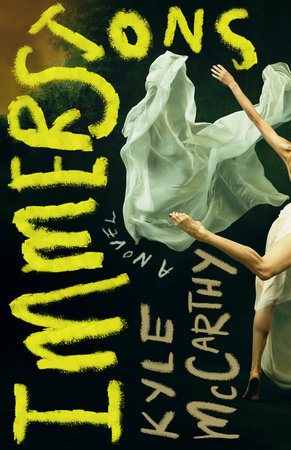
From Immersions by Kyle McCarthy. Published with permission from Tin House, an imprint of Zando, LLC. Copyright © 2026 by Kyle McCarthy.