One night in November 2021, I lost my sense of taste and smell. There was a woman sleeping in my bed. I licked her shoulder, buried my nose in her neck. I moved my face down between her legs. I couldn’t taste anything. The woman began to stir. She pulled me toward her, murmuring my name: “Mia.” She wanted to make love, but I was terrified. I turned my back on her. I closed my eyes and pulled the sheet over my face. The sheet didn’t smell of anything either.
Next came the fever. I lay in my bed shaking, as if I had malaria. Nothing seemed able to warm me up. I covered myself with duvets and blankets, but my teeth wouldn’t stop chattering. I lay there, bedridden, for days, alone in my apartment. Nobody came to see me, and I didn’t answer the phone. The few people who called me must have assumed I was busy writing. I kept coughing, and one night I thought I was going to die. I felt like I couldn’t suck enough air into my lungs. Around three in the morning I thought about calling an ambulance, but shame held me back. The shame of opening the door to them in my filthy pajamas, of letting them into an apartment that had not been cleaned or aired for days. I didn’t die. The fever abated. I ended up calling back the people who had left me messages. My editor. My mother. “What’s wrong with you?” they asked. I told them it was nothing. “Just tired, that’s all.”
In the days that followed, I tried to start work again. I would wake at dawn and sit at my desk. And wait. I could stay there for hours without doing anything, staring at the open Word document. I found it impossible to concentrate on my novel. Sometimes I would take a deep breath, slap myself on the cheek, and try to focus on the chapter I’d been working on. But soon my mind would start to wander, my thoughts growing blurry. Images would appear one after another, vague ideas bubbling up before vanishing with a pop. I couldn’t gather my thoughts, or rather I didn’t have any thoughts to gather. I would read the same page five or six times without being able to retain a word of it. As if it were written in a foreign language: the alphabet was familiar, but the vocabulary meant nothing to me. I felt lost, overwhelmed.
I’m the kind of person who always makes lists, but during this period it became an obsession. I would write to-do lists on a notepad in an attempt to clear my head, to simplify my life, but it just made things worse. I would stare at the list and start crying. I didn’t know where to start: what book to read, what chapter to write. I was paralyzed with indecision—should I do my laundry or clean the apartment?—and ended up just lying in my dirty sheets for days on end. I stopped going to the supermarket because I would freeze in front of every shelf, unable to choose. I felt like I was drowning. Sometimes I would realize that a whole day had passed without me managing to decide to get undressed and take a shower.
Everything seemed insurmountable. I would watch TV for hours, the shutters closed, my phone turned off. I couldn’t follow the plots of the shows I watched, but it passed the time and distracted me from my anxiety. I would roll joints in the middle of the afternoon and eat standing up in the kitchen: bland microwavable that I covered with mustard or Tabasco. There was a metallic taste in my mouth that reminded me of licking out certain women, although I couldn’t recall their names or their faces. I slept, but not the way I used to sleep. It was like I’d been smoking opium: I was simultaneously comatose and agitated, and every time I woke up I felt even more exhausted.
I avoided going out. But I couldn’t stop people worrying about me. I would leave their messages unanswered, but they didn’t give up. Finally, at Christmas, I agreed to eat dinner at my sister Inès’s apartment. It was a nightmare. I tried so hard to be cheerful. I drank champagne and—for a moment—I even felt happy to be there, to watch the children tear open their presents with their little hands and squeal with joy at the sight of a doll or a plastic truck. And then I felt myself disappearing. As if I’d been dragged to the depths of a pond by a crocodile who was going to let me rot in the mire before devouring me. I couldn’t follow the conversations around me. It’s like there was a delay between words emerging from people’s mouths and reaching ears, and all I could manage by way of an answer goofy smile. It must be like this when you’re very old. others sit you in an armchair in the corner of the room, and the party goes on around you: people laugh, they argue, and from time to time someone wipes the drool from your lips. “She’s tired,” my mother said, and I nodded. tired, that’s all.
After that, stayed at home. The outside world ceased to exist. This was not an unfamiliar feeling to me. I often isolate myself like that when I’m writing a novel—in my apartment or a house in the country—and I lose all notion of time. But I wasn’t writing. I couldn’t find the words. I just stared at the blank page as if petrified. I had suffered from writer’s block before; my inspiration had dried up and I’d been through fits of rage and despair. But this was different. The words churned around my head: I could think them, choose between them, but I couldn’t write them down or speak them aloud. One night, I woke with a start. I’d had an idea for my novel. I grabbed a blank page and a pen from my bedside table and scribbled down ideas for a scene. Mehdi in prison and a bar of chocolate. The next morning, when I woke, I looked for my notes. The sheet was lying at the foot of my bed. I tried to read what I’d written, but it made no sense. They weren’t even letters, just a mess of random lines, some vertical, some horizontal. I burst out laughing. I was going mad.
In March 2022, I decided to call a doctor. The woman who answered was a secretary. She was eating as she spoke. She offered me a choice of different dates and times, and I panicked. I couldn’t understand what she was saying. I asked her to repeat it. My forehead was damp with sweat. I felt as if the woman could see me and was going to make fun of me. I hung up. I tried again a couple of times, then finally managed to book an appointment online GP in my neighborhood. The doctor’s office was first floor of an apartment building on Rue d’Amsterdam. noted down the entry code for the door on the palm my hand, and I stared at it throughout the journey there. It was all that mattered to me. I climbed the stairs. The door was half open. I pushed it and went inside. people were seated in the waiting room, all wearing masks. I sat by the wall, to the right of the bathroom. Across from me, a woman with very beautiful eyes was looking at a poster about the dangers of smoking. I wanted to pull her mask down, to see her face. Through years of observation, I have noticed that people are always uglier than you imagine them to be. You can’t trust the beauty of a pair of eyes.
A woman about five feet tall came out of the office, holding a prescription to her chest. I heard my name. “Mia Daoud?” A very tall man came along the corridor. He signaled for me to follow him, and I stared anxiously at his massive back, his grimy white coat. My mother would never have worn a coat like that, with a torn pocket. He sat behind his desk and told me to take a seat. He never glanced at me for more than half a second at a time, and I started to imagine that there was something about me that disturbed him. He wrote down my date of birth and my address, then asked what I did for a living.
“I’m a writer.”
He turned from his screen to look at me.
“Ah, yes, I thought I recognized your name. Didn’t you win a prize?”
I nodded. I was sweating inside my winter jacket, but didn’t want to take it off.
“So what brings you here?”
I tried to explain. I kept repeating the word “tired.” I told him about crying in the supermarket and about the day when I forgot the code to my own apartment building. He didn’t seem worried. He was probably the kind of person who thinks all artists are a bit crazy.
“You’re depressed.”
I couldn’t argue with that. Of course I was depressed, but not to the losing my memory or my sense of direction. He advised me to book an appointment with a psychologist he knew.
“He’s very quick and effective. A miracle worker.”
The psychologist worked remotely. One Monday morning, I saw his face appear on the screen of my phone. Several times, during the hours before this appointment, I had thought about canceling it. But now I was here, lying on my bed, staring at the face of a stranger on a screen. I had spent a long time debating what to tell him, but in the end I didn’t say much at all. I mentioned my novel, the difficulties I was experiencing with writing, my faltering memory, my father’s death, and he started to nod. “Let me stop you there for a second.” He tried to explain something to me about dissociation and repression. He compared me to those fruits you sometimes find on cakes, those little round fruits whose name I can’t remember. “It’s very important that you continue to see me.” He seemed so sure of himself. I booked an appointment for the following week. I had to pay in advance: a hundred and forty euros. I made the bank transfer, but I didn’t keep the appointment. I blocked his number.
Back then, I was watching a TV series about a man with a brain tumor. I became convinced that this was what was wrong with me. The GP had made a very serious mistake. The psychologist had completely missed the point. I talked to my best friend, Hakim, about this phone. I never hide anything from him. I knew he make fun of me. He gave me the number of a man had taught him neurology when he was a student in He’s a brilliant doctor and a very good teacher too.”
I liked him right away. The moment I first saw him in the hospital corridor, I knew I could trust him. He was looking around like a child at a fairground. I have often noticed this kind of behavior among people with extremely sharp minds. They play at being lost, as if they are right there in front of you and at the same time miles away. I sat down in his light-filled office and he stared at me. His eyes were beautiful and distant, as blue as the sky in my homeland. He struck me as honest and humane. He listened attentively while I spoke, glancing down to take notes then looking up at me again with those blue eyes of his. I really liked the way he showed interest in me: sometimes he would repeat the ends of my sentences—“being there without being there”—and sometimes he would start them. He asked me questions.
“Do you take drugs?”
I told him I smoked joints occasionally. He didn’t look up from his notepad.
“That’s all?”
I didn’t want to tell him the truth. I had only known him for a few minutes, yet I hated the idea of disappointing him.
“I took cocaine for a few years.”
“It destroys the neurons. Did you know that?”
Then he went through a questionnaire. He wanted to know if I remembered what I’d eaten the previous night, what I’d watched on television. He asked me if I was having language problems.
“Do you sometimes get mixed up between words? Are there times when you can’t think of a particular word? And, if so, do you tend to forget common or proper nouns?”
He listened to my heart.
While he was examining felt compelled to make conversation. I was afraid would think I was a lunatic or a hypochondriac. I really wanted him to take me seriously. I told him that my mother was a doctor, that it was a profession I admired.
“There’s worse for a writer, you know . . . If I lose my memory, if I lose my language, I’m finished.”
He smiled and sat down behind his desk.
“A few days ago I saw a patient who was a glassblower. He had the same symptoms as you. Difficulties with language and attention. For him, though, a second’s inattention would leave him with third-degree burns on his hand or his whole workshop on fire.” He fixed me with his beautiful blue eyes.
“Have you ever heard of brain fog?”
I shook my head. And yet I felt immediately that those two words described perfectly what I had been experiencing. Often, during the previous months, I had felt as if I was walking through the same thick mist that we used to get in Rabat, those mornings when my mother would turn on the car’s headlights and we would see, in the middle of a roundabout, the ghostly figures of white wax policemen.
“I saw my first cases in July 2020,” the doctor went on. “Patients who were in despair because they no longer recognized themselves. I treated engineers who suddenly couldn’t tie their laces anymore. Politicians and doctors who fell to pieces whenever they had to make a decision. Imagine that each personality is a sort of harmonious ball,” he said, tracing a circle in the air with his hands. “Suddenly the ball shatters into a thousand pieces and the patient can’t put them back together again. It’s as if they’re running after themselves, never able to catch up, overwhelmed by everything that’s going on around them.”
With a piece of paper and a pen, neurologist explained how the Covid virus attacks the human brain. Whenever he used a difficult word, he apologize and attempt to translate it into layman’s language. Some of his images were so clear and poetic that made me envious. I tried to draw him into what for was more familiar terrain: emotions, literature. This studied the brain—memory, language—the very stuff of my own work. I wanted to talk with him about Proust and Perec, and when I did, he smiled.
“Ah, yes, but that’s something else. You know the brain is a highly complex machine.”
He asked me about my medical history.
“On your mother’s side of the family?”
“Blindness, madness, dementia.”
“And on your father’s?”
“Cancer.”
That was all I knew. My family tree was obscure, its branches hidden. The doctor prescribed a PET scan of my brain and advised me to be patient.
“But what if I’ve lost all my memories?”
“No, no, your memories are there, buried somewhere. From observation, I would say that the more you use your brain, the more you deluge it with information, the more difficult it becomes to access your memories. It’s emotion that will help you rediscover them. Fear, for example, is a very powerful marker.”
As I stood in the corridor outside his office, he put his hand on my shoulder and, in a voice that suddenly sounded shy, hesitant, he added:
“You mentioned Proust earlier. If I could give you one piece of advice, mademoiselle, it would be this: find your madeleine.”
__________________________________
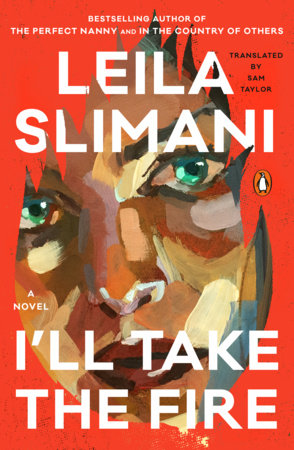
From I’ll Take the Fire by Leila Slimani, published by Penguin Books, an imprint of Penguin Publishing Group, a division of Penguin Random House, LLC. Copyright © 2026 by Leila Slimani.