I Thought I Had Nothing to Write About. Then I Got a Dog.
Camille Perri in Praise of Furry Friends and Furry Muses
A contract accepted under duress is typically considered voidable. My wife Helen is a lawyer, so she would understand this better than anyone, and yet when she convinced me to say yes to a puppy after years of hard no’s, I was particularly vulnerable to coercion.
The outside world was almost a year into the COVID pandemic, and my inner world had gone dark. As if the isolation from friends and family weren’t enough, I had also found myself unable to create, like I had run out of things to write about.
The age-old question asked of writers everywhere is: where do you get your ideas?
Personally, I’d always found it difficult to answer. An idea, after all, is nothing more than a formulated thought—but what is a thought if not something formed in the mind, such as…an idea? Logic is no help here. The correct response cannot be grasped, only meditated upon in the way of a koan used to train Zen Buddhist monks and force them into enlightenment.
At the exact moment in my life when I was most in need of inspiration, a muse, I instead acquired a self-important fur-monster determined to use my body as an ottoman and prevent me from writing.
I don’t know? I might say when posed with the question, sounding wholly unenlightened. They just sorta come to me.
Ideas for stories were everywhere and anywhere. There seemed to be an endless, abundant supply, like tissues in a brand-new box, or how people thought about fossil fuels before the nineties—until suddenly there was just…nothing. For a while, I had been busy working on screen adaptations of my books, which allowed me to pass some time believing a new idea for an original project would spring up once the task was done, but when that time came, I found the tissue box empty.
“Now’s a perfect time to get a dog,” Helen said. “I’m working from home and you’re not working on anything.”
“Thanks for reminding me,” I replied, as she scrolled her phone in search of an adoptable puppy.
Over the next few weeks, Helen would send me text-message links or Instagram pages of various breeds, which I looked at just long enough to screw up my search algorithm. Soon my entire feed was pugs and poodles and beagles and portmanteau blends with absurd names like golden doodle and cavapoo. All while I was trying to google a remedy for the emptiness I was feeling. Depression and I were old friends, but I’d always been able to write through it. This was something else. I had heard of creative burnout, but like so-called writer’s block I assumed it was a bologna excuse used by the lazy to sidle out of hunkering down and getting their work done. Now I had no choice but to believe.
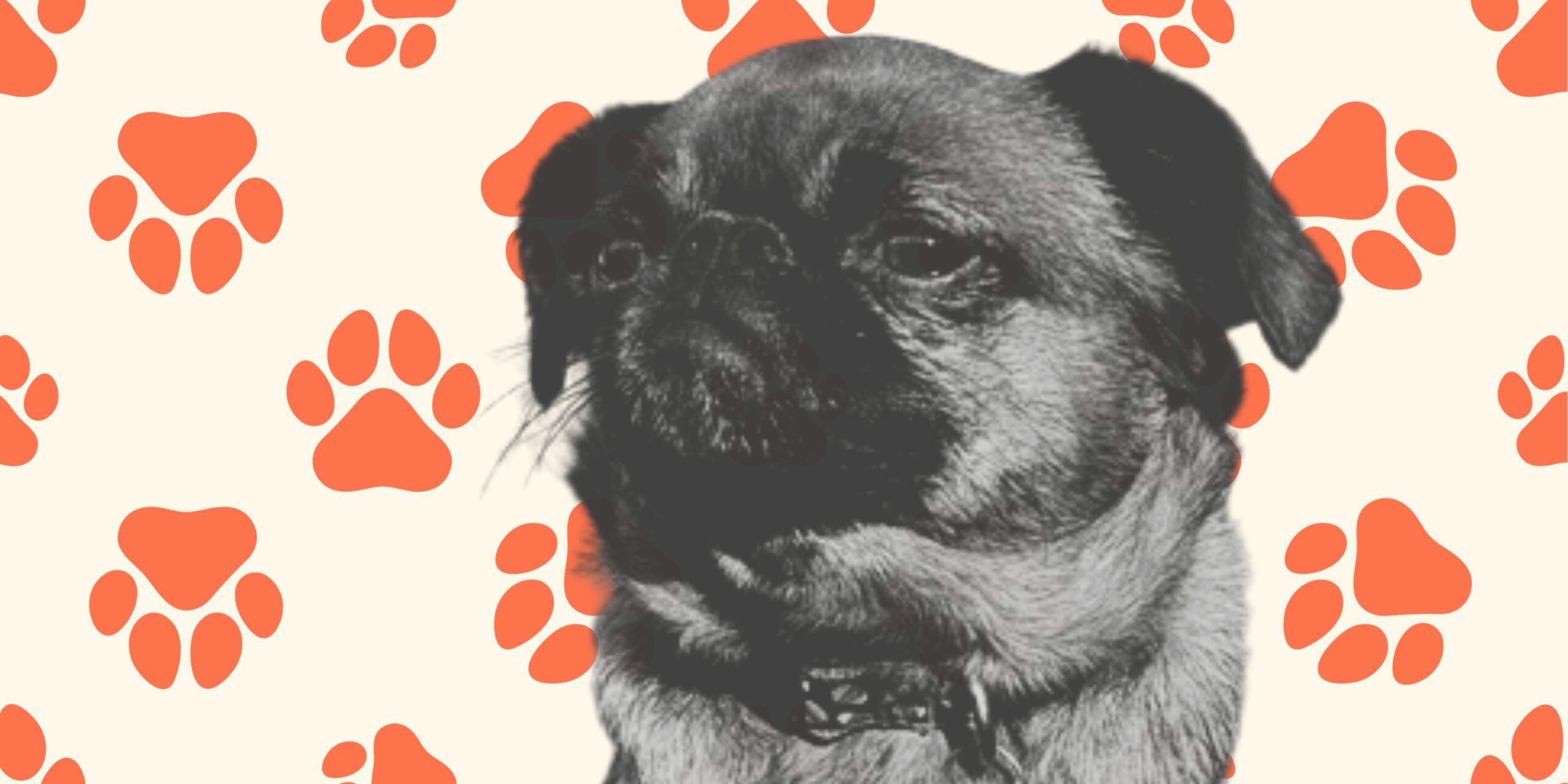
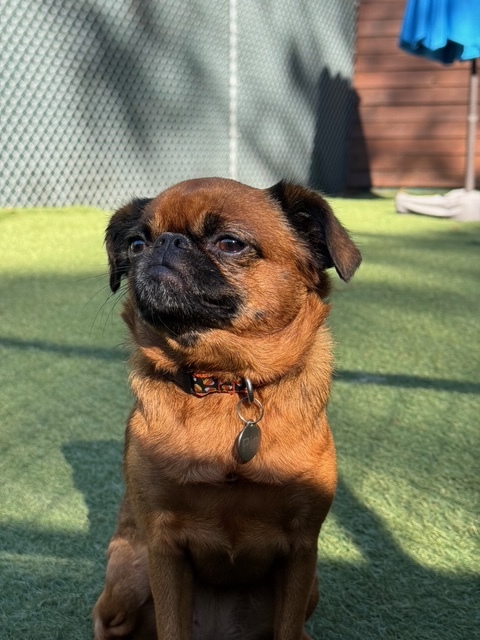
I must have been at a particularly low point when I discovered the Brussels Griffon, which the internet defined as a small, intelligent, and affectionate toy dog originating from Belgium. I was immediately taken in by its humanlike eyes and big personality, which was described as “spirited.” While continuing not to write, I followed a few famous Griffs on social media, which is just about the least responsible way to choose a dog breed for your home, but by then I was already in too deep.
Helen was quick to capitalize on my weakness, wasting no time in locating an available smooth-coated Griff just one drivable state away. Before I knew what had hit me this tiny, furry maniac was living in my house. We named her Pip.
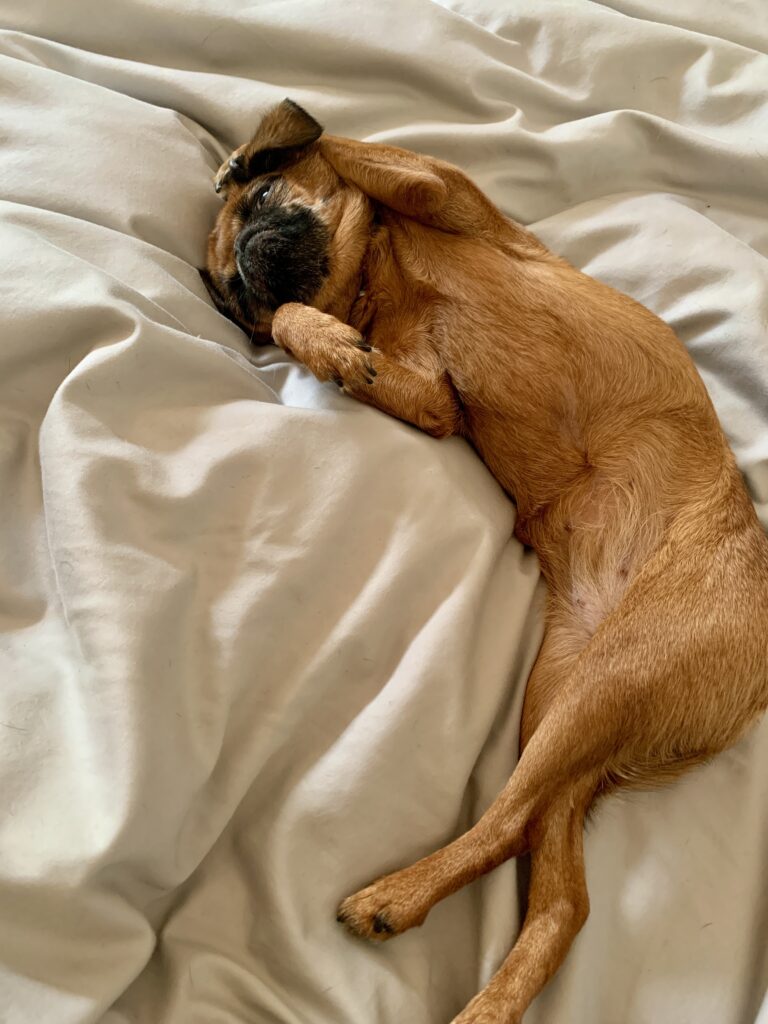
One of the personality traits of the Brussels Griffon is that they are the ultimate Velcro dog. I took this to mean they are loyal companions who like to snuggle, vastly underestimating the strength of Velcro’s clinginess—not to mention the horrible sound it makes when separated. Now, if I was sitting down, Pip was on my lap. If I was standing up, she would settle on top of my foot. If I went to the bathroom, she scratched at the door and whelped until I allowed her to watch me. For some reason—perhaps sensing which one of us was bringing home the kibble—she would allow Helen to work at her desk without interruption, but when I opened my laptop, she smacked it shut with her paw.
At the exact moment in my life when I was most in need of inspiration, a muse, I instead acquired a self-important fur-monster determined to use my body as an ottoman and prevent me from writing.
Through my brain fog, I could almost see the shape of a new novel. I had a sense of the characters and could make out the vague contours of the arc of their relationship, but what was their story? What was the setting and the all-important inciting incident? And who had time to figure all that out when Pip needed to be fed and walked and pet, and she wanted me to throw her frisbee again and again and again?
It occurred to me that the muse wasn’t inspiration after all, it was obligation, and caring for something external had interrupted my despair. It also forced me to leave the house.
At the same time, something strange was going on. I realized I was feeling less sad, anxious, and empty. I was even less fatigued. And, though Pip was far from a low maintenance dog, I never had any angry outbursts. Was it possible my depression was lifting?
Helen worried about Pip’s socialization. It was unhealthy for her to only be around the two of us all the time. She needed to interact with other dogs, other people, but I had settled in comfortably to pandemic-era social withdrawal. The idea of bringing Pip to the local dog park flooded me with terror. Would I have to converse with strangers? Make small talk? Did I remember how?
Both Helen and I were nervous at first, shy. We introduced ourselves to no one, standing back as we observed the various cliques from afar. Pip, however, took off running to unselfconsciously sniff the butts and private parts of every dog she could catch. She was a hit. Everyone wanted to know her name. Our names didn’t matter so much as we became acquainted with “Essie’s mom” and “Baxter’s dad.”
We quickly learned the politics of the place, and the juiciest park gossip. Who was sleeping with whom, who used to sleep with whom and now stood on opposite sides of the field. There was a Queen Bee, a loudmouth, a nerd, a jock, and more than a few basket cases.
The sun felt warm on my back. A warm breeze rustled my hair. And what was this sensation in my belly? I’ve got it, I thought. The setting, the inciting incident. I’m going to write a dog-park novel.
Pip scurried over to take a seat on my foot. She looked up at me with her big, wet eyes.
It occurred to me that the muse wasn’t inspiration after all, it was obligation, and caring for something external had interrupted my despair. It also forced me to leave the house.
“Thanks for getting me out of my own head, little one,” I said.
She wagged her tail and promptly took a dump.
As I pulled a poop bag out of my pocket and reached down to clean up Pip’s mess, I told her, “You’re lucky everything is copy.”
__________________________________
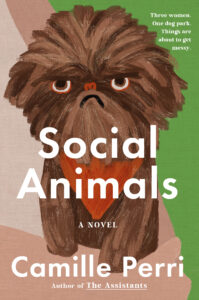
Social Animals by Camille Perri is available from G.P. Putnam’s Sons, an imprint of Penguin Publishing Group, a division of Penguin Random House, LLC.

Camille Perri
Camille Perri is the author of The Assistants and When Katie Met Cassidy. She has worked as a books editor for Cosmopolitan and Esquire. She has also been a ghostwriter of young adult novels and a reference librarian. She holds a bachelor of arts degree from New York University and a master of library science degree from Queens College.