“I Hope to Die Laughing.” On Tom Drury’s The End of Vandalism
Ross McMeekin Explores the Ways Fiction Can Help Us Cope With Emotionally Difficult Periods of Life
Roughly a decade ago, shortly after I moved from Seattle to a nearby suburb, I slid into a bipolar mixed episode for a period of a month or so before it descended into straight depression. During mixed episodes, a person can experience severe agitation, deep melancholy, and other seemingly contradictory symptoms all at once. The mix combines to make a sort of dark energy that’s very difficult to endure until it’s finished. You ride it out, medicate, meditate, try to sleep, try to exercise, lose yourself in work, distract yourself, what have you. You do the best you can. The time in question, my situation became difficult enough that on my psychologist’s recommendation I checked into a two-week PHP (partial hospitalization program) at a local hospital. I spent morning to night there, meeting with social workers, clinicians, and fellow travelers while still sleeping at home. The program helped.
I wasn’t expecting help from a novel. I believe there are times in our lives when a particular book will find us and make an indelible impact, not unlike what one might receive from a religious text. I had a lot of experience with religious texts—I was a former college minister and seminarian before dropping out to pursue an MFA in writing—but as is the case with many religious texts, there can be a strong focus on moral values and deeds, a focus that can erode the consolation the overriding message might give—even if that wasn’t the text’s intent. A reading can feel less about receiving needed love from a higher power and more about dictates as to what behaviors and actions a person should embark upon. This can feel discouraging when you have nothing to give, even to yourself.
The novel I mentioned offered no discouragement. It came to me by mail. I’d signed up for a book club program with Phinney Books in Seattle, where a bookseller would choose an underappreciated book and send it to subscribers along with an insightful introduction on a card that doubled as a bookmark. We received Tom Drury’s The End of Vandalism. Much of the relentlessly funny novel explores what, by the commonplace definition of drama, might be simply mundane circumstances in a small Iowa farming community—the kind that happen every day and could escape notice unless one is really paying attention. The kind of quiet drama that might be told over the weeknight dinner table but not make the cut for Thanksgiving conversation.
The ability to laugh at the frivolity of life, down to the details, with both thought and emotion, requires a person to pay attention to the details.
In many so-called quiet novels, the way a piece is written drives the plot more than the standard story arc taught to storytellers—the kind where a character’s desire meets opposition, causing a series of conflicts which, bit by bit, raise the stakes, until the conflict comes to an ultimate crisis, which then resolves toward a fitting end. Any digressions are left on the cutting room floor. By the time I was a few pages into Drury’s novel, very little of consequence had happened, and digressions abounded, but I realized I would read anything this guy wrote, regardless of how quiet and trivial the content might seem at first glance. I’d found a writer whose creative posture allowed me to see my own sufferings as, well, darkly funny. Worthy of deadpan. I found that what had usually called for a deep emotional response could not only be met with tears, but also with a shrug, or even a smirk.
Here’s an example of how Drury treats what could be a passage of emotional turmoil with a much lighter, comic touch. It begins with the heroine, Louise Darling, and the trouble her recent divorce has caused her:
Louise divorced Tiny that spring and found herself unable to watch television in a satisfying way. She could not settle into a show but had to keep drifting from station to station. On Jeopardy, as soon as there was a question that she could not answer, she would guess blindly—Fiji? What is the island of Fiji?—and change the channel to one of those phony crime shows, which she wouldn’t watch for long either.
From there, little mention is made of any internal sorrow or disruption related to the divorce and its aftermath. It’s there, but more an occasional, subtle breeze than a storm—to this reader it doesn’t plumb any depths beyond what one intuits from Louise’s channel surfing, which isn’t much. What might have been a heartbreaking subject—divorce, which of course can be a living hell—is given a funny paragraph gesturing toward her distraction. And all of this is delivered through a matter of fact and often playful tone.
Whenever reading the novel, for brief moments I didn’t take my suffering so seriously—a short but real sense of relief from the boorish gnaw of my episodes. That’s not to say that The End of Vandalism doesn’t take its characters’ struggles seriously—as the novel nears its end, a tragedy occurs, and it becomes heartbreakingly clear that Louise is deeply affected by it, as was I, the reader. But not everything is this way, whether in life or in fiction.
Drury’s novel gave a sense of levity to my troubles. I had more moments of despair than laughter during that time, but laughter was still possible, if I looked at myself and my new suburban life the way Drury looks at Grouse County, the fictional world he created. I read Drury’s novel again and again, even after I got through that month; whenever things got dicey, I’d pick it up and read a chapter or two, like one might do with a comforting spiritual devotional. I feel that Mr. Drury might laugh at this, but based on what I’ve read of his work, I think he’d get it. The humor his novel brought was less like sunshine bursting through the clouds and more like a tree that could have crushed your car but ended up yards away simply because, moments before, you slowed, rolled down your window, and hurled into the street because you’d finished up a week-long bender the night before. You’re saved, for now, by being an idiot. Life can be an idiot, and as such, absurdity can be a shelter for those that suffer.
Deadpan humor delights in our myopic focus on the trivial parts of life amidst broader concerns with more potent emotional meaning.
Since that time spent in Drury’s novel, I’ve had worse episodes, and I’ve felt the sort of prolonged despair that I didn’t think would end. I wrote an unpublished novel that dwells in the terrible pain I was in through the pandemic, that anathema to all our psyches. Again, nothing wrong with expressing despair and its siblings—it can absolutely be right to do so. Relief, illumination, and artistic transcendence can come by working through suffering with no artifice involved, for both writer and reader alike. But wry laughter, particularly of the gallows variety, reveals emotion too, a defiant kind, expressed with a sort of dignity—a straight back—again, posture—crowned by a double bird to what has happened and a fuck you to what might happen next.
My recent novel was inspired in part by The End of Vandalism. Instead of waxing philosophically about my episodes and delving into their deeper emotional meaning, I just made jokes, down to the minutiae of life’s absurdities, making myself and my wife laugh as best I could, only to sleep and suffer again. It grew in emotional complexity as time went on, but initially it was simply a gasp of laughter that led me through terrible times. Often it is the way in which something is written that determines whether a situation is quiet or loud. Like Mr. Drury does in his novel, in Pepperleaf I diminish the volume of certain dramatic aspects to bring others to the forefront. I did this because I feel it is true to life. The volumes at which our seemingly identical personal dramas ring out will inevitably differ between people. To think otherwise is to flatten humanity into an image of one’s making, if not an image of oneself.
I can no longer read The End of Vandalism and get the kind of relief I could then, though I’ve tried when times became difficult. Maybe there’s another book on the way for when things go south again. I hope so. The ability to laugh at the frivolity of life, down to the details, with both thought and emotion, requires a person to pay attention to the details, which—it just so happens—is often what a person does when they are suffering. Deadpan humor shows the grave digger getting a sliver from his shovel and cursing God that such a thing might happen. Deadpan humor delights in our myopic focus on the trivial parts of life amidst broader concerns with more potent emotional meaning, and in doing so brings laughter—that stumbling grace—again, posture—to those around us, and even to ourselves.
I hope to die laughing.
____________________________
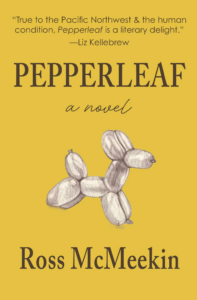
Pepperleaf by Ross McMeekin is available from Thirty West Publishing House.

Ross McMeekin
Hailing from the Pacific Northwest, Ross McMeekin is the author of a story collection, Below the Falls (Thirty West, 2024), & a novel, The Hummingbirds (Skyhorse, 2018). His short fiction has appeared in literary journals and magazines such as Virginia Quarterly Review, Tin House's Open Bar, Vol. 1 Brooklyn, Shenandoah, Redivider, & X-R-A-Y. He served as editor of the minimalist literary journal, Spartan, for over a decade. He studied fiction at Vermont College of Fine Arts, earning an MFA, & holds a BA in English from the University of Washington, minoring in music. He’s won year-long writing fellowships from Jack Straw Cultural Center & Hugo House in Seattle.