How Writing Helped Me Heal After a Trauma
Grace Spulak on Her Journey to Understanding Her Own Recovery
On June 4, 2015, I was sexually assaulted and nearly murdered. I went to bed in the evening, the way I always did. I read. I turned out my lamp. In the dark, I listened to the train in the distance, the one that rumbled past every night at ten-thirty.
I woke in a hospital two days later with no memory of what had happened to me, in a body that I could no longer make work.
“Someone broke into your house and attacked you,” a nervous-faced resident told me. She was young. Maybe unaccustomed to giving bad news.
My life swelled up with this: Someone broke into your house and attacked you. Never mind that I didn’t understand it. Never mind that I didn’t remember it and never would. I spent weeks in the hospital. Anoxic encephalopathy: A lack of oxygen to my brain that had been caused by—what? A pillow on my face? Hands on my throat? No one could tell me with any certainty.
In these moments, I am reduced to this fact: Someone broke into your house and attacked you.
They could only say the damage was diffuse and far-ranging, dipping into places I’d never heard of: basal ganglia, caudate nuclei, parietal cortex, frontal lobe. I recovered slowly and unevenly. My body had become an ill-fitting suit. My limbs moved with the pace of glaciers, slowly, slowly, slowly. An eternity for my hands to reach my face. My tongue like mud, the words it made as shapeless as its muscle fibers. Eventually, I regained much of my physical abilities. I know I am fortunate in this way. I can work, I can support myself, I can live independently.
But nothing felt the same. There were—are—still moments when my body fails me. A water glass slips through my fingers which have stopped remembering how to hold it, shatters. The word I want comes out wrong. Hot for cold. Or worse, I speak some strange amalgam: words like traumerized, comprensible. My thoughts move unexpectedly, randomly back, fixating on mundane things that are inexplicability frightening. A memory of my old window-blinds makes my heart race. The sound of a vacuum cleaner becomes terrifying. In these moments, I am reduced to this fact: Someone broke into your house and attacked you.
When this happened, I was thirty-one and trying to pivot from my work as a public interest lawyer to an MFA program, but I gave up this idea, at least in the short term, as I recovered. I felt myself turning away from writing because writing, like my body, seemed to no longer function for me the way it had before. It was no longer something I could turn to for reassurance. It was no longer a way for me to make sense of the world. The stories I had once written felt fragile and transparent. They had no depth, and maybe, worse, they were not interesting to me.
Nevertheless, I felt compelled to write—not about my own experience, or at least, not exactly—but fiction that took as its subject violence and trauma and memory. I had felt this way from that first moment I woke in the hospital. I tried to remember details, the beep of the hospital machines that lured me back to consciousness, the way my fingernails were swollen, strangely distended from me fingertips, crusted with blood. I would use these details, I thought. In fiction, I could find an escape.
But I struggled to find a way to write into what I’d experienced. It felt both opaque and reductive. What could I write about violence and sexual violence that would explain the short catch of my breath or my wilted neurons? That would explain the way my life had been derailed, bent around this thing?
The stories I wrote seemed to circle on themselves and collapse. All my efforts at narrative movement were ruptured, interrupted. The narrative modes that I’d been taught wouldn’t fit these stories. It seemed impossible that I could write fiction about terrible things that authentically reflected trauma yet offered some window for transformation. My characters were stuck like I was stuck, sealed in the repeats that ran the course of my mind.
But could I take the limitations of my stories, my life, and use them to find this wider aperture?
I began to question if there was value in writing, or more specifically, if there was value for me in writing; I began to feel that I was writing things that were dirty, unseemly. Around this time, The New Yorker published Parul Sehgal’s now widely read essay, “The Key to Me.” In this essay, Sehgal laments the way that a particular type of story about trauma flattens. But to me, her claim about the trauma plot, felt like a statement about the reality of traumatic experience as much as a statement about how fiction about trauma might function or not. Yes, traumatic backstory might allow writers to elude the complexities of character and plot, but traumatic experience also has an element of limitation. What happened to me had a determinative quality, no matter how I might not want this to be true, and if I could not write about it, what could I write about?
In all fairness, Sehgal does not fully dismiss trauma as subject. “In deft hands,” she says, “the trauma plot is taken only as a beginning—with a middle and an end to be sought elsewhere. With a wider aperture, we move out of the therapeutic register and into a generational, social, and political one. It becomes a portal into history and into a common language.” But could I take the limitations of my stories, my life, and use them to find this wider aperture?
As I was struggling to figure this out, I read Gayl Jones’s 1975 novel, Corregidora. The novel opens with an act of violence, and the bulk of the book deals with the attempts of its protagonist to come to terms with this violence and the violence that has haunted her family for generations. Jones uses repetition, the thing that seemed to frustrate my own fiction, to both highlight the effects of trauma on her characters and to create narrative momentum, to use a hallmark of trauma to create a narrative form.
And I wondered if I might do the same in my writing. Maybe this was the way to find Sehgal’s wider aperture.
I began to write stories that crashed up against the jagged shores of their worlds, but instead of withdrawing, I let them explode. I wrote stories that broke themselves, and in these pieces, I saw ways I might remake them.
What if I turned limits into possibility? What if I wrote a story that used language like I often did? Words that were comprished like my own. Words that appeared in wrong orders. What if this use of language appeared not only in the character’s speech but in the actual text of the story itself—an omniscient, third-person story? Writing this story felt both like a rebuke and a reclamation.
And once I understood that I might push the bounds of form to fit my own reality, other stories seemed to fall into strange trauma-based forms.
I took excerpts of the trial testimony that I read religiously, lists of DNA samples, my own and the person who raped and tried to murder me, and made them the scaffolding of a story, one where the story’s character morphs and mutates like DNA.
In another story, the trauma that follows a mother who has lost custody of her children to her abusive ex-spouse manifests as literal spots, a whole flock of them, but instead of destroying her like we might expect, they lift her out of the world, away from the systems that cannot offer her any actual relief or recourse.
In writing like this, I found a way to take the features of trauma and brain injury—the repetitions that are hallmarks of flashback, the way this event seemed to follow me, the fractured way I experienced memory, the physical limitations I still have–and make them modes of storytelling. To repurpose them. To look at them not as limitations but entry points to a writing that was stranger than I believed possible, one that I hope might offer some possibility to readers and other writers.
Writing has not helped me recover, but it has helped me understand that recovery is no longer my goal. It has given me a way to take my realities and shape a world around them and share them with other people in the form of a book, something I once thought was no longer possible.
__________________________________
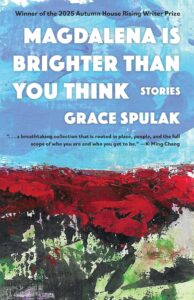
Magdalena is Brighter Than You Think by Grace Spulak is available from Autumn House Press.

Grace Spulak
Grace Spulak is the author of the short story collection, Magdalena Is Brighter Than You Think (April 2026), winner of the 2025 Autumn House Press Rising Writer Prize, selected by K-Ming Chang. A writer and attorney based in her home state of New Mexico, she holds an MFA from the Warren Wilson Program for Writers and a JD from Harvard Law School. Her work was awarded Witness Magazine’s 2021 Literary Award in Fiction and has appeared in the Ploughshares blog, Nimrod International Journal, and Southwest Review, among others, and her work has received support from Trillium Arts, New Mexico Writers, and Poets & Writers.