How Writing a Book About Diaries Changed How I Wrote My Own Diary Entries
Betsy Rubiner on What We Can Learn From Writing in Journals
For several years, while I was working on a book about the diary’s role in our lives and culture, I actively looked for “diary stories” and found them, which fueled my hunch that the diary or journal (I use the terms interchangeably) is a cultural mainstay, in an under-the-radar way.
But months after calling off my search because my book was done, I still see diaries, often in unlikely places. Diary! Diary! my brain alerted me recently when I read a passing mention of the late tennis great Arthur Ashe’s diary in Billie Jean King’s autobiography. And when a journal-writing passion was briefly noted in recent newspaper stories about actor Noah Wyle (of The Pitt), rapper Danny Brown, and Olympic swimming champion Michael Phelps. And when revelations from the journal of the late neurologist/author Oliver Sacks were used in a reappraisal of his work in a recent New Yorker. And during a ballet performance, when a dancer plopped down on a stage for a few minutes to write in, yes, a diary, signaling her character’s distress after a breakup.
My all-consuming book project also changed how I read, especially other people’s diaries. Instead of reading primarily for diarists’ accounts of their life and times, I’m looking for what, if anything, diarists wrote about their diary writing—why they invest time and energy to chronicle their experiences and thoughts, day by day. “I owe a good deal to this journal,” England’s Anne Lister wrote in 1821. “By unburdening my mind on paper I feel, as it were, in some degree to get rid of it.”
Beyond seeking a mental release, diarists write to preserve and retrieve memories.
Later dubbed the “first modern lesbian,” Lister became famous after the 1988 publication of her journal, which included details of her love affairs with women. The journal inspired the 2019 BBC drama Gentleman Jack, the nickname locals gave Lister for acting in what was deemed a manly way.
Beyond seeking a mental release, diarists write to preserve and retrieve memories. “The journal gives me back some of what I have lost,” American author Alice Walker explained in 2022. Some diarists write to report, reveal, rebel, resist. Witness the pandemic journaling projects that started soon after the Covid-19 pandemic. And Russian dissident Alexei Navalny’s diary entry from a remote penal colony where he was imprisoned in 2021: “If they do finally whack me, the book will be my memorial.” Part-memoir/part-diary, his book was published in 2024, months after Russian officials announced his death, during imprisonment.
Claude Fredericks, a classics professor, playwright and poet, considered his journal “a work of permanent importance.” Writing from age eight to shortly before his death at age 89 in 2013, he produced about 65,000 pages. He self-published a portion. A research institute later purchased the diary and other papers. Virginia Woolf wrote in 1919 that her diary writing “does not count as writing.” But writing for her “own eye only” was “good practice” that “loosens the ligaments.”
Reading my own diary, which I’ve written daily (almost) for more than fifty years, I tried to understand what I am doing and creating as a diarist. I started a diary and kept writing because I wanted to be a writer. Because I write on a diary’s blank page every night, I found that as a journalist, freelance writer and author I was not afraid (or was less afraid) of a blank computer screen. Because I can write anything I want in my diary, it offers a welcome break from my day job. It has served as a testing ground, for honing my craft, and a storage space, for squirreling away ideas for possible future use. (I didn’t expect that use to be a book about diaries.)
Now that my book has helped me better understand why I keep a diary, I’m more self-conscious and intentional when I write my evening entry. Because I’m now more aware of the potential value of what I’m writing—both to me in-the-moment and to possible future readers—I am trying to write more about what matters, to be a more conscious curator of my on-the-day experiences and thoughts about myself and the world.
I expect, and welcome, more diary stories soon, this time from my book’s readers.
Has my project changed my professional writing? It’s too soon to say. I am slowly starting to contemplate a writing life (or life in general) after “the book.” Maybe I’ll dig deeper into my diary to see what more I can make from or with it, and maybe I’ll write in a more diaristic way. Or maybe I’ll plunge into a different topic and genre, away from “the diary,” away from my nonfiction book’s blend of reporting and reflecting. I’m tempted to let my diary rest in peace. Reading it can be emotionally exhausting.
As for still seeing diaries, I knew, and feared, that more diary stories would surface after my manuscript deadline. Who knew I’d be able to keep a running list? For years now, friends and family have kindly emailed or texted me diary-in-the-news items and shared their personal diary stories, which enriched my book. Some keep sharing stories. Google and Facebook algorithms still occasionally feed my diary fixation, sending more content. At first, I found this creepy (Stop reading my mind Google!) until I realized the content often proved valuable.
Among the many diary mentions I’ve spotted, of late, some have bolstered what I learned during my diary research. A January trend story reported a surge of journal-and-pen shoppers at Chicago stationary stores and noted an abundance of online videos about the “lost art” of journaling, heralding a possible return to analog. Another newspaper story featured a man who wrote a marriage proposal to his girlfriend in the journal they share. (They married.)
German composers Robert and Clara Schumann started a joint “marriage diary” back in 1840. Appreciations of actress Diane Keaton after her death last year mentioned her journal and her beloved mother’s journal, both used for Keaton’s 2011 memoir. Writers who’ve used their own diary and/or mom’s diary include English novelist Will Self, whose 2024 novel Elaine is based on the diary of his late mother. A photograph of a teenager’s troubling journal entry accompanied a recent magazine article about his parents filing a wrongful death lawsuit against an artificial intelligence company, after the teen’s suicide. His journal suggested he was enthralled by an AI chatbot. Other diary entries have helped prompt legal action.
I expect, and welcome, more diary stories soon, this time from my book’s readers. Already, new diary-spotters who’ve heard about my book’s impending publication have stepped up. I’ve learned about a man who stole his wife’s diary; and about brother and sister diarists who made a pact that the diary of whoever dies first will be left for the surviving sibling to preserve, for family history and possible publication.
One friend thinks her travel photos may be a travel journal and reported reading the final diary entries of her sister, who recently died. “Whoa!” she texted me. These shared stories, combined with my book project-induced habit of seeing diaries where others may not notice them and my fascination with diarists’ motivations, continue to feed my diary fixation and drive my new diary-writing approach. If, or how, my lingering diary-on-the-brain affects what I write, beyond my diary, remains to be seen.
__________________________________
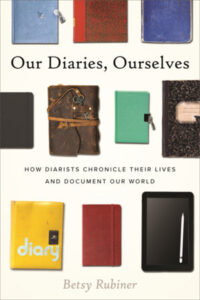
Our Diaries, Ourselves by Betsy Rubiner is available via Beacon Press.

Betsy Rubiner
Betsy Rubiner is a Chicago-based author, a journalist, and a life-long diarist. Her reporting and essays have appeared in publications including the New York Times, The Guardian, the Washington Post, TIME, and the Des Moines Register, among several media outlets where she has worked. Readers can learn more about her first book, Fun with the Family in Iowa, and connect with her at www.betsyrubiner.com.