How William Kennedy Turned a Bedtime Story For His Four-Year-Old Into a Publishing Sensation
Stephanie Gorton Talks to the Legendary Author of Ironweed About the Making of Charlie Malarkey and the Belly-Button Machine
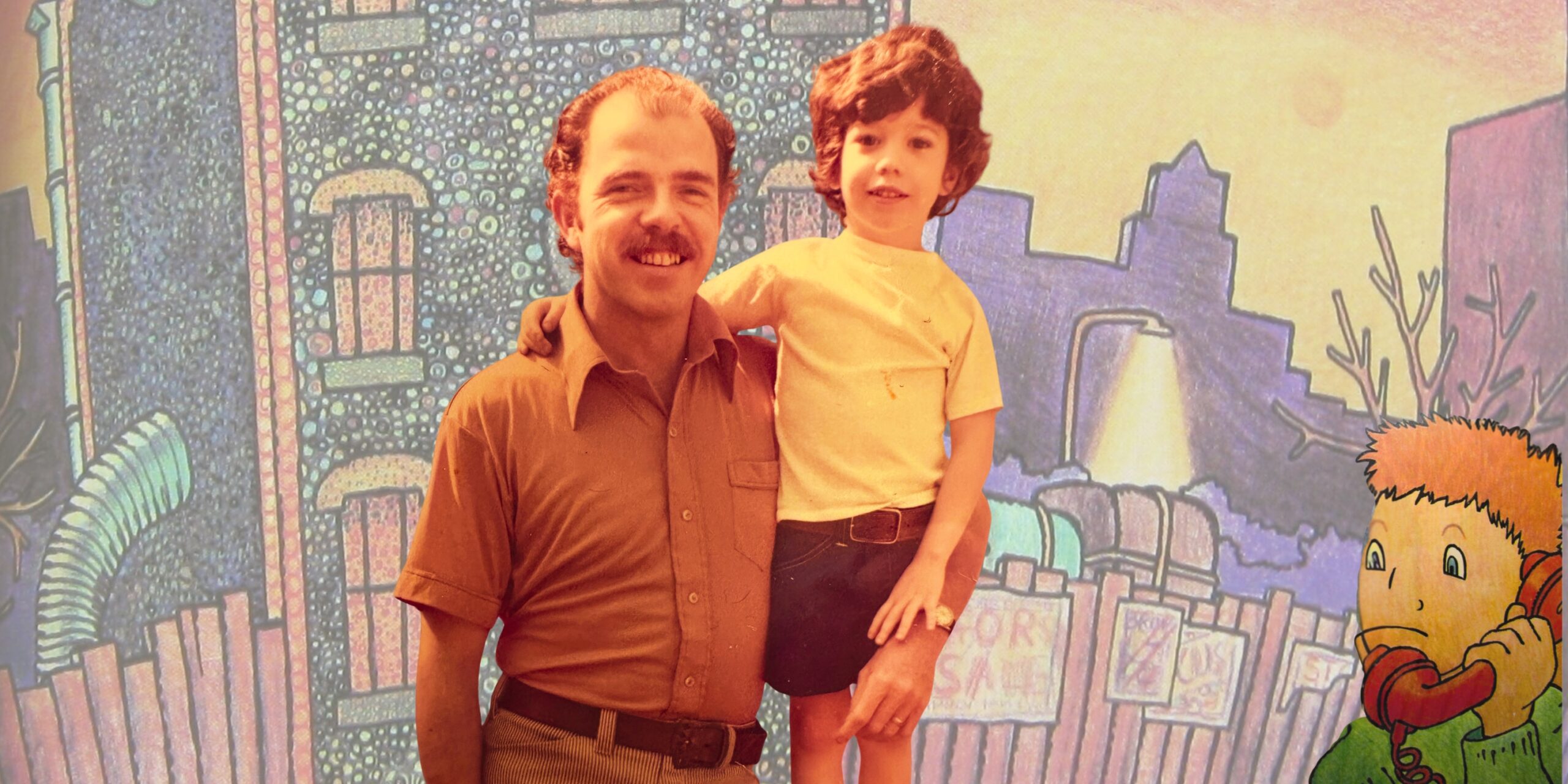
On a recent afternoon in Averill Park, New York, William (Bill) and Brendan Kennedy sat in a room built around a pool table. Posters for Bill’s films hung on the walls: Jack Nicholson and Meryl Streep in Ironweed, Diane Lane from The Cotton Club. A fully decorated Christmas tree presided; Kennedy likes to keep it up until March.
Together the Kennedys recalled the night in 1975 when four-year-old Brendan, the family’s third child and the youngest by a decade, asked for a story. Brendan’s belly button happened to be showing, and the first lines came easily to his father: “Once upon a time there was a guy named Charlie Malarkey. And once he went to sleep, and when he woke up, there was no belly button on him.”
Kennedy is, at 98, a singular, ebullient literary voice. His novels keep alive the Albany of the 1930s: the domain of swells, sports, and bums, of women with appetites, of flophouses and bowling alleys in the dark hours. In 1983 Kennedy was a MacArthur Fellow; a year later Ironweed won a host of prizes including the Pulitzer. His Albany Cycle, eight novels (and counting) set in his home city, is an American epic as absorbing to read today as decades ago.
Back in the 1970s, though, Kennedy did something that isn’t mentioned much anymore. With Brendan, he made stories for children. Looking back at this project a half-century later was a return to a pre-AI world of inspired imaginative meandering. It also conferred a welcome image of creativity and family life thriving together, one that cast doubt on my narrow idea of the seclusion from domestic life required to write.
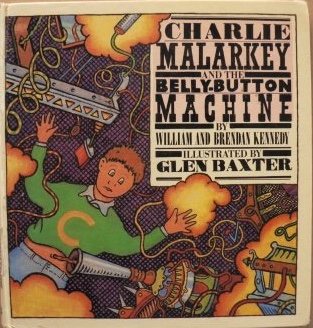
Charlie Malarkey and the Belly Button Machine was published forty years ago and landed in my childhood home like a slow-detonating hallucinogenic. The effect was due in part to the illustrations by British absurdist Glen Baxter, but the story held my brother and me transfixed. A warm, witty sequel published eight years later, Charlie Malarkey and the Singing Moose, showed off the Kennedys’ gift with puns in its portrayal of Barnaby the self-deprecating moose. Yet unlike William Kennedy’s novels for adults, of which new editions and stage adaptations keep proliferating, the children’s books are out of print.
Writing for children is harder than it looks. After their first two nights spinning Charlie Malarkey stories, Bill decided it could be a good book. Alone in his office, he worked for hours to hammer out the middle and end. It didn’t work.
To summarize of what follows those first lines about Charlie Malarkey: once his belly button vanishes, Charlie’s life spins out of control. His mother and the doctor, those well-meaning hapless adults, can only offer Quiet Medicine and marmalade meatballs. A man “with a face like a walnut” rings Charlie’s doorbell, introducing himself as Ben Bubie and peddling belly buttons ($500 new, $26 used). The next night, Charlie’s best friend Iggy’s belly button disappears too—despite Iggy sticking on a protective decoy button made of jellybean and Band-Aid.
The kids decide that instead of calling the cops, they’ll handle the situation themselves. They trace Bubie to a cobble-, pebble-, marble-, and golf-ball-festooned building in the city. Through a window, they see the belly button machine at work on a small brown monkey. When the adults step out, Charlie figures out how to hack the machine to get his button back, and Iggy’s and the monkey’s too. The villains burst in screaming threats, a fracas ensues, quick-thinking Charlie prevails, and belly buttons are restored nearly to their original position.
Reading Charlie Malarkey and the Belly-Button Machine might call to mind James Thurber or Roald Dahl, but it has its own hardboiled magic. One reviewer compared its style to Runyon and Joyce by way of a four-year-old, which basically hits the mark. Both Malarkey books capture that child’s-eye experience of seeing adults moving through the world in arbitrary and short-sighted ways. Aptly, Glen Baxter wrote to Brendan in the time of the first Malarkey, “I don’t think that my work is in any way weird. Rather, it is the world in which we live that I find weird.”
Regardless, the first Malarkey book was rejected by publishers when it initially made the rounds in 1975. Charlie’s travails were “too Freudian for comfort,” one editor wrote. The Kennedys’ favorite rejection got to the truth of it: an editor at Doubleday compared it to Charlie and the Chocolate Factory, calling it “a story kids would love but that editors will have a hard time coming to terms with. There are definite limits to our child’s eye view of things, unfortunately.”
The authors persisted despite the gatekeepers. But the wider tendency to project adult preoccupations onto kids’ stories, or any work of imagination and humor, has only gotten more aggressive. Today, the fault doesn’t only lie with blinkered publishers; chapters of Moms for Liberty have successfully lobbied for bans on Maurice Sendak’s In the Night Kitchen and Shel Silverstein’s A Light in the Attic, books that are beloved by children, unsettling as they are.
The world could use the Malarkey stories just now: kids find them delightful and so do many of their parents. At the same time, it’s still an open question whether the grown-ups at the gates can get over their preconceptions of what stories for children are supposed to be and to do.
*
Writing for children is harder than it looks. After their first two nights spinning Charlie Malarkey stories, Bill decided it could be a good book. Alone in his office, he worked for hours to hammer out the middle and end. It didn’t work. “I realized that I wasn’t going to be able to write this all by myself,” he said. He called Brendan into his office and asked him questions about where the plot was going next.
Four-year-olds tend to be imaginatively unbound. “You were a very weird child,” Bill tells his son admiringly. Brendan’s imagination drew from a deep well of source material unsullied by handheld screens or Berenstain Bears. Through his childhood, he would sit in Bill’s office, a companionable presence, and page through art books of Picasso, Magritte, Dali, and an illustrated edition of Eugene Ionesco’s absurdist children’s stories. His family read him Huckleberry Finn, Damon Runyon, The Old Man and the Sea, Edward Lear, and Winnie the Pooh. They socialized with Gabriel Garcia Marquez, Hunter S. Thompson, and Jerzy Kosinski.
“I started interrogating him,” Bill recalled. “What happened? You know, where did, where did Charlie look for his belly button?” (Under the porch.) What did the belly-button machine smell like? (Vicks Vapo-Rub and smoked oysters.) Was “Moop” really right for a particular line of dialogue? (Yes.) Brendan had the goods.
The Kennedys had, as far as I can tell, cornered a niche in the plot market. Not long ago, I lost my own belly button to a fluke abdominal surgery.
In this way, the book took shape over a couple of months, with Bill revising it multiple times. He typed up the drafts on the flip side of his manuscript for the novel Legs (1975), a tour de force about the murder of gangster and bootlegger Jack “Legs” Diamond in Albany in 1931 that Kennedy rewrote eight times over a period of six years. “It’s a pattern in my life that I can’t read anything that I’ve written without slashing and cutting, rewriting, correcting what I see as imprecise language,” he said. “I was able to add to the invention, but it was Brendan who needed to write the book. I’m not as crazy as the book is.”
Humor is “elemental to my work,” Bill says. (The same goes for every one of his novels: Billy Phelan’s Greatest Game is salted and spiced with lines like, “He salted his oatmeal and spiced it with raisins, those wrinkled and puny symbols of his own dark and shriveling years.”) Yet this project was as serious for him as it was for Brendan. Having written for newspapers, film, and “just about every kind of thing you could write,” he had for years taught In the Night Kitchen to fiction writing students at SUNY Albany. He recognized that children could be an exacting audience, and children’s writers, the excellent ones, had mastered the precision he strove for so consistently.
On the page, Kennedy devotees will find plenty to savor in Charlie Malarkey. Ben Bubie has elements of Harvey Hess, “a dude who wore good suits but fucked them up with noisy neckties and loud socks,” and Bump Oliver, “a dapper little guy with a new haircut who played cards with his hat on” from Billy Phelan’s Greatest Game. Bubie’s assistant Marvin Melon, “who had a head like a small cantaloupe,” is akin to Lemon Lewis, another Billy Phelan character and a “pointy-headed bald man, which was how he got his nickname.”
The belly-button machine itself is “full of electricity, and terrible gas and oil, and smelly acid, and hot pepper,” not dissimilar to the description of ironweed in Ironweed: “full of fiber and acid and cannonade.” In the same novel, Francis Phelan’s view of the “cemetery of dead things: rusted-out gas stoves, broken wood stoves, dead iceboxes, and bicycles with twisted wheels” sounds like Albany’s Dead Machinery Museum, where the belly-button machine ultimately ends up.
The Kennedys had, as far as I can tell, cornered a niche in the plot market. Not long ago, I lost my own belly button to a fluke abdominal surgery. Besides making me realize I’d never read another non-medical text dwelling on the situation, the experience made me reflect on the tradition of telling young people stories likely to scare them. These imaginings are purportedly larger than life, yet occasionally just like it. Hans Christian Andersen didn’t shy away from nightmarish imagery, nor did Dahl. In their work, strange things happen, trusted adults turn monstrous, and children aren’t given the voice or agency they deserve.
Finding an editor as open to Belly-Button Machine took more than a decade. Thirteen publishers rejected Ironweed before Saul Bellow helped find it a home at Viking in 1983; at least eleven passed on Charlie Malarkey. Joyce Johnson was editing books at the Atlantic Monthly Press in the mid-1980s when she heard about the manuscript. (Thirty years earlier, she had had a two-year relationship with Jack Kerouac and started building a career with a potent writing voice of her own.) After another editor tipped her off at a Vanity Fair party, she acquired it. Soon after, she led the Kennedys to Glen Baxter.
Bill and Brendan’s publicity itinerary, bracketed by Pan Am flights, prime-time interviews, and a jaunt to New Orleans, evokes a long-past era in book publishing.
Over email, Baxter told me how Johnson talked him into illustrating the book over an Italian lunch on one of his many trips to New York City in the 1980s. “I don’t tend to illustrate other people’s work so I was a little nervous,” he said. Again, a child was instrumental in pushing the project forward. “I had no idea how I was going to do it but my wife Carole and young son Harry loved the book and so I caved in.” He used Harry as his model for Charlie, and otherwise had just one guiding idea in mind: “it had to be colorful.”
Baxter, whose collectors include King Charles III, Salman Rushdie, and Tom Stoppard, has described his artistic approach as “deadpan Buster Keaton.” He styled Ben Bubie after a combination of anarchic 1950s bandleader Spike Jones and a Mafia don. It was his only foray into children’s books over the span of his career. He says of it now, “I actually had fun.” Looking at the pictures, you can tell.
A blazing, redemptive season in the spotlight followed the book’s publication in 1986. By this time, Kennedy’s star was high. It was just three years after he won the MacArthur (right after he’d gotten a Chinese fortune cookie that said, “This is your lucky week”) and two years post-Pulitzer, National Book Critics Circle Award, and PEN/Faulkner. Brendan, now sixteen, accompanied Bill on Good Morning America, Panorama, Fresh Air (“It’s about time somebody wrote about the belly button,” Terry Gross began her interview), and All Things Considered. They did Live at Five alongside Demi Moore, The Pointer Sisters, and George F. Will.
Bill and Brendan’s publicity itinerary, bracketed by Pan Am flights, prime-time interviews, and a jaunt to New Orleans, evokes a long-past era in book publishing. There were two parties celebrating the book and at one of them, the caterers served marmalade meatballs, Charlie’s favorite dinner, and green punch inspired by Quiet Medicine. Closer to home, the Kennedys read one or the other of the Malarkey stories to more than a hundred classrooms, they estimate. In the years that followed, the family adapted Charlie Malarkey and the Belly-Button Machine into a script for TV, complete with a 1980s hair-metal soundtrack.
Their tour notes also paint a rare picture of a novelist’s family collectively enjoying a phase of literary high life. Maybe it’s testament to how we over-mythologize writers like Kennedy that it feels like a surprise to find him delighting in his child’s ideas, deciding his work is richer because, and not in spite, of them. Over the course of his career, Kennedy has been published concurrently with John Updike, Philip Roth, and Cormac McCarthy. At this level, being a so-called Art Monster might be considered as part of the job.
But that doesn’t quite fit with the Kennedys. Bill was married to Dana Kennedy for 66 years, until her death in 2023. The family often did literary events together. Bill got the call he’d won the Pulitzer on the same day he met his first grandchild, and in the meticulous 2017 documentary Kennedy of Albany, both events are given equal weight. Today, his children all live within a twenty-minute drive. They are, in Brendan’s words, “weirdly functional.” In the Charlie Malarkey files in Kennedy’s papers at SUNY Albany, Bill’s favorite fan letter lies near the top of a folder: “Dear Daddy, Thank you for sharing our book.”
*
Toward the end of our interview, it was time to open a bottle of wine. Brendan shared vignettes from another collaborative work in progress, also for young readers: a scene incorporating an evil lobster and a peanut butter machine, minor roles for “clock juice, telephone soup, hippopotamus cookies, lizard sauce, French fried socks.” The high-flown literary atmosphere in the house took on a glaze of Lewis Carroll, Dr. Seuss, and SpongeBob SquarePants.
As an adult, I’ve loved sharing the Charlie Malarkey books with my children. What was mesmerizing at 2 is, at 42, funny, outlandish, and uniquely satisfying to read aloud. The kids haven’t tired of it, either. My older daughter was a toddler during the pandemic; she requested Belly-Button Machine on a near-daily basis during that time and took to calling herself Charlie Malarkey. A snippy New York Times review of the book argued kids would tire of the book because it takes longer than five minutes to read. That may be true for most books, but since those six-plus minutes are so genuinely relished by everyone involved, none of us have ever resented reopening the book and starting it over yet again.
Writing doesn’t get easier with time; “it gets harder,” Bill said. He asked Brendan to lay out books of the Surrealists and Goya before we left him to the evening, thinking they would help with what lay ahead of him that evening. There’s another novel in the works, a screenplay for Legs, notes and scripts for more Charlie Malarkey, a stage adaptation of Ironweed starring Jessica Hecht and Mark Ruffalo, a Library of America volume introduced by Colum McCann.
When we finished talking I wished Kennedy a good night, and he said it was time he got to work.

Stephanie Gorton
Stephanie Gorton is the author of Citizen Reporters: S. S. McClure, Ida Tarbell, and the Magazine that Rewrote America (2020), a finalist for the Sperber Prize for journalism biography, and The Icon and the Idealist: Margaret Sanger, Mary Ware Dennett, and the Rivalry that Brought Birth Control to America (2024). Her work has been published in The New Yorker, Smithsonian, and Paris Review Daily, among other publications. She is the recipient of fellowships from the Logan Nonfiction Program at the Carey Institute for Global Good and the Massachusetts Historical Society. Lebanese-American by birth, she lives in Providence, Rhode Island.