How We’ve Handled Disease Throughout History
Susan Wise Bauer on Epilepsy, Understanding Illness, and Ancient Diagnoses
The child was born late: much longed for, the only son. He is five now. He sits quietly beside the well, waiting for his mother to finish drawing water. The other women look at him from the corners of their eyes, and move carefully to the other side of the well. Just in case. It is not good to be too close when the hand of the god reaches down.
The child stands, in response to his mother’s call, and turns toward her. And then he stiffens, his eyes raised to the sky. A murmur rises from those around: half horror, half excitement.
He pitches straight backward, flat and rigid in the red sand. For a long, suspended moment all is still, and then his head jerks sideways. His arms and legs flail. Foam collects around his lips. His eyes are white. A dark stain spreads beneath him. The women at the well are silent, now, waiting. His mother is frozen in place. She too knows to stay away.
Epilepsy: the Greeks called it the “sacred disease,” but they were not the first.
The arms and legs slowly still. The child lies motionless. His eyes close, and then open again. He turns his head to the side, looks for his mother; she comes forward, cautious, and helps him to sit up. The women begin to move again, to speak quietly.
The god has come, and gone.
Epilepsy: the Greeks called it the “sacred disease,” but they were not the first. In Sumer, around 2000 BCE, a scribe describes an epileptic convulsion “caused by the hand of the moon-god Shin” or his deputy demon:
The sick man’s neck turns to the right, time and again, while his hands and feet are paralysed, his eyes are now closed, now rolling, saliva flows from his mouth, he makes sounds . . . he does not know himself when it seizes him.
For nearly a millennia and half, even in the centuries when physicians were beginning to supplant priests in treating the ill, epileptic convulsions (unexpected, frightening, enigmatic) remained the territory of the priest. Seizures were the sign that a god or demon had intruded into the space of men.
Hippocrates, as refracted through his followers, is a pragmatic naturalist: If you can’t see and test it, you shouldn’t be theorizing about it.
The Babylonians, who followed the Sumerians in the lands between the Tigris and the Euphrates, blamed personal uncleanness that gave demons a chance to infest sufferers; the Inner Canon of the Yellow Emperor chalked the disease up to the “long-term invasion of evil”; in pre-Socratic Greece, epilepsy was a punishment sent by Poseidon (if the sufferer made hoarse sounds) or the earth-goddess Cybele (if the seizure was stronger on the right side of the body and involved the gnashing of teeth).
Then, in the fifth century BCE, came the Greek doctor Hippocrates. He himself wrote nothing down, but he was an active practitioner and a vigorous teacher, and he assembled a core of devoted students and followers who recorded his precepts into the collection now known as the Corpus.
In many ways, the Corpus is the first thoroughly secular medical text. Hippocrates and his disciples did not disbelieve in Asclepius, the god of medicine (or any other god). But after studying decades of careful medical record keeping, they argued that most (if not all) diseases are caused by purely physical factors—and those can be discovered by physicians.
Epilepsy was Exhibit A. “This notion of [epilepsy’s] divinity,” Hippocrates says tartly, “is kept up by men’s inability to comprehend it.” Hippocrates, as refracted through his followers, is a pragmatic naturalist: If you can’t see and test it, you shouldn’t be theorizing about it. Hippocrates bases his explanation of epilepsy, that most perplexing of illnesses, on observation. Men who suffer head injuries are far more likely to suffer unexpected convulsions, so the cause of this syndrome is clearly located in the head.
The Greeks were unclear about what exactly went on up there within the skull, but the jelly inside obviously controlled the body in some way: “The brain exercises the greatest power in the man,” Hippocrates explains in On the Sacred Disease.
What about a child with convulsions, but no history of head injury? Hippocrates and his followers held on to their belief in natural causes. Seizures followed on head troubles: cause and effect. There had to be something wrong with the brain.
But what?
For an answer, they turned to the most modern observations. Alcmaeon of Croton and others had established the current consensus: Four essential bodily fluids could be observed, measured, even drained (yellow bile, blood, phlegm, black bile). The normal state of those four fluids is harmony and perfect proportion, or eucrasia. But the humors are acutely sensitive to their surroundings. They constantly fluctuate in response to changing temperatures and winds, the waters available for drinking, and the landscape around them. They can easily be pushed, by these outside factors, into imbalance. This imbalance, dyscrasia, is what produces illness.
So, Hippocrates argued, the illness of epilepsy must be caused, like any other illness, by imbalance, not demons. Too much phlegm or bile had collected in the head, rather than being properly dispersed throughout the body, and it was blocking the proper flow of air and blood and causing those terrifying seizures.
How to treat it?
She was three, the first time the fits came upon her; she stumbled and fell, as toddlers do, but instead of scrambling back to her small feet she remained on the floor, her head jerking, her arms grabbing at the air.
As with all imbalances, by correcting the temperatures, winds, and waters that had thrown them into dyscrasia. Thus the title of the central work of the Hippocratic corpus:
On Airs, Waters, and Places. “Whoever wishes to investigate medicine properly, should proceed thus,” it begins, in the first place to consider the seasons of the year, and what effects each of them produces . . . the winds, the hot and cold . . . [and] the qualities of the waters . . . [and] the ground, whether it be naked . . . or wooded . . . and whether it lies in a hollow, confined situation, or is elevated. . . . For if one knows all these things well . . . he will not be in doubt as to the treatment of the diseases.
Epilepsy was no different from fever, catarrh, stomach pain, or joint pain: “The disease called the Sacred,” Hippocrates concludes, “arises from causes as the others, namely, those things which enter and quit the body, such as cold, the sun, and the winds, which are ever changing and are never at rest.”
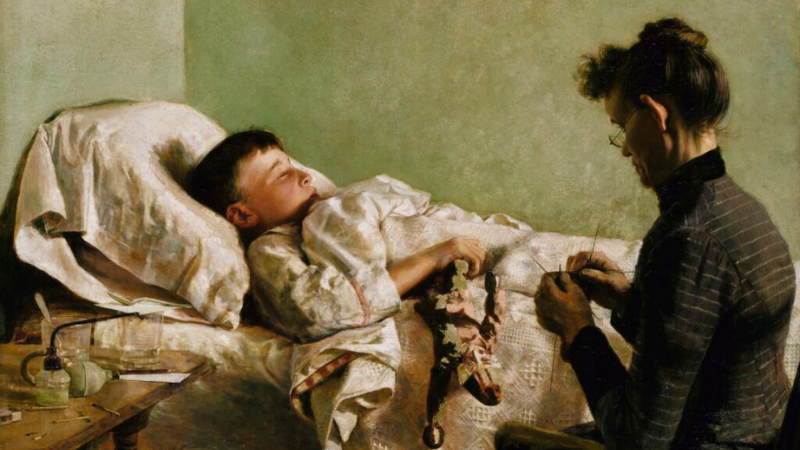
The child is five, the youngest of a large, well-to-do family and the only daughter: doted upon by her mother and her nursemaid, exquisitely dressed in tiny silk dresses patterned after those worn by Queen Victoria’s children. Her shining brown curls are carefully arranged each morning, tied up with pink ribbon, festooned with flowers. Her nursery is luxurious with cushions and toys, soft rugs and sofas.
And she is never left alone.
She was three, the first time the fits came upon her; she stumbled and fell, as toddlers do, but instead of scrambling back to her small feet she remained on the floor, her head jerking, her arms grabbing at the air. Her nurse scooped her up and ran to put her into a cold bath, and slowly the motions faded. But it happened again, and again. On advice of their physician (the best money could assure), mother and child traveled to the countryside, away from London’s noise, dust, and heat.
Her days are patterned, quiet, and slow; her toys make no clattering sounds, the nursery is decorated only in soothing, dim colors. Three times a week, she takes the waters at a nearby warm spring, and as soon as she emerges from the water her hands and feet are covered in woolen stockings and mittens. Her diet is a cool one: milk and soft vegetables, boiled chicken and porridge. (Her doctors have warned severely that salted meats, pastry, and cheese are to be avoided at all times; her mother will not even allow them in the kitchens.)
She goes outside only early at morning, or late in the evening, when the traffic of carriages and horses has faded and will not cause any excitement or stir any dust. And only on still, mild days. On days with fog or wind, she remains indoors, drinking a cup of bitter ale liberally diluted with water.
She is better. It has been months since her last fit. But her mother guards her fiercely, because even the most minor imbalance in her small, cloistered world could bring the seizures back again.
__________________________________

From The Great Shadow: A History of How Sickness Shapes What We Do, Think, Believe, and Buy by Susan Wise Bauer. Copyright © 2026 by the author and reprinted by permission of St. Martin’s Publishing Group.

Susan Wise Bauer
Susan Wise Bauer is a historian and educator. Her sweeping works of narrative history include, among many others, The History of the Ancient World, The Story of Western Science, and the Story of the World series for young readers. She is the co-author of The Well-Trained Mind, author of The Well-Educated Mind, and owner of the Well-Trained Mind Press. She taught at the College of William and Mary for eighteen years and now writes on the family farm, Peace Hill, in Charles City, Virginia.