How Weimar Germany’s Proportional Democracy Put Hitler in Power
Dana Bash and David Fisher on the Rise of Nazism Through an Embattled Electoral System
“We warn our opponents not to drive us to the uttermost,” he bellowed. “Hunger is preferable to disgrace, and deprivation is to be preferred to dishonor.”
And, as it turned out, the harsh terms of the treaty caused massive resentment, which eventually was transformed into political—and military—action.
A proportional elective system, in which a political party earns representation based on the percentage of votes it receives rather than the first-past-the-post winner-take-all system, ensures that a wide variety of beliefs will have a voice. To elect government leaders, the different parties form coalitions in the absence of an outright majority. In a closely divided government, the smallest parties, whose few votes could determine the majority, wield power far greater than their electoral support would indicate. It also ensures that numerous parties with different ideologies will be competing for votes.
While in theory this system might seem to be the purest form of representative democracy, in practice it has often led to fragmented or unstable governments, weakened by a continuous shifting in the combinations of ruling parties. In the Weimar Republic, for example, at various times more than forty different political parties won seats in the Reichstag. Among them were Ebert’s liberal Social Democratic Party (SDP), the moderate Centre Party, the Communist Party (KPD), and the far-right German Workers’ Party, which evolved into the National Socialist German Workers’ Party.
The Nazi Party.
The party was originally formed in 1919 by a small group of men, among them a locksmith and a sportswriter, established to appeal to middle-class workers alienated by the terms imposed on the nation by the Treaty of Versailles and suffering from the inability of the Weimar government to stabilize the economy. Rather than supporting democratic reforms, from the beginning it adopted anti-government, anti-Communist, and anti-Semitic policies. Its weekly meetings were held in the back of a beer hall in Munich.
The German Army, alarmed by the Communist leanings of some of the small parties that had sprung up, assigned soldiers to attend their meetings and submit reports. In September 1919, war veteran Corporal Adolf Hitler was sent to monitor the right-wing Workers’ Party. Hitler had been born in Austria-Hungary. After being rejected by an art school in Vienna, he earned a meager living selling small watercolors and drawings. To escape compulsory military service, he had moved to Munich, but when the Great War began, he enlisted and served on the Western Front, where he was wounded. When assigned to report on the meetings in the beer hall, he finally found a place he belonged. He embraced the party’s radical, anti-Semitic policies, which fit perfectly with his own racist, ultranationalistic views. He became the fifty-fifth member of the party.
Hitler’s extraordinary public speaking skills enabled him to rise rapidly to party leadership, and after being discharged from the army he began working for the party full-time. In his early speeches he began referring to Germans as Aryans, a “pure” master race responsible for all significant human accomplishments. As he later would write in his political autobiography and manifesto, Mein Kampf, “My Struggle,” “Everything we admire on this earth today—science and art, technology and inventions—is only the creative product of a few peoples and originally perhaps one race.”
When Germany was ravaged—just like the rest of the world—by the 1929 Depression, Hitler was politically well positioned to respond to the needs and desires, but mostly the fears, of the people.
Aryans.
As the divided Weimar government continued to prove itself incapable of dealing with the myriad economic problems facing the country, more Germans began to search for radical solutions. By 1923 the Nazi Party had attracted more than fifty thousand members, among them the widely admired World War I general Erich Ludendorff. Hitler and Ludendorff believed the party was powerful enough to stage a revolution.
Their attempted coup began in the Munich Beer Hall. The Nazis claimed they had seized control of the Bavarian state government, believing Germans across the nation would rise in support and overthrow the Weimar government. “The government of criminals sitting in Berlin is deprived of office,” Hitler boasted. “Tomorrow will see the execution of a nationalist government in Germany, or it will see us dead. There is no middle course.” General Ludendorff was proclaimed dictator. In Berlin, President Ebert declared that Hitler, Ludendorff, and anyone who supported them were traitors. Rather than joining the rebellion, the army remained loyal to the government. The next day Munich police confronted an estimated two thousand Nazis marching toward the center of the city; in a shootout, sixteen Nazis, four police officers, and a bystander were killed. Hitler was arrested and tried for treason. His month-long trial gave him both publicity and a platform to spread Nazi propaganda. As “steel-helmet soldiers reinforced by Munich police” prevented pro-Nazi demonstrations, Hitler was found guilty of treason and sentenced to five years in prison, but the trial had become a great victory for the party.
General Ludendorff was acquitted, perhaps due to the respect he had earned during the war.
Rather than serving five years, Hitler was released from Landsberg Castle Prison after slightly more than eight months. While serving his sentence, Hitler wrote Mein Kampf. In it, he left no doubt about his intentions, declaring, “The weapon of ruthless, brute force is of greatest value in war between two diverse views of the world…The 1914 frontiers mean nothing to Germany’s future. They were not a protection in the past, and they would not mean power in the future.”
Many European and American politicians tended to dismiss the threat, believing, as the Brooklyn Eagle reported, that his release “indicates that the Bavarian Government has ceased to care about Hitlerites. Their complete defeat in the recent elections indicates popular sentiment has turned against them.”
That confidence was shaken in 1925 when seventy-eight-year-old Field Marshal Paul von Hindenburg, the commander of the German military during the war, became the first president of the Reich directly elected by the people. He received nine hundred thousand more votes than his opponent. The conservative, authoritarian Hindenburg was the candidate of the nationalistic right, and many supporters believed he would use his power to destroy the republic from the inside, but in his inaugural address he said, “No war, no inner insurrection, can free our fettered and disunited nation. It needs long, quiet, peaceful work…The President is especially called upon to uphold the sacredness of justice.”
Despite the challenges he faced, Hindenburg managed to bring a period of calm and some prosperity to Germany. The economy was stabilized by currency reforms and increased foreign investment—although that required borrowing substantial sums from America to pay war reparations and support industry. Several agreements signed with wartime enemies in 1925 to respect the existing borders led to Germany joining the League of Nations, restoring some national pride and allowing the country to begin participating in international affairs. German culture once more began playing a significant role in the arts; the Bauhaus, for example, the renowned school of art, architecture, and design founded in Germany in 1919, significantly influenced creative arts throughout the world. The constitutional liberties also resulted in a vibrant culture that transformed Berlin into a cosmopolitan intellectual center.
But underneath the glamor, the glitz, and the economic recovery, the repressive Nazi movement continued growing in strength and numbers—waiting. When Germany was ravaged—just like the rest of the world—by the 1929 Depression, Hitler was politically well positioned to respond to the needs and desires, but mostly the fears, of the people.
*
The Nazi propaganda machine that Hitler created with Joseph Goebbels and architect Albert Speer was a masterful mélange of politics and psychology, creating an encompassing culture designed to reinforce the image of the invincible leader. Der Führer, the leader, as he later would refer to himself, was portrayed as a man who understood their struggles in the world. The party had begun holding meticulously planned rallies every few years in Nuremberg. They were choreographed to evoke emotions, to make people feel they were part of an unstoppable movement greater than themselves—that they mattered. By 1929, the Chicago Tribune was reporting that at that year’s rally “120,000 uniformed Hitlerites marched past their leader,” although other outlets estimated far lower numbers.
Still, before the Depression the radical Nazi Party had remained on the fringes of electoral power. In the 1928 elections, it had managed to win only 12 of the 491 seats in the Reichstag. But when the American Stock Market collapsed a year later, Germany was especially hard hit. American banks demanded the repayment of recent loans to the country, which increased the pressure on the German economy. Just as in the United States, businesses failed, unemployment soared, hyper-inflation wiped out savings, and by the middle of 1931, almost all the banks had closed.
The Reichstag struggled and mostly failed to provide any meaningful assistance, so President Hindenburg claimed emergency powers and with Chancellor Heinrich Brüning began issuing decrees allowing the government to institute economic reforms. Nothing helped. The promises of democracy had failed. By 1932, more than six million workers were unemployed and industrial production had fallen an estimated 42 percent. Desperate Germans again began looking for other solutions, and the extremist political parties, the Nazis on the right and the Communists on the left, gained significant support. Hitler’s National Socialists became the second-largest party in the Reichstag. It was no longer possible to dismiss its influence.
During a crisis, people often look for scapegoats, desperate to blame someone, anyone, any entity for their problems. The Nazis had always preached German racial purity, accusing Jews, Communists, liberals, and non-Aryans of weakening the nation. As misery spread, so did the virulent anti-Semitism.
The presidential election of 1932 pitted eighty-four-year-old Hindenburg, representing the anti-Nazi centrist parties, forty-two-year-old Hitler, Communist Ernst Thälmann, and Theodor Duesterberg, the head of a large veterans’ organization, against each other. Hitler campaigned across the nation, becoming one of the first politicians to utilize a chartered airplane, which enabled him to attend as many as four rallies a day. And the rallies were spectacles, staged with dramatic lighting and music, featuring bold symbols like the eagle and swastika. A Toronto Star reporter wrote:
Adolph Hitler entered the arena. Eight thousand men and women leaped erect, stretching their hands in the Fascist salute. The roar of ‘Heil Hitler’ penetrated far beyond the walls and were echoed back by the multitude standing in the streets of Munich…
Inside the arena Hitler spoke. He was an evangelist speaking to a camp meeting…his converts moved with him, laughed with him, felt with him. They booed with him the French. They hissed with him the republic. The 8,000 were an instrument on which Hitler played a symphony of national passion…Hitler, the evangelist, could found a new religion. Hitler, the actor, could sway packed theatres. Hitler, the orator, could make a revolution.
Adolph Hitler is the hero a million people worship; the threat that Europe fears.
Hindenburg ran a more traditional campaign, positioning himself as a national hero who could bring together the moderate parties to form a stable democratic government. Thälmann also campaigned heavily, blaming the capitalist system for causing the economic disaster and promising to replace it with a government modeled after the Soviet Union, in which land and industry belonged to all the people and the wealth of the nation was spread to the middle and lower classes.
The German electoral system provided for two rounds of voting; if no candidate received a majority of votes in the first round, a runoff would be held several weeks later. American newspapers forecast that “it would be a close race, with the idolized Hindenburg stemming the Fascist tide by a narrow margin, although not by enough to re-elect him…Frequent public references in the campaign to the danger of civil war…if Hitler is not elected served to heighten the national tension.” In the first round Hindenburg received 49.6 percent of the vote, tantalizingly close to a majority but still requiring a run-off weeks later. Hitler lost by more than seven million votes, getting only about 30 percent. But the possibility existed that a Fascist could still win the presidency. The Des Moines Register cautioned, “If Hitler wins in April the future of the nation and even of Europe is to a great extent uncertain.”
The world was temporarily reassured in April 1932 when Hindenburg won the runoff with 53 percent of the vote, even though Hitler increased his support by more than two million votes. After the results were known, Hitler claimed he had achieved “a great victory. Despite persecution and oppression…you have proved yourselves worthy to carry further the banner of national freedom. Tomorrow a new battle begins.”
To try to quell the increasingly militant right wing, Hindenburg appointed conservative diplomat Franz von Papen the new chancellor. Papen was an ambitious monarchist who believed an authoritarian government, with the power to make and impose decisions, was necessary to bring Germany out of the Depression.
Hitler had lost his election, but was winning the electorate. In many parliamentary systems, under certain conditions the leader of the government, the president or prime minister, can dissolve the assembly and call for new, unscheduled elections. Hindenburg made a huge mistake; believing he could restore confidence in his government, he called for another round of elections in late July. Rather than reinforcing support for Chancellor Papen, the election allowed the Nazis to solidify their April gains; they won an incredible 230 of the 608 seats with 37 percent of the vote, more seats than any party had won in the brief history of the Weimar government. Suddenly, the Nazis were the most powerful party in the Reichstag. The Social Democrats lagged well behind with 21 percent, and the Communists trailed with 14 percent.
*
As the leader of the dominant party, Hitler demanded that Hindenburg appoint him chancellor. The idea repulsed the president. It was well-known that he despised Hitler, and purportedly responded, “That man for a Chancellor? I’ll make him a postmaster and he can lick the stamps with my head on them.” Bold words, but it had become obvious that Hitler could not be ignored. As yet another parliamentary election in November demonstrated, Papen had lost whatever credibility he once had; the desperate Hindenburg replaced him as chancellor with another right-winger, General Kurt von Schleicher, in a last-ditch attempt to deal with Hitler. That proved to be politically disastrous; Schleicher’s effort to split the Nazi Party by supporting Hitler’s main rival was a dismal failure.
The number of votes for or against him made no difference. Hitler had used the tools of democracy to destroy it. The election was neither free nor fair.
German politics had become confusing, complex, and highly combustible. Hitler did not hold an elective office, although arguably his ability to control his mass following made him as powerful as any elected official. But while the army remained loyal to the Weimar government, as shaky as it was, his options were limited. To achieve his objective of destroying the government, he first had to become part of it.
Hindenburg finally decided he had to deal directly with the threat posed by Hitler. He was persuaded by Papen to bring Hitler into the government, where he could be controlled.
It was a remarkable gamble: By giving Hitler power, Hindenburg believed, he could contain his power.
On January 30, 1933, after several days of negotiations, Hitler was named chancellor. The United Press service reported, “President Paul von Hindenburg has insisted on a cabinet wherein the Nazi leader and his colleagues shall have only a minority of available places. It is obvious the old Field Marshall does not intend to…allow Hitler to install Fascism and a permanent dictatorship of his Brown Shirts, if it can be prevented.
“The question is, can it be prevented?”
The reporter doubted it, adding, “This insignificant appearing little man with a Charlie Chaplin moustache is one of the world’s greatest demagogues and a first-class politician.”
Adolf Hitler had never personally won election to any government office. Instead, he had successfully plugged into the zeitgeist, the prevailing mood of the German people, and used their support to rise to the pinnacle of the republic. As the Chicago Tribune explained it at the time, “Hitler restored to the millions of his followers faith in themselves, faith in their own country, faith in their future. For this, millions of Germans idolize him.”
And after Hindenburg invited him into the government, Hitler moved rapidly to transform Germany into a dictatorship. His first action was to convince the president to hold another round of parliamentary elections the following March. The campaign was marked with violence, as Nazis intimidated and beat people, broke up meetings, and ransacked newspaper offices and printers with absolute impunity.
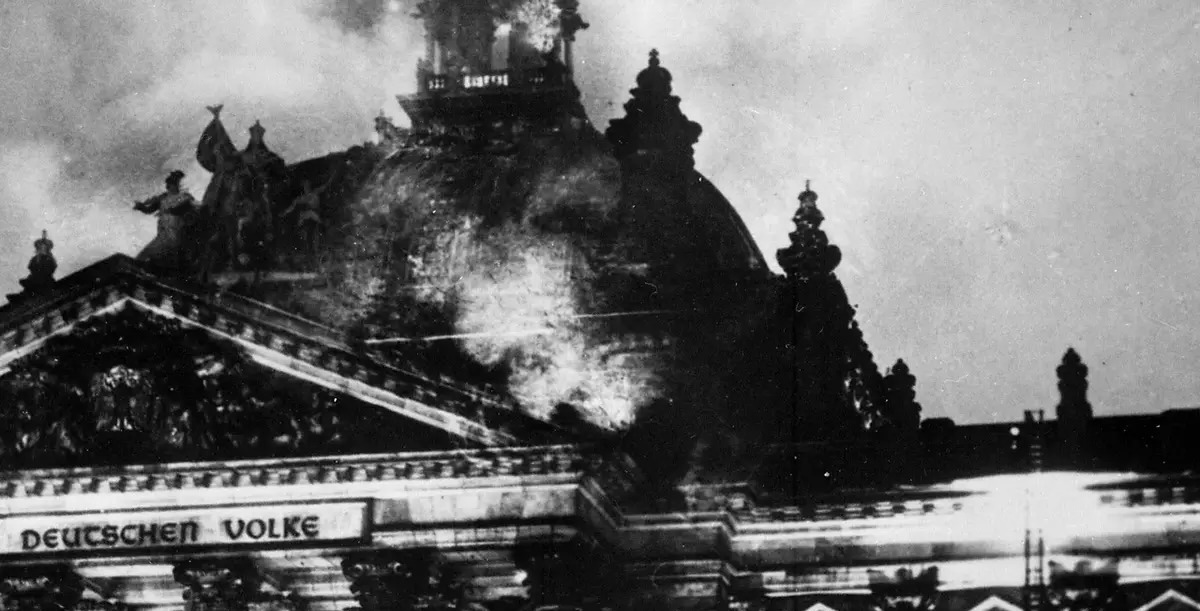
The legal takeover of the nation began five days before those elections were scheduled to take place when a massive fire broke out in the Reichstag. A twenty-four-year old Dutch Communist, Marinus van der Lubbe, was caught at the scene, supposedly carrying plans to set additional government buildings and palaces on fire. According to reports, this was to spark an uprising, a “bloody Bolshevik revolution and civil war.”
Almost immediately questions were raised about this claim; it was considered unusual for an arsonist to have his passport and planning documents with him when committing his crime, and how one man could carry so much gasoline into the building was never made clear. There was considerable speculation that Nazis had actually set fire to the Reichstag. While van der Lubbe was convicted of high treason and arson and executed by guillotine, historians have never found sufficient evidence to determine what actually happened that night.
Whoever instigated the attack, the fire provided the excuse the Nazis needed to seize additional power. While firemen were still battling the flames, the cabinet drafted an emergency decree “for the protection of the Germen people against the Communist danger,” which allowed the government to basically impose martial law. Civil liberties were suspended and political opponents were imprisoned. The Communist Party was essentially outlawed; about one hundred Communist members of the Reichstag were arrested, opposition rallies were banned, and leftist newspapers were prohibited from publishing. Six thousand Nazi storm troopers were given guns and truncheons and granted police powers. In the following days, as many as four thousand people were imprisoned.
The right-wing members of Hindenburg’s cabinet had failed to exercise any control over the Nazis. Europe feared the outcome. The Times of London wrote that the Continent “is facing a calamity as great as that which came with the declaration of war nineteen years ago.”
The outcome of the parliamentary elections was assured. The vote totals didn’t matter: The Nazis had taken control. “The German democracy, after a precarious life of 15 years, has succumbed,” the AP reported. “Chancellor Adolph Hitler, by ruthless suppression of the opposition parties, by occupying Communist headquarters and breaking up political meetings, and by mustering his Brown Shirt volunteers in every important city to terrorize the voters, has negated in advance whatever vote the German people may emit tomorrow.”
As Chancellor Hitler demanded, within weeks the new Parliament passed the Enabling Act, which gave the cabinet—over which he had total control—dictatorial powers. “Hereafter,” it read, “the Chancellor will simply proclaim laws decided upon by the cabinet. These laws will not require the approval of the Reichstag…Laws proclaimed by the chancellor may deviate from the constitution.”
Speaking from a balcony, as the huge jubilant crowd roared “Heil Hitler,” he said, “The first chapter of our movement is closed. Now we begin the second.”
Throughout the rest of 1933 Hitler consolidated his power. He abolished all the other political parties and trade unions, he arrested opponents and sent them to the first concentration camp, Dachau, which became a training camp for guards and a model for the thousands of additional camps that would be established. He began systemic persecution of Jews, including starting a nationwide boycott of Jewish-owned businesses and prohibiting them from holding government jobs, teaching in universities, or practicing law. He appointed governors to exercise control over the various state parliaments. And he took the first steps toward rearmament by withdrawing from the League of Nations, which had limited the nation’s military.
The only person who could have stopped him was the aged Reichspräsident Hindenburg. But for a variety of complex reasons, he failed to act. When Paul von Hindenburg died in August 1934, his son, Colonel Oskar von Hindenburg, announced that just before his death his father had designated Hitler as his “direct successor as head of the German State.”
Hitler named himself president and chancellor, declaring himself Der Führer, the unrestrained leader of the nation, and held a referendum to confirm that this was the will of the people. Although he received almost 90 percent of the forty-two million votes cast, American newspapers, perhaps searching for some positive news, noted that this was fewer votes than he had gotten only months before.
The number of votes for or against him made no difference. Hitler had used the tools of democracy to destroy it. The election was neither free nor fair.
In addition to fraud, throughout history, powerful men have intimidated voters to deliver the election results they demanded. Fear is an effective political tool. The Nazi party had proved that dissent was dangerous, sometimes deadly. Political enemies had been imprisoned or killed. The 1933 Law against the Founding of New Parties had essentially ended any organized opposition. Conversely, the Nazi Party had begun restoring the German pride that had been surrendered in the Treaty of Versailles. Ebert’s plea to the victorious Allies to treat his nation with respect and economic decency after the Great War had been ignored. So, while some voters were intimidated into supporting Hitler’s referendum, many others did so to celebrate Germany’s return to the world stage as a powerful nation that had to be respected.
The results of that election—while certainly not legitimate—made the world pay attention.
During the next few years, he rebuilt the German military and instituted more and stronger racial and anti-Semitic laws. He created an oath to the Führer, in which Germans pledged their unconditional allegiance to him rather than the state. In late 1934, more than seven hundred thousand people attended the now annual Nazi rally in Nuremberg, which became a massive propaganda victory when the documentary made by Leni Riefenstahl, Triumph of the Will, introduced the rebuilt militant Germany to a global audience. The 1936 Berlin Olympics provided a platform to show the world how Germany had emerged from the ruins of the Great War to once again become a powerful nation whose rights and desires had to be recognized and respected by the rest of the world.
Europe did not know how to deal with this new Germany. During the ceremonial march of nations into the Olympic stadium, for example, the Atlanta Constitution reported, “Sensational enthusiasm was evoked by the French squad, which not only dipped its colors but gave the Nazi salute during the entire circuit of the track. Hitler stood, returning the salute.” But that same newspaper informed readers, “France, alarmed by Hitler’s reoccupation of the Rhineland and the disintegration of the Versailles and Locarno pacts, built a monster line of subterranean forts along the Rhine and speeded her munitions factories.”
Hitler truly began pursuing his dream of a vast German empire, a Third Reich that would last for a thousand years, when he annexed Austria in 1938. World War II began on September 1, 1939, when German troops attacked Poland, causing England and France to declare war. By the time the Führer committed suicide in his bunker beneath a Berlin street on April 30, 1945, and Germany surrendered a week later, more than seventy countries had been involved in the conflict. As many as fifty million civilians and twenty-five million soldiers—including 5.3 million German troops—had been killed. In hundreds of concentration camps in Germany, Poland, Austria, and other occupied countries, six million Jews, more than a third of all the Jews in the world, had been murdered. It was the deadliest war in history. Vast parts of Germany and much of Europe were reduced to rubble, traditional borders across Europe had been erased, and an estimated twenty million people were homeless. The chaos created by Hitler resonated for decades. In the years following the war new political alliances had been forged, new nations had been created, a Cold War between the Western Allies and the Eastern Communist bloc had begun, bloody border disputes erupted in Europe and the Middle East, and regional wars had become almost common.
Beginning in the back room of a beer hall, with only a few other men, Hitler has become a symbol of evil equal to the most reviled villains of history. But his life, and his rise to power, remain a vitally important lesson of how democratic institutions can be perverted for individual gain.
____________________________
Excerpted from The Elections That Changed the World: Fifteen Pivotal Moments That Shaped How We Live by Dana Bash, with David Fisher. Copyright © 2026 by Dana Bash and David Fisher. Published by arrangement of Hanover Square Press/HarperCollins Publishers.

Dana Bash and David Fisher
Dana Bash is CNN's Chief Political Correspondent and the anchor and co-host of Sunday morning's State of the Union. She regularly serves as a moderator for CNN''s political town hall specials and debates, including the 2024 presidential debate between Joe Biden and Donald Trump. She has conducted sit-down interviews with major political figures, including Kamala Harris, Donald Trump, Ted Cruz, Marco Rubio, Bernie Sanders, and more. She is based in Washington, D.C.
David Fisher is the author of almost one hundred books, of which twenty-five are New York Times bestsellers. He lives in New York with his wife, Laura.