How We Paint Dogs Says More About Us Than It Does Them
Thomas W. Laqueur on the History of Dogs in Art
Dogs have long occupied a position at the boundary where the human animal meets the rest of creation. The great Victorian critic John Ruskin thought that the artists of Renaissance Venice—Titian, Veronese, Tintoretto—painted dogs “to give the fullest contrast to the highest tones of human thought and feeling.” They attracted these painters not because they are “the basest of animals, but the highest – the connecting link between man and animals.” This is not a claim about their position on an imagined evolutionary tree or even a Great Chain of Being, but a status conferred on them by artists who thought of dogs on a social and moral continuum with humans, as a kind of double in another register.
This idea has a long history. Diogenes the Cynic, a younger contemporary of Plato’s, was known as the dog philosopher—from the Greek word for dog, Kynikós—because he lived a life at the borderlands of culture: like a dog. Diogenes was a liminal creature; he lived on the street, close to nature; he did in public what civilized humans did only in private. And why not? he argued. He was ever unmasking the natural man who resides within the civilized one. Plato is reported to have thought of him as a mad version of Socrates in his challenges to civic convention. Diogenes the dog philosopher was not—could not have been—the cat, or the horse, or the donkey, or the bird philosopher; there is no equivalent thinker for other species.
If we were to translate Diogenes’ real-life effort to live on the same scale as a dog—‘like a dog’—into a continuum of the visual and literary figuration of animals more generally, we might put birds at one end. They stand in a metaphorical relationship to us—a parallel world on another level—that takes on various meanings. Think of doves in paintings of the Annunciation or dead pheasants in Dutch still-life paintings. Dogs would be at the other end of the scale, metonymic creatures that stand in for us—and did for Diogenes—by virtue of their cultural proximity. They are “almost human.”
They go with us as a double, a step or two ahead or a step behind or a step at our side; looking at us; looking at what we are looking at or in a direction we might look to next; or showing us where to look; or looking as if from the position of the artist or in the direction he or she wants us to look; or looking with a central human figure in an image; or sometimes dogs are just being there in a great variety of spaces and places represented in the visual arts, doing their part to create an imaginary world.
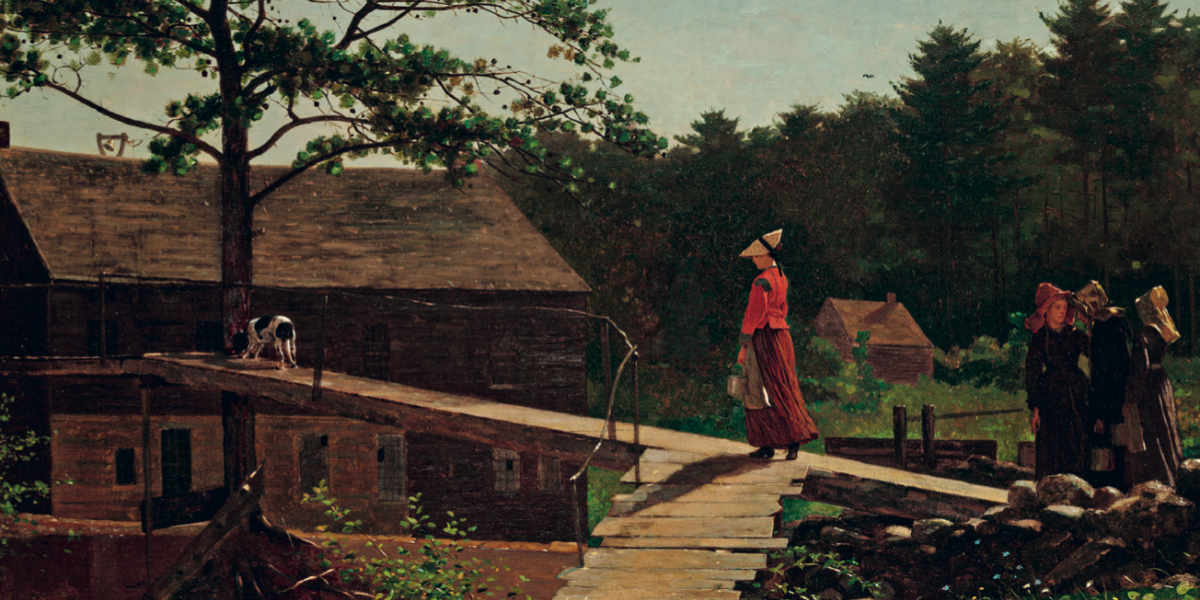
Winslow Homer’s The Morning Bell (originally The Old Mill, pictured above) is illustrative of this distinction in art. The dog on the raised walkway and the bird in the sky above the girl entering the mill make us think in an altogether different register about the painting. That is, they are details that get our attention, that make us focus. Like the punctum of a photograph, they visually and emotionally grab us. The bird is such a detail: a metaphorical creature from a parallel world, from the light-blue sky that stands in contrast to the more sombrely painted earth. It could mean the ‘naturalized image of the soul’s ascent’, as one critic suggests, or the freedom of flight as opposed to the oppression of long days in the factory, or the possibility of escape. But whatever it means it captures our attention and it is not in the girl’s world, a different, hence metaphorical creature.
They—together—make us focus; they make demands on how we see the painting.
The dog is an altogether different matter. It is a metonymic creature in this painting: very much a part of her, a double, a few steps ahead. The two are painted as a pair formally and in any narrative account we might give of the painting. Their images divide the diagonal axis almost exactly into thirds. Unlike thousands of hunting pictures, including those by Homer, where dogs belong, there is no such reason for the dog to be here; workers did not take dogs into the factory.
And indeed, it is not clear in the painting where the girl and dog are going; the walkway seems to end in shadows, in a dead end. The dog is ahead and has stopped by the tree that bisects the diagonal; the girl with the bright red coat who seems to be paused behind him. They are in synch, emotionally and visually bound together (but for how long?), poignant and hopeless together on a bridge from somewhere to somewhere. They—together—make us focus; they make demands on how we see the painting. This is what I mean by dogs as doppelgängers.
Or close relatives. From the Neolithic rock art of what is now Libya to ancient Egypt, China and India, to medieval and Renaissance Europe, creatures at borderlands of what was taken to be civilization were represented as cynocephalic, that is, humans with dog heads. These are not like the bird-headed therianthropes of Palaeolithic and later rock art, which are evidence of cultures that understand the boundaries of the human and the animal to be porous as part of themselves and the world they inhabit: animism. They are visual claims about purportedly dog-headed creatures in the natural world.
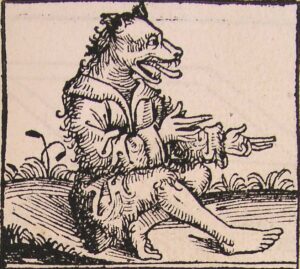
St Christopher is represented as dog-headed, for example, in icons of the Armenian and Byzantine churches because he was said to have been from a strange savage tribe in north Africa before his conversion, or more generally because he was a foreigner who might also be interpreted as a protector of Christ and his people. He is doing one of the things that dogs do: protect humans. There are humans with a dog’s head in John de Mandeville’s account of Ethiopia, his fourteenth-century Book of Marvels and Travels, which became one of the most popular travel books ever; they are there from very near the beginning of the age of print in books, like the widely circulated illustrated encyclopedia, the Nuremberg Chronicle (pictured above from the chronicle is a woodcut of a cynocephalic creature by Hartmann Schedel, 1493).
There are very few hints in art of dogs being dirty, vicious or rabid.
St Augustine was skeptical that these strange creatures existed on the other side of the world, which may not exist either: “what am I to say of those dog-headed men whose dog’s heads and actual barking show they are more beasts than men.” But he concludes that if there were such a place and if dog-headed people lived there, and no matter how unusual they might be, they “derive from the original and first-created man.” That is from Adam, just over the border of the fully human from the very beginning. In the visual arts that I engage with in this book there are no paintings of cynocephalic humans. But these images as well as those from other cultures are evidence of how deeply the dog is lodged in folk consciousness as an imaginary animal alter ego. We not only see them but we understand that they see us and our environment in a mutually intelligible way, gazing and not just being gazed at.
Readers might think that from the perspective of the dog my engagement with its gaze is naively anthropocentric. If a dog were writing this book, it might be called “What the Dog Smells,” because we know that it is the dog’s prodigious olfactory powers that determine much of how it experiences the world it inhabits and presumably its relationship specifically with us.
But such a book is not possible. First, of course, because a dog would not be writing a book; but also because smell is so hard to represent. Proust in speaking of his aunt’s apartments in Combray writes about “the countless odours springing from their own special virtues, wisdom, habits, a whole secret system of life, invisible, superabundant and profoundly moral, which their atmosphere holds in solution”; smells “coloured by circumstances as are those of the neighbouring countryside, but already humanized, domesticated, confined, an exquisite, skilful, limpid jelly . . .” Proust has no equal in conjuring the culturally and physiologically dense human experience of smell. But no human can begin to describe the granularity of the world present to the dog’s refined sense of smell as it takes a walk or runs in a field.
Visual artists are severely limited in how they might represent the sense of smell in humans. There is a small genre of works that tries in the context of paintings of “the five senses,” which either represent people happy and contented smelling something that we take to smell good—flowers for example—or scrunching up their noses when confronted by something we understand as smelling bad—a rotten egg or a decomposing body for example—or in some other way responding to something under their noses; Rembrandt in his study of the five senses paints a woman being revived from a faint by smelling salts. None of these strategies would work to represent a dog smelling. Their faces cannot express how they think about a smell and they are not very discriminating. As Darwin pointed out, dogs seem to delight in pretty much anything. We have far fewer common references with them than we have with other humans.
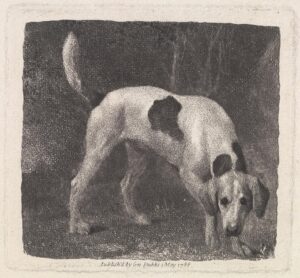
And there is another problem. Even when artists represent dogs doing what they do best, their long, dolichocephalic heads with their long noses make it seem that they are simultaneously making a visual gesture. Even when they aren’t, their noses are like a pointing index finger in the direction of their eyes. They appear to be looking and pointing even if, as in a George Stubbs’s drawing (“A Foxhound on the Scent,” pictured above, 1788), the artist tells us explicitly that the dog is smelling. In countless pictures of dogs with hunters holding game or in the presence of well-perfumed humans we can infer that they are smelling something of interest but that is not what we see. Neither word nor image is adequate to the task of representing the dog’s sensorium. This is inevitably a book by a human about how humans—the makers of art and its viewers—understand the dog seeing in relation to our species.
And yet, even from the dog’s perspective, its sight is essential to its ability to live with us and join in what we do. A dog’s responses to visual cues from humans is the foundation of its social competence generally and in particular contexts. So-called sighthounds, for example—greyhounds, whippets and their kin—are disproportionally represented in the Western visual arts from Giotto to the nineteenth century because of their skill in coursing, a favorite subject for artists. This is a special case. The pervasive cross-species relationship we have with dogs is grounded in their gaze which, in turn, makes possible their wide social competence and the ease with which they live with us so comfortably and in such numbers.
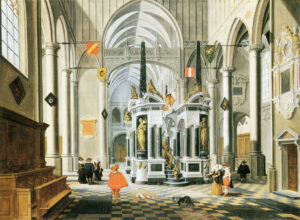
But this reality itself does not account for their place in the artistic imagination. Artists are free to choose to include them or not. There are two dogs, for example, in Bartholomeus van Bassen’s painting of an imagined church interior with the tomb of William the Silent (pictured above, 1620). The same holds true for dogs in fields, and taverns and studios and all the other places where they might have been or not. Their outsize presence in mythological paintings is of course not a question of reality—of naturalism—at all. The stories need them but this is the case because dogs figure so powerfully in how literature and the visual arts imagine human interactions among themselves and with the gods who them-selves have dogs. In all these cases their presence thus represents not so much reality as the reality effect, the sense that this is how a world is made to seem as it is.
In one important way the dog in art does not reflect reality, in the real world, or in the imagination, the reality effect. There are very few hints in art of dogs being dirty, vicious or rabid. Nothing about the frequency of dog bites. Nothing that reflects the sheer abjection of the murderous dog pounds of the nineteenth and twentieth centuries or the many individual cruelties visited upon dogs. Nothing in art about their being polluting.
The reason for this absence is that dogs appear in art as part of a social contract; they see us, and we see them; and we engage with the world together. On occasion, artists represent dogs gently breaking out of the comforting premises of good order. The dogs in paintings of the story of Diana and Actaeon who attack their master after the goddess has turned him into a deer bear witness to the fragility of our mastery of nature and the compact we have with some animals. It touches the boundaries of what it is to be human; Actaeon becomes a man in a deer’s body. Generally the vicious or rabid dog or the cruelly treated dog or the dog who acts out of character in art is a sign of something morally amiss.
Dogs are also there because of the emotional work they do: they humanize humans.
If paintings were like unedited photographs in the all-seeing eye of God—a record of human attitudes toward, and treatment of, the dog’s ubiquitous presence in life—then reality might explain why there are so many of them in art. But neither painting nor photography imitates nature.
If anything, it’s often the other way around. The story is told that Sir Peter Lely, the most important portrait painter of the British Restoration period, claimed that for want of a dog he could not finish a portrait of the well-known artist Mary Beale. A friend searched the vicinity of Covent Garden to find one: “I hunted about ye towne from one end to the other after a dogg,” he reports, and finally found one that he dragged back—kidnapped—to Lely’s studio. The painting was completed and “dispatched to Allbrook” where the Beales were living. Three centuries later Richard Avedon, one of the twentieth century’s great portrait photographers, writes that when he was a child his parents used to borrow a dog for their family portraits. Such social conventions dictate how nature is imagined and represented in art, not the other way around.
The philosopher Nelson Goodman goes a step further. He argues “that nature imitates art is too timid a dictum”; “nature is a product of art and discourse.” We make the world we live in as creatures in culture through symbols and signs, and dogs in art constitute part of that symbolic system. They bring their world into ours, which is perhaps how they make us feel less lonely as a species. This is the abstract answer to the question of why there are so many dogs in Western art and what they are doing there.
A less abstract one would be: Formally, dogs are there in art because they organize the visual space of an image and the ways we are asked to respond to it. They point to things, they tell us where to look, they make connections both between things in the image and gesture to us as observers of the image. They don’t all do it in the same way. Some-times it is perspective that they help create; sometimes looking out at a great expanse; sometimes intimate close looking and pointing.
Dogs are also there because of the emotional work they do: they humanize humans. They have done this since the earliest days of Western literature, since Homer. When Odysseus returns to Ithaca he sees the dog with whom he had “hunted down wild goats and roe deer and hares . . .”, missed by no one since his master had gone away:
So there lay Argos – ‘Flash’ – riddled with vermin, that plague of dogs. Now, though, as soon as he sensed Odysseus was close by,
Look! – he wagged his tail and both his ears went flat.
But after he hadn’t the strength to come closer to his master, Who looked in the other direction and brushed away a tear.
The formal and the social and psychological work of dogs in art are both consequences of their gaze. The rest of this book explores these themes.
__________________________________
Excerpted from The Dog’s Gaze: A Visual History by Thomas W. Laqueur. Copyright © 2026. Reprinted with permission of the publisher, Penguin Press, an imprint of Penguin Random House. All rights reserved.

Thomas W. Laqueur
Thomas W. Laqueur is the Helen Fawcett Distinguished Professor of History Emeritus at the University of California, Berkeley. An internationally renowned cultural historian, he has published books on topics ranging from working class religion and education during the industrial revolution to the history of sexuality and the body. He is a member of both the American Academy of Arts and Sciences and the American Philosophical Society, and recipient of the 2007 Mellon Foundation Distinguished Achievement in the Humanities Award and the 2016 Cundill Prize for Historical Literature. His work has been translated into twenty languages.