How Trotsky and Stalin, Ruthless in Their Own Ways, Absolutely Hated Each Other
Josh Ireland on the Deadly Rivalry Between Two Power-Hungry Revolutionaries
When did Joseph Stalin decide to crush, or destroy, or kill Leon Trotsky?
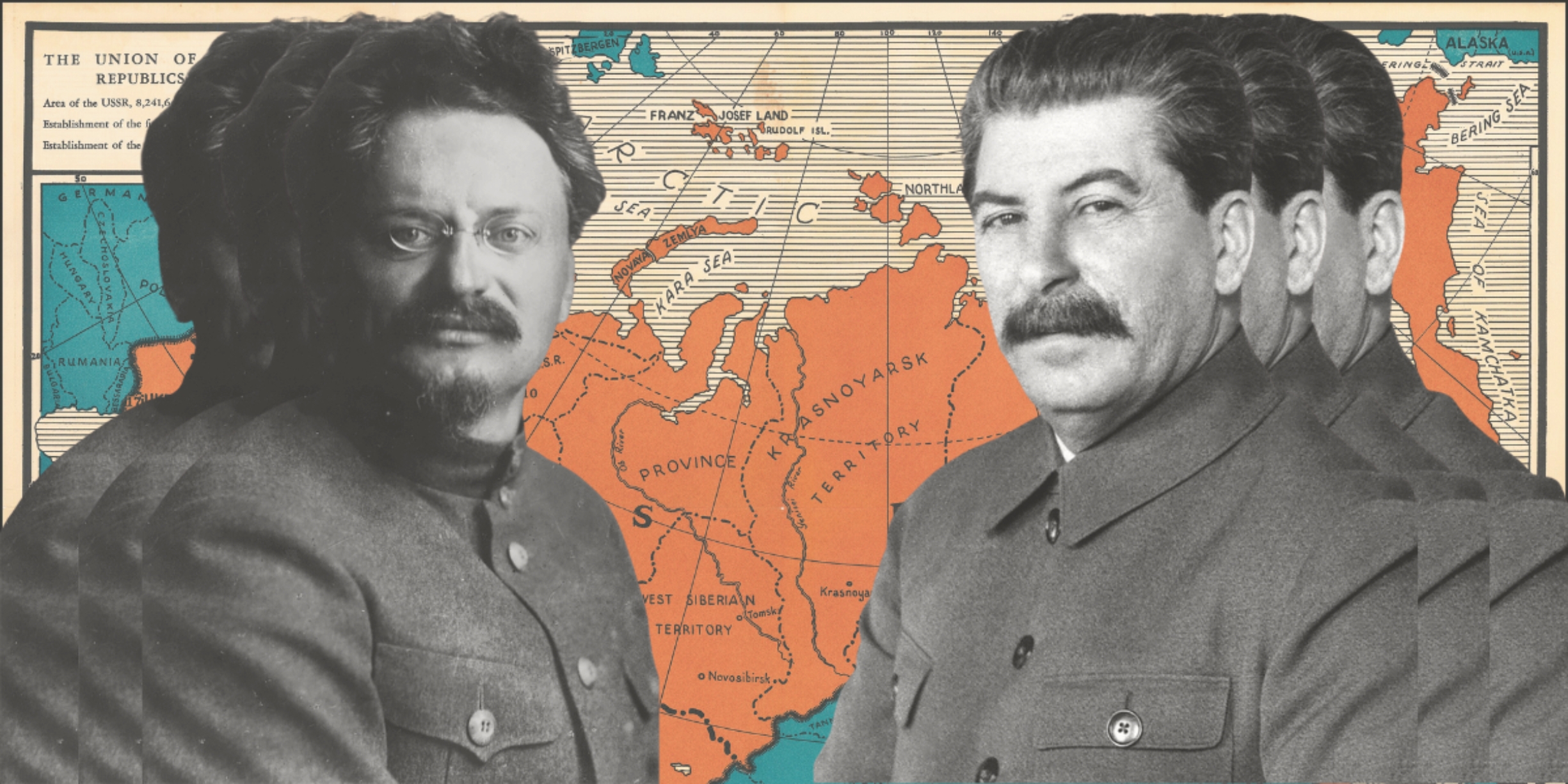
Perhaps it was the first time these two men met—in 1907, at the Russian Social Democratic Labor Party’s Fifth Party Congress in a damp, shabby church in London. Trotsky claimed later not to remember even seeing Stalin, who apparently remained mute for the whole three weeks of debates and arguments.
Trotsky was tall, with broad, muscular shoulders, a “great head,” abundant hair, and curiously small hands. He looked, at times, like a bird of prey: most of all because of his “mouth—big, crooked, biting. A frightful mouth.”
He was vain. There was something instinctively theatrical about him. He was always “calculating the effects of his gestures, his pauses and intonation.” He loved dressing up in gloves and shapely clothing—the things that the revolution he identified with so closely was supposed to be sweeping away.
He was clever, with an insatiable desire to exceed others. Even when he became one of the most infamous figures on the planet, he never quite stopped being a clever schoolboy desperate to show others how much he had learned. Many thought he was the most dazzling speaker of his era. The kind of man who could make old, familiar ideas appear new and fresh. Even when he was wrong—and Trotsky was often wrong—he was still intoxicating. His arguments were original, surprising, and often brilliant. When he talked, his face lit up and his eyes flashed. Witnesses spoke wonderingly about his voice’s “electric crackle.”
Trotsky was the man who had done more than almost anyone else both to help the Bolsheviks seize power and to protect their prize during the Russian Civil War. For this he was celebrated and vilified in equal measure.
And yet none of this would have mattered had he not married his fine words and fine gestures to immense courage and a queer instinct for those moments when history’s tectonic plates were shifting.
This precocious son of an illiterate Jewish farmer from an obscure part of what is now Ukraine, he emerged as a national figure during the revolution in 1905 that briefly shook the Russian Empire’s foundations. Somehow this shortsighted dandy who had never worked in a factory, nor spent a day in uniform, nor even studied at a university, found he could fire the imaginations and mirror the emotions of workers, soldiers, and students. He was just twenty‑five, and yet, standing at the head of the St. Petersburg Soviet of Workers’ Deputies, he spoke with an authority that exceeded even that of the tsar. (When a gendarme tried to arrest Trotsky while he was in full flow, the young revolutionary rounded on the startled police officer: “Please don’t interfere with the work of the Soviet. If you wish to speak, kindly give your name and I will ask the assembly if they wish to hear you.”) His glory was, of course, short‑lived. Prison, then exile, followed.
This was the second time he had been banished to Siberia. His earliest revolutionary activities, when he was still known as Lev Davidovich Bronstein, had been brought to a sharp halt by his arrest in 1898. He spent two years behind bars awaiting trial—during which he married his first wife, Aleksandra Sokolovskaya—before he was sentenced to four years in the farthest‑flung corner of the Russian Empire. He studied philosophy, had two daughters with Aleksandra, and then, in 1902, urged by his wife (“Go, a great future awaits you”), he escaped in a hay wagon.
In my hands, I had a copy of the Iliad in the Russian hexameter of Gnyeditch; in my pocket, a passport made out in the name of Trotsky, which I wrote in it at random, without even imagining that it would become my name for the rest of my life….Throughout the journey, the entire car full of passengers drank tea and ate cheap Siberian buns. I read the hexameters and dreamed of the life abroad. The escape proved to be quite without romantic glamour; it dissolved into nothing but an endless drinking of tea.
One thing led to another and he found himself in London, where he met Vladimir Ilyich Lenin, a man whose respectable clothes, neat beard, and “strange, faun’s face” were scant disguise for the ruthless, uncompromising will to power that lay beneath. How, asked one of his political opponents, can you deal with a man who “for twenty‑four hours of the day is taken up with the revolution, who has no other thoughts but thoughts of the revolution, and who, even in his sleep, dreams of nothing but revolution?” The party he led, the Russian Social Democratic Labor Party, was perhaps the most extreme of the many socialist groups formed in Russia during this period. They were “millenarian sectarians preparing for the apocalypse,” willing to sacrifice everything, willing to countenance any amount of bloodshed, if it meant they could depose the hated tsarist regime and completely transform society. Their ambitions were not limited to Russia. Revolution there would simply be the first act in the eventual, inevitable worldwide triumph of the working classes.
But although Trotsky would one day call Lenin the “greatest leader of the proletariat in the history of mankind,” for more than a decade, they both found themselves embroiled in the factional struggles that saw the party split into two warring sides: the Bolsheviks, who argued for a smaller, more tightly organized party; and the Mensheviks, who favored a looser organization. Lenin led the Bolsheviks. Trotsky initially supported the Mensheviks, though later he adopted a more independent position, calling himself a “non‑factional social democrat.” This was not enough to save him from the rancor that surrounded these disputes. Lenin, whose gift for vituperation was unmatched, called Trotsky a “Little Judas,” a “scoundrel,” and a “swine.” Trotsky was just as vicious in return—abuse was a common currency in the incestuous world of exiled Russian revolutionaries; it was only years later that he came to regret his invective.
His second exile began with another daring escape that allowed him to rejoin the family he had started with Natalia Sedova, whom he had met in Paris in 1902. Over the next decade and a half, they moved through London, Vienna, Paris, Spain, and finally New York, where in February 1917 he learned of the uprising in Russia against the tsar. As fast as he could, he scrambled to return home.
*
Joseph Stalin was compact and ungainly, with a withered left arm and a pockmarked, sallow face whose expression told nothing of what he felt. His sunken feline eyes were honey‑colored most of the time but flashed a lupine yellow when angry. When he walked, it was with a limp; the second and third toes of his left foot had grown together. In meetings he spoke rarely and in a low, monotonous voice. Occasionally, his tone softened still further, and his Georgian accent emerged. At other times he simply smoked a Dunhill pipe packed with cigarette tobacco and doodled (phrases such as “Lenin‑teacher‑friend” or, as one foreign visitor noted, a drawing of wolves).
Melodramatic and vainglorious, moody and capricious, a fidgety, neurotic hypochondriac, Stalin was a bundle of appalling contradictions. He was a frustrated poet and a fine singer who destroyed every intimate relationship he entered. He possessed both an uncontrollable temper and extraordinary willpower. He was capable of bewildering recklessness and cold‑blooded displays of control. Much of his behavior was possible because he despised pity, sympathy, mercy. Some people dated this rejection of ordinary human values to the death of his first wife. He had pointed at the coffin and said to a friend, “Soso, this creature softened my heart of stone; she died, and with her died—my last warm feelings for all human beings.” At this he moved his right hand to his heart: “It is all so desolate here inside, so inexpressibly desolate.” It’s also possible his moral deformation occurred during his harsh childhood. On one of the very few visits he made to his mother in Georgia, Stalin asked her why she had beaten him so often.
“That’s why you turned out so well” came the reply.
Nobody was better than Stalin, a man who read Machiavelli constantly, at spotting weakness in another person or institution. (He possessed an uncommon talent for snatching more from situations than they appeared to offer.) And nobody could sink their teeth so viciously into that soft spot, tearing and ripping until he had got exactly what he came for.
Stalin was an exceptional student who might have become a priest, but instead ended up as a gangster‑revolutionary. Like Trotsky, he had come from one of the far corners of the Russian Empire—in his case, Georgia. But he had traveled little and felt uncomfortable among the cosmopolitan exiles who made up much of the party. He loathed the way they talked, the jokes they told; he loathed émigré life, foreign countries, the intelligentsia—all the things that Trotsky embodied.
The two men felt an immediate and almost physical revulsion for each other. Stalin hated Trotsky’s delicately balanced pince‑nez and sweep of dark, glossy hair, his self‑confidence, eloquence, and authority. Trotsky was repulsed by the Georgian’s pockmarked face, his coarse manners, his provincialism.
Their paths crossed again—once they both returned to St. Petersburg in 1917 after the tsar had abdicated following the revolution in February of that year. Trotsky arrived in Russia on May 17, 1917. It was clear that his sympathies now lay with the Bolsheviks, who realized that the ferment into which Russia had been thrown offered them an unprecedented, perhaps unique, opportunity to establish, for the first time in history, a true workers’ state.
While the party’s leader, Lenin, was in exile in Finland and other Bolsheviks wavered just as it looked as if power were in their grasp, Trotsky was a force of nature: agitating, organizing, leading, doing everything he could to help prepare the coup that would allow the Bolsheviks to supplant the floundering liberal Provisional Government that had succeeded the monarchy. Then, on the night of October 25, 1917, with Lenin now back in St. Petersburg, the insurrection began. In the course of a little under twenty‑four hours, a handful of violent idealists seized control over an empire of millions of souls.
During these months, Trotsky and Stalin saw each other everywhere: at meetings, conferences. Stalin had obviously become an important figure—he was Lenin’s “wonderful Georgian”—and yet Trotsky appeared unable to see him as a personality in his own right. He might have registered the way Stalin’s cold eyes fixed on him each time they passed each other in a corridor, or he might have noticed Stalin sitting on the other side of the room, but Trotsky never seemed to recall if Stalin had even spoken. (Trotsky on Stalin’s revolutionary record: “The sum total of Koba’s revolutionary activities during the years of the First Revolution seems to be so inconsiderable that willy-nilly it gives rise to the question: is it possible that this was all?”)
Stalin was not just incensed by the way that this strutting peacock dismissed and disregarded him; he was jealous of how he himself had been supplanted in the Bolshevik firmament. By most measures, Stalin’s life was already a success. He had made an astounding journey from being the child of illiterate parents to thriving at the heart of a revolutionary government. But it was Trotsky, not he, who emerged as a preeminent figure once the Bolsheviks were in power. It was Trotsky, who had been a Bolshevik for only a matter of months, who was seen as Lenin’s right‑hand man and likely successor. And with the onset of civil war—which pitched the Bolshevik Red Army against the White Army, a loose coalition of factions from across the political spectrum united only by their desire to thwart Lenin’s increasingly repressive regime—it was Trotsky who was made war commissar.
*
Trotsky welcomed the civil war that followed the Bolshevik coup in October 1917.
He was intoxicated by the Bolshevik triumph, which he called “the festival of the oppressed.” His entire life had been devoted to an almost abstract idea of change. And now it had come. Despite the Soviet state’s parlous position, he was suffused with hope. A better future seemed to be just within reach. And his vision for this future was ecstatic: a universal order that would set the human spirit free.
In one celebrated passage, he talked lyrically of how human beings would change under socialism.
Man will become incomparably stronger, more intelligent, more subtle. His body will be more harmonious, his movements more rhythmical, his voice more musical; the forms of daily existence will acquire a dynamic theatricality. The average human type will rise to the level of Aristotle, Goethe, Marx. It is above this ridge that new summits will rise.
Every atom in his body was obsessed with revolution. There was nothing more important to him, nothing he believed that was not worth sacrificing to make it work. He once told a biographer that he and the party were perfectly happy to “burn several thousand Russians to a cinder in order to create a true Revolutionary American movement.” He meant it. Nothing, he said, was more humane in a revolution than the utmost ruthlessness.
And now a chance to show this ruthlessness had arrived. With victory, the Bolsheviks would be able to eliminate the nation’s exploiting classes once and for all. The jet‑black hair and lively bright blue eyes of the new war commissar appeared everywhere. He was carried in a train stuffed with weapons, uniforms, and felt boots. It had a printing press (occupying two carriages); a telegraph; radio and electric power stations; a library; a garage complete with trucks, cars, and a petrol tank; and a bath as well its own secretariat, team of agitators, and twelve‑man bodyguard (who, when not protecting Trotsky, looked out for food such as game, asparagus, and butter.) Over the course of the war, one of his companions estimated that they traveled the same distance as they would have if they had circled the world five times.
Just Trotsky’s presence at the front was sufficient to raise morale. Troops lined the route and greeted him with great cheers or renditions of “The Marseillaise.” Clad head to toe in black leather, he would then proceed to act with extreme, flamboyant decision: setting up revolutionary tribunals to try turncoats; giving instant orders to repair supply problems; creating new divisions on the spot.
He was fond of rewarding those soldiers who distinguished themselves in battle with gifts such as watches, binoculars, telescopes, Finnish knives, pens, waterproof cloaks, and silver cigarette cases. Once, when in Bogorodskoe, he was presented with twenty men but found he had only eighteen gifts. With a flourish he gave one man his watch and another his Browning pistol.
There was another side to this largesse. One of the carriages on Trotsky’s train was set aside as a revolutionary tribunal to deal with deserters and cowards. It was suspected that some of those shot for treachery on Trotsky’s orders weren’t guilty. But that was not the point. The word “ruthlessly” appears with extreme regularity in his Red Army orders.
Trotsky did not see, until it was far too late, that his opponent was both stranger and more gifted than he thought possible.
It was Trotsky—the man with the phenomenal cultural range and princelike bearing—who had argued, “We must rid ourselves once and for all of the Quaker‑Papist babble about the sanctity of life.”
It was Trotsky who ordered the slaughter of sailors from the Kronstadt naval base who had risen up against the Bolsheviks. These rebels, who Trotsky himself had once called the “adornment and pride of the revolution,” were disappointed by the way the Bolshevik government had diminished the civil rights of the working classes and become increasingly consumed by a mania for centralization and bureaucratization. This challenge could not be tolerated, so Trotsky sent sixty thousand troops from the Red Army to crush them. Revolutionary justice was applied without mercy.
It was Trotsky who, when faced with a peasant rebellion, approved of the measures introduced by the local commissars, which included the burning of insurgent villages, “the merciless execution of every single person who has taken direct or indirect part in the uprising,” and the execution of every fifth or tenth adult male inhabitant. “The nests of these dishonest traitors and betrayers must be destroyed,” he said. “These Cains must be exterminated.”
And it was Trotsky who, as much as any other leader, was intimately involved in the construction of the apparatus of terror—including helping to create the Soviet secret police, the Cheka (an abbreviation of the All‑Russian Extraordinary Commission, the forerunner of the NKVD)—that allowed the Communist Party to subjugate a population of millions. In a very profound sense, he combined what was most attractive and most repellent about Bolshevism.
*
The Civil War was an opportunity for Stalin too: it gave his desire for recrimination and revenge a physical form. He used his own authority to persecute Trotsky’s proxies. (At one time, he imprisoned four hundred of them in a barge moored on the Volga River—many starved or were shot or died when the barge sank. “Death solves all problems. No man, no problem,” Stalin said when he learned of the tragedy.) He placed articles filled with insinuations and crude exaggerations in Pravda, sent telegrams full of administrative slander, interfered with Trotsky’s orders, and tried to undermine his authority.
In response, Trotsky attempted several times to remove Stalin from any position with military responsibility, complaining to Lenin by effectively accusing Stalin of sabotage: “I consider Stalin’s [conduct] a most dangerous ulcer, worse than any treason or betrayal.”
Stalin was convinced that if Trotsky were to ever become the Bolsheviks’ leader, the revolution would be in mortal danger. But while Stalin identified Trotsky—the man he derided as an “operetta commander, a chatterbox, ha‑ha‑ha!”—as his main obstacle to securing power once the ailing Lenin died, Trotsky remained insouciant. It was as if he could not believe his comrade could also be a threat. Trotsky was the man who had done more than almost anyone else both to help the Bolsheviks seize power and to protect their prize during the Russian Civil War. For this he was celebrated and vilified in equal measure; his notoriety stretched across continents. Trotsky did not see, until it was far too late, that his opponent was both stranger and more gifted than he thought possible.
__________________________________
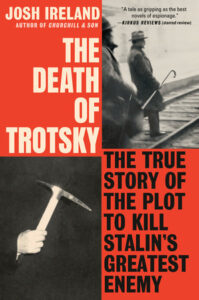
From The Death of Trotsky: The True Story of the Plot to Kill Stalin’s Greatest Enemy by Josh Ireland. Published by Dutton, an imprint of Penguin Publishing Group, a division of Penguin Random House, LLC. Copyright © 2026 by JoshIreland.

Josh Ireland
Josh Ireland is a writer and editor. He lives in London and is the author of The Traitors (2017), an Observer book of the year, and Churchill & Son (2021) a Daily Telegraph book of the year. He has also ghosted a number of top-five Sunday Times bestsellers and written for the Daily Telegraph, Prospect, Spectator and the Times Literary Supplement.