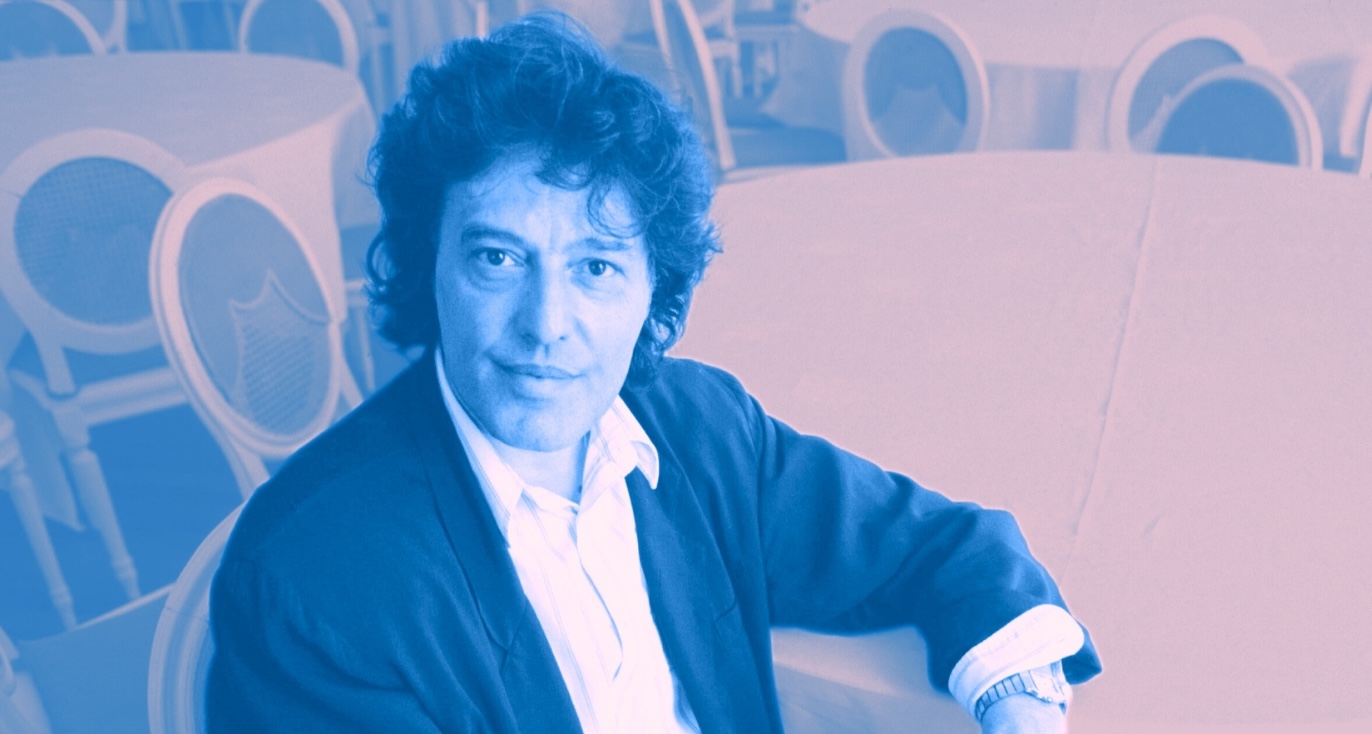
How Tom Stoppard’s Arcadia literally saved lives.
It’s unusual to encounter good news these days, particularly on social media. So I was delighted to come across this image on Bluesky earlier today, of a letter to the Times of London in reference to the great Tom Stoppard, who died over the weekend.
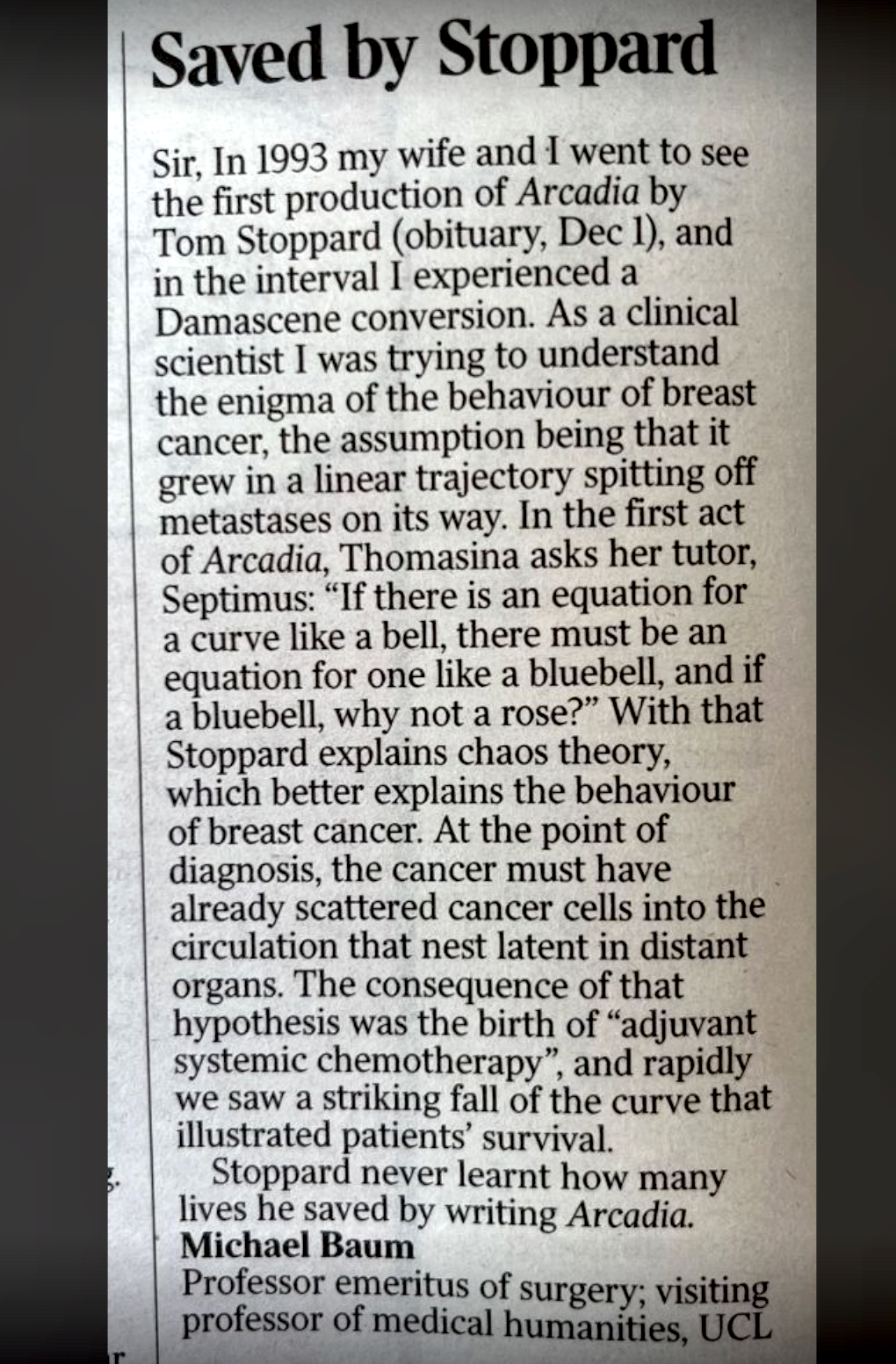
It’s from Michael Baum (Professor emeritus of surgery; visiting professor of medical humanities, University College London) and in it he cites some lines from Stoppard’s masterpiece, Arcadia, as the inspiration behind reconceptualizing the behavior of breast cancer cells. Here’s the salient bit:
In the first act of Arcadia, Thomasina asks her tutor, Septimus: “If there is an equation for a curve like a bell, there must be an equation for one like a bluebell, and if a bluebell, why not a rose?” With that Stoppard explains chaos theory, which better explains the behaviour of breast cancer. At the point of diagnosis, the cancer must have already scattered cancer cells into the circulation that nest latent in distant organs. The consequence of that hypothesis was the birth of “adjuvant systemic chemotherapy”, and rapidly we saw a striking fall of the curve that illustrated patients’ survival.
Now, fully half the Lit Hub staff have claimed to have had their lives changed by seeing Arcadia in college, but that’s nothing compared to how many lives must surely have been extended or saved by the aforementioned innovation. A remarkable example of how art really does change the world, and a fitting testament to Stoppard’s capacious (and restless) erudition.

Jonny Diamond
Jonny Diamond is the Editor in Chief of Literary Hub. He lives in the foothills of the Catskill Mountains with his wife and two sons, and is currently writing a cultural history of the axe for W.W. Norton. @JonnyDiamond, JonnyDiamond.me