How to Write a Book When Your Country Is on Fire
Anjali Enjeti on the Hard Choice to Carry On, Even in the Face of Authoritarianism
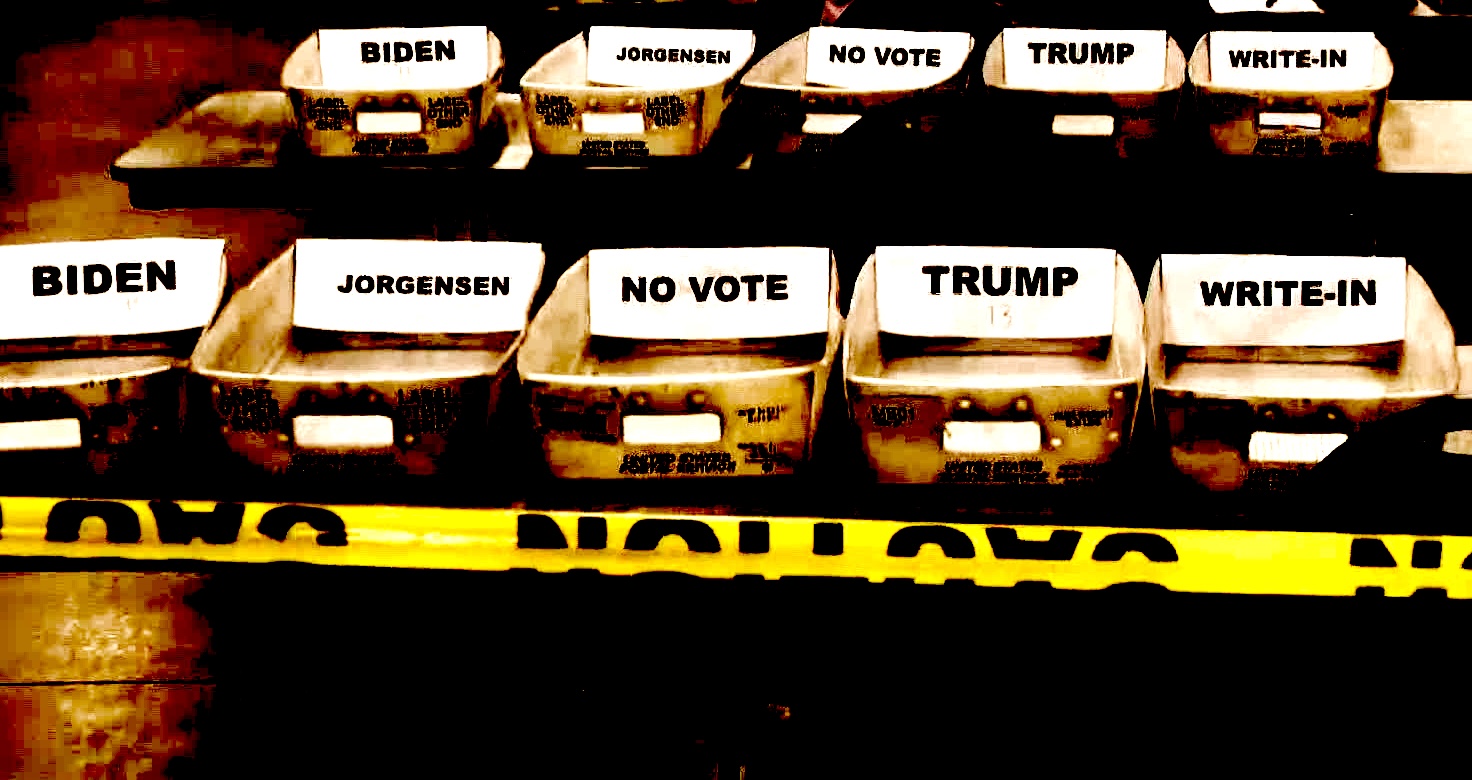
In August of 2023, I pitched a book about voting called Ballot for Bloomsbury’s Object Lessons series. I was confident, if not cocky, about the fact that I could write this book. I had been voting for over thirty years in every single election since I was nineteen years old. As a longtime Georgia voter, I had front row seats to the aftermath of the 2013 Supreme Court decision, Shelby County v. Holder, which gifted states with a history of racist voting laws a wide berth to re-implement them. I had co-founded an organization for South Asian Democratic voters. I had knocked thousands of doors and phone-banked for dozens of candidates, including for Joe Biden’s 2020 presidential campaign and Jon Ossoff and Reverend Raphael Warnock’s Senate campaigns. Meanwhile, I carried out my duties as a Fulton County poll worker and joined a group of Asian Pacific Islander voters in a lawsuit against my state for enacting a discriminatory voting law.
There was already a plethora of excellent books on voting rights, including my personal favorite, Carol Anderson’s 2018 book, One Person, No Vote: How Voter Suppression Is Destroying Our Democracy. Ballot would pick up where Anderson’s book left off. It would primarily focus on voter suppression laws and policies enacted after the 2020 presidential election, when Trump’s defeat spurred an epic temper tantrum (an electoral insurrection, so to speak), which pressured the battleground states he’d lost to erect a slew of voting barriers for Black, brown, and Indigenous voters.
I could write Ballot in my sleep. Or so I thought.
By the time I signed my book contract at the end of 2023, my despair over the US-backed genocide eclipsed any desire I had to write it. At the time, Israel had already killed at least 20,000 Palestinians in Gaza. I joined several local pro-Palestinian groups to figure out how we could best pressure our elected officials to implement a ceasefire. I left messages with the White House switchboard for Biden to stop the bombings and open the Rafah crossing. I called, wrote, and met with my members of Congress (virtually) to urge them to vote against sending arms to Israel.
That spring, inspired by Michigan’s Uncommitted Movement, I joined Georgia’s “Leave It Blank” campaign, which encouraged voters to cast blank ballots in the presidential preference primary. (We did not have an “uncommitted” option on our ballots.) Biden had won Georgia by the thinnest of margins in 2020. We hoped enough blank ballots would persuade him to change policy toward Israel in order to hold onto our state’s sixteen electoral votes. Unfortunately, all efforts to end the genocide went unanswered.
Meanwhile, several states passed laws that made it more difficult to vote. A revitalized Voting Rights Act laid dead in the water. Voting protections that once had decades of bipartisan support had drowned in a sea of anti-voting extremism.
Resistance against authoritarianism requires a revolution that goes beyond words.
I could not tune out the rise of fascism in the US, or the US’s role in genocide, in order to write my book. (How could I?) I could not stop scrolling through TikTok, X, or Instagram—the best platforms for accurate, time-sensitive reporting by Palestinian journalists. Nor could I ignore messages from my new friends in Gaza who needed medicine, tents, and baby formula, or quiet the very loud voice in my head that Trump would return to the White House if Biden didn’t change course on the genocide.
My book was the furthest thing from my mind.
*
Words build narratives, and narratives sow the seeds of revolution. I am a student of June Jordan, Angela Y. Davis, James Baldwin, Zora Neale Hurston, Audre Lorde, and Assata Shakur, among many other Black radical writers, scholars, and activists. During the genocide, I revisited their books, and also immersed myself in the writings of Palestinian authors Refaat Alareer, Adania Shibli, Susan Abulhawa, Mosab Abu Toha, Rashid Khalidi, and Edward Said. My belief that books had the power to pave the path to liberation remained unshakable.
Of course, books cannot replace concrete direct action with a measurable impact. They also can’t sustain social movements. We saw this play out in 2020, when the police killings of Black people, including Minneapolis resident George Floyd, intensified the Black Lives Matter movement and ignited calls to defund the police. The sales of Black-authored books soared. Non-Black readers, among other things, joined anti-racist book clubs and shared posts of reading lists. They rallied against the prison industrial complex, colonization, and opened their minds to abolition as the way forward. (I never thought I’d see the day.) Unfortunately, when incidents of crime increased, their Black-authored books began to collect dust. Or perhaps they were never read at all. Some returned to voting for “tough on crime” district attorneys and sheriffs, supported the expansion of police budgets, and greenlit the construction of cop cities across the US.
*
As our nation continued to burn in 2024, so did I. My Long Covid symptoms flared. I underwent a tailbone amputation surgery after thirty years of intractable pain, but the surgery failed to bring relief. In May, our family flew north to attend our first-born’s college graduation. I was relieved to finally have something to celebrate. Despite a disciplinary action pending against her for serving as a negotiator for their pro-Palestinian encampment, my daughter had been assured that she would be allowed to graduate with her class. But during the procession, she and two other encampment negotiators were refused entrance into the stadium. My husband and I vacated our seats to join them outside. We spent the evening surrounded by police in riot gear while pleading with an administrator, unsuccessfully, to let the students walk.
Given the tyrannical inferno that engulfed these precariously united states, my personal plights were mere embers, ashes, in the grand scheme of things. But the totality of the circumstances greatly impeded my ability to write Ballot. Each day brought an avalanche of doubt about whether I should be writing at all. Was Ballot an essential addition to voting discourse or was it an ego-driven, ill-timed missive? I knew the book had value—I simply wondered whether it was the best use of my time.
Given the tyrannical inferno that engulfed these precariously united states, my personal plights were mere embers, ashes, in the grand scheme of things.
In an unprecedented chain of events, in July 2024, President Biden abandoned his re-election bid. Vice President Kamala Harris became his successor, and adopted Biden’s same pro-Israel, Republican-friendly, and xenophobic platform. I spent that fall trying to convince anyone who had any influence on her campaign that if she didn’t drastically depart from Biden’s presidency, she would lose. In October, I sped over to a local Harris-Walz event hosted by Congresswoman Pramila Jayapal. A few minutes before the program began, I pulled her aside to plead my case. My friends are dying in Gaza. We have to stop arming Israel. Trump will win if we don’t. Will Harris at least consider an arms embargo if elected president? I could not hold back my tears. Jayapal gave me a long, tight hug, and offered a kind though unsatisfactory response. I left the event before it started.
Trump won every single swing state, and more than enough electoral votes to return to the White House without suspicion of election tampering or controversy. Minutes after his inauguration, he began attacking and dismantling our system of government. I couldn’t look at Ballot for several weeks after the election.
I seriously considered pulling the plug on it.
*
In June 2025, a bright light shined in the darkness. New York State Assemblymember Zohran Mamdani, an unapologetic progressive and proud Democratic Socialist, trounced Trump-endorsed former governor Andrew Cuomo in the New York City Democratic primary mayoral election. Mamdani stood unapologetically against genocide. His candidacy, and the diverse coalition of voters who rallied behind it, helped remind me of what was possible in our elections. I celebrated his win from Georgia while eagerly awaiting my first round of copy edits for Ballot. His win had given me my writing mojo back.
Last October, while proofreading a printed copy of my final manuscript, the Supreme Court held oral arguments in Louisiana v. Callais, a gerrymandering case that challenges the constitutionality of Section 2 of Voting Rights Act. Commentary and questions, particularly from anti-voting rights Justices Clarence Thomas, Neil Gorsuch, and Samuel Alito, seemed to suggest that the Court was poised to take a wrecking ball to the VRA. My chats with voting advocates exploded. It took everything in me to keep from walking over to my gas stove, flicking on the lighter, and burning every page of the book. Instead, I forced myself to add a paragraph addressing the case, and shortly thereafter, re-submitted the book to my editors.
*
I hope Ballot will widen our imaginations about what’s possible for our electoral system, and our nation. But it may not bring more people to the polls. It may not inspire leftist candidates to run for office or the resurrection of a robust Voting Rights Act. It may, in fact, sell poorly and be forgotten in six months. My ability to complete Ballot during a genocide and despotic takeover hinged on confronting these uncomfortable truths.
But resistance against authoritarianism requires a revolution that goes beyond words. Prize-winning poet Renee Nicole Good was protecting her Minneapolis community, not penning poems, when ICE executed her on January 7th. As Ballot enters the world, I hold this truth, her life, her family, and her sacrifice, close to my heart. My debate about whether to spend less time writing and more time engaging in direct action continues, as it should. It is the crux of my identity as a writer and an activist. After all, whether widely celebrated, or circulated underground in secret, our books will always be a force for good. They will continue to exist in one form or another.
Our rights may not.

Anjali Enjeti
Anjali Enjeti is a former attorney, journalist, activist, and election worker based near Atlanta. She is the author of two award-winning books, Southbound: Essays on Identity, Inheritance, and Social Change, and the novel, The Parted Earth. Her other writing has appeared in the Los Angeles Times, Boston Globe, Harper’s Bazaar, Oxford American, and elsewhere. She teaches creative writing in the MFA programs at Antioch University in Los Angeles and Reinhardt University in Waleska, Georgia.