How to Make a Literary Community (and Why It’s So Important Now)
Carrie Olivia Adams on Her Reading Series, Poetry, and Biscuits
Flour. Baking powder. Salt. Heavy cream or butter. These ingredients are the beginnings—of biscuits—as well as, for me, a literary community, one that has proven to be more essential than I could have imagined.
I often joke that I started a house reading series—known as Poetry & Biscuits—because I hated to leave the house, and while I slide into the comfort of my slippers to begin to receive guests, I have to acknowledge there’s some truth in this. But what began as an extension of the small press Black Ocean, which I cofounded twenty years ago, has become so much more. It’s not just a space for writers to share work with an engaged audience, but a refuge, a much-needed commons for those who want to believe in the power of art to sustain our sense of humanity. (And, it just so happens to be a commons that comes with warm, fresh out of the oven southern-style biscuits on the side).
I live in a Victorian-style cottage, built in 1902 in Chicago’s Ukrainian Village neighborhood. And I’ve found that if people are willing to be really cozy—as poets generally are—we can fit about forty writers into my dimly lit living and dining room, seating, kneeling, perching, leaning, but together. In the warmer months, we often move to the garden. It’s not uncommon in July for the standing-room-only crowd to have to peer around a towering dahlia bush or two, stop to pick a strawberry, or pause for a moment while a neighbor yells out into the alley.
The people and the care they show for their own and each other’s work sustains me (as I hope it sustains them).
So often, as writers, we feel our work go out into the world and into a vacuum, a chamber that never sounds back. But, in the intimacy of this kind of reading, readers can feel their work responded to in the moment and chat about it later with attendees while getting drinks in the kitchen. That immediacy is a sensational feeling and hard to replicate any other way.
Going on sixteen years now, it’s also a scene in which I’ve had the pleasure of seeing many writers come into their own. I first learned the capacities of my living room when a teacher friend brought his entire undergraduate creative writing workshop from DePaul to the reading, and over the years, many who started coming first as students of friends have become regulars or readers with new books of their own to share. As a poet who isn’t a teacher, it’s fun to be able to provide an environment that nurtures aspiring writers, while also providing inspiration and support—as well as new obsessions and curiosities—for those at any stage in their careers.
I remember watching one friend excitedly taking notes during a reading and finding out later that the evening had inspired what would become a months-long research project into ghosts and local hauntings. There have been nights of great absurdity and silliness, as one poet used a deck of cards for audience participation in choosing the poems to be read, and another casually stood and spun around between poems to indicate when one was over, and another began.
And of course, there have been evenings of great profundity, writers wailing charged political verse into the dusk of the garden, or the shared grief we all felt gathering the night after the Tree of Life Synagogue shooting. And while the events never have a theme, one often emerges among the readers, who either by chance or spur of the moment choice, read work that becomes an informal dialogue with each other—on family, on memory, on the failures of language and our persistence in its place.
To create your own literary community, you don’t need a big living room or a complete set of dishes. You don’t even need to be a writer or know one.
While there is always a moment in the day leading up to a reading where I’m exhausted from the work week and can’t imagine that I’m about to open the door to friends and strangers, I always end the night incredibly grateful that I did. The people and the care they show for their own and each other’s work sustains me (as I hope it sustains them).
One of the great pleasures of starting your own form of literary gathering, on any scale, is the relationships that you can build and those that you can help others cultivate. I’ll often sneak upstairs from the party after the readings to check on my cat Maya, and my favorite part of the night is standing on the back stairs spying—listening and watching—as new literary friends are made and existing ones renewed. I love moving between the different snippets of conversation from craft and reading recommendations to shared influences (who knew so many writers loved Columbo?!). There is something magical about watching a community be made. And something so necessary.
Right now, I think we all need community. It’s the best weapon we have against despair in a society that continues to fracture and fragment. There is hope in shared experience. There is hope in words that can reframe our perspectives, entertain and offer humor, or commiserate in our rage or grief. And honestly, sometimes it just feels good to be together.
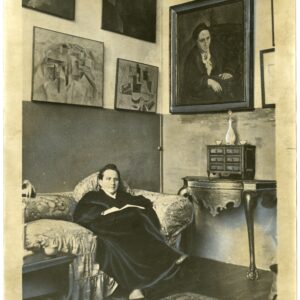
When I started the series, the idea of making a biscuit dough that would have the integrity to be cut with a biscuit cutter seemed intimidating, so for the first several years, I made drop biscuits instead. Just as I eased my way into the biscuit-making, I also tiptoed into the process of becoming a host. I knew I wasn’t going to be George Plimpton or Gertrude Stein. My salons may never be that kind of legendary, but I hope—and think—they are meaningful for those who have been a part of them.
To create your own literary community, you don’t need a big living room or a complete set of dishes. You don’t even need to be a writer or know one. Online reading series and friendly book clubs can also be perfect ways to create a similar space. What matters is the idea of a gathering, a shared space, physical or abstract, and a shared desire to connect—we need more opportunities to remember the human in the humanities and what keeps us coming back to novels and stories and poems—to words that can both transport and affirm.
To get you started, here is the original biscuit recipe, adapted from one my mother gave me. Just like today’s biscuit recipe, it is extremely customizable. You can add raisins and cinnamon or cheese and herbs to make them as sweet or savory as you’d like. You can make them for yourself now as you reach out to a bookish friend or two. Just get started.
__________________________________

The Book of Marys and Glaciers by Carrie Olivia Adams is available from Tupelo Press.

Carrie Olivia Adams
Carrie Olivia Adams lives in Chicago, where she is the executive editor for the nonprofit press Black Ocean and the promotions and marketing communications director for the University of Chicago Press. She is the author of five collections of poetry, including, most recently, The Book of Marys and Glaciers. She writes the “Poetry & Biscuits” newsletter on Substack and curates a house reading series by the same name. When she’s not making poems, she’s making biscuits.