How the Enslaved of Saint-Domingue Struck Fear Into the Hearts of the Ruling Class
Carrie Gibson on François Makandal and the Impact of Superstition and the Supernatural in the 18th Century Caribbean
If all the fears of white planters could have been bundled up into one person, he might have been Makandal: An African. A healer. An herbalist who had a way with poisonous plants. A maroon. Even his name held magic, being the Kikongo word for amulet or charm. François Makandal (also Mackandal or Macandal) was all that and more, and while the precise details of his legend have been subject to debate, there is no contesting the importance of the mythology about him. As one anonymous colonist in Saint-Domingue wrote in a June 24, 1758, letter: “The number of people he [Makandal] caused to die…is incalculable.”
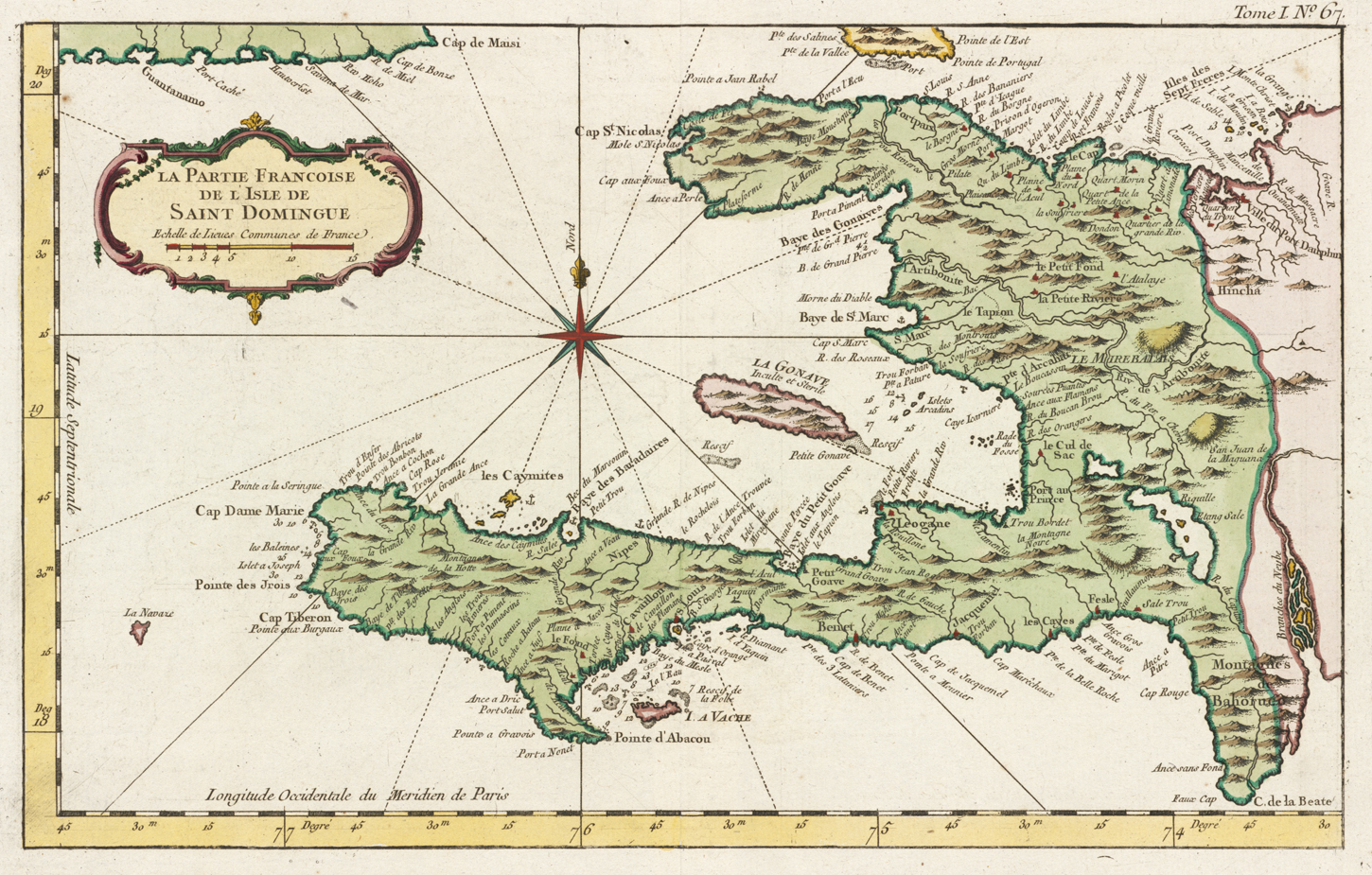
This plantocracy version of Makandal’s story can also be seen in the writings of Médéric Louis Élie Moreau de Saint-Méry, a Martinique-born lawyer and administrator, best known for his multiple volumes on French colonial law and writings about Hispaniola. In his time, the island was divided into French Saint-Domingue in the west and Spanish Santo Domingo in the east. French buccaneers spent much of the seventeenth century hiding and plundering along the northwest coast of Hispaniola, eventually realizing more money could be made farming tobacco and sugar. France’s hold on that third of the island was secured by the Treaty of Rijswijk in 1697, and Saint-Domingue soon ascended to the top of the colonial hierarchy as France’s “jewel” of the Caribbean. Sugar played a large part in this, but coffee and indigo also benefited from the versatile topography of Saint-Domingue.
Slave ships began to arrive in significant numbers by the 1720s, hitting a peak in the 1780s. An estimated 690,000 Africans arrived in Saint-Domingue in the century after it was ceded to France, many from West Central Africa and the Bight of Benin, the majority carried under a French flag. By 1778, the value of Saint-Domingue’s exports to France, along with the smaller contributions of its other colonies, was nearly 180 million livres tournois annually, nearly three times the 60 million livres tournois they were worth in 1749.
That Makandal survives in the collective imagination of Haiti today attests to the power of the vision that has been attributed to him.
France, too, had created an African world in the Caribbean, and nowhere as dramatically as in Saint-Domingue, where the enslaved population would grow to be seven times as large as the population of the white and free people of color combined by the end of the century. With such an imbalance and with a mountainous landscape, the island offered numerous opportunities for marronage, of both the grand variety, where people fled never to be seen again, and the petit, where they returned to a plantation after a short absence.
Like the rulers of other European colonies, French colonial administrators sent in troops—known as the maréchaussée—to track down the maroon groups, but the French rarely negotiated. Some maroons persisted, like those in Le Maniel, a community in the southern mountains near the border with Santo Domingo, despite French and Spanish officials trying to drive them out. However, French officials’ tolerance of petit marronage allowed for the forging of maroon and slave connections across the island, as people gathered for religious ceremonies or dances, building networks that were useful at the time and would become vital in the future.
*
In Moreau de Saint-Méry’s telling—which came some 30 years after Makandal’s death—this famous maroon was born in Africa but survived the Middle Passage to end up on the estate of Lenormand de Mézy, in Limbé, in the north of Saint-Domingue, where sugarcane dominated. Other accounts mention Makandal’s use of Arabic words such as “Allah,” with one report saying he used “words that seemed to come from the Turkish [Arabic] language,” suggesting he was from a Muslim part of Africa. Makandal lost one of his hands working in the plantation’s sugar mill and was put to work tending livestock before he finally ran away. In another version of the story, he and his enslaver fought over a young black woman, leading Makandal to receive 50 lashes of the whip and leave soon thereafter.
Once he was a maroon, his full powers were on display, according to Moreau de Saint-Méry: “He became famous for his use of poison, which spread terror among the blacks and made all of them obey him.” As part of Makandal’s work, he created objects known as fetishes or gris-gris, amulets made with symbolic ingredients, such as particular herbs and fragments of bones. Such talismans blended Africa and the Americas, bringing together old and new practices, beliefs, and objects. Indeed, the word macandal comes from two possible Kongo roots, mak(w)onda (amulet) or makanda (a packet of something wrapped in a leaf).
Like fire, poison was a constant concern for colonial societies. Many unfortunate events were blamed on poison—the unexpected death of an enslaver or a slave, a spate of local deaths due to a virus or other disease, or problems on the plantation such as ill livestock or bad harvests. Enslaved people also worried about dangerous potions, because they could be used to settle disputes or end romantic rivalries. In addition, the creation of the fetishes, with their bits of bone, dirt, plants, and other objects, also unnerved enslavers and colonists. They did not understand the practice and considered it to be heretical, though sometimes incense or holy water, both common in Catholicism, were used in the making of a gris-gris.
Another account, from 1787, described Makandal as carrying a stick made from the wood of an orange tree that had carved upon it “a small figure of a man who, when touched a little at the base of the head, moved its eyes and lips and seemed to come to life.” Apparently, the little man was an oracle, foretelling deaths with certainty. Such were Makandal’s reputed powers that “at the slightest sign from him, people died.”
Moreau de Saint-Méry wrote that Makandal had “agents all over the colony” who would assist him with his “vast plan” to overthrow the whites. The reality of his situation is more difficult to ascertain. In his 18 years as a maroon, Makandal would have relied on a network of people, but it is difficult to establish how big his community was, and what his role as leader entailed. What is clear is that he was connected to small traders, known as pacotilleurs, who sold goods to the enslaved community.
Through these sellers, Makandal had a means of distributing what officials called his “supposedly magical packets,” his herbs and potions, around the area. In doing this, he made connections with enslaved and free people alike. For all of this, the authorities deemed him a threat—and wanted to see him dead. An official document from 1758 claimed that Makandal was somehow responsible—either directly or through this network—for a staggering 6,000 deaths over the previous three years. In the months leading up to his capture, at least 18 other people—12 enslaved and six free—were arrested on charges relating to poison, such as its possession or alleged misuse.
Makandal’s eventual arrest came after a night during which he went to a dance on the Dufresne plantation, where he began to drink and “found himself deprived of reason.” He was sleeping in a slave hut when he was arrested by two white men who had been informed of his whereabouts by a slave. They left him under the guard of two other servants, who later fell asleep. Relying on physical rather than supernatural powers, Makandal climbed out of a window, but the noise woke his guards and the plantation’s dogs, and he was soon recaptured.
After his arrest, the author of the June 1758 letter claimed that Makandal “had discovered three types of poisons, some of which are so dangerous and violent that dogs who were given them by doctors and surgeons died immediately.” Another report, commissioned by the French government, claimed, “The trial of François Macandal and his accomplices…clearly proves that the nègres in their superstitious practices successively move on to all [kinds of] crime,” though there was no evidence except the existence of gris-gris and other talismans.
Poison was another weapon in the arsenal available to enslaved people, and the idea of these deadly concoctions brewed up terror without requiring an actual potion.
On January 20, 1758, the council of Le Cap condemned Makandal to death at the stake, wearing a sign declaring him a SEDUCER, PROFANER, POISONER. His alleged crimes were many, including emancipating himself, using poisons and instructing others how to administer them, and, not least of all, conceiving “the hellish project of eliminating everyone in Saint-Domingue who was not black.” Furthermore, according to Moreau de Saint-Méry, Makandal had sworn he would not die at the hands of the French but that, should he be caught by the whites, he would turn into a mosquito to escape—more proof of his dark arts.
What happened next was nearly as dramatic. His stake was prepared in front of the church in Le Cap. But “the stake to which he was chained was rotten, and his violent movements…pulled out the metal ring and he tumbled out of the fire. The blacks cried out, “Macandal sauvé [Macandal saved].” The guards then tied him to a plank and tried again, but the faithful did not believe their eyes, and many remained convinced “that the execution did not kill him.”
The unnamed planter who wrote his June 1758 letter recounted the “general dismay” Makandal caused. The author noted that “since this execution, four or five have been burned every month,” by his count 24 people, mostly slaves, over the latest poisoning scare. According to other accounts, some white residents believed Makandal and his allies were behind a plot to poison the water supply in all the houses in the city of Le Cap. Then, as people became panicked, they would flee into the countryside, where they would be massacred. The letter-writer who witnessed Makandal’s death complained, “We tremble to go to each other’s houses, and we do not know who to trust, it being impossible to do without the service of these wretches [slaves].”
Some historians contend that this alleged plot actually existed and that it was an opening maneuver of another sort of rebellion—not a local response to bad treatment, or the establishment of a community in the forest, but an organized, intricate plan to upend the system of slavery on Saint-Domingue. That Makandal survives in the collective imagination of Haiti today attests to the power of the vision that has been attributed to him.
The question of poison, however, went beyond Makandal. The French had long prohibited the use of poisons as unfamiliar plants or concoctions were often understood to be at the time, and traditional healing practices were likewise restricted or banned. While all colonial enslavers were anxious about the possibility of poisoning plots in general, other, more local, even personal, concerns existed, such as an enslaver’s fear that one of his captives might try to hasten his death by putting something toxic in his food.
In one case, in the year before Makandal’s death, a servant in Saint-Domingue named Médor was arrested for poisoning his enslaver to obtain his freedom. In the subsequent testimony, Médor claimed that the only way to stop these poisonings was for enslavers to stop promising slaves their estate would free them after their death. Médor said in his confession that “if he named all the slave poisoners and criminals he would never finish, since they are on all the plantations.” Poison was another weapon in the arsenal available to enslaved people, and the idea of these deadly concoctions brewed up terror without requiring an actual potion.
__________________________________
Excerpted from The Great Resistance: The 400-Year Fight to End Slavery in the Americas by Carrie Gibson. Copyright © 2026 by Carrie Gibson. Reprinted with the permission of the publisher, Atlantic Monthly Press, an imprint of Grove Atlantic, Inc. All rights reserved.

Carrie Gibson
Carrie Gibson is the author of two acclaimed works of history, Empire’s Crossroads: A History of the Caribbean from Columbus to the Present Day, and El Norte: The Epic and Forgotten Story of Hispanic North America. She received a PhD from Cambridge University focusing on the Spanish Caribbean in the era of the Haitian Revolution and has worked as a journalist for the Guardian and contributed to other publications, as well as the BBC. She has done research across Mexico, the Caribbean, South America, and the United States. She lives in Seoul, South Korea.