How the Criminal Justice System Decides Who Lives and Who Dies
Elizabeth Vartkessian on the Arbitrary Nature of Capital Punishment in America
Growing up, I saw little of my father. He worked two to three jobs, rarely had a day off, and was often asleep or about to leave for work when I wasn’t in school. Many of the conversations with him I remember from my youth are connected to his views about justice. He was born and raised in Baghdad and fully believed in an eye-for-an-eye response to crime. Someone caught stealing should have a hand cut off. A person who committed a murder should be killed. He believed this consequence to be fair and, in many ways, superior to the American system of justice, which took too much outside the crime into account.
When he stopped working in his early seventies, he spent most of his time watching television, especially CNN and Fox News. I would travel back to California for holidays or occasional visits and sit next to him on the sectional with the large-screen television blasting in the background, an experience oddly similar to those I had on almost a weekly basis as I traveled the country connecting with witnesses in my cases. A breaking news report would flash across the screen, something involving crime, usually coverage of a terrible murder. My father’s response was always the same. He took it for granted that the alleged perpetrator was guilty. Staring at the television, he would tut, then remark that the suspect was “crazy.” I would agree, but offer some scenarios for him to consider.
What if a person was hallucinating, and a voice told them to commit the crime? What if the perpetrator had some sort of contact with the victim—sexually abused him, for example? What if the accused had lived a good life, served in the military, had a terrible accident, and started behaving oddly before the crime, but no one stepped in to help? Each offering softened his views of what the right outcome should be. Even my father, who held to a black-and-white view on crime and punishment, acknowledged that not every crime or convicted person is the same. The law acknowledges this, as well, using the terms aggravating factor or mitigating factor to describe the context that should be provided to decision-makers. As a mitigation specialist, my job has evolved from that tradition.
*
The current way of determining who is deserving of mercy emerged out of a moment in the United States where the death penalty effectively didn’t exist: a four-year period from 1972 to 1976. The hiatus was caused by the United States Supreme Court’s decision in a collection of cases commonly referred to as Furman v. Georgia.
In an effort to construct a system of law that could prevent arbitrary outcomes, the court ended up making room for plenty of arbitrariness in who was allowed to live and who was sentenced to die.
Around two AM on an otherwise ordinary summer morning in August 1967, twenty-four-year-old William Henry Furman broke into William Joseph Micke Jr.’s Savannah home. Micke, who had served in the Coast Guard, woke to sounds coming from the kitchen. Perhaps due to his training or to the fact that he was, at twenty-nine, a young father to five children, he decided to investigate. When he entered the kitchen, Micke discovered Furman, who after a day of heavy drinking had entered the house with a pistol.
Upon seeing Micke, Furman took off, firing one shot through a closed door as he fled the home. The single bullet, which Furman said was an accidental shot caused by him tripping over the power cord of a washing machine, struck Micke in the chest, killing him instantly. Police arrested Furman quickly; they followed tracks from the home and discovered him hiding underneath his uncle’s porch with the gun in his pocket. This wasn’t a whodunit.
At the time of the crime, Furman was impoverished, had a sixth-grade education, and was living with serious mental illness. His mental health and functioning were such a concern prior to trial that he was sent to the state hospital in Georgia for evaluation. There, doctors concluded that he was psychotic. Nevertheless, Furman was taken to trial. The jury found him guilty and sentenced him to death.
On that day in 1968, the jury heard evidence of the crime, decided that Furman was guilty, and then were asked to determine an appropriate sentence. They did not receive any guidance regarding the sentencing—nothing to help them focus on aspects of the crime or Furman himself to justify a sentence of death. When Furman’s case reached the U.S. Supreme Court in 1972 after completing his direct appeal, his attorneys argued that this lack of guidance violated the constitutional protection against cruel and unusual punishments.
Why would one person convicted of murder receive the ultimate penalty when another person convicted of a similar crime avoid the same fate? That was the issue Furman’s attorneys brought to the court. Absent such direction, the death penalty could be given for inappropriate reasons like one’s race, religion, or gender, or appear as an essentially random outcome. At that time research had started to show that in this standardless system, sentencing outcomes could often be traced to defendants’ traits, including factors like race, income, and mental health, supporting the growing unease around the death penalty’s application.
A Supreme Court majority, five of the nine justices, agreed that capital punishment needed to change to be lawful, though the five justices could not reach a consensus about how it needed to change. Two justices said that the death penalty was inherently unconstitutional because it was excessive. Two justices argued that the standardless system could lead to arbitrary results, making the sentence cruel and unusual in application. One of those two justices focused on how it was underused, rendering it ineffectual for deterring others from committing crimes. The fifth justice to form the majority argued that it was unconstitutional by virtue of disproportionately affecting the poor and minorities. The result from the collection of opinions was that capital punishment was suddenly no longer permitted, but without a specific agreed-upon reason, it was possible for the death penalty to return.
Since the court did not outlaw capital punishment under any circumstance, states that wanted to be able to seek the death penalty went to work to craft new laws that could address the various issues raised by the justices. States took one of two approaches: find a way to guide juror decision-making, or make a sentence of death automatic upon conviction of an eligible crime. When the court heard challenges to the new post-Furman laws, it decreed that automatic death sentences (the eye-for-an-eye response to murder) were not lawful. I find the writing about why automatic death sentences are not allowed under our set of laws very moving. Here is a shortened version from the court’s decision in the case brought against the North Carolina law that adopted automatic sentences of death for people convicted of murder:
The respect for human dignity underlying the Eighth Amendment, requires consideration of aspects of the character of the individual offender and the circumstances of the particular offense as a constitutionally indispensable part of the process of imposing the ultimate punishment of death. The North Carolina statute impermissibly treats all persons convicted of a designated offense not as uniquely individual human beings, but as members of a faceless, undifferentiated mass to be subjected to the blind infliction of the death penalty.
States that took the first approach permitted the use of capital punishment when there was an effort to guide the sentencing jury. This statutory method became known as “guided discretion,” and sought to focus capital sentencing on specific factors without stripping jurors of their independence. Legislatures passed the laws that identified the specific sentencing factors jurors could consider. These factors, known as aggravators and mitigators, identify the kind of evidence the prosecution and the defense need to collect to support their side—death or life, respectively.
The effort to apply “reason,” as understood by the law, to a decision like capital punishment has had, from its inception, both admirable aims…and, despite the gravity of the subject matter, almost comically muddled results.
Aggravators are facts about the defendant, victim, and nature of the crime that increase the harm caused by the offense, and therefore might increase eligibility for the death penalty. It could be that the victim of the crime was especially vulnerable, like a child or an elderly person. Or the defendant had already been convicted before. Perhaps the murder occurred while the defendant was in the process of committing another felony, like arson, burglary, or robbery. Aggravators articulate a spectrum of circumstances, creating a framework for determining why some people might face the death penalty while others might not, and do so without considering extralegal factors.
Mitigators work in the other direction, articulating a spectrum of factors that might support lessened punishment, such as the defendant having no prior criminal record, or acting under significant duress. Mitigation might ask: Was the defendant coerced into the offense? Were there other equally culpable defendants who did not receive the death penalty? Some states also included mitigating factors that specifically addressed mental illness, allowing for a lesser sentence if the illness could be shown to have played a role in the commission of the crime.
It took about two years for a case to reveal the main issue with these recently adopted guided discretion laws. In 1978 the Supreme Court heard a new case, Lockett v. Ohio. The defendant, twenty-year-old Sandra Lockett, the getaway driver for a robbery gone wrong, was sentenced to death under Ohio’s guided discretion statute. The Ohio law specified three reasons why someone eligible for a death sentence could get a lesser sentence: the victim played a role in their own death; the defendant was coerced; or the defendant had a mental disease that accounted for their crime. None of the three reasons applied to Lockett. Her relative youth, her experiences of poverty, and other potentially relevant factors had no way to figure into the final decision.
Here was the paradox: the court didn’t want death sentences to be imposed in an arbitrary fashion, and states were not supposed to limit factors that could be considered in mitigation, but this meant mitigating factors could be potentially limitless. Youth, emotional disturbances, and challenges during childhood; the ability to adjust well to incarceration—truly any evidence that could aid in reaching a “reasoned moral decision” about the sentence was on the table.
The same was true for aggravating factors. The court allowed juries to hear hypothetical evidence of a defendant’s potential future dangerousness and permitted victim impact statements to be considered in sentencing. In an effort to construct a system of law that could prevent arbitrary outcomes, the court ended up making room for plenty of arbitrariness in who was allowed to live and who was sentenced to die. Justice Harry Blackmun, who had voted in favor of the guided discretion statutes, made the following statement twenty-four years later:
From this day forward, I no longer shall tinker with the machinery of death. For more than 20 years I have endeavored—indeed, I have struggled—along with a majority of this Court, to develop procedural and substantive rules that would lend more than the mere appearance of fairness to the death penalty endeavor. Rather than continue to coddle the Court’s delusion that the desired level of fairness has been achieved and the need for regulation eviscerated, I feel morally and intellectually obligated simply to concede that the death penalty experiment has failed. It is virtually self-evident to me now that no combination of procedural rules or substantive regulations ever can save the death penalty from its inherent constitutional deficiencies.
I offer this incredibly simplified piece of history to give just a glimpse of the complexity of mitigation’s history, and also to suggest that the effort to apply “reason,” as understood by the law, to a decision like capital punishment has had, from its inception, both admirable aims—to remove bias—and, despite the gravity of the subject matter, almost comically muddled results. It’s worth considering whether reason can ever be applied to what is fundamentally a moral question.
__________________________________
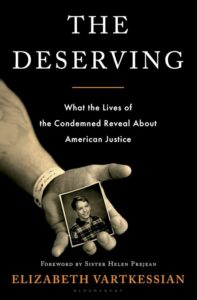
From The Deserving: What the Lives of the Condemned Reveal About American Justice by Elizabeth Vartkessian. Copyright © 2026. Available from Bloomsbury Publishing.

Elizabeth Vartkessian
Mitigation specialist Elizabeth Vartkessian has been investigating the life histories of those facing the most severe penalties possible in the United States since 2004. She holds a PhD in law and an MS in comparative social policy from Oxford, and BAs in philosophy and political science from George Washington University. She is the founder and director of Advancing Real Change Inc., a national nonprofit dedicated to conducting life history investigations in criminal cases. She lives in Baltimore.