How Pregnancy and Childrearing Alter Our Perception of Time and Aging
Nora Lange on Motherhood As a Time-Travel Journey
There are truths which predate and postdate us. Bear with me as I get a little psychedelic, as I get a little Frozen part II (wherein water has memory), as I lean into some arguably specious reasoning, and get a little writerly, a bit motherbaby, as Rachel Cusk terms the amorphous space and time that is “mother.” Hang tight as I am myself—hyper-taxed working modern mother microdosing (if only) at the park and pushing a drought-resistant child in a swing.
For your consideration, I present motherhood as a form of time travel.
Or, of time’s multi-directionality: before, now, after (of any variation). Pre, mid, post (of any variation). Beginning, middle, end (of any variation). Past, present, future (of any variation)—these have become for me abstracts. What of it, this overlay, this synchrony? The social scientist Sarah Blaffer Hrdy in her seminal work on shaping the human species, Mother Nature, writes that every component of our neuro-chemistry and emotions has a “rich and convoluted history, bearing witness to multiple long-running legacies that we share with earthworms, amphibians, small mammals, and other primates.” As one of Sylvia’s beloved tunes, “Over the Deep Blue Sea,” sings: “We’re going this way, that way, forwards, backwards, up and down, up and down, over the deep blue sea.”
Pre, mid, post (of any variation). Beginning, middle, end (of any variation). Past, present, future (of any variation)—these have become for me abstracts.
Sylvia will be four in August. Her birthday is one day after mine. Mine was one before hers. After last years’ epic meltdown which sent the dog into hiding, Nick and I have agreed hence forth that she and I will switch dates. In this updated arrangement of birthday time, I will be, or shall I say I will remain, one day younger than I had been previously. An article from March 2024, published in the Yale School of Medicine, showed that while pregnancy accelerates the age of a mother, “there appears to be significant reversal of this effect in the postpartum period.”
Additional studies into a mother’s reverse aging processes have suggested that the fetus may have a rejuvenating effect on the mother. Researchers are now looking to pregnancy as a unique, physiological parabiotic model of the interaction between two organisms of different ages with a partially shared blood system. They have confirmed that pregnancy rejuvenates the mother’s organism or slows its aging.
This could be the story of my life.
In the beginning of her development, Sylvia was in my mind. A what if. An uninvited proposal. A vision that interrupted my drinking of cooking wine while in my late teens in a dorm room at La Cité internationale universitaire de Paris. A persistent image of me with two children on bikes at a farmer’s market which came out of nowhere, as I had no interest in children—note the drinking of cooking wine. But they, it seemed, had an interest in me. Or years later to the baby showers I’d attended when I found myself seated next to the new mother’s mother, also in attendance, who tells me that I am a natural as I find myself picking up discarded wrapping paper off the floor.
At some point we too are pregnant. Our first known child must be aborted for various medical reasons. I am in awe of this child who will not leave my body on its own, but who needs a push to exit. I can remember wondering what would happen if I were to hold onto it. During pregnancy we know that cells from the fetus cross the placenta and enter the mother’s body where they become part of her tissues. What if I were to simply refuse the medical advice I’d been given? But then a rat in our in-law unit on the ground floor scuttered by and I swallowed the prescription pills. It was 2016. The election results were rolling in. Nick drank himself under the rug to assuage the toxic news, and I said goodbye meets hello to the child that would not come to term in our bathroom. From that day forward, everyone sighed and said what a year.
What a year.
2022 and Sylvia was in the womb. She was in the middle of my body. I am not very tall, or my legs are not that long in any case. And by a certain end stage in the process, in other words by birth she was at the bottom of me, and from there she was starting something new. Regardless, from the beginning, and by the end, she would leave behind inside of me her DNA, her cells, and those of the bathroom miscarry, and of her vanished twin brother who I’d named Elliot, and who’d I’d speak to when he was alive in a proper sense. Sylvia would eventually consume her twin brother Elliot in utero. As if she’d been presented with a tidy, screw-like riddle from the Sphynx.
Some scholars claim that the Sphinx was the first philosopher and Oedipus the second. The ancient story goes that the Sphinx, female, asked a question, also a riddle, also a joke: What maneuvers on four legs in the morning, on two legs in the afternoon, and on three legs by the evening? A wrong answer would end in death. Oedipus would guess the correct answer to the riddle: As a baby, man crawls on all fours; later and grown, he walks on two legs; reaching old age, near death, he moves such as it were with a cane. Never mind what the Sphinx did afterwards. Remaining in the car at day care drop-off I wish I could answer her: whale. A reverse bit, a sophist philosophical move on my part to compliment this exercise in non-linearity which I’d started to hope might save future selves. Or, just to see what fate might become of me.
Do we not begin in water? Our human bodies upward of sixty percent of water, Earth’s surface covered in seventy-one percent of water and dubbed the “water planed”—we might as well say we will return to water. In any case, surrounded by amniotic fluids in utero, Sylvia would absorb her vanished twin. To this day, when I go searching for the opposite of ancient, I find recent or contemporary. Try as I might to reconcile this unresolve, this bludgeoning oversight and to my mind fallacy, I come up for air to find a scheduled email from myself to myself, a reminder to call my stepmother who has recently given up speaking. And another from my mother who cannot walk much these days. While we’re considering things together, some additional for consideration: Chimera, transmitter, hypnosis, cosmic, wormhole, interstellar, transhuman, omens, magnets, poetics, primordial.
I can remember the day when I no longer heard Elliot. I was walking as I often do in the hills wherever I live (at this time in the NW part of Portland, OR). Rich people like green so the air is welcoming and the sights pleasurable, and they don’t run errands so there’s little car movement to worry about, and they absolutely adore the height a tall hilly geography provides, and on happy occasion a passerby might even stumble across one of those rinky-dink sidewalk libraries (in this case not so janky) with books for free. I want to stop myself from “over writing” or “over sharing” but I won’t. That day I didn’t hear back from him, my so Elliot. As I spoke to him looking out to the Cascade Range, a volcanic mountain range, things had changed. I was changed. He was no longer present in the same way.
The term scientists use to describe a mother’s body that will for perhaps a lifetime carry the cells and DNA of any child—a child that comes to full term and those children that do not—is microchimera. Named for that mythical hybrid creature composed of three animals, typically some combination of a lion, a goat, and a snake, which I would like to think of as past, present, future (order redundant, perhaps irrelevant, and why not?) Researchers in an essay on microchimera in Aeon say that, “Within weeks of conception, cells from both mother and foetus traffic back and forth across the placenta, resulting in one becoming a part of the other.”
Throughout pregnancy, researchers claim that as much as 10 percent of the free-floating DNA in a mother’s bloodstream comes from the fetus. These numbers drop after birth, but cells remain. Conversely children will carry the population of cells received from their mothers into adulthood. Furthermore, “with each successive conception, the mother’s reservoir of foreign material grows deeper and more complex, with further opportunities to transfer cells from older siblings to younger children, or even across multiple generations.”
Fetuses leave lasting imprints on a mother, as well as child.
Inception. Evolution. Just as when you were about to eat a hard taco your plump motherbaby breasts decided to dump themselves all over the (mostly) breathable (mostly) cotton blouse you’ve put on, never mind the underarm rings, never mind it’s too snug, to munch hard tacos in the summer heat with cold beer like a big girl with her friends. Slash to appear post-birth-disappearance decently alert at hard taco brunch with other adults who have been wondering about you, as in about your wholeness as a person—then boob communications from a baby not even present arrive. Incoming messages from baby Sylvia at home with her father there to inform my body that she is ravenous and now is the time.
Nick liked it too, the milk. “It’s very sweet,” I remember him confirming of the defrosted bag of milk he’d pulled earlier from the freezer.
I can remember distinctly being in different times and places as I breastfed Sylvia, which I did until going on tour for my first book, Us Fools. Before that, I had tried weaning her, to no avail. Our separation would need to be curt and the novel did it. (I tried a night away only to have the return scene look like this: the two of us rushing toward one another screaming and wailing uncontrollably like nuclear reactors.) The writer Rachel Cusk, in her book on motherhood A Life’s Work, asks if her breastmilk is carrying messages—and yes, in fact it does and it was.
Dr. Katie Hinde, an assistant professor of Human Evolutionary Biology and director of the Comparative Lactation Lab at Harvard University, studies breast milk. Her work suggests that by supporting and feeding gut bacteria in their infants, mothers are cultivating their children’s vital internal “microbial gardens,” which help with things like digestion and the development of the immune system. Dr. Hinde also thinks that there is a connection between these bacteria and brain development and behavior, which means that mothers are subtly influencing their babies’ minds, through their milk and microbes and shape their brains and emotions vis-à-vis the bacteria in an infant’s intestines releasing neuro-chemical signals that travel from the gut to the infant’s brain and shape it.
It was all here—and seemingly against time’s arrow, our mothers come from us too. Between water, memory, myth—herein lies the universality as it meets the moment.
After giving birth to her first child, Cusk notes, “When I look at old photographs of myself they seem to resemble the casts of Pompeii, little deaths frozen in time.” Later in her book, Cusk writes of another mother she come across, a friend who has just given birth to her own mystery, that she is trying to “stay in time.” Memory movement, memory evolution. For Cusk, after giving birth, she’d found that the act of reading books referenced new themes which she’d missed previously: “Like someone visiting old haunts after an absence I read books that I have read before, books that I love, and when I do I find them changed.” After which she began to find them—prophesies—everywhere of what’s to come. Can I say it is like the story of time and water.
Some scientists agree with Elsa in Frozen II. Some argue that water has memory. Nobel award winning scientist, Luc Montagnier has tested some of these early studies and found that certain substances, like DNA, emit electromagnetic signals. “Water memory is a hypothesis that suggests water has the ability to “remember” substances once dissolved in it, even after those substances have been removed or diluted beyond the point of detection.” We do know for sure that it is a vessel for storage as we do see and know of time, time and time again, as it exists frozen in ice.
Primordial which has no antonym, as old as story itself.
Only a few days ago was I sitting with Sylvia at a picnic table outside of a small depot which sells luxury items and local breads. I’d stopped off there with my daughter to grab a “fancy water” to share before picking up a friend of hers to walk to the small park we’d named after her friend. Now there’s an interesting interlude worth exploring: In Salt Lake City, where we haven’t lived long, there are these lovely and intentional paths that the city has implemented but which do not really go anywhere.
All these paths, maybe about five or so disjointed ones, which are paved and which feel as a passerby very lucky to encounter, simply drop a person off at a street. The sense is that they should connect. That they should lead someplace. In any case, my daughter and I were enjoying this fancy beverage before picking up her pal at her school to walk to the park when a newer than me mother with her two-year-old, as I’d happened to learn, asked if I would do it again. She was feeling older and had begun thinking about the clock. I told her she’d be happy either way, even though I’d no business doing so.
Adrienne Rich writes, “We all come from a mother.”
Later that night as Sylvia slept beside me, rotating in her sleep, a small planet, dreaming dreams I worry I’ve passed on to her—a worry I’ve worried since she started dreaming rough—in one of those in-between states, a chimeric reality, part dream past, part wakeful present, part subconscious future, part conscious beginning—I saw myself with another child. A baby. I was holding a baby, carrying this baby through the stages: uterus, birth, suck, crawl, words. And this baby, when I went into her, to smell her, and to know her like a blooming rose bush—was my daughter, the future. A duplicate. Sylvia is the only person in this capacity, this enormity, that I would want to know further. There was nothing more out there. The very next morning I told this to Nick, who couldn’t care less about having more children. It was all here—and seemingly against time’s arrow, our mothers come from us too. Between water, memory, myth—herein lies the universality as it meets the moment.
__________________________________
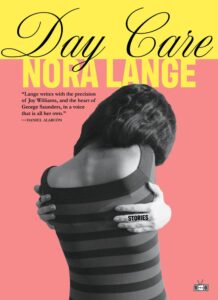
Day Care by Nora Lange is available from Two Dollar Radio.
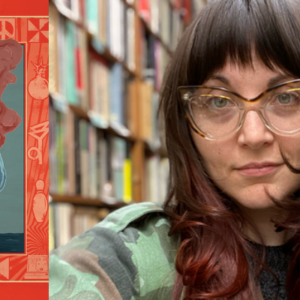
Nora Lange
Nora Lange's debut novel Us Fools was awarded the The Sue Kaufman Prize for First Fiction, was a finalist for the National Book Critics Circle Award in Fiction, named a best book of 2024 by The Boston Globe and NPR, a Los Angeles Times bestseller, and a New York Times Editors’ Choice pick. Her writing has appeared in The Believer, BOMB, Hazlitt, and elsewhere. Her project “Dailyness” was longlisted for the 2014 Leslie Scalapino Award for Innovative Women Performance Writers. She has received fellowships from Brown University and is a fellow at USC’s Los Angeles Institute of the Humanities. She recently moved to Salt Lake City with her family.