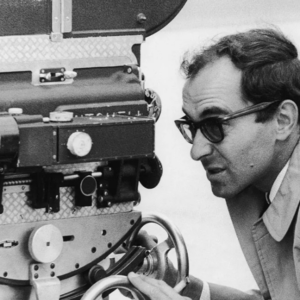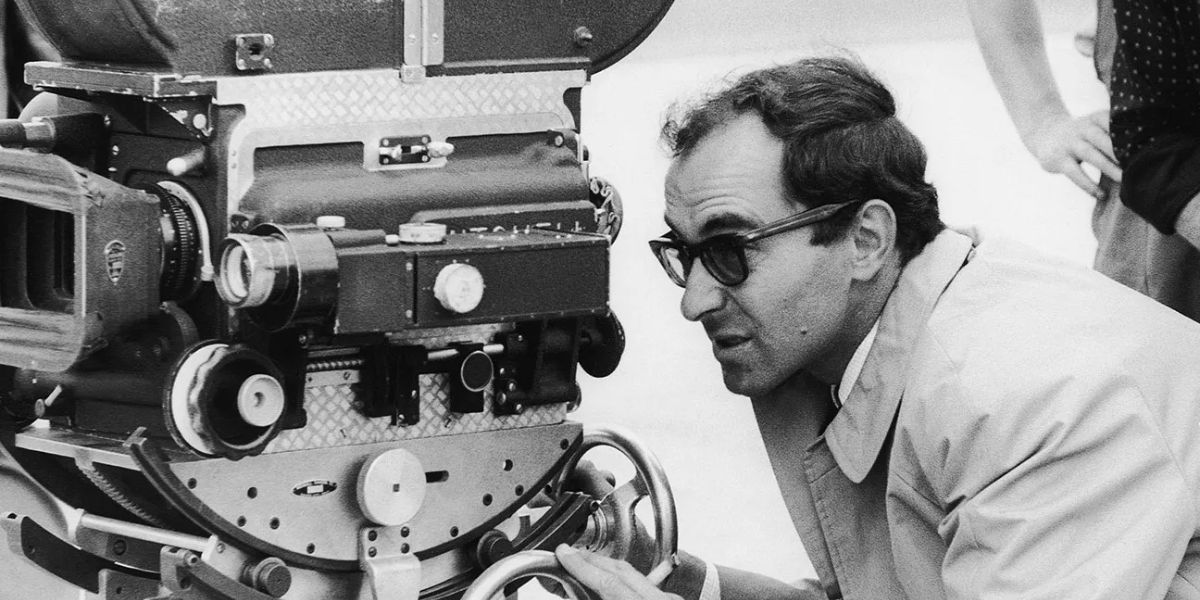
How Legendary Filmmakers Funded Their Creative Lives
Mason Currey on Making a Living Through Making Art
The Belgian filmmaker Chantal Akerman wasn’t born into any special artistic lineage. Growing up, she was, in the words of a friend, “a lower-middle-class nobody whose father owned a clothing store.” (She was born in Brussels, in 1950, to Jewish Holocaust survivors from Poland.) And yet Akerman managed, with no money, to make her first film at age eighteen: a short film, only thirteen minutes long, filmed in one room and in one night with no retakes, but bursting with energy and ideas.
Called Saute Ma Ville, or Blow Up My Town, it was figuratively and literally explosive—in the final moments, Akerman, who directed and stars, cranks up the gas on her kitchen stove and sets some papers on fire; the film ends with a black screen and the sound of an enormous explosion—and it was the beginning of a series of brilliant short films leading up to Akerman’s audacious first feature, 1974’s Je Tu Il Elle, and her follow-up the next year, the three-hour-and-twenty-minute Jeanne Dielman, 23 Quai du Commerce, 1080 Bruxelles.
In Sight and Sound magazine’s 2022 poll of the greatest films ever made, voters nominated Jeanne Dielman for the number one spot, edging out Vertigo and Citizen Kane and Tokyo Story. The greatest film ever made! By a twenty-four-year-old high school dropout (she quit film school, too, after three months) who originally wanted to be a writer until she discovered the work of Jean-Luc Godard and decided to be a filmmaker instead.
I said above that Akerman made her first film, the thirteen-minute Saute Ma Ville, on no money, but of course that’s impossible. In a 1983 interview, Akerman explained how she really did it:
I wanted to make a feature film so I decided to sell stock in the film. I made a stock book and went to Antwerp and sold certificates on the Diamond Bourse, selling the pages for $3 each. By the end I had only $200 or $300, not enough to make a feature film. I made a short film with that. It wasn’t enough to finish the film, so I worked in banks, in shops, sending telexes; Phillips Petroleum telex, American Express telex. Then, when I went to New York [in 1971], first I worked in a restaurant, La Poulade, in the Fifties. I took care of coats and hats, putting glasses of water and butter on the tables. . . . I worked at the New School, modeling for sculpture. I also worked in a photo lab blowing up pictures. Later I worked in a thrift shop, and then on Orchard Street. Then I worked at the 55th Street Playhouse, the porno pictures, as a cashier; and in three weeks I stole $4000, and I made [the short films] Hotel Monterey and La Chambre with that. That was the end of it for stealing, I stopped. Then I made Je, Tu, Il, Elle; for that I worked as a typist. Then that was finished because I got some grants from my government.
Above, Akerman neglects to mention another theft from around this time. In a 2015 documentary about her career, Akerman said that she stole boxes of old 35 mm film from a photo lab and used it to make Je Tu Il Elle: “I hid them under my bed and I was very scared that the police would come, but nobody cared about these boxes.”
But for Godard to become a filmmaker, he needed to reject this world—or to force his family to reject him.
In the same documentary, Akerman also elaborated on her porno theater theft: She would pocket the money from every other ticket sale; to make the ticket sales match the cash intake, she ripped each ticket in half, giving one half to the first customer and the other half to the next. “My pockets were filled with money,” she tells the camera, eyes gleaming mischievously.
Akerman was inspired to become a filmmaker after seeing Jean-Luc Godard’s 1965 film Pierrot le Fou in the theater. “That was the first shock of my life,” she later said of the movie, which she went to without knowing anything about it, simply because she liked the title. “I got crazy about movies immediately and I decided to make movies the same night. I was 15.” Did she know that Godard financed his early filmmaking career through theft, too?
Unlike Akerman, Godard was born into a world of wealth and privilege: His father was a Swiss physician, and his mother was the daughter of one of the most prominent bankers in France. Born in Paris in 1930, Godard was raised mainly in Switzerland, where his father moved the family in 1934 so he could work at a private medical clinic on the shore of Lake Geneva. (He later started his own clinic near Lausanne.) Godard spent much of his childhood at a pair of family chalets on opposite sides of the lake. He later recalled, “I lived my childhood in an extremely rich family. . . . There was so much money that we didn’t notice it.” But for Godard to become a filmmaker, he needed to reject this world—or to force his family to reject him.
Initially, Godard sought to be an engineer, or at least that was the plan when he went to Paris in 1946 to study at the Lycée Buffon, a secondary school in the fifteenth arrondissement. Instead, the sixteen-year-old Godard fell hopelessly in love with movies, at the expense of his studies. In 1948, he failed his baccalaureate exam and had to retreat to a cramming school in Switzerland before retaking it; this time, he passed.
Godard considered going to the Sorbonne next, to study art, then changed his mind and applied to film school, but was rejected. So he embarked on his own course of study, obsessively attending a group of Left Bank film clubs, chief among them the Cinémathèque Française, an idiosyncratic temple of cinema cofounded by the film archivist Henri Langlois. In this era, Godard would see three or four films a day, or else sit through repeated screenings of the same film, sometimes entering the theater at 2:00 in the afternoon and not leaving until 10:00 at night.
Previously, he had thought vaguely of becoming a writer, but cinema proved much more alluring to Godard and to the fellow young obsessives he met at the Cinémathèque, including the future filmmakers François Truffaut and Jacques Rivette. “When we saw some movies,” Godard later recalled, “we were finally delivered from the terror of writing. We were no longer crushed by the specter of the great writers.”
Godard’s parents had planned to support his university studies, but they were not willing to fund him watching movies all day and cut him off. To stay afloat, Godard “borrowed” money from his mother’s best friend with no intention of repaying it and then turned to outright theft. Godard’s maternal grandfather, Julien Monod, the prominent banker, was also a key figure in the French literary world: He had been a close friend of the writer Paul Valéry and after Valéry’s death became his literary executor. At the Monod family residence in Paris, Godard’s grandfather kept his collection of first, private, and rare editions of Valéry’s books, which Godard began to steal, selling them for cash at Paris book stalls.
If this sounds about as far away from filmmaking as one could get, Godard still managed to turn it into an opportunity.
According to Richard Brody’s book Everything Is Cinema: The Working Life of Jean-Luc Godard, he went even further than filching books and additionally “stole and sold a painting by Renoir that belonged to his grandfather.” With the profits from his thefts, Godard not only funded his own lifestyle (a relatively meager one; according to a friend: “In Paris he had a big Bogart poster on the wall and nothing else”) but produced his friend Jacques Rivette’s short film Le Quadrille.
Around this time, Godard also began writing film criticism, first for the short-lived La Gazette du Cinéma, which he helped to found, and then for the hugely influential Cahiers du Cinéma, launched in 1951. Criticism did not make Godard and his fellow Cahiers critics any money, but it did prove a brilliant means of breaking into filmmaking. Brody explains: “By writing about the films they saw, they did two things: they elaborated and refined their ideas about the cinema, in anticipation of the day when they could make films; and they created for themselves a public identity that would get them the chance to make films.”
Indeed, Godard and his friends became notorious for their rejection of what they saw as classical French cinema’s excessive stuffiness and their embrace of popular directors like Alfred Hitchcock, Howard Hawks, and Orson Welles, whom serious cineastes had regarded as mere cogs in the American studio machine and hardly the major artists that the Cahiers crew now argued they were.
But Godard stole money from Cahiers, too, and got caught. According to the biographer Colin MacCabe, “Cahiers was a tiny magazine which lived from hand to mouth, and the incident was serious enough to make him persona non grata for a considerable time.” The discovery of this theft apparently influenced Godard’s decision to move from Paris back to Switzerland, where he stayed at his mother’s house for a time (his parents’ marriage had by then broken up) and, with her help, got a job at a Swiss television station, where he was again caught stealing, from the station’s safe.
This time, Godard was arrested and held in a Swiss jail for a few days, until his father managed to persuade the authorities to release him to the care of a psychiatric institution. After his stay there—the amount of time he spent in the institution is unclear, perhaps two or three months—Godard was thoroughly alienated from his family. He had little to do with them going forward and certainly could not expect their financial support.
Needing money, Godard turned to manual labor, getting a job at the construction site for the massive Grande Dixence Dam in Valais, Switzerland, which, when it was finished, would be the tallest dam in the world. If this sounds about as far away from filmmaking as one could get, Godard still managed to turn it into an opportunity. First he got himself transferred from manual labor to a position as a switchboard operator (apparently with the help of a cousin in a leadership position at the construction company—so even without family money, Godard was still benefiting from family connections). According to MacCabe, “because of the extreme weather conditions the construction site could operate fully only in the summer, but a twenty-four-hour telephone exchange operated all year round and Godard was taken on as one of three telephonists.”
Normally, the three telephonists would work back-to-back eight-hour shifts—but Godard suggested a new schedule, described by MacCabe: “Instead of working three eight-hour shifts, the telephonists should pool their labour and each spend ten days on twenty-four-hour duty and take the other twenty days off.” The other telephonists were game, and thus Godard was able to draw a full wage while only working ten days out of the month, spending the other twenty days in Lausanne or Geneva. (A friend described how Godard managed to work nonstop for ten days: “He spent the nights there on a cot, he got up when the telephone rang.”)
Godard was ambitious, sure, but more than that he had nerve.
In his spare time, Godard dreamed up a new plan: He would use the money he had been saving from the Grande Dixence job to produce a documentary about the dam’s construction and then sell this film to the construction company, to be used as promotional material. One of Godard’s Swiss friends persuaded a pair of friends in Geneva to lend Godard a 35 mm film camera for the shoot, and one of these Geneva friends also served as cinematographer.
Over the summer of 1954, Godard shot and edited a twenty-minute film that he titled Opération Béton (that is, Operation Concrete). Remarkably, his plan worked: When he showed the film to the construction agency, they were so impressed that they agreed to pay, MacCabe writes, “a sufficiently large sum to bankroll himself for the next two years.” He even got some publicity for the film. A journalist wrote in a Swiss film magazine: “For two years, he tightened his belt to be able to show what he could do. Like a medieval artisan, he created his masterpiece in order to obtain his mastery. Now, he wants to make a more ambitious film.”
Godard was ambitious, sure, but more than that he had nerve—as did many of his fellow New Wave filmmakers, including his friend François Truffaut, who as a teenage film lover founded his own cinema club in Paris and then, to keep it afloat, stole and sold a typewriter from his father’s office, an incident he later dramatized in his first film, The 400 Blows, another of the era’s masterpieces. (After the theft, Truffaut’s father forced him to confess to the police, leading to Truffaut’s three-month stay in a juvenile detention center.)
But let’s not pretend that theft is enough, that great films were made on porno theater or cinema journal cash register filching alone. Chantal Akerman was ultimately able to make Jeanne Dielman because she received a $120,000 grant from the Belgian government. Truffaut’s filmmaking career was aided by a strategic marriage: At the Venice Film Festival, he met, and soon after married, Madeleine Morgenstern, the daughter of Ignace Morgenstern, a Hungarian-born French film producer who owned Cocinor, one of the era’s largest film distributors, and it was this new father-in-law who enabled Truffaut to make The 400 Blows. Claude Chabrol, another of the era’s great filmmakers, had a similar connection: He was able to make his first film, Le Beau Serge, by drawing on an inheritance from his wife’s family.
In fact, Chabrol played a key role in Godard eventually making his first film. Before Le Beau Serge, Chabrol had been working in the publicity department of Twentieth Century-Fox’s Paris office. After Le Beau Serge’s modest success, Chabrol was able to quit working at Fox and continue making his own films, and he recommended that Godard be his replacement. Godard was interested because he thought he could use the job to meet producers for his own filmmaking efforts—and this is exactly what happened. Richard Brody writes:
After one screening, in early 1958, of a French film called La Passe du diable (Devil’s Pass), which was being offered to Fox for distribution, Godard confronted the producer and declared, “Your film is a disgrace.” The relatively young producer, Georges de Beauregard (born in 1920), who made films on small budgets under eccentric and risky circumstances and barely scraped by . . . was curious about this audacious young man.
Prison was always good for Genet’s writing; in fact, it was prison that made him a writer in the first place, because it gave him lots of time to read.
A year later, Beauregard was producing Godard’s first film, Breathless, and he would go on to produce several of the brash young director’s subsequent pictures, including Pierrot le Fou, which so inspired fifteen-year-old Chantal Akerman when it was released in 1965.
Jean-Luc Godard was not the only French artist to fund his early creative endeavor by stealing books. Perhaps his most famous predecessor was the novelist and playwright Jean Genet, who, in the early 1940s, listed his profession as a “broker” of books, but who really shoplifted valuable secondhand editions from one bookseller and resold them to another—after he’d read the books himself, of course. To ply his trade, Genet employed a special leather satchel that he kept pressed under one arm. He wrote, “I perfected a trick briefcase and I became so handy in these thefts that I could push politeness to the point of pulling them off under the very nose of the bookseller.”
But Genet didn’t always evade detection, and during this time he spent multiple short stints in prison for stealing books as well as clothing from department stores and a bolt of fabric from a tailor. Prison was always good for Genet’s writing; in fact, it was prison that made him a writer in the first place, because it gave him lots of time to read—the most essential training for any writer but especially for Genet, whose formal schooling ended at age twelve—and also because it gave him a kind of mission, at least if you trust what the narrator in Genet’s autobiographical fifth novel, The Thief’s Journal, says:
The boredom of my prison days made me take refuge in my past life, even though it was vagrant, austere or destitute. Later on, when I was free, I wrote again, in order to earn money. The idea of being a professional writer leaves me cold. However, if I examine my work, I now perceive in it, patiently pursued, a will to rehabilitate persons, objects and feelings reputedly vile.
In a sense, Genet’s whole life was about rehabilitating the “reputedly vile.” He embraced homosexuality, vagrancy, theft, prostitution, prison; he made the subversive seem not just more adventurous but more honest than supposedly respectable lifestyles. The last sentence of the first chapter of The Thief’s Journal gives a good taste of his approach: “With fanatical care, ‘jealous care,’” Genet wrote, “I prepared for my adventure as one arranges a couch or a room for love; I was hot for crime.”
Genet’s very first acts of theft took place in September 1920, when, as a nine-year-old choirboy in the village church in Alligny-en-Morvan, in central France, he began to steal books, pencils, and sweets. He had been placed in the village by the state, after being abandoned by his mother in Paris at seven months old. (She was a twenty-two-year-old governess; Genet’s father remains unknown.) His foster parents were modest artisans who sent Genet to the village school, a few meters from their front doorstep. Genet’s success in school saved him from a life as a farmhand; instead, at age thirteen, he was apprenticed to a typographer at the École d’Alembert, near Paris.
But after ten days he ran away, and over the coming weeks and months Genet continued to frustrate and evade all institutional attempts to contain him. Finally, two years after leaving the village, he was condemned to an agricultural penitentiary colony in Mettray, a “children’s prison” where he lived for two and a half years. After that, he spent seven years in military service, in Syria, Morocco, and France; in between tours of duty, he vagabonded through Spain and eastern and northern Europe.
“I wrote in prison,” Genet said. “Once free I was lost.”
Genet’s military career ended in 1936, when he abruptly deserted his regiment; for the next year, he drifted through Europe dodging the authorities, getting himself expelled from one country after another, finally making his way to Paris, where he was arrested for stealing a dozen handkerchiefs from a department store. Genet avoided prison in this case, but before long he was engaged in a seemingly endless cycle of theft, arrest, brief imprisonment (for weeks or months), and release, only to steal again and restart the cycle.
It was during one of these imprisonments, in late 1939, that Genet discovered that he was a writer. He had just turned twenty-nine. Before this point, he had never written anything other than letters, none of them showing any special literary promise. But during this particular imprisonment, something shifted. In an interview, Genet explained what happened:
I was alone in the clink, in the cell. . . . I sent a Christmas card to a German woman friend who was in Czechoslovakia. I’d bought it in prison and the back of the card, the part meant for the message, was grainy. And this grain had really touched me. And instead of speaking about Christmas, I spoke about the grain of this postcard, and the snow it evoked. I started to write from that moment on. I believe that was the trigger.
In a different context, however, Genet said that he’d “always been writing, even before I ever tried to write anything. The career of a writer doesn’t begin at the moment he begins to write. The career and the writing may coincide earlier or later.” Perhaps that explains how he was able to find his voice on the page so quickly; the first book he wrote in prison, in 1941–42, titled Our Lady of the Flowers, was immediately recognized as a work of uncommon literary merit and began to circulate underground even before it was properly published. In the meantime, he wrote another novel, Miracle of the Rose, also while imprisoned.
Indeed, when Genet finally broke out of his cycle of theft, arrest, and imprisonment—which only happened after he narrowly avoided being deported to a Nazi concentration camp at the end of 1943—it posed a problem for his burgeoning literary career. “I wrote in prison,” Genet said. “Once free I was lost.”
This isn’t strictly true. Genet wrote his first two novels while in prison, but he wrote three more after serving his final prison sentence. However, as Edmund White points out in his 1993 biography of Genet, during the ensuing years Genet always felt the threat of imprisonment hovering over him—he had by this point been convicted of so many thefts that, under French law, he was now eligible for a lifetime sentence. When the French government finally issued an official pardon, and Genet could stop worrying about going back to prison, he really did stop writing. For the next six years, silence. When he finally resumed writing, in 1955, it was for the stage only—he never wrote fiction again.
But was it prison that enabled his writing, or was it the act of theft that he practiced so assiduously during all those years? In The Thief’s Journal, his final novel, Genet described committing a burglary: “When I have broken the lock, as soon as I push the door it thrusts back within me a heap of darkness, or, to be more exact, a very thick vapor which my body is summoned to enter. I enter. For a half hour I shall be operating, if I am alone, in a world which is the reverse of the customary world.” He could almost be describing the act of writing itself—and perhaps once he entered “the customary world” for good, Genet lost access to whatever it was that happened alone in that room, in that very thick vapor that was his natural element for so long.
__________________________________
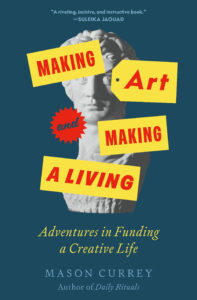
From Making Art and Making a Living: Adventures in Funding a Creative Lifeby Mason Currey. Copyright (c) 2026 by the author and reprinted with permission of Celadon Books, a division of Macmillan Publishing Group, LLC.

Mason Currey
Mason Currey was born in Honesdale, Pennsylvania, and graduated from the University of North Carolina at Asheville. Currey’s first book, Daily Rituals: How Artists Work, was published by Alfred A. Knopf in 2013. He lives in Los Angeles.