How It Feels to Watch a Civil War Unfold From the Comfort of Your Living Room
Tareq Baconi on the Experience of Repeated Exile For His Palestinian Refugee Family
Amman, Jordan, 1985
Each night, Baba, Mama, and Tata congregated around the TV set to watch the eight o‘clock news, waiting to hear snippets from Beirut that might affect loved ones who had chosen to remain despite Lebanon’s civil war: Baba’s parents, Tata’s brother, sister, and sister-in-law. There was often a communications blackout around Beirut, and when calls did go through, the best anyone could hope for was a garbled exchange of pleasantries against erratic static. The conversations were neither substantive nor fulfilling, but they nonetheless offered proof of life, and a temporary salve until the next round.
Normally, nothing on the evening news came as a surprise to any of them because Baba had his portable radio alongside him wherever he went, broadcasting updates from what was then Amman’s only English radio channel, 96.3 FM, to everyone within earshot, every hour on the hour. And because he read Jordan’s three main newspapers—الرأي ,الدستور , and Jordan Times—daily, page by page. This fact did not stop them from sitting in front of the screen with fried nerves, as Tata said, every night.
Baba’s parents, who had stayed behind, had internalized an altogether different lesson from the Nakba: It is better to die in one’s home than in exile.
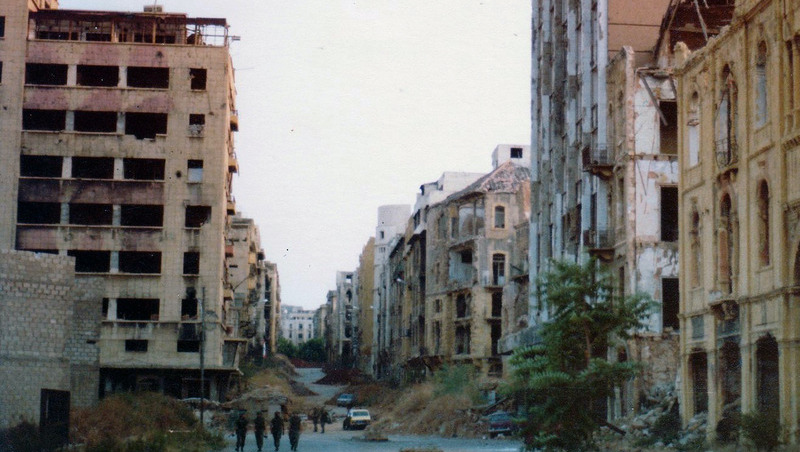
Mama, Baba, and Tata had escaped Beirut along separate routes in 1976, a year after the war began. But that is not how Tata answers me when I ask when they fled. “We left after Tal al-Zaatar but before Sabra and Shatila,” she would say. A timeline etched in massacres. Just as Deir Yassin in Palestine almost three decades prior had foreshadowed what might happen if Tata’s parents stayed in Haifa, the slaughter of Palestinian refugees in the Tal al-Zaatar camp was enough to force the three of them to leave for Amman. Then came the months and years that fried their nerves, as they watched their country descend into a gruesome war.
Baba’s parents, who had stayed behind, had internalized an altogether different lesson from the Nakba: It is better to die in one’s home than in exile. It was a lesson that was incomplete. When his father did die of a stroke, in a besieged city that Baba could not get to, leaving his mother grief-stricken and alone under heavy bombardment, the full truth dawned on them: Neither exile nor home could ever offer shelter from heartbreak or the senseless violence of war.
*
I was too young to have witnessed this myself; I was only two in 1985. The entry in Tata’s diary, dated August 20 of that year, notes that she had heard deeply upsetting news on TV. I assemble the rest of the scene with recycled anecdotes, which is easy to do, because that evening has become the stuff of family folklore.
Neither exile nor home could ever offer shelter from heartbreak or the senseless violence of war.
A hot August in Amman and a burning Beirut. The war had taken a bad turn. The initial fighting between Palestinians and Muslims on the one hand, and right-wing Christian Phalangists on the other, had given way over the course of a decade to ever-expanding violence between Lebanon’s numerous sects and to Syria’s involvement. Car bombs were once again exploding all over the city, and efforts to achieve a truce between the warring factions were faltering. The week before, leaders of the fighting militias had met in Damascus to try to carve out some kind of agreement, to no effect. Their failure tipped the city into another round of bloodletting. Baba is glued to the TV for the 10 p.m. segment alongside Tata, who is dressed in her light-blue nightgown. Laith and I have gone to bed and Mama is preparing a late-night snack for Baba in the kitchen. The news anchor is recounting the events of the day. A car bomb had exploded in a Christian district in East Beirut—“That’s Hazmieh,” Tata had exclaimed. “That’s where Daoud lives!”—and the militias were exchanging missile fire from their bases over residential towers. Some apartment blocks were badly damaged by errant missiles, the anchor noted, as they cut to a picture of a burning building.
Tata leans forward, closer to the TV. She squints. A fire is billowing on an old roof, which is dotted with water tanks and laundry lines that have white bedsheets hanging from them, smudged with soot from the smoke. Suddenly, Tata is on her feet shrieking. “Daoud! Daoud! Leila! Leila!” she screams, pointing at the TV. Baba is looking at her like she is a madwoman as Mama rushes in from the kitchen, wiping her hands on a towel. Tata looks at Mama while shaking her finger at the screen. “That’s them, that’s them,” she shrieks as she watches her brother and sister-in-law trying to douse the flames, dressed in their pajamas and night slippers, Leila’s white hair done up in a nest of curlers, strands coming undone. The TV returns to the news anchor as Tata slumps back on the sofa, sobbing. Mama comes over and sits beside her, trying to comfort her. “Well,” Mama says, holding her, “you keep complaining that you haven’t seen them in a while. Here they are. They look well.”
Tata’s sobs give way to a giggle as she smacks Mama’s knee.
__________________________________
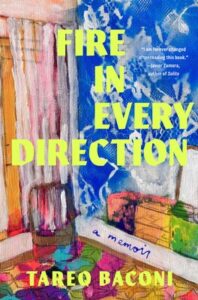
Adapted excerpt from Fire in Every Direction by Tareq Baconi. Copyright © 2025 by Tareq Baconi. Published by Washington Square Press, a division of Simon & Schuster, Inc.

Tareq Baconi
Tareq Baconi is a Palestinian writer, scholar, and activist. He is the grandson of refugees from Jerusalem and Haifa and grew up between Amman and Beirut. His work has appeared in, among others, The New York Times and The Baffler, and he contributes essays to The New York Review of Books and the London Review of Books. He has also written for film; his award-winning BFI short One Like Him, a queer love story set in Jordan, screened in over thirty festivals. He is the author of Hamas Contained: A History of Palestinian Resistance, which was shortlisted for the Palestine Book Award, and Fire in Every Direction.