
How Humor Can Be an Effective Tool For Social Change
Chris Duffy on Relieving the Horrors Through Laughter
Miracle Jones was only thirty-five years old at the time I interviewed her, but she was already a power player in her native Pittsburgh. She’s an attorney who leads get-out-the-vote efforts. She was a member of Pittsburgh mayor Ed Gainey’s transition team. She volunteers with community members dealing with mental health crises by connecting them to services, and she provides resources for her unhoused neighbors.
And that’s all on top of her day job as director of policy and advocacy for 1Hood Media, a nonprofit devoted to “art, education, and social justice.”
You might expect someone dealing with such weighty issues in her day-to-day to be extremely serious. Yet Miracle is anything but. She’s light and joyful and has a big laugh that comes easily. She tells anyone who asks that her sense of humor is a big part of why she’s able to do what she does. “I hope people would say that I show you can be yourself, have fun and make a difference, [that you don’t] always have to be serious and stressed out despite fighting back against white supremacy and violence.”
But what a sense of humor can do is relieve some of the tension.
Miracle has experienced more than her fair share of struggles and oppression in life. But to her, a sense of humor is so crucially important “because joy is a part of protest. Joy is a part of pain. We don’t live in these siloed lives where we pick either or… Joy is how we are able to engage and strengthen and support each other… That’s why joy and happiness is infused into revolutionary work.”
When Miracle is working with fellow organizers, she makes sure to intentionally allow space for singing, dancing together, watching a movie, or just goofing around. No matter what is going on, she told me, she knows she has to make time “just to laugh… and to keep that joy flowing.”
We live in a time when the world can feel quite a lot like a horror movie. When there are no cataclysmic floods, there are rampaging wildfires. When there’s no deadly heat wave, there’s an unprecedented ice storm. One day it’s horrific violence, the next it’s a slide into autocracy. And through it all, multiple overlapping systems of oppression not only remain but seem to entrench themselves deeper each year.
It’s overwhelming to even write about, much less to live through. Having a sense of humor doesn’t solve any of these issues. It’s not a magical quick fix.
But what a sense of humor can do is relieve some of the tension. It can make the work of achieving justice feel a little bit less like a horror movie and more like a comedy. Humor is a powerful tool in combating cynicism and burnout and in developing a vision for a better world. Instead of causing the work for social change to feel draining, it can make it empowering.
The first step in any movement for social change is to get people to understand the reality of the current situation. If you’re unaware of an issue, you’re probably going to be pretty terrible at solving it. As we saw in chapter one, one of the strengths of humor is getting us to pay closer attention to the world as it is. When people laugh hard, one thing they often say is “It’s so true!”
Comedians can sometimes be eerily accurate in the way their jokes predict the future. The Yugoslavian sketch comedy group Top lista nadrealista (TLN, or Surrealists’ Chart Toppers) was hugely popular and influential during the late 1980s and early ‘90s in Sarajevo. The group had a dark, punk-rock-inspired style, and their sketches often skewed political and satirical. Before the dissolution of Yugoslavia and the ensuing wars in the Balkans, TLN sketches identified the societal fault lines that would come to be central in the violence.
In one sketch, a husband and wife decide to get a divorce due to irreconcilable political differences. The family dispute soon escalates into entrenched urban warfare as they destroy the apartment with explosives and heavy artillery. At one point, the wife, taking cover behind a partially destroyed wall, yells about how she deserves ownership of the kitchen and bedroom because “it’s my historical right!”
In another sketch, a man and a woman are on a date at a nice restaurant. But the woman speaks Serbian while the man speaks “Herzegovinian.” Throughout the dinner, the couple use a translator to communicate. However, since the languages are identical, the interpreter just repeats the exact same words verbatim after each line.
TLN’s sketches are funny and surreal, and yet just months later, those same types of artificially created divisions and historical arguments would be used as justifications for violence between neighbors who had previously lived peacefully side by side. The laughter their sketches were getting was based on the audience’s realization of just how charged these issues were. But the comedians also used those laughs to reveal the fundamental absurdity of violence and conflict.
Here in the United States, the writer and filmmaker Mike Judge has garnered praise over the course of his career for getting laughs out of broken systems and absurd ignorance in American culture. His 1999 movie Office Space is a cult classic, in large part thanks to the ways it satirizes the soul-crushing, paper-pushing uselessness of many corporate jobs. Judge’s follow-up, the 2006 movie Idiocracy, pushes even further.
Borum writes that “structural policy change cannot happen—or be maintained—without narrative change, a fundamental shift in a culture’s feelings and beliefs about people and their fundamental humanity.”
In the year 2505, protagonist Joe Bauers wakes up from hibernation to discover an America dominated by corporations and led by profoundly anti-science and anti-intellectual politicians. The country is facing a massive food shortage because the government is spraying a corporate sports drink instead of water to irrigate the nation’s farms. It’s bad for growing the crops they need to live on but great for the stock price!
At another point, Bauers enters a hospital only to be arrested and sent to prison for not having a barcode tattoo to pay for treatment. And in a scene that predicted the conservative legal insistence that “corporations are people,” a woman whose children are starving loses custody of her kids to a fast-food vending machine, being told, “Carl’s Jr. believes no child should go hungry. You are an unfit mother. Your children will be placed in the custody of Carl’s Jr.”
Judge’s movies are cult classics, popularized by word of mouth and rewatched endlessly for the way he pinpoints some of the exact spots where society is currently broken. Very few people want to buy a ticket for a lecture on overconsumption, corporate exploitation, and the dumbing down of public discourse. But when Mike Judge wraps it up in humor and casts Terry Crews, Maya Rudolph, Luke Wilson, and Dax Shepard, audiences not only gladly sit down to hear his message, they also pass it along to their friends and family.
Roy Wood Jr., the acclaimed stand-up comedian and former correspondent on The Daily Show, told me that “comedy is journalism.” In his view, whether you’re making explicitly political jokes or mining laughs from your personal life, successful humor comes from honesty. “You’re just reporting on either what’s happening to you personally or what’s happening to all of us collectively. And I think once you’re in a truthful space, then you have an opportunity to truly connect with people.”
Roy’s father was a legendary civil rights journalist who reported on stories like the Soweto uprising against the apartheid government in South Africa and the dire and dangerous conditions facing predominantly Black platoons during the Vietnam War. Roy grew up watching the local news, he told me, and his father “would yell at the news the way people yell at football.” As a result, even from the earliest days of his career as a comedian, Roy has been thinking deeply about the impact and the focus of his comedy. But as anyone who has seen him perform live or watched one of his award-winning comedy specials can attest, that’s never come at the expense of genuine laughs.
One of my favorite jokes that Roy tells onstage is about what he thinks when he sees a lot of American flags in the same place:
You know how something ain’t racist, but it feels-it’s got the residue of racism on it? … Have you ever been somewhere and it’s too many American flags? It just feels … There’s a little too much freedom in this space. And it just don’t feel right. Like, how many American flags equal one Confederate flag? I don’t know what the number is, but there IS a number.
There’s so much that I love about that joke, both in its relatable construction and in the way that it highlights a granular type of political weirdness that I’d never thought deeply about before. Roy thinks it’s foolish to deny that jokes can have real power.
“You could write a joke that could destroy somebody and make them feel inhuman,” he told me. But when he’s getting laughs out of big issues like politics and race relations, “it’s naive to think that you can make a joke and speak truth to power and the establishment, and the government will change with this joke.”
So what role does humor play in making big, systemic changes? Caty Borum, author of The Revolution Will Be Hilarious: Comedy for Social Change and Civic Power, describes uses of humor like Judge’s films and Roy’s stand-up as building “narrative power,” an idea she attributes to the labor organizer Ai-jen Poo.
Borum writes that “structural policy change cannot happen—or be maintained—without narrative change, a fundamental shift in a culture’s feelings and beliefs about people and their fundamental humanity.”
As an example, Borum cites the story of Amanda Nguyen, who in her early thirties had already been nominated for a Nobel Peace Prize and was named one of Time’s Women of the Year. Nguyen has used humor and her personal story to build narrative power and use it to enact real world change. A sexual assault survivor, she was instrumental in proposing and drafting legislation that would allow survivors access to their own medical evidence to seek justice. Thanks to her work, the Survivors’ Bill of Rights Act of 2016 passed unanimously in the U.S. Congress. Even with an issue this serious, Nguyen was able to use the power of humor.
How did she do it? She partnered with the Will Ferrell-founded Funny or Die production company and made a series of short videos, including one called “Even Supervillains Think Our Sexual Assault Laws Are Insane.” Nguyen’s use of comedy, Borum reports, helped “unlock stalled legislation and capture the imaginations and attention of policy makers, the public, and media.”
For Nguyen, the key element is getting people to pay attention, and humor is a power tool. “It’s like taking your vodka with a chaser,” she told Borum. “It is my personal belief that social movements cannot be sustained on anger. Anger will burn out.”
__________________________________
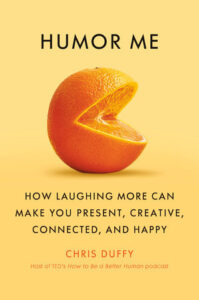
This is an excerpt from Humor Me: How Laughing More Can Make You Present, Creative, Connected, and Happy by Chris Duffy. Reprinted by permission of Doubleday, an imprint of the Knopf Doubleday Publishing Group, a division of Penguin Random House LLC. Copyright (c) 2026 by Christopher Duffy.
Audio excerpted with permission of Penguin Random House Audio from Humor Me: How Laughing More Can Make You Present, Creative, Connected, and Happy by Chris Duffy, read by the author. Chris Duffy ℗ 2026 Penguin Random House, LLC. All rights reserved.

Chris Duffy
CHRIS DUFFY is a stand-up comedian who has worked as a television writer (Wyatt Cenac’s Problem Areas on HBO, National Geographic Explorer) and is currently host of TED’s hit podcast How to Be a Better Human, winner of the 2025 Webby Award for Advice & How-To Podcasts. He has appeared on Good Morning America, ABC News, and NPR.