







How Humans Made the Loch Ness Monster
Laura Fernández Explores Our Need For Truth In a World of Uncertainty
You’ve probably heard of Dr. Livingstone. You’ve probably heard someone say (DOCTOR LIVINGSTONE, I PRESUME) more than once and smiled, not quite knowing that, in doing so, you were reenacting the birth of news as something you could fabricate. Let me tell you briefly about James Gordon Bennett, the charmingly eccentric owner of the New York Herald in 1869. A guy who responded with a wad of cash to anyone who had qualms about his behavior. The kind of guy who, when every reputable casino had banned him from setting foot on their ornate carpets, built his own casino. Or the kind of guy who, when he got tired of being on dry land, took to the sea on a yacht with a cow on board, so he could have fresh milk whenever he felt like it. In other words, someone to whom it didn’t matter which direction the world was turning, because he could easily turn it the other way. The kind of someone who, when reality failed to produce news that might sell newspapers, simply created it. Or sent out someone who could.
One could say that, until the discovery of David Livingstone—the British missionary who was lost and presumed dead in who knew what corner of Africa in the late nineteenth century—news had simply been whatever happened. That is, a ship would sink—like the Titanic would in 1912—and the newspapers, the next day, or whenever they managed to find out what had happened, reported on it. They could make it as spectacular as they wished, but they weren’t pulling a rabbit out of a hat. The thing had already occurred. But was Bennett about to wait for reality to deliver any (GOOD) news? Oh no. He was going to go out looking for it. Not him, of course. One of his best correspondents. Or at least that’s how he regarded Henry Morton Stanley when he called him aside in 1869 and asked him to withdraw one thousand pounds from the bank and set out in search of Livingstone.
We need to know because we know. As the supposed only beings that know we are going to die, we need a sense of purpose for what we’re doing here.
According to Fergus Fleming, he told Stanley: “When those thousand pounds run out, withdraw another thousand, and when you’ve spent that take out another, and so on until you find him.” Fergus Fleming is the author of an enthralling book called Ninety Degrees North: The Quest for the North Pole. Because, well, Bennett wouldn’t be satisfied with just searching in Africa. So Bennett and his best correspondents were going to specialize in finding lost explorers. Then they would sell a ton of newspapers. Because finding a lost explorer was the closest thing to finding a gold mine—you know how many stories each of them could come back to tell? And all of them would surely be fascinating. Fascinating enough to result in a series of articles capable of keeping readers hooked with each new installment, as with a serial novel. And wasn’t each of those lost explorers a true story told in installments?
And hadn’t the story of the Loch Ness (MONSTER), since 1933, become a true story, told in installments?
No doubt, that’s what it became. Only it wasn’t exactly a true story—it was an imaginatively true one.
You could say, from that point on, reality began to warp enough to make room for the possibility that such a thing might exist. Could it be that so many people were mistaken? Could it be they hadn’t actually seen what they said they’d seen at all? Such respectable people? Why would they lie? Not a single day went by without a sighting. The newspapers received letters. And not just from anyone. Every published article made it very clear that the “spotter” had been a doctor, a lawyer, or an engineer—in other words, someone with a respectable profession was risking that respectability for this. And what was this? A (MONSTER). Damn. All those people were crossing to the other side. Oh, and there’s a line separating the weird from the acceptable, of course. And it seemed that every one of those articles tried to blur it. Welcome to the (NEWS) (FACTORY). Welcome to the world after James Gordon Bennett and Dr. Livingstone, I presume. A world facing what serial journalism would consider an endless gold mine. One that, moreover, had opened a (BREACH) in reality.
And this doesn’t often happen. Because the world doesn’t often consider itself a (FANTASTICAL) place, even though it has always been one. Because the concept of reality is invasive and controlling, and attempts to eliminate the possibility that something that hasn’t been accounted for could exist, anything that the writing species—that is, humans—hasn’t yet encountered. It’s curious. Everything just exists. Things would happen in the exact way they happen, even without us creating a narrative for them. The force of gravity would exist, but it wouldn’t have that name. It simply wouldn’t be named. Like the mountains of Mars described by Ray Bradbury in The Martian Chronicles. Human beings have invented many explanations for things just so they can sleep at night. You probably do this too. People do this because they can’t help it. T. C. Boyle says human beings have the free will of birds. We do what we do because we couldn’t not do it. And maybe that’s true. We need to know because we know. As the supposed only beings that know we are going to die, we need a sense of purpose for what we’re doing here. We need to know because we know. Human beings have discovered a code capable of predicting the future. And of moving away from any kind of mystery. Of leaving the dark behind. What we are. What we do here. What all this is. They’ve done it, yes. But have they really? Here is the (BREACH) that the Loch Ness (MONSTER) opened. Which opens, each time, the possibility that something that has not been inventoried exists. Or, put another way, the certainty that reality is a construct permanently under construction.
The avalanche of sightings in 1933, and the first photograph taken of the (MONSTER) in November of that same year—a photograph that became the first tangible proof something could be out there—timidly brought the debate to the table; that is, the dispute between those to whom the construct meant nothing, or the possibility that it could change, and those who weren’t willing, for anything in the world, to believe in the existence of something that simply could not exist. Because monsters don’t exist, and dinosaurs became extinct sixty-five million years ago, could Loch Ness—as surrounded as it was by life, by human life, as in contact with civilization as it was—hide a prehistoric creature? Was reality suddenly Arthur Conan Doyle’s The Lost World? In The Lost World, Doyle fantasizes about the possibility that there still exists a corner of the world, completely unexplored by humans, where dinosaurs aren’t extinct, and where they live as if nothing had ever happened. And that nothingness includes human beings.
The novel was published in 1912, and in it, supposedly an expedition—in which Doyle, not coincidentally, places a journalist, Ed Malone, from the Daily Gazette—finds that other lost world at Mount Roraima in the Venezuelan Amazon jungle. That, at least, was the place that served as inspiration for the misty and mysterious plateau of the fiction, and didn’t the remoteness become part of the pact of verisimilitude, or credibility, that could take place upon such a discovery, even within a novel? And in what way could such a thing be believable, then—that this might happen among people?
Because there is reality, and there is what is told about it, and it’s important that the difference is clear when one is speaking, as we are here, about impossible things. I mean, how is it even possible that a prehistoric creature had never stopped inhabiting a lake in which humans fished and bathed, a lake on which they sailed? Not to mention the longevity of the creature in question. Could something have lived, there or anywhere, since the beginning of time? When faced with this possibility, as happens with everything that occurs, human beings construct a narrative to make sense of it. But how could that make sense? The moment the (NEWS) (FACTORY) was set in motion, there was also set in motion the most astonishing example of humanity’s need to believe that, somehow, we’re not alone.
It’s no coincidence that, in the future—a near future that is, drumroll, connected to the hippies—yes, Loch Ness became a refuge for a good number of them, when Charles Manson and his Family, the residents of Spahn Ranch, murdered the future—a future in which monster hunters will abound along the shores of that enigmatically famous place, where a guy named Frank Searle—don’t forget that name, and remember that he wore, the entire time he lived by the lake, a badge on which (I’M ALMOST FAMOUS) clearly could be read—would boast of having photographed at once both the (MONSTER) and a flying saucer. But that will happen in the future. The first thing the (NEWS) (FACTORY) will produce will evidently be proof. Because to be acceptable, admissible, believable, the possibility that a frequently sighted (MONSTER) existed had to be proved. That is, if almost anyone who came close to the lake could see it, why wouldn’t they photograph it? If Nessie were a narrator—that is, if she were someone attentive to the need for the story to move forward, and for it to do so, pursuing what could make that story acceptable, admissible, believable—she wasn’t going to take too long to provide that thing (THE WORLD) with that photograph. But as a skilled narrator, she wasn’t going to just hand over the photograph the world wanted. She was going to be shy about it. She was going to give them something that could be anything.
The lake is no more than a stage. A background for the selfie one is about to take. A tiny conquest, a nerdy conquest, and perhaps laughable, or not even.
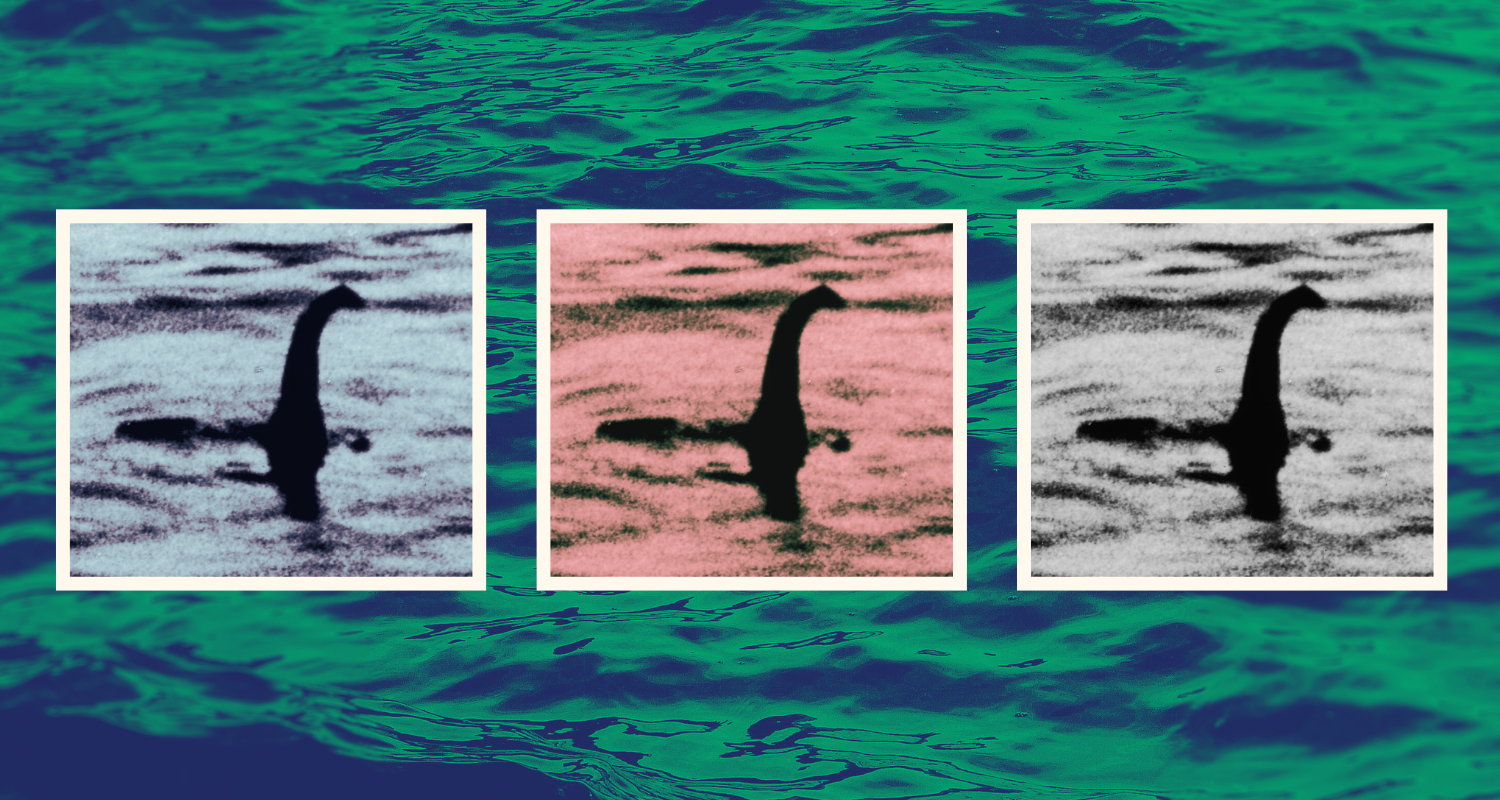
The photograph taken on November 12, 1933, and published in the Daily Express/Daily Sketch on December 6, the photograph taken by a man named Hugh Gray, came with a certificate from Kodak—yes, the photo company, or the photo monster of that era—stating that the negative had not been tampered with in any way, which is like saying that the photograph was of something real, not fake. In the photograph you can see something emerging from the lake, but it’s an amorphous something, surrounded by foam, and excessively geometric—although clearly a fin. That, inevitably put the world on guard. Had the negative really not been retouched? Could it be true?
Bertram Mills, a circus magnate who, also not coincidentally, sent his circus touring through Scotland at that exact moment—some claim he let his elephants bathe in the lake, causing all sorts of interference in the official story—offered a reward of twenty thousand dollars to anyone who found her alive. A home was even built for her. It consisted of an enormous house-shaped cage. A house about nine meters wide and a bit more than seven and a half meters high in which this Mills character planned to exhibit the (MONSTER), because obviously, for those twenty thousand dollars—equivalent to half a million today—it was going to be the property of his circus. Mills even had a model built, with which he toured all of Scotland, a papier-mâché (NESSIE) with crazed eyes, pointy humps, and antennae. A kind of winged dragon mounted on a trailer, always surrounded by five guys in raincoats.
Oh also, the rain. Do you know that in Scotland it rains 286 days a year, even now? Do you know that Loch Ness is one of the country’s thirty-one thousand lochs, including five thousand freshwater ones, which produce 2 percent of the world’s water and 91 percent of the UK’s water? That’s why the Scots don’t pay for water, the bus driver taking me from Edinburgh to Inverness tells me, dropping me off at Dochgarroch Loch, the departure point for my Loch Ness cruise, which will take place at some point in that accelerated and cynical future we live in today. Of all those lochs, the darkest and deepest is, of course, Loch Ness. And it is also the largest in terms of volume of water, and not only in Scotland, but in all of Great Britain—that is, the entire island. The driver, who is also the guide, doesn’t mention that the “New York Zoo” also offered a reward back when Bertram Mills assumed the (MONSTER) would soon be one more attraction in his traveling circus. And both rewards ended up in the (NEWS) (FACTORY); of course, they ended up in all types of newspapers of the era, and produced the desired pull effect. An effect different from anything you’d see today. Because in those days, anyone who reached the shore kept their eyes glued to the lake, looking for anything that moved below the surface, because anything that moved could make them rich. Nowadays, when the reward still remains in effect and stands at no less than one million pounds—one million, yes, (DO YOU WANT TO BE A MILLIONAIRE?), no one pays the slightest attention to the lake when they cross it.
The lake is no more than a stage. A background for the selfie one is about to take. A tiny conquest, a nerdy conquest, and perhaps laughable, or not even, just an (I WAS THERE) and (YOU KNOW?) (IT WAS JUST A BUNCH OF BLACK WATER), and perhaps it didn’t even cross their minds—or it did—that something could appear and that that something, in another era, had been fearsome and could devour them, but now, in this future, it could be worth a not-inconsiderable one million pounds—offered not by the government, as the guide who drives the bus will assure me, but by the betting house William Hill, which also organizes an annual photography contest that awards one thousand pounds to whoever takes the best Nessie picture, and the prize is called simply the (BEST NESSIE SIGHTING OF THE YEAR AWARD), and yes, you can peruse the list of winners and the photographs, and if you want to participate, you must do so through the Official Loch Ness Monster Fan Club—but it didn’t seem that that was what was happening. It was more like each of them had a ridiculous trophy, a trading card, something in their collection, an (I WAS THERE), and no, of course they didn’t see a (MONSTER) (I JUST SAW A BUNCH OF BLACK WATER) (PITCH BLACK) and (IT WAS RAINING) and the guy on the megaphone spoke as much about the (MONSTER) as about Scotland, and the loch, and the castle, of course, Urquhart Castle, next to which so many photographs of Nessie have been taken in this last almost century, and (DID YOU KNOW?) (THEY WERE JUST A BUNCH OF RUINS) and (YOU COULD WALK BETWEEN THEM, YES) and (WHAT DOES THE LAKE LOOK LIKE FROM THERE?) (OH, THE SAME THING) (ALL THAT BLACK WATER).
_______________________________
Excerpted from There’s a Monster in the Lake: The World as a Fantastical Place by Laura Fernández, translated by Alexis Almeida. Copyright © 2024 by Laura Fernández. English translation copyright © 2026 by Alexis Almeida. Reprinted with the permission of Graywolf Press, Minneapolis, Minnesota.

Laura Fernández
Laura Fernández is a writer, journalist, and critic. She is the author of six novels, the most recent of which won the Ojo Crítico de Narrativa Prize and the Finestres Prize for Narrative, among others. She writes for El País and lives in Barcelona.