How Christianity Was Used By the Powerful and the Marginalized to Shape Post-Civil War America
Matthew Avery Sutton on the Role of Religion in Reconstruction
Charles Shelton, a “home” missionary in the Dakota Territory, penned an article in 1885 for a missions magazine titled “The Indians from a Christian Standpoint.” He hoped to inspire more evangelistic efforts in the West. The nation’s tribes, he warned, faced inevitable extinction. Yet Christians could play a role in determining how best to “exterminate” the “savage.” “You can send to the Indian the rifle and exterminate him in this way,” he wrote. “It is a slow and very expensive method.”
Or, he suggested, “we can send to the Indian this Gospel of Christ, this great power of civilization, and through its influence exterminate the savage, but save the man.” Survival for Indigenous people, he told his White Christian audience, required their transformation. If tribes “continue to be pests to society, expense to our government, a blot upon our fair name, a reproach and a contradiction to every profession that we make of Christian love or of Christian conversation, the fault,” he concluded, “rests with the churches.”
In the aftermath of the Civil War, federal leaders sought help from Christian groups like Shelton’s as they sought to reassert their power across the entire United States. The US Army had won on the battlefields, and now governing authorities and their protestant collaborators sought to secure the peace. They aimed to reconstruct the nation, to rebuild Americans’ shattered sense of their nation’s exceptional history and manifest destiny, and to reinvigorate their commitment to the United States’ Christian mission. But to succeed, policymakers knew they needed to limit dissent—including religious dissent.
Across the nation, Reconstruction policies provided new opportunities for church leaders in collaboration with the government to impose their ideas and values on the land and its peoples.
Christian activists played key roles in every part of postwar reconstruction. In the South, Black ministers and White missionaries welcomed the formerly enslaved into the faith and worked with them to establish independent social and political lives. Defeated Southern Whites launched a multi-generation effort to defend their treason by reimagining the causes of the Civil War and God’s role in it. In the West, a series of Indian wars led to the US government’s creation of a comprehensive reservation system, where government-sponsored missionaries sought to Christianize tribes and “civilize” their children. In Utah Territory the US government cracked down on the Church of Jesus Christ of Latter-day Saints and its impressive theocracy, seeking to quell religious dissent.
Across the nation, Reconstruction policies provided new opportunities for church leaders in collaboration with the government to impose their ideas and values on the land and its peoples. Protestant activists believed that they alone had the tools and expertise to integrate Black and Native peoples, former Confederates, and religious dissenters into the body politic, while bringing healing and reconciliation to all Americans on their terms. Rocked by the split over slavery and then the war, they worked to build unity by identifying common threats and enemies and organizing Christians against them. Their actions demonstrated that after the conflict, just as before, the free exercise clause did not apply to all equally. But minority groups constantly challenged the power of mainstream Christian leaders.
*
Black Americans secured literal freedom in the 1860s and also discovered a new sense of spiritual independence. Black denominations in the North had rushed to send missionaries, ministers, and supplies into territories retaken by the US Army. Young African Methodist Episcopal preacher Theophilus Gould Steward traveled South from New Jersey to minister during the conflict. Black Americans, he noted in 1865, were “lying under an almost absolute physical and moral interdict. There was no one to baptize their children, to perform marriage, or to bury the dead. A ministry had to be created at once—and created out of the material at hand.” He and his colleagues leapt into the work, building up churches where liberated African Americans could find refuge, spiritual instruction, and discipleship.
Only about one-third of enslaved Americans considered themselves Christian at the start of the Civil War. But in the Reconstruction era Black church going skyrocketed. And just about all of those who converted chose to attend Black-led churches. The days of Southern Black Christians submitting to second-class treatment in the house of the Lord had ended. In urban areas, African Americans could usually join churches that Black activists had founded before the war. In rural areas, they had fewer options. They sometimes had to settle for makeshift meetings in vacant buildings or arrange outdoor services until they could build rudimentary houses of worship.
Black clergy became some of the strongest advocates for full equality and rights in the postwar South. Seeing Jesus as a liberator, they aimed to make the egalitarianism of the gospel and the Declaration’s line that “all men are created equal” the reality in the United States. Many engaged directly in politics, understanding that while slavery might have ended, securing political equality required vigilance.
Formerly enslaved Baptist minister James Simms, who won election to the Georgia assembly, explained why so many of his fellow clergy engaged in politics. “In seeking out men to represent the colored people in the councils of the nation and State,” he wrote, “the most competent men were to be found, with few exceptions, among the ministers of the gospel of Christ.” He acknowledged that Black clergy’s participation in politics might raise questions of the separation of church and state, but the context demanded it. “It was unavoidable,” he insisted. “Many pastors and preachers necessarily had to leave their flock and legitimate field of labor to enter the arena of politics in order to secure right and justice for their people.” They refused to separate political freedom from spiritual freedom.
Black ministers’ political engagement made them targets of violence. Members of the Ku Klux Klan, a terrorist organization founded by Southern Whites shortly after the war, burned down churches and threatened Black activists. A journalist testified to the US Senate about his interview with a minister. While “he had been preaching on the circuit,” Klansmen dragged the preacher from bed in the middle of the night and “beat him severely.” They “told him that if he returned to the county he would suffer for it.” This was one example of many. As racial violence escalated in the South, serving as a minister proved dangerous.
AME leader Henry McNeal Turner, like Simms, kept one foot in the world of politics and the other in the church. As a teenager Turner had joined the predominately White Methodist Episcopal Church, South, but he later transferred his membership to the African Methodist Episcopal Church. He served as the first Black chaplain in the Civil War. After the conflict, he worked with the Freedman’s Bureau, an organization that supported formally enslaved men and women as they built new lives, he helped expand the Republican Party, and he planted new AME churches around the South. He also ran for office, winning a seat in the Georgia legislature.
In both his religious and civic life, Turner fought for Black equality. In 1875 Congress passed a civil rights act outlawing racial discrimination, but in 1883 the US Supreme Court invalidated the law. The decision had profound implications for voting. “It has made the ballot of the black man a parody,” Turner excoriated, “his citizenship a nullity and his freedom a burlesque.” Furthermore, like slavery before it, segregation made a lie of claims that the United States represented in any way God’s chosen land. “And as long as the accompanying decision remains the verdict of the nation, it can never be accepted as a civil, much less a Christian, country.”
Their actions demonstrated that after the conflict, just as before, the free exercise clause did not apply to all equally. But minority groups constantly challenged the power of mainstream Christian leaders.
Frustrated by White Americans’ propensity to cloak their racism in their religion, Turner drew on the liberationist stream of Christianity to defend Black rights. He made the radical claim in 1896 that “God is a Negro.” “We have as much right biblically and otherwise to believe that God is a Negro,” he wrote, as Whites “have to believe that God is a fine looking, symmetrical and ornamented white man.” Many Americans, he recognized, believed that God is a “white-skinned, blue-eyed, straight- haired, projecting-nosed, compressed-lipped and finely-robed white gentleman, sitting upon a throne somewhere in the heavens.” But for Black Christians, this image proved destructive. “Why should not the Negro believe that he resembles God as much so as other people?…God is a Negro.” Having lost hope in the United States, Turner eventually called for North American people of African descent to emigrate to West Africa in search of true freedom.
Historian, sociologist, and Black activist W.E.B. Du Bois summarized in 1903 the role that churches played in Black life, especially in the postwar South. “The Negro church of today is the social centre of Negro life in the United States,” he wrote, “and the most characteristic expression of African character.” Postwar Black churches, as Du Bois understood, represented the heart of Black efforts to secure social, political, and religious equality. Church leaders had engineered the Christian faith into a tool of liberation, which made them a threat to the White Christians of the South and much of the rest of the United States.
In addition to working to suppress Black political and religious power, many Southern Whites launched a quasi-religious campaign to reshape the memory of the Civil War. Rather than acknowledge their deep investment in slavery, they recast the conflict as a tragic clash between two honorable forces—the North fighting to preserve the Union, and the South struggling to defend local autonomy and states’ rights. The authors of this revisionist account reduced slavery to a secondary issue, incidental to the “real” causes of the war. As a result, by war’s end, many White Southerners felt they had no reason to repent, no moral reckoning to face, and no obligation to embrace Black equality or suffrage. For them, the war had simply preserved the Union and, almost as an afterthought, ended slavery. Nothing more.
Christianity became central to this new Southern narrative. In defeat, White Southerners cast themselves in the role of Christ, imagining their suffering as redemptive. They claimed they had sacrificed for the greater good of the nation, their values—chivalric protection of White women, paternalistic care for those they enslaved, and Christian devotion—positioned them as the rightful moral leaders of the country. In their view, God had chosen them to guide the nation toward righteousness, but first he had humbled and purified them through the bloodshed of war.
__________________________________
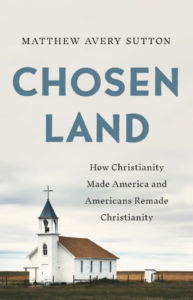
Excerpted from Chosen Land: How Christianity Made America and Americans Remade Christianity by Matthew Avery Sutton. Copyright © 2026 by Matthew Avery Sutton. Available from Basic Books, an imprint of Hachette Book Group, Inc.

Matthew Avery Sutton
Matthew Avery Sutton is the Claudius O. and Mary Johnson Distinguished Professor and department chair in history at Washington State University. He is the author of five other books on the history of American Christianity, including Double Crossed and American Apocalypse, and the recipient of a Guggenheim fellowship. He lives in Pullman, Washington.