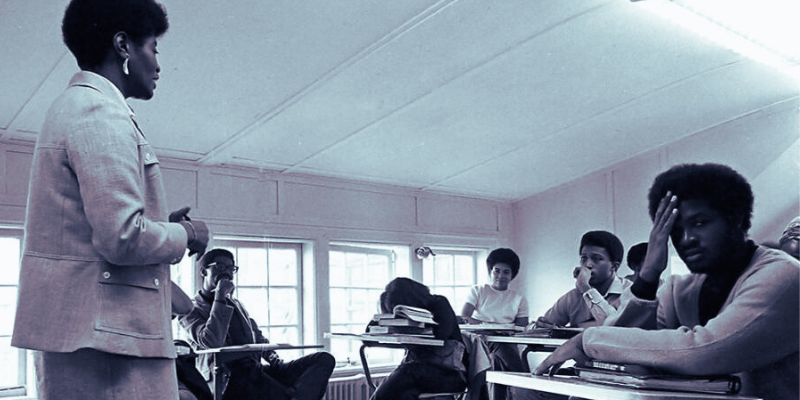
How Black Studies departments are being dismantled at American colleges.
A new report in the Chronicle of Higher Education shows how Black Studies departments around the country have been kneecapped by a multi-pronged conservative strategy to halt the study of race at American schools.
Those who have been paying attention to the administration’s ongoing campaign against “DEI” will not be shocked to find that gambling’s been going on here. But Jafari S. Allen, author of the Chronicle analysis and editor of Souls: A Critical Journal of Black Politics, Culture, and Society, broke down the how and the who in a compellingly clear-eyed study.
Inspired by an emergency forum held earlier this March—which convened leaders of the imperiled discipline from colleges all around the country—Allen takes a bird’s eye view of bummer terrain. The current crisis facing ethnic studies, he argues, is the result of four distinct rhetorical, legal, administrative, and enforcement strategies.
Allen pins the origins of a rhetorical strategy to early 2020, when conservative activist Christopher Rufo launched his screed against Critical Race Theory, a complex body of scholarship that he effectively defined as “any teaching in K-12 education about race, racism, and American history.”
This tack gained major traction on the right, and became a key Trump platform. And while public opinion was being whipped, a legal strategy kicked off behind the bench.
In June 2023, the Supreme Court’s decision in Students for Fair Admissions v. Harvard ended “race-conscious admissions,” i.e., affirmative action.
The past three years of enrollment data show the consequences of this landmark decision. Black student enrollment has fallen drastically at Ivy League schools. Which correlates to a decline in the number of students concentrating and majoring in Black Studies.
Those schools, in turn, can now defund programs based on low numbers. But “this is not an oversight,” Allen insists. “The argument that departments are failing to attract students is being made by the people who ensured fewer of those students would arrive.”
On the admin end, colleges have been lately cowed by new regulations at the Department of Education. A 2025 letter enshrined the SFFA decision into a general—if, again, vaguely defined—policy.
In a particularly craven twist, this letter enlisted the Civil Rights Act of 1964 and the Equal Protection Clause to halt or hinder affinity programming in schools. Because as the new legal logic goes, any theory designed to acknowledge race in America is racist.
The last move—enforcement—launched in February of this year, when the Education Department announced that dozens of universities would terminate their partnerships with the PhD Project, a nonprofit “that has helped more than 1,500 Black, Indigenous, and Latino students earn doctoral degrees in business.”
Schools that signed on to this resolution also allowed an audit of all their external partnerships, so federal and state enforcers could suss out potential Civil Rights violations. Which will inevitably lead to more stories like this one, about the recent curricular kerfuffle ousting Plato and his gender ideology from Texas A&M.
*
Allen’s report also shows how ethnic studies departments have been structurally vulnerable since their inception. Early investment in race and gender studies “favored programs over departments,” which has always made financing a tenuous proposition. And at the end of the day, even the highest minded universities stay beholden to bottom lines and trustees.
Noting a pattern whereby ethnic studies programs are bundled or absorbed into other departments—a recent phenomenon we can observe at New York University and the University of Iowa, among other places—Allen is clear-eyed.
“An institution genuinely committed to Black intellectual life as part of its scholarly mission would respond to the current assault the way it would respond to any political intervention threatening a department whose scholarly standing was beyond dispute. An institution merely managing minority difference will run a calculation.”
The thing to change, then? We’re back to rhetoric.
*
To recap: the conditions are Not Great, Bob for ethnic studies across the board. In Kentucky, where House Bill 4 recently eliminated DEI programs at all public universities, the University of Louisville’s Pan-African Studies doctoral program is now on the chopping block. This program represents the state’s only comprehensive Black Studies department.
The University of Texas recently dissolved its department. And a Senate Bill in Florida has siloed its African American Studies courses—among others, ethnically-minded—through a keyword search stripping courses of “their general-education designation,” which status is crucial to secure funding.
What does this mean for the future of a key American intellectual tradition? Traditions?
Allen insists that there is a path to resistance. And in the meantime, rolling over is a non-starter. “The most dangerous threat to Black studies right now is not coming from the federal government,” he writes. “It is coming from institutions that have decided, in advance, that accommodation is the same thing as survival.”
Image via

Brittany Allen
Brittany K. Allen is a writer and actor living in Brooklyn.