How Being a Mediocre Scientist Helped Me Become a Better Novelist
Vincent Yu on the Creative Lessons He Learned From His Stint In Evolutionary Biology
For a long time I was a good student, until I was very suddenly not.
It took considerable evidence, after so many years of being categorized as precocious, to convince me that my days of being ahead of the curve had ended. Only after flailing through dozens of exams in infectious disease and genetics, after bumbling through numerous chemistry and physiology labs in which my mistakes veered into biohazard, was I finally forced to accept that the curve hadn’t just caught up to me—it had run me over.
My problem, I came to realize, was application. I’d chosen to pursue evolutionary biology because I found it elegant that a set of natural laws could explain aspects of animal behavior. Indeed, problem sets made beautiful sense to me once their solutions were revealed; their retroactive logic was undeniable. Sometimes, while debriefing an exam question with an exasperated TA, I felt as if I were analyzing a great play in the bottom of the third or a masterfully constructed point in the second set. I was far better suited as an enthusiast of the subject than as a practitioner.
I began to realize that the fundamental aim of evolutionary biology—to understand why a thing behaves the way it does—mirrored the goal of my fiction.
But realizing this took time, and I was no longer quick to anything—least of all self-discovery. I began to feel as if my four years splashing in the fount of undergraduate knowledge had been spent ruling out, rather than homing in on, what I wanted to become.
I can’t say whether this same obtuseness led me toward the preposterous idea of becoming a novelist in my very last semester of college, but it certainly gave me the poor sense to stick with it. By the time I realized how silly it was to populate made-up stories with made-up people, and further, to expect real life humans to draw any sort of meaning or pleasure from them, it was too late. I was in love.
And this was an impetuous, addictive, utterly nonsensical sort of love—quick acting and long lasting. The kind that might compel someone who’d just graduated with a Bachelor of Science, whose professional experience comprised solely of internships at pharmaceutical companies, who’d never taken a writing class in his life, to devote himself wholesale to the craft of fiction.
Perhaps there are some things you learn too late only because you leapt in too quickly.
I eventually realized that love was a fantastic, though slovenly, motivator: It provided little assistance in the actual conquering of the blank page, and in my earliest years as a writer, I produced some truly abominable fiction.
It was a frustrating, discouraging time, though I understand now that I should’ve been heartened. Because at least I was capable of disliking my own work. Knowing what I wasn’t good at hadn’t carried me very far as a college student, but when it came to writing, it conveyed productive information. It was evidence of a voice, somewhere. A sensibility which might be triangulated.
This, too, was a delayed bit of clarity. Although, for the first time, I didn’t feel panicky or behind the proverbial curve. My obtuseness began to resemble a kind of perseverance. I was actually thankful for it, and for thousands of wince-worthy pages essentially generated through trial and error, all of which helped me realize how certain aspects of my scientific “training” lent themselves well to fiction.
There was the process of writing itself, which always began as an experiment—a person (or people) brought up against a set of conditions. And from there, how everything needed to be properly designed: the controls, like backstory and character, needed to be compelling; the narrative stakes, like an abstract, had to be clearly and properly noted.
Variables needed to be well-defined and accounted for, even in their unpredictability. As the story ran, observations needed to be made. If I was lucky, I noted encouraging results—although much of my work failed to reach this stage. Most studies began and ended as hypotheses.
However, on occasion, I’d stumble upon something promising.
When I first heard about the ballistic missile alert sent in error to the state of Hawaii in 2018, I couldn’t stop considering its repercussions. I thought of the cauldron of feelings a person might experience: surrealness, terror, regret, and began to wonder, what else? Under which conditions might such an event inspire shame? Relief? Even hope?
The potential reactions were so myriad, each set of conditions so compelling, that I needed to build out an entire community’s worth of stories in order to satisfactorily explore them. Each character was inoculated upon a petri dish, subjected to the same narrative stresses, allowed to develop and react.
In the process, I began to realize that the fundamental aim of evolutionary biology—to understand why a thing behaves the way it does—mirrored the goal of my fiction. And so my writing needed to be similarly rigorous but open-ended. I needed to back off and observe my characters, while courting the surprising, even the unfathomable, in search of those minute chances and unlikely moments that truly open up a life.
As I did so, I began to rediscover certain biological concepts in the context of my work, and to find them suddenly and irresistibly literary.
Take, for example, the ecology of archipelagos—constellations of islands often formed by volcanic activity, of which the Galapagos are a famous example.
While I can’t say I’m any quicker to self-knowledge these days, I am more patient. I know enough, now, to be truly grateful for all those instances when I was slow on the uptake.
The islands that comprise the Galapagos are clustered closely enough for a community of finches to have populated each, yet isolated enough for each population to have developed profound, island-by-island variances in the shapes of their beaks. This condition was noted by a young Charles Darwin, and inspired him to develop his idea of adaptive radiation—in which populations of the same species spread across multiple land masses and develop advantageous traits that are particular to the geography of each.
What a lovely framework through which to imagine the ways in which a human community, after experiencing a devastating and fracturing event, might find distinct ways to cope and reconcile.
I’ve always been fascinated, too, by the concept of an evolutionary arms race, in which two closely interacting species—a predator and its prey, a parasite and its host—co-evolve. Over the course of many generations, advantageous mutations in one species allow for heightened rates of survival, and are therefore selected for, permeating the gene pool until the other species responds with its own advantage-granting trait.
The constant escalation results in single species that possess what seem like arbitrary traits (the profound toxicity of the milkweed plant, for example, or the cheetah’s blistering quickness) but, when paired with another, forms a complete story (the monarch butterfly’s resistance to milkweed toxin, the gazelle’s ability to outrun a pursuing cheetah).
Nature seems to have provided a perfect blueprint for a human relationship in tumult.
It is humbling, especially as a dilettante of science, to recognize that the world is still fit to bursting with organisms whose behaviors are not properly understood, with species whose bizarro traits bear no sense of evolutionary narrative. Recognizing this is of a piece with the wonder and curiosity required to create good fiction.
And while I can’t say I’m any quicker to self-knowledge these days, I am more patient. I know enough, now, to be truly grateful for all those instances when I was slow on the uptake. Because there are plenty of stories in which clarity only arrives at the end, once the entire narrative and its possibilities have been seen through. There’s nothing wrong with holding off the big reveal for extra dramatic tension.
But just to be safe, I won’t be picking up any new hobbies in the near future.
__________________________________
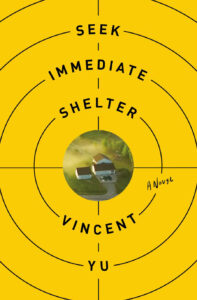
Seek Immediate Shelter by Vincent Yu is available from Flatiron Books, an imprint of Macmillan.

Vincent Yu
Vincent Yu is a sales manager at W.W. Norton/Liveright and the winner of the 2021 Ashley Bourne Prize for fiction from Ploughshares. Seek Immediate Shelter is his debut novel. His work has been published in Prairie Schooner, StoryQuarterly, Ninth Letter, Able Muse, and elsewhere. He lives in Brooklyn.