How Back to the Future Made Me a Misfit Skateboarder
Sean Mortimer on Embracing Counterculture and Following His Passions
Misfit passions have a way of mutating expectations so wildly that it puts you in a “state of becoming,” as Bob Dylan once put it.
A transformative momentum sweeps you away from your old life and begins to construct an original identity as you adapt to this new reality. There is so much going on that it takes some time to understand how this new you—or perhaps “authentic you” is more accurate—is coming into existence.
Each movement that takes you deeper into your misfit passion serves two purposes—information gathering and confidence building. These two actions blend into a metamorphic process that feels as if it’s happening of its own accord.
If you’d stopped thirteen-year-old me—anxious and lacking confidence—before I entered the theater for Back to the Future and said that if I chose skateboarding I would have to run from cops and even get tackled and put in headlocks by the boys in blue, become a walking target for empty bottles and worse thrown by strangers, and have school guidance counselors laugh in my face, I would have said no thanks.
I hadn’t experienced a passion grand enough to offset great sacrifice and did not have access to the confidence required to invite that kind of abuse.
I hadn’t experienced a passion grand enough to offset great sacrifice and did not have access to the confidence required to invite that kind of abuse. I’d have turned the option off, shut myself down, unaware of the change and joy it would infuse into my life along with those obstacles. Before I sat in that theater seat I was a different person. But after that simultaneous moment of destruction and creation in the theater? Whether I wanted to skateboard no longer fit into the question-and-answer paradigm.
Underground cultures exist outside mainstream radars, which can render entrance points virtually invisible to the more traditional.
A misfit passion connects immediately, but the character development behind it happens gradually, without one’s realizing it. The journey into an unknown misfit world starts alone, demanding a certain strength of character. Go play Little League, Pop Warner, join the Girl Scouts or various other traditional youth activities in which a parent walks you up to the registration table, where they line up with other parents, sign official paperwork, pay a fee, receive a uniform, which automatically makes you a member of the team, perhaps even necessitating name patches or random numbers on the back in order to tell players apart. It’s not uncommon for multiple generations to have cycled through the same organization and same procedure.
Complete the process and you are officially on a team. Well, as long as you follow their rules. This is a “normal” activity, and traditionalists understand the expected ways to react when playing, spectating, coaching, or practicing. If not, there is a community of controllers around to correct you.
By contrast, fringe subcultures operate in a more cryptic and chaotic manner. There are scant parentally assisted ways for a newcomer to enter an esoteric subculture and automatically “get on the team.” Underground cultures exist outside mainstream radars, which can render entrance points virtually invisible to the more traditional.
There is a reason for the descriptive label of underground cultures and subcultures. They are hidden from conventional daylight. Skating was declared illegal in many cities, so “skate rats” scurried around in the shadows to avoid being busted. Alternative culture stores and venues are usually located in out-of-the-way areas. Low-rent underground clubs like CBGB and Cuckoo’s Nest were created to host the punk and New Wave music that established, “successful” clubs ignored with prejudice. Basements became de facto headquarters for D&D campaigns. Nirvana’s Kurt Cobain chose the word “subversive” to describe Mark’s band DEVO for a specific reason.
This “underground” aspect of misfit activities forces you to go on a search once again, but this time with a specific mission in mind. For most of us, this search is the first time we’ve had to figure out how to make life happen completely on our own. “I told my parents that I wanted a skateboard,” Shepard says. “Their only association with skateboarding was through my dad’s head nurse, whose son had dropped out of high school, was doing a lot of drugs, had a mohawk, and was skateboarding. So they tried to keep me from skating by saying I had to pay for half of a new board. I was fourteen years old and had to raise half the $120, so I mowed lawns and babysat and earned that sixty bucks and then they had to fulfill their side of the bargain.”
A fear loomed that not only was I not ready, but that some misstep based on my lack of worthiness would earn me permanent exile from this world I couldn’t even comprehend.
I love my parents and they never made me feel bad for not fitting in, but they were going to be absolutely zero help in my search to discover what my misfit passion was all about. “There was a ballet teacher in my neighborhood with three kids and she told her kids not to play with me because I was going to waste my whole life riding that skateboard,” Stacy remembers. “She was right—there was no such thing as skateboarding back then. It wasn’t looked at as a sport or a legitimate activity. I spent three hours a day skateboarding, and there wasn’t one time in my life that my parents said, ‘Hey, can we come watch you?’ ”
Not only will normal guides be of no use, parents can even transform into obstacles via stereotypical knee-jerk reactions to anything unconventional. I know many misfits whose parents took away the tools of their outcast passion. One friend’s father even extracted an oath from his kid promising that they would quit at a certain age. (FYI: Misfit didn’t quit.)
Instantly obsessed with skateboarding after Back to the Future and totally clueless, I didn’t even know how to start investigating my unconventional interest. I had never pursued anything that wasn’t readily available. Nobody I knew did the fringe activity, and I mean nobody. No friend of a friend, classmate, or distant cousin did anything even remotely related—not that I knew what was related to skating at the time.
Back then you had to look in a phone book called the Yellow Pages for business’s numbers and addresses. They sectioned them under various generically labeled groupings. Sports. Tailoring. Music Lessons. Record Stores. Obviously, there wasn’t a skateboard section, and it took many dead ends, crossreferencing, and blind guesses before I finally found something relevant.
Luckily, one of the few skateboard shops in Canada at the time, PD’s Hot Shop, was not only located in Vancouver, but was roughly only an hour’s bike ride away. I traced a map and penciled in the street names so that when I got lost, I’d know what to ask for. As a shy suburban kid with my two-tone beige Sears jacket and mall haircut, I’d never biked this far before, over bridges and through fields, into an unfamiliar part of Vancouver.
Pay phone change in case of emergencies jangling in my pocket, an extra bowl of cereal ingested for fuel, tire pressure checked. But even with all my preparation there was a nervousness around this whole enterprise that I didn’t recognize. A fear loomed that not only was I not ready, but that some misstep based on my lack of worthiness would earn me permanent exile from this world I couldn’t even comprehend. I was going to screw this up! I’d never felt this texture of fear before.
Somehow, this new sensation emitted an awareness of the magnitude in which skateboarding would warp my life, which only ratcheted up the anxiety of blowing it. It does not calm the nerves to understand you have something to lose before you even know what it is.
Stray tall grasses pinched in my wheel’s spokes, T-shirt sticky with sweat, face red from the midday ride, I finally arrived at PD’s Hot Shop, a tiny store decorated with bold black-and-white signage and crowned with a powerfully aggressive DIY image of a skull that had become the logo for Skull Skates. Clueless to the punk scene at the time, the closest I could compare first seeing the outside of the store to was magically entering a headbanger’s school binder.
Known as Rowds in our area, short for rowdy, the long-haired, acid-munching metal heads populated shop classes and were familiar faces in detention with their sleeveless back-patched jean jackets. Wearing their rejection with pride, they drew Iron Maiden’s ghoul mascot Eddie and Motorhead’s snaggletooth beast on their notebook and tagged Metallica’s, Sabbath’s, and AC/DC’s logos onto walls and lockers. They owned being misfits and glowed in the hallways and designated school smoking areas with a dangerous anti-authority radioactive radiance. The Rowds were the only counterculture vibe I had ever been exposed to at this point.
My reflection on the glass looked like I’d arrived fresh from a mall portrait studio. I was not hardcore.
The awareness of PD’s being an actual threshold to cross was so visceral that I stayed out in the parking lot, sitting on the wooden rails and then pacing around, trying to force myself to go inside the small shop.
Later in life, a bunch of us would go cliff jumping in Mexico and we were all psyched in the boat driving to the island and then we climbed the cliffs and looked over and every one of us knew what the other was thinking—Oh damn . . . how am I going to make myself do this? I knew I was going to jump, but I did not yet know what I was going to do in order to force myself to run to the edge of the cliff and leap. I knew I was going to go through the doors of PD’s. There was full recognition of how badly I wanted it and how it was going to change me, but at that moment what I needed was behind a wall of fear. Fear of what? What else—the unknown.
I paused at the doorway, looking through the glass for some clue that might make it easier. I knew nothing about skateboarding and the guys inside all had short punk flattops and wore mostly black clothing, shirts adorned with skulls, sleeves hacked off, a combination at the time that was a bold enough statement to draw aggressive stares on Vancouver streets. I stared at a crudely contrasted image of a mohawked skull with “HARDCORE” written underneath. My reflection on the glass looked like I’d arrived fresh from a mall portrait studio. I was not hardcore.
I’m well aware of how overdramatic this sounds, but the employees at PD’s honestly appeared to be ferocious guardians at that moment. I’d never wanted anything in this way before. The hostile reaction I imagined when they discovered that I was just some soft kid trying to fake my way into their scene was enough to give me serious pause. In my mind, their unconventionality was a manifestation of their fierce protectiveness of a beloved subculture.
I didn’t care if they liked me—I cared if they could somehow block me from entering the world of my misfit passion. I wasn’t aware of any other portal through which to enter my passion. I looked down and saw my hand on the door. Employees must have seen me by now, I thought, and if I turned and ran they’d recognize me the next time. There was no choice but to walk through the door.
A punker behind the counter in his twenties with precision flattop hair and a scab above his eye looked up as I walked through the doorway and greeted me with a friendly nod and a “Hey.”
There was no judgment, no riddle to be answered or trial needing to be passed. Or maybe there was and I had passed it. He saw something in my eyes that showed how blown away I was by all the skateboard product. I had never seen that much treasure in my life, and all the strange graphics, colors, smells of the store discombobulated me. I couldn’t relate to the explosion of aggressive creativity and nonconformist possibilities, and my expression visibly showed how it was all melting my brain.
Another skater came in and it was obvious that the two guys knew each other by how he asked what the deal was with the employee’s face. “So stupid. I was just skating down the street and this dog charges out and bites my leg, totally takes me down.”
What the . . . even dogs attack skaters? And they seem, like, crazy casual about it. Scarface turned his attention back to me. “Hey, anything you want to check out?” he asked me as if he didn’t know I was a phony. “Got any questions I can help you with?”
I spent forty-five minutes asking many, many questions.
At one point I asked Scarface about “re-actor” pads and the formidable punk softly corrected me by calling them “Rector” in the nicest way I’d ever been corrected. I’d never felt so mind-blown and so at home at the same time. My read on the aggression was correct, but if they sensed you really cared it was aggressively inclusive and aggressively unconventional.
It was total immersion in a new world, one cut off from familiarity and guardrail parents, mandated histories, known rules and laws. It was the first search I’d ever started alone, but immediately after walking through those doors, “alone” was the furthest feeling from my emotional state.
__________________________________
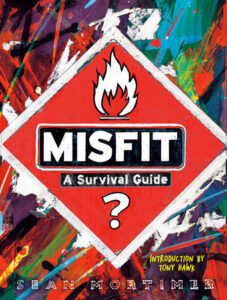
Excerpted from Misfit: A Survival Guide by Sean Mortimer. Introduction by Tony Hawk. Copyright © 2026 by Sean Mortimer. Used by permission of Ballantine Books, an imprint of Random House, a division of Penguin Random House LLC, New York. All rights reserved. No part of this excerpt may be reproduced or reprinted without permission in writing from the publisher.

Sean Mortimer
Sean Mortimer was a sponsored skateboarder in the late '80s. He is the former editor of SkateBoarder Magazine and the author of HAWK Occupation: Skateboarding with Tony Hawk and The Mutt: How to Skateboard and Not Kill Yourself. He lives in Southern California.