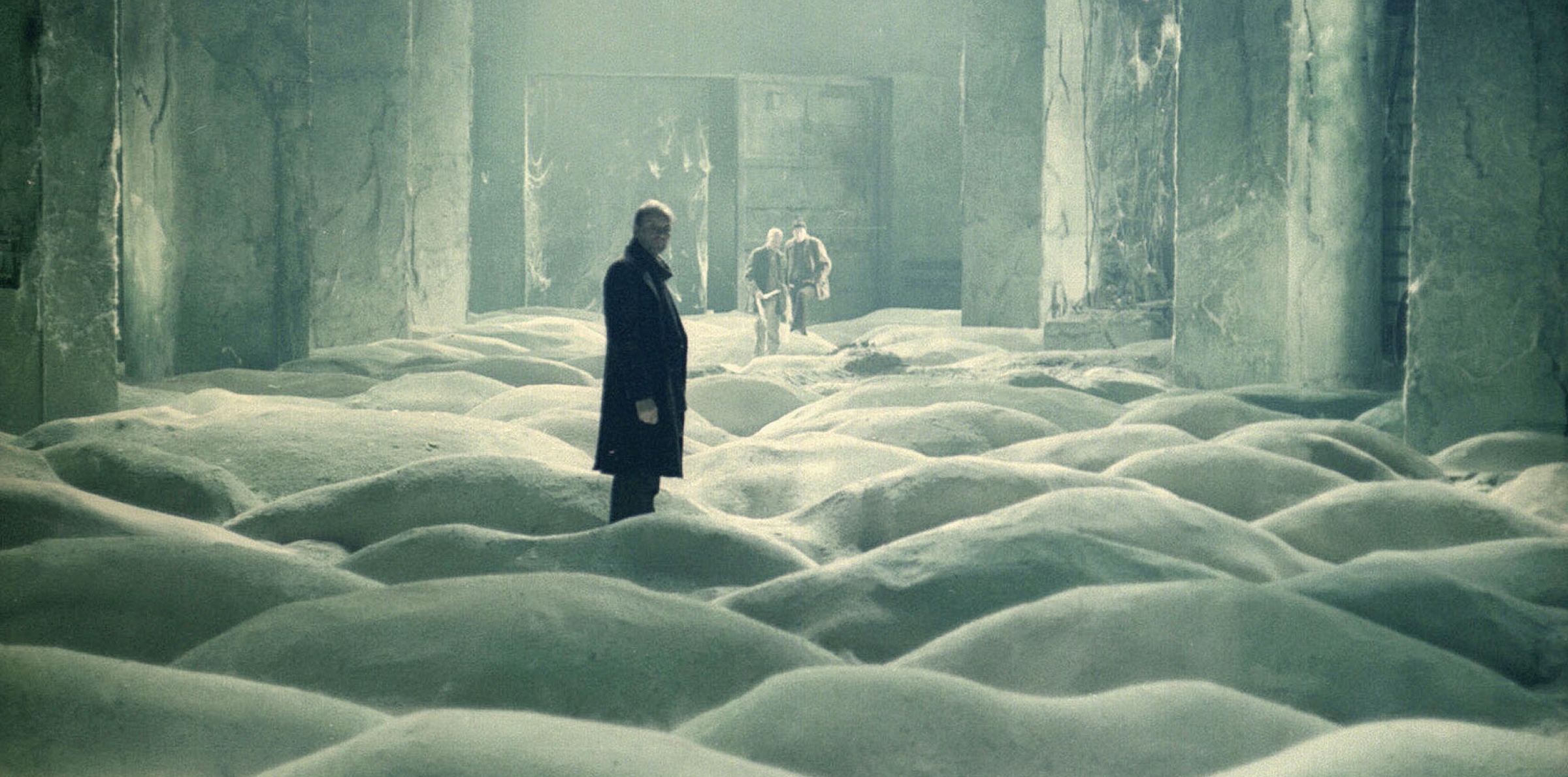
How Andrei Tarkovsky Taught Me to Write About the American West
Caroline Tracey on Tarkovsky’s Stalker and Salt Lakes
In 1983, Telluride Film Festival co-founder Tom Luddy took Russian filmmaker Andrei Tarkovsky on a road trip. Tarkovsky’s film Nostalghia was going to screen at the event. They drove from Luddy’s home in Berkeley to Telluride by way of Monument Valley, the expanse of desert belonging to the Navajo Nation and famous for grand sandstone buttes that stand alone like statues on its floor. The site was used over and over again by Hollywood to evoke the distinct atmosphere of the American West: director John Ford used the valley as the location for ten Westerns; John Wayne played the hero there six times.
Yet as Tarkovsky traveled through the Southwest, he was disappointed. The houses built of “slats, planed boards and plywood” that he had thought were poorly-built Hollywood stage sets, he saw, were really the dwellings of Americans. “Toy towns and the splendid steppe,” he wrote of the trip. “Poor Americans—soulless, rootless, living on a land of spiritual riches, but unknowing and unfeeling its value.”
When he took the stage at Telluride, Tarkovsky chastised the American cineasts for their treatment of cinema as entertainment rather than art, inducing the ire of the many industry bigwigs in the audience. As evidence, he spoke of Monument Valley. “It’s not American. It’s another world, not the material one,” he said. “It wasn’t put there so westerns could be shot, but as a place to meditate.” The Native Americans were right, he added, to consider it a spiritual landscape.
He shows that the character’s relationship to the land is carnal and humble—muddy, weedy, and poisoned as it may be, he cherishes it.
Stalker, the last film Tarkovsky made before leaving the Soviet Union, is a masterpiece of slow cinema. The film lasts 161 minutes and has only 146 cuts. (The average shot length in contemporary English-language films is about 2.5 seconds.) It takes place in the “Zone,” a former industrial area that has been cordoned off due to an undescribed catastrophe. Rumor has it that there is a room deep in the Zone’s interior that has the power to grant one’s deepest desire. The character Stalker makes his living leading seekers to the site.
Stalker’s two clients are Writer and Professor. Their journey begins in an abandoned factory. From there, they venture into a marshland and across various bodies of water, in and out of decaying ruins. The film presents a critique of industrial society: in the functioning industrial society outside the Zone, darkness, depression, and melancholy loom; inside, where industry has failed, the Zone is overgrown, slowly being reclaimed by nature.
The Zone is damaged, but despite its post-apocalyptic ugliness, for Stalker it retains a spiritual pull. Tarkovsky repeatedly stages scenes of Stalker lying down in a fetal position on the cold and damp earth. He shows that the character’s relationship to the land is carnal and humble—muddy, weedy, and poisoned as it may be, he cherishes it.
The damaged landscape’s importance to Stalker is most clear in the last scene in the Zone, as he is about to lead Writer and Professor into the mythical room of their hearts’ desires. As Stalker implores his travelers to think of their most sincere wish—and above all, to believe—he discovers that his initiates have only skepticism. Professor pulls out a bomb, prepared to destroy the room.
Stalker tries to wrest the bomb from the visitors, and when he is unsuccessful, falls to his knees, crying. At first, he tries to persuade them that their cynicism is wrong. Then he chastises himself. “You’re right, I’m a louse, I have done nothing on this earth and I can’t do anything,” he says. Finally, he pulls himself together and defends the Zone. “My everything is here. Understand me! Here! My happiness, my freedom, my dignity—it’s all here!” he cries resolutely.
Though Stalker critiques the environmental harms of the Soviet Union’s rapid industrialization, it does so not by focusing on the ills of factories, but by reaching deep into Stalker’s heart to show their affinities with nature. What was most inspiring to me was that Tarkovsky could make this feel so clear in such a damaged landscape.
The week of my wedding, I invited some colleagues over for drinks. One of them asked my soon-to-be wife and me what our plans were. I told him that we were going to get married at Owens Lake.
“You know that’s not a real lake, right?” he asked skeptically, as though concerned that we were going to arrive at our chosen venue and be disappointed.
The site had seemed apt because my marriage, a queer one, was also the result of an immigration process that had often felt like a legal battle.
But I knew perfectly well that Owens Lake wasn’t a big, picturesque pool of water. Instead, it’s much more like the Zone. Located in the high desert to the east of California’s Sierra Nevada, the lake dried up in the early 20th century as a result of water diversions by the city of Los Angeles. By the 1990s, 76,000 tons of dust spiraled off its exposed lakebed each year, provoking severe respiratory issues in local residents and emitting more particulate matter than any other source in the U.S.—123 times the EPA’s legal limit.
Then, a series of legal battles obligated Los Angeles to control the dust. Today, Owens Lake consists of a brine pool surrounded by an immense dust-mitigation area. There are cells flooded with water, cells planted with salt-tolerant crops, beds of gravel, and rows of dirt clods compacted well enough that they won’t release particles. The mitigation techniques were developed over years by trial-and-error. With the exception of Lake Texcoco outside Mexico City, no similar project had ever been undertaken.
The site had seemed apt because my marriage, a queer one, was also the result of an immigration process that had often felt like a legal battle. Still, as we approached the lake, my friends, wife, and I resembled Writer and Professor. We were skeptics, equally lured in by the place’s post-apocalyptic reputation and repulsed by the possibility that we were subjecting ourselves to respiratory harm. (In reality, after years of mitigation efforts Owens Lake now has better air quality than most cities.)
But I wanted to be more like Stalker, a believer in the power of the place. I had learned from Tarkovsky to dig deep to understand the attraction of unusual landscapes. After all, I was the one who had wanted to go there in the first place. I had to recognize not only the strangeness, but the sacredness of the place.
This wasn’t so hard to do. Owens Lake is overlooked by the dynamic, sheer eastern face of the Sierra Nevada, and its saline water vividly reflects the mountains and the sky. The shallow flooding ponds and other dust mitigation efforts have created small ecosystems that attract birds and other species. No one ever visits Owens Lake; though you’re surrounded by concrete berms and metal piping, the setting is remote and still.
Marriage is a life event held sacred in nearly every culture. In celebrating mine at Owens Lake, the event and the landscape mirrored one another. Each elevated the other’s sacredness, celebrating its twists and turns and its unusual topography. Owens Lake gave me permission to make my queer home in the interstitial places being reclaimed by nature.
__________________________________

Salt Lakes by Caroline Tracey is available from W. W. Norton and Company.

Caroline Tracey
Caroline Tracey holds a PhD in geography from the University of California, Berkeley. Her work in English and in Spanish has appeared in The New Yorker, New York Review of Books, and elsewhere. Originally from Colorado, she lives in Tucson, Arizona.