How an Enslaved Gardener Transformed the Pecan Into a Cash Crop
Beronda L. Montgomery on the Unsung Contributions of Black and Indigenous People to American Biology
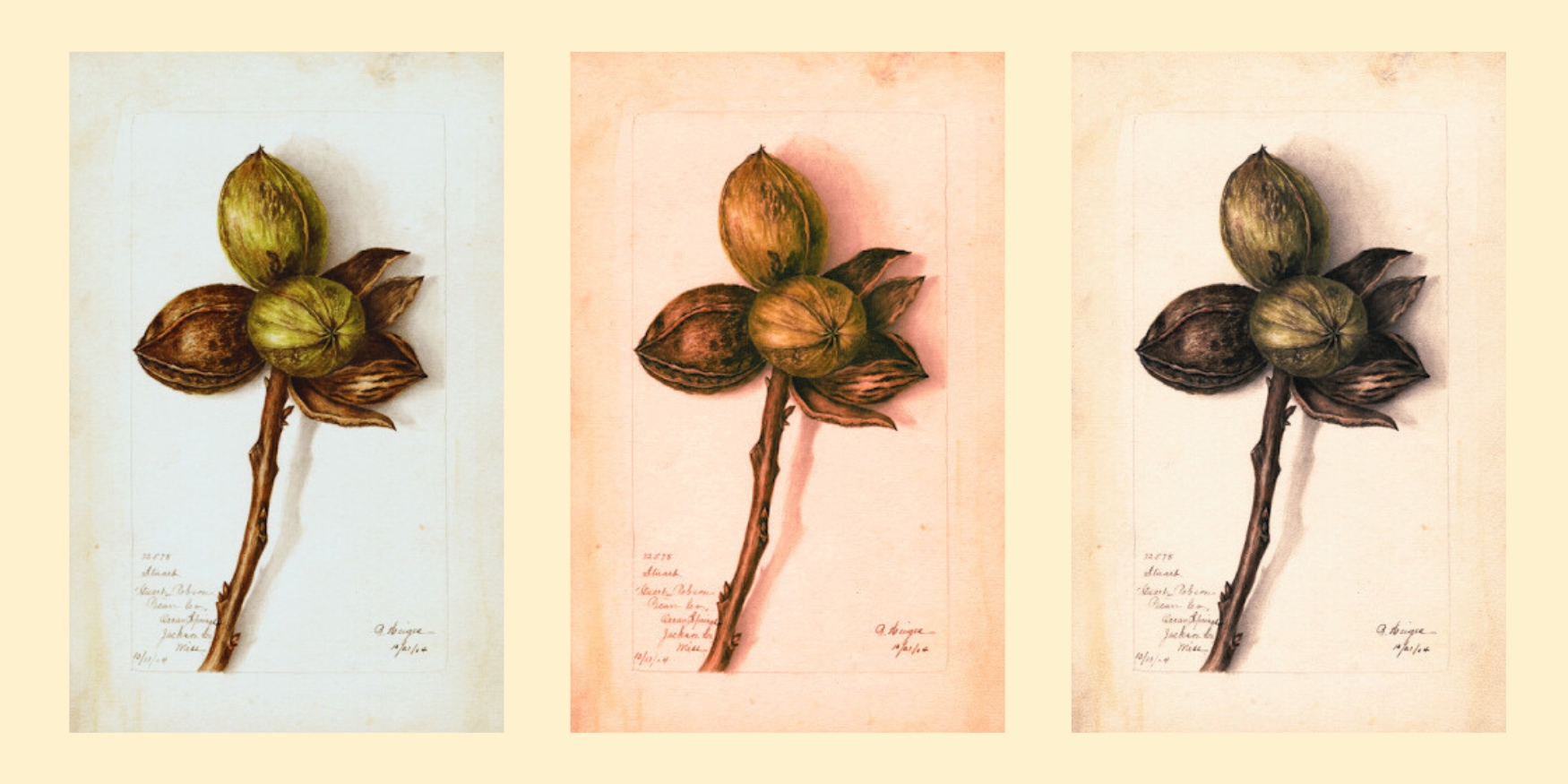
Pecan nuts were already a dietary staple for Native Americans in various parts of what is now the United States before Antoine’s innovation established the basis for a commercial pecan industry. This use of pecans by Indigenous people should not be surprising given that that the name of the nut, “pecan,” itself is thought to be derived from the Algonquin word “pakani,” which translates to “a nut too hard to crack by hand” or, alternatively, “a nut requiring a stone to crack.”
Pecans were used in various dishes by Native Americans; they were also central in trade and in other important parts of life. Fermented nuts were used in traditional Indigenous ceremonies. For example, fermented nuts were used by the Algonquin to make a drink known as “powcohiccora” that was consumed in sacred ritual, as well as during battles to enhance the bravery of fighters. Additionally, extracts from pulverized pecan tree parts such as leaves and bark served medicinal purposes, including as antibacterial and antifungal agents, to treat ailments such as ringworm and nausea.
Antoine’s successful inosculation would produce what came to be known as the Centennial variety of pecan, which transformed the commercial pecan industry.
Noting the many decades, if not centuries, of importance of pecans in the lives of Indigenous people in the United States, it was Antoine’s plant grafting experiments with pecan trees during the nineteenth century that led to the development of a viable propagation method. This ability to increase propagation and growth was important, as these nuts were consumed by many Southerners in the areas where they grew and were indeed a prized nutrition source due to their fat content and ease of storage and transport.
Both George Washington and Thomas Jefferson planted pecans at their plantations, with Washington being known to carry them around in his pockets as a snack. Earlier attempts to develop a commercial market for pecans based on growing trees from seeds had been unsuccessful, as trees originating from seeds have a long lag period until maturation and production of nuts. Additionally, trees grown from nuts that are the offspring of a single individual frequently result in trees that are highly variable in terms of the nuts produced, including a range of nut sizes and nut quality.
Such variability is generally not good for commercial crops, which thrive on uniform and predictable nut production. Antoine’s advancements in the propagation of pecan trees that produced high-quality pecans of reproducible form, then, resulted in these nuts being cultivated as a cash crop that could be mass produced. This agricultural advance ultimately supported the production of up to ten million pounds of pecans annually by the early 1920s, resulting in a multimillion dollar pecan industry.
Antoine’s trees were eventually felled after the plantation changed hands multiple times after the death of enslaver Roman. A new agricultural industry of sugarcane had emerged with the promise of greater profitability. Thus, the effort to establish these successful pecan trees that were the foundation for American commercial pecan production was literally cut down. However, Antoine’s achievement in developing a viable grafting method for pecan trees should not be undervalued.
Grafting is a delicate, if not altogether tricky, experimental process. Grafting involves joining together parts of two or more plants into a new, individual plant that can grow and develop successfully. If composed of two parts, there is often a scion—the upper or shoot portion of a plant—which is joined with a separate rootstock to produce, if successful, a healthy grafted plant. There are two major types of grafting: stem grafting, which involves grafting a shoot onto the rootstock of another plant, or bud grafting, which involves grafting a dormant bud of one plant into the stem of another stock plant.
Having conducted—unsuccessfully, for the most part—stem grafting experiments with plants, I know that more often than not a grafting process can fail. That is, the joining of two parts—for me a scion with a rootstock—does not always result in a productive joining where the xylem (the water-conducting tissues that support transfer of water and nutrients taken up by roots through the full plant) and the phloem (the sugar-conducting tissues that carry sugars produced through photosynthesis) are successfully connected across the junction of the grafted plant parts. In the absence of a successful graft junction, water taken up from the root stops at the failed junction and only temporarily benefits the rootstock. Likewise, the sugars produced by the green leaves of a scion cannot be shared with the lower stem and roots of the plant if the graft fails.
Each time I worked carefully to delicately graft seedlings was a stressful process. I’d first have to grow and obtain healthy plants, from which I’d select the two halves for grafting. When it was time for the grafting process, I’d move everything into a sterile environment and sterilize all the tools that I’d be using. Wearing gloves and a face mask, I’d still my breath as if I was stilling air, in hopes of reducing the likelihood of introducing any contaminant into my workspace. After methodically performing the isolation of tissues and joining the scion and rootstock under sterile conditions to prevent bacteria or other unwanted materials inhibiting the joining of the parts, I’d observe the grafted being daily with bated breath while waiting to see if the process had been successful. You could tell pretty soon if it was likely to have worked, because when it didn’t, tissue at the graft junction would first turn brown before both parts of the graft atrophied and died.
Antoine likely undertook this process in an environment that was as still and controlled as he could manage, in order to limit the likelihood of contaminating his grafted seedlings. Yet in the nineteenth century, as much as he could manage was surely not much. Antoine accomplished his success as a pecan grafter with far less sophisticated equipment and far less sterile grafting chambers than I and other scientists have access to when doing these very difficult experiments now. Still, working by candlelight would have provided Antoine a focused, well-lit environment for the delicate dissection of two seedlings in order to isolate the scion and rootstocks he wanted to graft. The candlelight would have duly served as a source of heat for him to sterilize his tools during his work.
An effective joining of a scion and rootstock is known as “inosculation,” a joining or connection that makes multiple parts continuous. I know the pure joy and hopefulness that bubbles up and over when a graft successfully takes. I can truly imagine Antoine’s at first cautious optimism and then his sincere triumph and joy when he obtained his first successfully grafted pecan seedlings. His careful protection and cultivation of those seedlings into the sapling stage would have been a sure victory. Although he certainly lost some of the attempted grafts along the way, as we all do when carrying out this process, Antoine’s botanical stewardship of some saplings into more mature stages ultimately paved the way toward his expert production of the first mature grafted pecan trees. Antoine’s successful inosculation would produce what came to be known as the Centennial variety of pecan, which transformed the commercial pecan industry.
Antoine’s successfully grafted pecan trees catapulted this industry into a profitable one across areas of the South, including Georgia, where pecan crops remain one of the distinguishing profitable nut-tree industries, with annual production resulting in hundreds of millions of pounds of nuts valued at five hundred million to one billion dollars. Pecans are a vital ingredient in Black southern cuisine. Uses of the nutmeat include the widely recognized holiday pecan pies and pecan pralines.
*
In addition to tending to and harvesting from her pecan groves, my grandma and other elder women in the community would mix herbal concoctions at a moment’s notice using herbs, tree leaves, and other tree parts, as well as the aloe vera plants that were ever present on their kitchen windowsill. These concoctions might be used to treat a sprained ankle or sore throat. Grandma called them “family healing recipes” that had been passed down via the matriarchal line. These versatile salves might serve to treat a burn, as a facial cosmetic, or as a hair conditioner in a pinch. Such botanical knowledge, used for enrichment in the form of horticultural and culinary endeavors, as well as in health and medicine, has roots in global botanical exploration and exploitation. Additionally, some African cultural and religious practices involved central objects that were sticks or trees, or occurred in natural spaces such as the woods.
Rarely do we hear the stories of enslaved gardeners such as Antoine who have had major impacts on life and industry in America and beyond.
Stories of botanical expeditions are often retold through the lens of a European explorer or innovator “leading” voyages, usually omitting the role of the knowledge and expertise of enslaved or Indigenous individuals. Commonly framed and told histories of Indigenous women such as Pocahontas and Sacagawea, who are associated with famous expeditions by white English settlers in North America, are clear examples. Pocahontas is often painted as a “friend” to Captain John Smith of the Jamestown colony and the one who saved his life. Sacagawea is connected to the Lewis and Clark expedition as a translator and helper in navigating Native American communities and spaces. Historian Tiya Miles describes the reality of these famous stories as starker, in that the knowledge of these two women about how to navigate nature and identify and utilize plants was likely co-opted by these white men and their associates and their labor may have been largely uncompensated, or at least not fairly so.
Revered biologist Jane Goodall is most associated with her careful observation and reporting on the complex lives and communities of chimpanzees. Dr. Goodall also wrote on plants and described global botanical explorations. In her book Seeds of Hope, she waxes poetic about the varieties, life cycles, and cultural significance of a range of key plants and trees identified around the world. Of note, in her inspiring writing about global plant expeditions and associated brave and creative plant explorers, she offers only a cursory mention of enslaved individuals of African descent as plant caretakers or botanical experts.
This oversight is present throughout her work and other literature and research. Goodall mentions the enslaved people who were exploited by plant explorers in their global expeditions to seek out new plant forms as merely “plant hunters” and “slaves.” In one passage, she describes an expedition on behalf of Egypt’s Queen Hatshepsut and writes: “Fortunately for the queen (and probably for those who delivered the specimens), the climatic conditions were excellent, and there were many slaves to carry freshwater, fans, sun blinds, and so on to keep the plants well-watered, cool, and happy” (emphasis mine). In stark contrast to her curt description of the enslaved, her empathy is on full display for the plants that she sympathetically describes as “captives.”
Later in Seeds of Hope, Goodall does speak of plantations as sites where “crimes against plants and humanity” occurred. However, far removed in terms of pages from the earlier literary, if not literal, oversight regarding the dire plight of the enslaved people who were held captive to care for the plants that a queen was fortunate to have brought back to her from the expedition, the later focus on crimes against humanity on plantations provides a somewhat hollow recognition. Still today, rarely do we hear the stories of enslaved gardeners such as Antoine who have had major impacts on life and industry in America and beyond. The erasure of enslaved expertise and sacrifice during global plant expeditions, as well as of Black botanical expertise in US agricultural history, is highly prevalent in many forms.
__________________________________
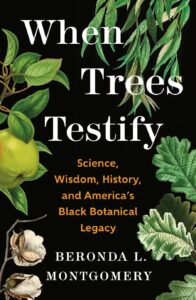
From When Trees Testify: Science, Wisdom, History, and America’s Black Botanical Legacy by Beronda L. Montgomery. Copyright © 2026. Available from Henry Holt and Co., an imprint of Macmillan.

Beronda L. Montgomery
Beronda L. Montgomery is an award-winning plant biologist and the author of the acclaimed Lessons from Plants (Harvard University Press, 2021). She has been named one of the journal Cell’s 100 Inspiring Black Scientists in America, and was awarded the 2021 Cynthia Westcott Science Writing Award and 2022 Adolph E. Gude, Jr. Award for outstanding service to the science of plant biology. She was named a Radcliffe Fellow at Harvard University (2025-26), and is a fellow of the American Association for the Advancement of Science, the American Society of Plant Biologists, the American Society for Biochemistry and Molecular Biology, and the American Academy of Microbiology.