How a Lightning Strike Affected My Identity—And My Main Character’s
Nafissa Thompson-Spires on Being a Live Wire
In my forthcoming debut novel, the Four Wives and Five Deaths of Richard Milford, nearly every terrible thing that can happen to a man has happened to the titular character, a terrible person in his own right. The beginning of the novel catalogs his traumas, searching for an all-encompassing origin story that might explain his delinquency. A hot-tempered moonshiner and ne’er-do-well with four “wives,” Rich ascribes his brash, abusive behavior to barometric pressure, the electricity remaining in his body and hands from a lightning strike when he was a child. And it almost works for him, until he crosses all of the women in his life at the wrong time. The novel’s conceit stems in part from my attempt to grapple with my family’s and my own trauma and what constitutes truth. But what interests me most here is the lightning, the actual lightning.
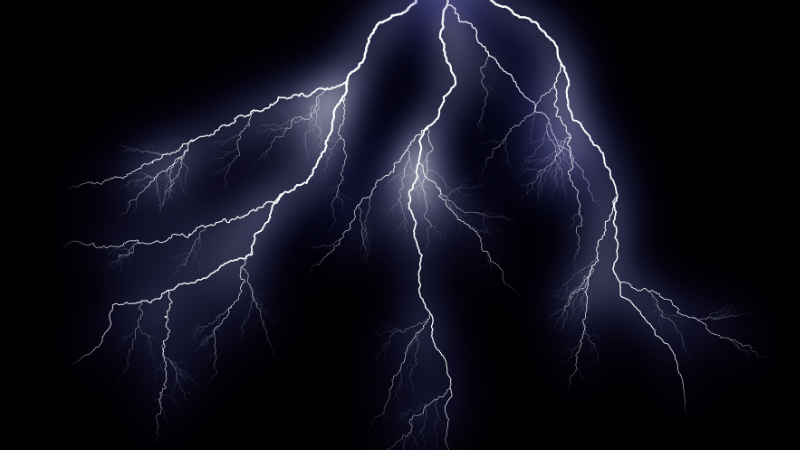
It was, indeed, a dark and stormy night when the first blueish pulse of lightning zhuzed across my chest, followed by another millisecond flash. I’m sure wind and rain continued to beat against the windows of my Ithaca bedroom, in a converted attic with low-sloping cathedral ceilings on which I regularly hit my head. Maybe lightning flashed again nearby—it must have. I don’t recall the scent of singed skin or hardware in the air, even though I watched the bolts enter through a slat in my AC unit. What I know with vivid clarity, however, is that I lay stiff, face up in my bed, completely still except for my heartbeat, another pulsing thing.
According to Jacob Stern in a recent Atlantic article, the odds of being struck by lightning in the United States “in a given year are one in 1.2 million,” but I am not the first or only person in my family to be struck.
When I finally felt safe enough to reach for my phone, the clock read sometime after 1 am. For the next several hours, wide awake and afraid to move much, I pieced together the facts via Google search and logic: I was only alive by the grace of God and because lightning bypassed my heart and ribs. It struck the ledes in my spinal cord stimulator, a kind of permanent TENS machine I’d endured open-back surgery the year before to have installed—a surgery during which I woke up multiple times, my face near the anesthesiologist’s pelvis, asking him for more juice, please. Lightning was not the kind of juice I meant.
According to Jacob Stern in a recent Atlantic article, the odds of being struck by lightning in the United States “in a given year are one in 1.2 million,” but I am not the first or only person in my family to be struck. Oral tradition holds that my maternal great-grandfather Jethro, who lived and died in East Texas, was hit with a bolt when he was a teenager. Although their father spent the first fifteen years of his life enslaved—a trauma like few others—Jethro’s siblings credited the lightning for their brother’s violent temper. A moonshiner and notoriously cruel adult, he went on to marry three wives and have forty children, all of whom he abused with a riding crop. I started the process of writing my novel by considering how things might have turned out if all of these women sought revenge against this troubled man and how the upheaval of a near-death experience—and the context of a Jim Crow South—affected him.
But I didn’t begin to fully understand this character until other strange events and information came together. Right after my strike, my spinal cord stimulator, which works by sending small electrical pulses to areas of pain in the body, began to malfunction, issuing its paresthesia with increased violence, alarming shocks like milder bolts of lightning electrocuting my legs and spine without warning or reason. I had to turn off the machine, which runs via an implanted rechargeable battery and a remote control, and go in for repeated reprogramming by my reps—who noted its odd fluctuations—until the stimulator stopped causing additional pain.
During a rare SoCal storm, I survived electrocution after I stuck tweezers into a socket in my childhood family room.
Medical anomalies did not define me, but they certainly seemed to chase me. By June 16, 2022, the date of my lightning strike, I had sustained six concussions, three of them from falling while heavily medicated for chronic pain and three from my antics: a grandstanding handstand during my home yoga practice, an accident with a pirouette spinner when I decided at age thirty-nine that I was ready for pointe shoes after only three years of undergrad ballet, and a twerking attempt that resulted in a temporary dent in my forehead. Thick skull, hard head, flat behind, yes. But high voltage? Also, yes.
In first grade, I performed an uncannily on-the-nose poem that began with the line, “I wish I were electrified” in the schoolwide speech competition. Three years later, during a rare SoCal storm, I survived electrocution after I stuck tweezers into a socket in my childhood family room. The force blew out the power in my house, the surge throwing me a couple of feet across the room, but I dropped the hot tweezers, their tips blackened, before the current fully reached my body. I told someone this story, along with that of the lightning once at brunch, and they said they couldn’t find direct proof of it, but electricity attracts electricity. I couldn’t find proof of that, either, though I did learn about sliders, people who believe themselves conduits for electricity, and with the direction of another friend, I came across several examples of inexplicable lightning-related phenomena.
Take the Olesen family from Illinois, featured in a 1997 episode of Unsolved Mysteries. Starting in 1899 and continuing into 1966, ten members of the family were struck or very nearly struck by lightning. Then there are people who have themselves been struck more than once. A South Carolina man named Melvyn Roberts claimed eleven lightning strikes, the most of any person I’ve encountered in my research. How did the repeated physical and emotional traumas Roberts and the Olesen family sustained affect their personalities and lives thereafter?
During the two months immediately following my strike, I experienced an intense identity crisis. The traumatic event seemed to awaken a darker part of me, perhaps always latent, perhaps not. It emboldened me in ways I still find astonishing, creating a sense—albeit short lived—of invincibility. I sought greater thrills and electric feels. I made poor choices, the details of which I’ll leave to the imagination, that pre-lightning me would not have made. Here, like my character Rich Milford, or my great-grandfather’s siblings, I want to blame it on the rain, but the consequences of my actions lasted far beyond that turbulent summer. Since then, I have made amends where possible and developed what I hope is a stronger sense of self and self-compassion. But just as Four Wives and Five Deaths attempts to locate Rich’s bad behavior in trauma and draw him with empathy, he, like myself, is ultimately responsible for his decisions.
If we humor sliders and the theory that electricity attracts electricity, the idea, like epigenetic scarring, like intergenerational trauma, certainly bears out in my extended family. Thus, I’m doing my best to stay far from the path of storms, metaphorical and literal. And given that my great-grandfather was also hit by a train and lived to tell, I’ll actively avoid railroads, too, just to be safe.
__________________________________
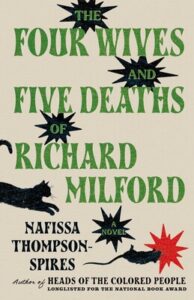
The Four Wives and Five Deaths of Richard Milford by Nafissa Thompson-Spires is available from Scribner.

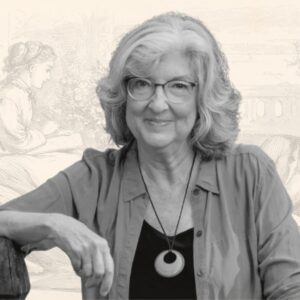
Nafissa Thompson-Spires
Nafissa Thompson-Spires earned a doctorate in English from Vanderbilt University and a Master of Fine Arts in Creative Writing from the University of Illinois. Her work has appeared in Story Quarterly, Lunch Ticket, and The Feminist Wire, among other publications. Her debut story collection, Heads of the Colored People, is now out from Atria. She is a 2016 fellow of the Callaloo Writer’s Workshop.