How a Childhood Bookmobile Sparked My Love of Reading
Brenda C. Wilson Remembers the Start of Her Reading Journey
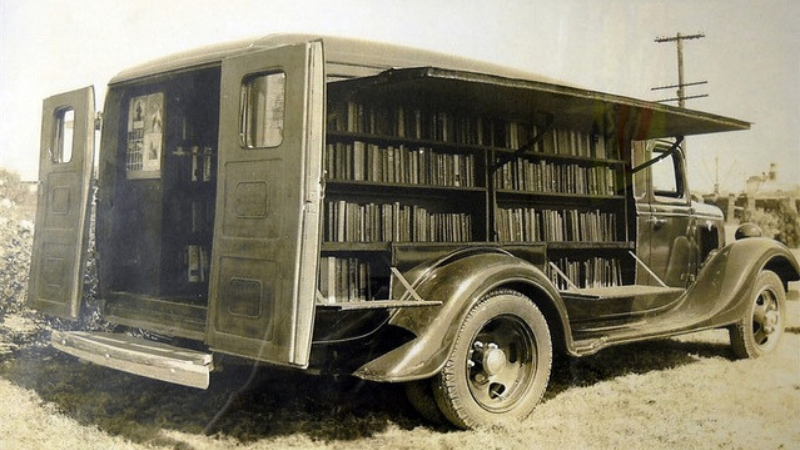
When I was a child, the public library in my small Alabama town, a one-story frame building that had once been the train depot, was off-limits to me. This was the early 1960s, more than a decade before the schools were integrated and “public” buildings became accessible to all. As Black children, my siblings and I could only use the bookmobile that arrived during the summer months and parked in front of our community’s elementary school.
The bookmobile was wonderful, though. Its interior felt cavernous, like the inside of the school bus that my uncle drove, except bookshelves lined the interior instead of bench seats. Every summer for three years, between the ages of three and five, I checked out the same book. As an adult, I have periodically searched for this book, to satisfy my curiosity over my perceived memories, but only recently did I find what I was looking for.
As the youngest of five children, I spent years at home while my older siblings went to school. Kindergarten programs didn’t exist at the time, so lucky kids like me learned to read, write and recite famous speeches like the Gettysburg Address from their older siblings.
My mother sent us to the bookmobile with orders to bring home at least two books each, and to be ready to discuss them with her at the supper table once they’d finished reading.
My mother, a high school dropout (she later earned her GED), had ordained that we would all attend college. Very few people attended college from our county’s one all-Black high school—though ironically, Alabama has the largest number of historically Black colleges in the country. According to the 1960 U.S. Census, illiteracy rates in Alabama and four other Southern states were the highest in the country—and before the Civil Rights Voting Act of 1965, a literacy test was required to register to vote, as part of the systematic effort to suppress voting by descendants of the formerly enslaved.
But there would be no illiteracy in our family. Thanks to the efforts of my mother, all of my older siblings could read and write by the time they entered first grade. As the only left-handed child, my mother and I couldn’t seem to make the same kind of progress that she had achieved with my siblings, though, so the task of teaching me to read fell to my oldest brother. Luckily, he found a way.
My mother sent us to the bookmobile with orders to bring home at least two books each, and to be ready to discuss them with her at the supper table once they’d finished reading. She made us dress for the bookmobile, because white people were never going to get to judge us for not being clean or well-groomed.
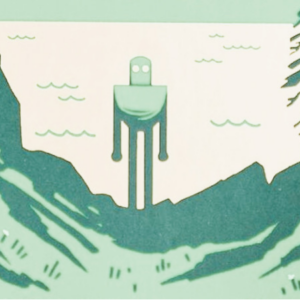
My reading journey began with a story that stretched more than 5,000 miles away, from Denmark to Alabama. While my siblings searched for new books, I always checked out the same one: The Marsh Crone’s Brew. It was a Danish folktale by Ib Spang Olsen, an award-winning writer and illustrator, about a witch and her family who brewed spring in the marshes. I lived inside this story all summer, hiding with my treasure under tables or beds, transported into a fantasy world that suspended time and space.
In the book’s open meadow, I had been part of the conjuring of spring, joining the impish little boys who blew butterflies from their ears and the girls who had flower-growing hair. I was enamored of this book much longer than I ever was with any Christmas toys, including the dolls that we buried in the backyard and the teddy bear who lost an ear in an unfortunate accident.
But eventually, as my reading skills improved, I outgrew my witch’s tale. By 1968, after the implementation of “school choice,” we were bussed to the one Black elementary school in the county. By the fall of 1971, schools were integrated—instead of the 30-plus minute bus ride past two white schools, we went to our own town’s school— and the public library was finally open to us. We recognized immediately that we had read most of the books on the shelves, from the blue biographies with their titles outlined in red to the cookbooks. My sister still has the Betty Crocker Cookbook, last checked out in 1967.
Olsen accomplished what every writer dreams of: he found his perfect audience. In this case, it was a child who was waiting to be mesmerized by a good story.
I forgot about The Marsh Crone’s Brew for years. But then one day, while surfing the Internet instead of writing, I stumbled onto an article referencing crones in a Netflix show called The Witcher. Three witch sisters live in a bog and one is named “Brewess.” It all came rushing back. I found a copy of my beloved book on eBay and ordered it, before calling my two older sisters, from whom I received less enthusiasm than I had hoped. They had read this book to me many times, and they were not fond of it. They had only tolerated the frequent re-reading out of fear of parental reprimand. To them, the Marsh Crone, like their baby sister, was simply annoying.
It wasn’t the same edition of the book I had loved as a child – this one lacked the original cover, was bigger than I recalled, and had no color illustrations. But I kept searching.
I ordered a second copy, this one stamped by the Peoria Public library. When I saw the size, my heart beat faster. It was even smaller than a Little Golden Book: a four-year-old could manage it perfectly. It was in less than pristine shape, but the cover illustration was right, plunging me right back into my happy childhood memories of an uncomplicated world without television, telephones, or the Internet.
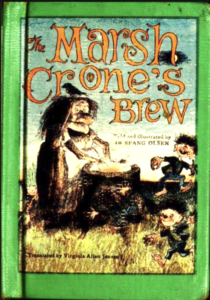
On the final page of the book, the crone sniffs the air under a star-filled sky and decides it’s time to begin brewing again. But my favorite page was the one that enumerated the contents of her brew, and whose rhymes resonate like an old song that I once knew:
“As the Marsh Crone brews, many good things go into the cauldron. She uses moonlight, sunset glow, dandelions, and rooster’s crow; willow spears, evening dew, foxes’ ears and leeches spew…”
Ib Spang Olsen created magic in the country of Denmark—a country that we didn’t know existed. The magic found its way to the bookmobile and was just the right size for a preschool child. Olsen accomplished what every writer dreams of: he found his perfect audience. In this case, it was a child who was waiting to be mesmerized by a good story.
I was attached to this book as if it belonged to me, and the best part of it did. My desire to be taken on a journey time and again meant the printed word never failed to fill me with a sense of awe. Reading this story and other fairytales, I started to believe that I could write. My first micro-fiction of one line, I Hate Green Beans, was created on a writing tablet with blue guidelines, using a fat preschool pencil, and was totally unsuccessful. My mother laughed and gave me an extra portion that my older brother ate when she turned her back.
But since then, I have never stopped writing. I believe that I am destined to brew a book that will have the potential to leap across oceans, under starlit skies, and give flight to another person’s imagination.
Within the next five years, the reality of the world would come crashing through. Integration shut down the community schools; girls like us died in the Birmingham church bombing; the March on Selma crossed a bridge to the future; my father joined a union; TVs became standard living room features; the bookmobile drove off one summer and never came back. But my desire to experience and create a transcendent story never ended, and never will.
__________________________________
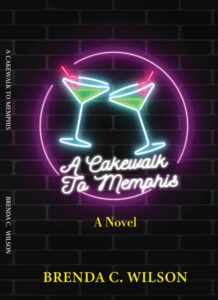
A Cakewalk to Memphis by Brenda C. Wilson is available from Redhawk Press.
Brenda C. Wilson
Brenda C. Wilson grew up in Alabama and now lives in Charlotte, North Carolina. She holds an MFA from Queens University and participated in the inaugural Poets & Writers Publicity Incubator. Her short fiction won the Jacobs/Jones Literary Prize in 2024 and 2026; North Carolina Literary Review has selected her 2026 short story for publication this summer. A Cakewalk to Memphis, her debut novel, will be published by Redhawk Publications in September 2026.