“The Clairvoyant”
That man had a beautiful, exotic name—Leo. And that’s what he looked like too, like a lion.
He had let his hair and beard grow long, and one harsh winter they’d both gone gray, God knows why.
Leo the clairvoyant lived on a state pension because, although it’s hard to believe it, once upon a time as a young man he had an accident in a mine and lay buried for two days almost one hundred meters down in a hot, black hole, like a mother’s womb, painfully conscious the whole time, his bright spirit shining around his head in a phosphorescent halo. He was sure he would die, but he didn’t. The rescue team pulled him out, and then he spent a long time in the hospital. After it was all over he got down to real life—reading books from dawn till dusk. First he read whatever came his way, but in time he was drawn to unpublished manuscripts that he got from a semi-legal mail-order bookshop in Kraków. These included the writings of Besant, Blavatsky and Ossowiecki, muddled reports of spiritualist séances, Hindu cabbalas, Jewish cabbalas and prophecies of all kinds. They were full of tables that rehashed long-forgotten orders and diagrams featuring alluring multilevel harmony. One day he came across the address of the Astrologers’ Society in Bydgoszcz, and from the book they sent him, one Christmas he taught himself to read horoscopes. From then on nothing gave him so much pleasure as immersing himself in the intricate sequences of numbers printed in books of ephemerides. Sometimes he would pore over them until dawn, and at sunrise he would start to see the future. It was always terrible—dead and empty. There were never any people or animals in it. He could see it springing up in the gloomy corners of the room and spreading outside, into the stairwell of his block, onto the lawns in front of it, into the streets and the marketplace in Nowa Ruda. When he went for a quick walk in the evenings he would brush against it, and it would leave a strange metallic smell on the sleeves of his overcoat.
He became a proper clairvoyant when his wife died. It looked as if it was she who had kept him down to earth and grounded his every thought, his every presentiment. She was like a powerful atmospheric depression that squeezes every puff of smoke out of chimneys and casts winter smog over cities. She controlled his thoughts by magic, forcing them to concentrate on standing in line in the stores, weeding the beets at the allotment and tossing the coal into the cellar. What’s more, her voice used to follow him all round town. She would stick her head out of the window and call across the courtyard, “Leee-o, Leee-o, Leo!” until all the children looked up and repeated after her, “Leo, Leee-o, Leee-o!” She was a sorceress.
So when she died, suddenly it all went quiet, and images that had been suppressed for years began to surface in his head and spread like frost on a damp windowpane—they linked arms unexpectedly and made rings and fancy sequences; quite at random they built bewitching patterns that made perfect sense. This was real clairvoyance.
His clients were all women. Only once in his career as a clairvoyant did a man turn up to see him—a well-dressed old gentleman, bloated from a bad diet, and perhaps from too much vodka. He knew him by sight, but he couldn’t help him much, because the old guy’s problem was love, that most overrated of all emotions, and at best an absurd one anyway, arising as it did out of inner confusion and hormones. He was looking for his teenage lover, which was both funny and pitiful. Leo did not want to take this on at all, especially since the young girl had not left even the most trivial thing behind her, not a trace. But the man’s despair was so affecting, he looked so pathetic in his stiff woolen overcoat with his felt hat pulled over his eyes, as if he was completely lost in everything, even his own clothes.
“Where is she? That’s all I want to know,” he said.
Leo looked into the past. He saw the girl at once, because she was more restless and more conspicuous than other beings. She horrified him; she wasn’t a teenage girl at all, or a woman—she wasn’t even human. My God, Leo took serious fright, and only told the sad old man, “She’s here,” because he could see her in the present and the future too.
“In town?” cried the man gladly, and Leo saw his eyes for the first time—they were puffy and tear-stained.
“Somewhere in the neighborhood.”
Before leaving, the man furtively pressed a banknote into his hand.
“Please keep this a secret,” he requested.
There was no need to say that, thought Leo afterward. You should never talk about such things. Who would believe it anyway? That you can see something that isn’t there, and that a person may not necessarily be human through and through, that every decision you make is just an illusion. Thank God people have the capacity for disbelief—it is a truly bountiful gift from God.
The women were always more specific when they asked about love; they wanted to be hugged, to walk through the park arm in arm, to bear someone’s children, to wash windows on Saturdays and make soup for someone. When he closed his eyes he could see their lives; they didn’t interest him and he found it hard to concentrate on the details that concerned them—whether their husband would be a redhead or dark, whether they’d have one or two children, a healthy body or a sick one, money or bare cupboards. But if he made an effort he could manage it. In his visions he counted children, peered into drawers and inspected the hair color of men in white T-shirts eating Sunday lunch. He found the women’s lives touching. Sitting opposite him, gazing expectantly at his face, they were like timid creatures, deer, or hares in spring—gentle and shy, and at the same time extremely clever at dodging, escaping and hiding. Sometimes he thought of a woman’s existence as a sort of mask that she puts on as soon as she’s born, then she goes through life in camouflage, never fully revealing herself to anyone. He reckoned they didn’t ask the questions they ought to ask.
He changed the money he earned through clairvoyance (which wasn’t much) into dollars. He wanted to go to India, which he never managed to do, because India, like everything else, ceased to exist.
But first of all, many times he looked into other people’s futures, and they all merged together in his mind into one single, common future. He knew that the end of the world was coming, and that it wouldn’t be long now—it was only a matter of calculations.
He saw a valley, over which hung a low, orange sky. All the lines of this world were indistinct and the shadows were blurred, cast by some alien light. In the valley there were no houses, no traces of humanity, not a single clump of nettles or wild currant bush was growing. There was no stream, though the place where one used to be was overgrown with thick, hard, tawny grass, like a scar. In this world there was no day, and no night either. The orange sky kept shining all the time—neither warm nor cold, motionless and indifferent. The hill was still covered in forest, but when he looked at it closely he could see that it was dead; at some point it had hardened and turned to stone. Pine cones hung on the spruce trees, and their branches were still covered in ashen needles, because there was no wind to scatter them. He had a terrible foreboding that if any sort of movement were to occur in this landscape the forest would come crashing down and turn to dust.
This was how the end must look. No deluge, no rains of fire, no Auschwitz, no comet. This is how the world will look when God has deserted it, whoever He is. Like an abandoned house, everything coated in cosmic dust, muggy and steeped in silence. Everything living will congeal and grow mold in light that has no pulse and is therefore dead. In this spectral light everything will crumble to dust. The man who saw the end of the world every day lived calmly.
From time to time he went to Kraków for books and gazed out of the train window at the passing scenery, mainly Upper Silesia and its temples of industry, then the fields in Opole county stretching to the horizon, neatly sown with rapeseed that blooms each year on the tenth of May. He had descriptions of all sorts of apocalyptic visions in his canvas rucksack, typed out hundreds of times (the final copies were almost illegible, but the solemn atmosphere was still there), the pronouncements of ghosts on the collapse of civilization, visions of the Virgin Mary, and the abstruse poetry of Nostradamus.
Suddenly the plains ended and the mountains began. The train entered the spruce forest, pushed its way through stony ravines and wound through valleys until it reached the center of Wałbrzych. Some people got out at the Town Station, but Leo went on, to the Main Station, because that was where he changed trains for Kłodzko.
Wałbrzych Main Station was dark and deserted, with a single kiosk where miners from the night shift bought cigarettes and condoms. At the bar they sold pierogi with bacon dripping and weak tea, brewed with difficulty in lukewarm water. The train to Kłodzko via Nowa Ruda was usually empty. Leo liked to find a seat on the upper deck to get a better view, because this was the most beautiful train route ever. It ran along tall viaducts across broad valleys, and along mountain slopes above villages and streams. At every turn, breathtaking new vistas unfolded, featuring the gentle line of the mountains, the silky sky, and ribbons of greenery. Down below, people were walking along the road, driving cows; dogs were running; a peasant burst into laughter; the little bells jingled on the sheep’s necks; higher up, a man with a rucksack went by and waved; smoke rose from the chimneys into the sky, and birds flew blithely to the west. In a train like that it’s impossible to read—you simply have to look.
Leo began to write a book, and started with a title: The End Is Nigh. It was about the end of the world. He did a thorough analysis of the heavens in it. The world would start to end on the second of April 1995, when Uranus would enter Aquarius, and it would end once and for all in August 1999, when the sun, Mars, Saturn and Uranus would form a great cross in the sky. He wrote this book in the winter of 1980, when it wasn’t yet clear what would happen in Poland. But when the strikes began, and in Wrocław the striking trams were drawn up in the shape of an enormous cross, covering the entire city, Leo accepted that he might have made a mistake in his vigilant observations, or in his interpretation of the tiny little figures in the ephemerides, and that the end of the world might be coming sooner. Indeed he couldn’t wait, and lived in a state of pure anticipation. He wore out all his old shoes, his clothes tore at the seams, the elastic in his underpants broke, his socks were worn full of holes, and the heels became a very thin gauze of nylon threads with the hardened skin showing through. He kept no supplies, nothing at all for the future. The empty mayonnaise jars were begging to be filled with jam and preserves for the winter, and with stewed fruit just in case he were suddenly admitted to the hospital. But the winter might not come, there might not be a next summer. The bread had to be eaten to the last crumb, and the soap washed down to a thin flake that could then be used for laundry.
He predicted that there would be a great flood in the summer of 1993. Ice would suddenly melt in the north and the water in the oceans would rise. Holland would disappear underwater. The same would happen to Żuławy. It might be even worse, with nothing but plateaus and mountains left above the surface. Nowa Ruda would survive because it was high up. Then a war would break out in the Middle East that would turn into a world war over the following year. Once again armies would march across the waterlogged low-lands. The cathedral in Wrocław would become a mosque. Then, at the beginning of 1994, the sky would be dark for several days because of nuclear explosions. People would start to fall sick. Nothing would happen to Nowa Ruda, thank goodness.
Leo published the book himself, using money earned from clairvoyance, in 1990 when there was no more paper rationing. For three years he waited for the first signs of the end of the world, but they never came, despite all the jam jars he emptied and dry bread crusts he consumed. In the summer of 1993 there was a heat wave, and he took the terrible heat to be the beginning of the end, but it stopped when the children went back to school, and people baked plum tarts and gathered the potato harvest as usual. In Leo’s kitchen the gas boiler broke, and because it was cold and he needed hot water he had to fix it. As he was rummaging around in its nozzles he had a chilling sense of futility. When the end of the world is nigh, all activity becomes a form of sickness.
For Leo the world did end, however, on November 14, 1993, during the great conjunction of Uranus and Neptune in the eighteenth degree of Capricorn. He realized it one night as he was sitting in the bathtub—which was the only effective way of warming up his whole body quickly. That evening on television they said that some sect in Uruguay was expecting Armageddon today. Then the Pope, with his right arm in a sling, blessed the world with his left hand, and the weather report included a blizzard warning. At the end a tired presenter appeared and as she was saying good night, she added in a sarcastic tone, “Despite the pessimistic predictions of the Uruguayan sect, the world has not yet ended.” At that moment Leo reckoned there were forty-five minutes left until the end of the world, one school lesson’s worth, and he went to have a bath.
As he was sitting in the bathtub, the light in the bathroom went out, the television fell silent and icy water began to flow out of the tap. He froze in horror, but didn’t even try to get help in the darkness. Columns of figures from the ephemerides were racing through his head, along with a gloomy diagram of the solar system. The pipes in the bathroom started blaring like the trumpets on Judgment Day, and Leo’s naked body began to shiver. He thought of all his nearest and dearest—though they were distant, rather than near, as he had no one else in his life—and wondered what all the town’s animals were doing, the dogs, cats, guinea pigs and hamsters, whether they were afraid too, and whether animals would accompany people beyond this moment. He wondered whether a fiery sword would appear in each and every home, even on the eleventh floor of tower blocks, and where the earth would be rent asunder, when there wasn’t even room to park. Suddenly in the dark bathroom he had a clear vision of an image that had terrified him as a child: the dead rising from the earth, naked and sleepy, rubbing their eyes and raising their hands to their faces in the blinding sunlight; stone crosses shaking in the cemeteries and gravestones moving aside. An angel stands on the horizon, his beautiful face contorted with anger and disgust, while around his head a hurricane rages. That was the image in Leo’s head.
The bathroom remained dark.
The roar of the pipes was making the walls tremble slightly. Leo’s jaw began to shudder until he could hear his teeth chattering, but not out of fear. The only emotion he felt was disappointment. First it was faint, like the feeling at Christmas when his mother had bought him pajamas instead of the longed-for rocking horse, then it grew stronger and stronger, until finally it was unbearable. Was that how the end of the world was supposed to be? Darkness, and the pipes rumbling?
The man who predicted the end of the world—even if he might have got the exact date wrong—was at heart an optimist. He wanted to witness the whole thing, as if he himself had summoned it up, and even now he was remembering a rare conjunction of Neptune and Uranus, when they narrowly scraped past each other, causing a clash of energies.
All he wanted now was to look at the sky, to see if it had been extinguished, to see if the planets had stopped orbiting, if galaxies had collided in a headlong dive and the apocalyptic dust solidified at zero degrees Kelvin. He clamped his shuddering jaws shut and got up from the stone-cold water.
And then, in the single most incomprehensible moment of Leo’s life, the naked light bulb flared on, the tap wheezed and gushed hot water, and the voice of the television rang out from the sitting room, as if the TV and its million faces was the only life form to have risen from the dead. Startled by this unforeseen turn of events, Leo froze with his foot on the edge of the bathtub and blinked as his eyes adapted to the sudden light. Clouds of steam were forming condensation on the broken mirror. The faded towels hung motionless on their pegs just as indifferently as before.
Leo got out of the bath, opened the door onto the corridor and listened. Someone was shuffling down the stairwell. From the neighbors above came the sound of monotonous mechanized music. Leo crossed the sitting room and opened the door onto the balcony, his body so preoccupied that it didn’t even notice the cold. He saw the town before him, just the same as it had been yesterday, or an hour ago. There were lights shining and a droning sound coming from below. But Leo thought everything seemed slightly different. How? He didn’t know. In this safe, familiar view he could sense a falseness. He sniffed the air, as if expecting to smell burning. After several minutes, as his body went numb with cold, he realized that the world had in fact ended, although it had retained the outward appearance of continuity. So that was what the end was like.
For some reason people are unable to imagine endings, the ends not only of momentous events, but even of the most minor ones. Perhaps the very effort of imagining something has the effect of exhausting reality; perhaps it doesn’t want to be imagined, maybe it wants to be free, like a rebellious teenager, and that’s why it’s always different from how we might imagine it.
From the next day Leo began to live in a world that no longer existed, a pure illusion, a dream born of instinct, a habit of the senses.
It wasn’t at all hard to do; it was easier than the old life. Nowadays going into town was like stepping into a mist, or a stage set. He made faces at people and laughed when they looked at him in amazement. He even allowed himself to pinch the occasional item from the deli, but not much, just little things, because otherwise it would have felt wrong somehow. He stopped bothering about his clothes, only remembering not to freeze. He put on odd shoes, and when he accidentally spilled oil on his coat he swapped it for a blanket that he cut a hole in and wore like a poncho. As he had thrown all his ephemerides and other calculations into a corner, he had a lot of time; he would sit in the park by the river and stare at every stone, every wall, watching for signs of disintegration, and he found them, all right. The river changed color almost every day—one day it was brown, dark as coffee, the next pink as champagne. The stones were starting to wrinkle. The little bridge was crumbling, and Leo waited impatiently for phantom people to fall into the unreal water. He would walk among the stalls at the vegetable market and take the ripest fruits from their baskets. Some people shouted at him, others didn’t. He would accost girls at the gate, more as a joke than anything else, or to conquer his fear of alluring women in tight skirts, but he didn’t really want to do anything with any of these nonexistent people.
He would also stare at the sky, which made him feel nostalgic; every day it looked different, like the colored river, because the stars were moving about in a chaotic, unpredictable way. He spent hours looking for Mars, because it wasn’t where it ought to be. The Milky Way had become almost impossible to see. Above Mount Anna a bright light would sometimes rise, but he didn’t know what it could be. Sometimes he saw phantom people looking at the sky too, but they didn’t seem worried. They would kiss in the moonlight, although from that day it had become hard to predict the moon’s phases anymore—it just did what it wanted.
Leo would go to sleep and dream that he was walking about the town, pinching fruits from the stalls and watching the river.
Sometimes he would stick his finger in a wall and dig about in its warm, decaying interior. The stone would give way beneath his fingertip, crumbling and yielding to his touch, leaving a hole that would never heal up again. Once he thought one of the houses by the river had wilted. It looked as if it had withered, become brittle and defenseless, then sunk under its own weight and quietly lain down on the ground. Only one wall was left, which was being held up by the neighboring building. The phantom people didn’t seem to have noticed. They went past the empty spot as if nothing had ever been there, as if the spot where the house should have been had grown over.
This feeling of sad amazement made him start wondering about himself too—about whether he existed or not. He touched his hands and face, but he couldn’t bring himself to touch his stomach. He was afraid his finger would be tempted to start drilling a hole in there too, that he’d pierce himself all the way through and the hole would never heal up, so he’d be stuck with it forever.
He sometimes came across people whose faces looked familiar, though less and less often. The woman selling vegetables was replaced by a new, vague face, more like a cauliflower than a person. Nor did he see the schoolmaster anymore—his neighbor from the first floor. There seemed to be someone else living in his large flat now, a glib, slimy fellow, his ugly face licked clean by the light, completely smooth-shaven every morning, always filtering his bookish knowledge into the phone receiver and winning all the radio competitions. The two little girls, like two peas in a pod, who used to play on the garage roof in the summer weren’t there anymore either. Now whenever it was warm some skinny young women would be basking up there, presenting their white bellies to the washed-out rays of the sun, which didn’t tan the skin the way it used to, but made it go gray, like a faded burlap sack.
The familiar faces were those of a woman who he thought had died long ago, as he had known her since the war, and a young man with shoulder-length hair, a provincial hippie—he saw him almost every morning on the bridge, by the weather-worn statue of Saint John of Nepomuk; he would cross the bridge and spit into the river on his way. Maybe he was going to work, thought Leo, because he assumed some sort of work must be going on somewhere. For example, he could hear the Tinworld mill roaring over the hills, and some nights there was a glow of dirty yellow light from over there.
He told himself to weep, because it seemed appropriate, although he didn’t really feel any sorrow. And sometimes he managed it. Standing at the junction of Piast Street and Podjazdowa Street he would weep, as the hideous cars drove past, incapable of doing him any harm.
__________________________________
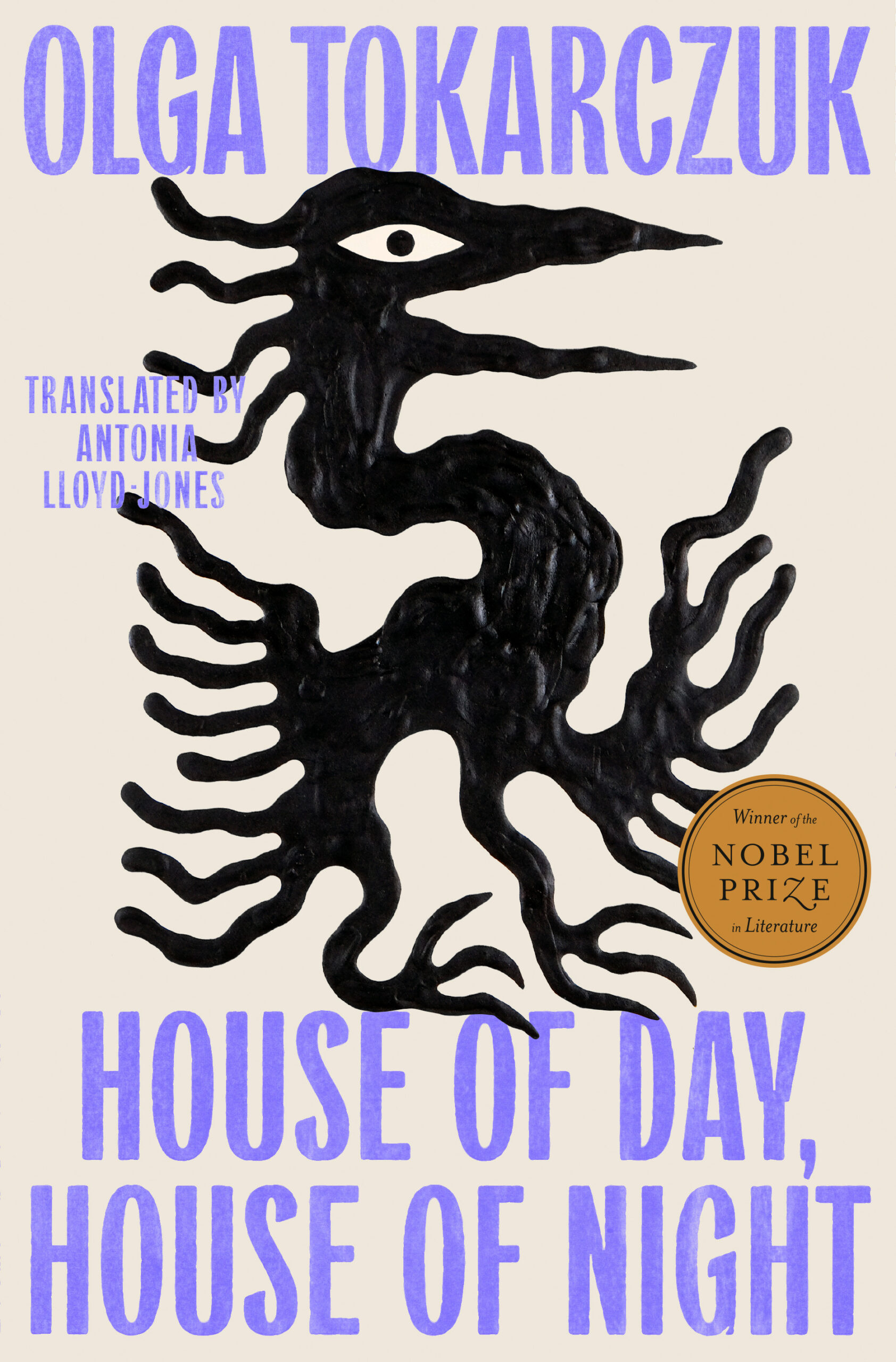
From House of Day, House of Night by Olga Tokarczuk (trans. Antonia Lloyd-Jones). Used with permission of the publisher, Riverhead. Copyright © 2025.