Have You Ever Tried Going on a Blind Date With a Book?
Jess deCourcy Hinds Offers 13 Ways of Looking at the Book World’s Latest Phenomenon
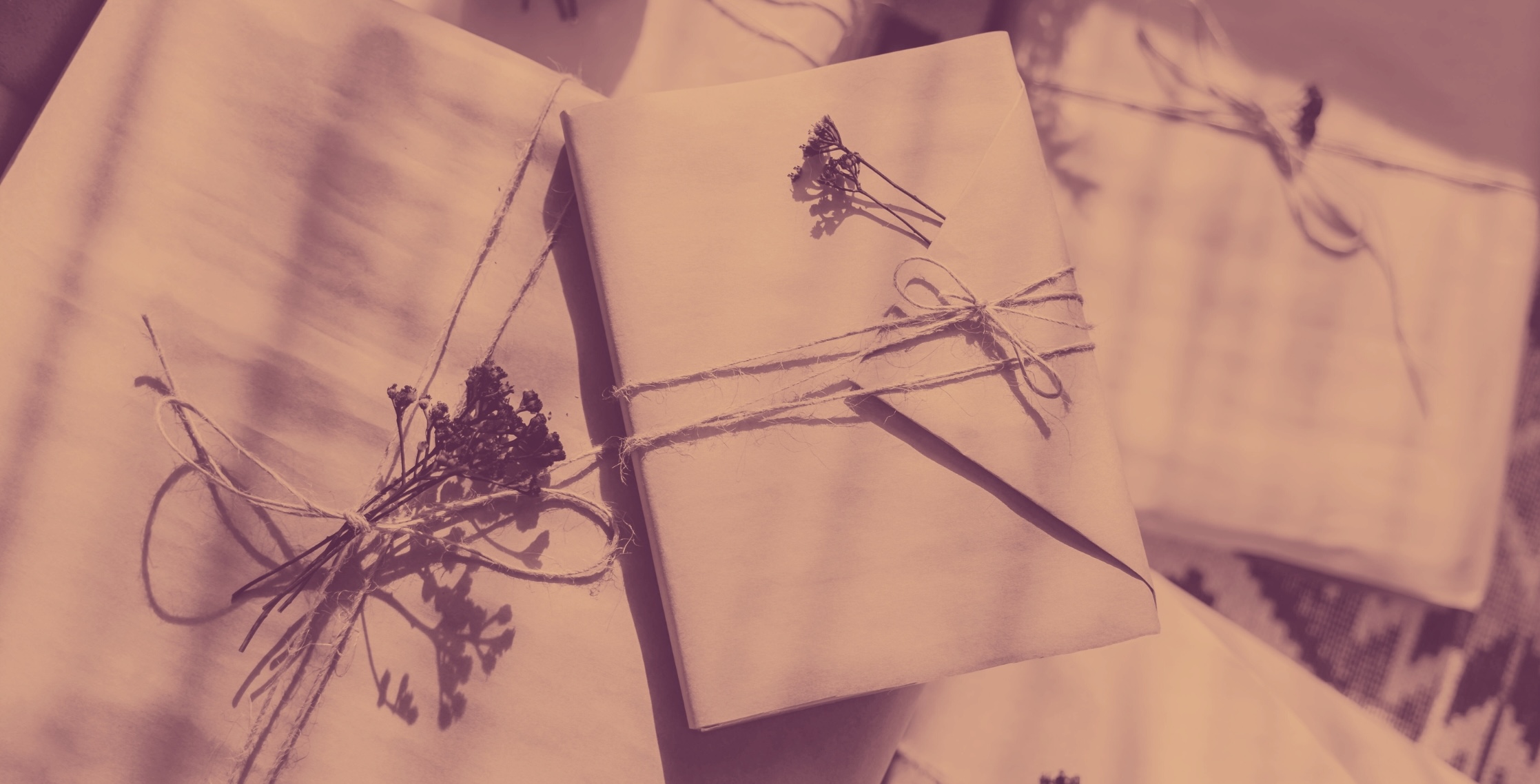
Curling up with a “Blind Date with a Book” sounds like the perfect Valentine’s Day for this content divorcée. I first learned about the “Blind Date with a Book” phenomenon through my 13-year-old daughter’s school project. We quickly became hooked: wrapping gently used books in brown paper, decorating them with colorful metallic pens, offering potential readers enticing clues about the contents and essence of a book.
Examples of some hints: “Tween mystery. Girl spies, time-traveling feminist figures and Cheetahs.” These are clues for the middle grade novel Spy Society: The Case of the Missing Cheetah by Veronica Mang (Viking, 2021). We decorated the whole cover with cheetah spots and vintage women’s fashion, and attached a homemade peacock feather bookmark.
It’s a family affair—my 13-year-old, 6-year-old, and ex-spouse join together to assemble Blind Date Books. Community members browse our wares and try to guess what books we have hidden. “Did you make up this idea?” many people ask. We did not. We’re among countless enthusiastic practitioners of the Australian literary craft. Blind Date with a Book turned 13 the year my older daughter did, so I thought I’d assemble 13 facts, musings, and tidbits about this literary phenomenon. What is Blind Date With a Book really about, and what does it say about us as readers and humans?
1. An Australian family store.
The originator of Blind Date With a Book was Elizabeth’s Bookshop, which has several locations across Australia. Throughout their 52 years in operation as a family business, Elizabeth’s distinguished itself by honing concise and persuasive staff recommendations. Over the years, staff members noticed that the descriptions grew “more and more cryptic,” and that customers found it fun to guess what books they were describing. The first wrapped books were written in elegant black calligraphy with brown paper wrapping, white twine and artful luggage tags.
The store started the process of registering trademarks in 2000, but their website states that 2012 was Blind Date With a Book’s official first year. The concept took off in the UK in 2015, and booksellers in the US joined in shortly after. Despite how commercialized their concept has become—you can buy Blind Book Date kits on Amazon—Elizabeth’s still creates everything by hand. A staff member mentioned that they clear a display table of Blind Date Books and serve Christmas dinner there.
Elizabeth’s has a flair for descriptions in a list format, including this one, which uses ellipsis for dramatic effect:
Stationery Shop
Pens, paper…
Personal drama
Odd characters
The rest of the description in the photo is obscured by a bow, but I’ve read enough to feel hooked into the story.
2. An ecofriendly way of letting go.
Blind Date Books have become a creative way to weed one’s home bookcase and give a recycled gift. When I wrap up my old books and linger over the description and how to dress up the package, I have one last chance to meditate on what the book means to me. Gifting a book to loved ones feels back to myself, experiencing the book vicariously through my friends’ reading experience.
3. Supporting and empowering artists
The New York Times featured the dynamic, mesmerizing pop art illustrations on Blind Dates Books at the iconic Strand Bookstore in New York City. The colorful, detailed drawings span the full cover, quite different from Elizabeth’s minimalistic but stylish approach.
Kat Pongrace, the Strand’s Marketing Director, describes Strand booksellers as a “multi-talented” group that includes artists who have launched careers in book design after working at the bookstore. “There are a million ways to handsell a book, and this way just so happens to be hand drawn.”
One of the store’s book buyers, Gailyn Neutzling, describes the illustrators as having a major role in the operation. “Every few months, a manager will ask us to send them a list of potential Blind Date With a Book titles, but those don’t move forward in the program without approval from the folks providing original artwork.”
4. Writing book clues is a creative exercise
As a writer and librarian, packing Blind Date Books allows me to practice all my professional skills in a playful way. I spend most of my waking hours summarizing books and finding the right words, so I’m right at home writing clues. Distilling the essence of a 300-page book into a few pithy phrases is an invigorating activity for creative writing students of all ages. Writing clues invites out-of-the-box thinking, like imagining how a book’s movie trailer would look.
5. Blind Date Books help us live well
In Southern Oregon’s wine vineyards, visitors to the Hummingbird Estate Inn and Cottages will enjoy Blind Date Book mixers in 2026. General Manager Meghann Walk, a former librarian, believes in pairing books and wine. In a sense, reading the clues on Blind Date Books resembles sipping wine in search of the right bottle in the company of loved ones or new friends. “As a winery, we are always looking for ways to connect wine with living well,” Walk shares.
Blind Date Books aren’t usually wrapped in gift paper, but brown paper as if to suggest literary forbidden fruit.
6. The original Blind Date Book inventor is a secret
When I asked the staff at Elizabeth’s Bookshop who really created the Blind Date With a Book, they hesitated to disclose the identities of the original founders. However, they did point to one individual who was the “driving force” of the project. Appropriately, the bookstore prefers to keep her identity hidden, but they do provide one tantalizing clue. She is “a young lady who has since become a very senior member of the Australian Diplomatic service!”
7. Blind Dates With Books champion unsung books
Holly Nikodem and Vina Castillo, owners of the Kew and Willow Bookshop in Kew Gardens, New York, never wrap bestsellers or well-known titles as Blind Date Books. Instead, they use the brown wrapping to “spotlight the books that might not be getting the love they deserve.” Nikodem notes that many publishers’ jacket material or blurbs don’t adequately describe what a book is about. She finds that when she identifies the hook that caught her attention, even if it’s a less prominent aspect of the book, she can market the book better than the publisher. The Blind Date Book project gives power to booksellers.
8. Blind Date Books are painstakingly vetted
Blind Date Books are often nominated, evaluated and voted on by booksellers as if they are on an award committee. At Elizabeth’s Bookshop, the staff have “endless discussions about suitable titles and suitable clues.”
As Cristin Stickles, Book Buyer at the Strand says, “The book selection process is significantly more rigorous” than almost any other part of their operation, and “all of these titles are genuinely loved.” Once a book makes it onto the Blind Date list, sales often improve. For example, Stickles notes that Kate Racculia’s YA mystery Bellweather Rhapsody (Houghton Mifflin, 2014) was a personal favorite that has sold 500 copies since becoming a Blind Date 15 months ago.
9. Blind Date Books appeal to people overwhelmed by decisions.
According to Nickodem, people want to be relieved of the decision of choosing a book among countless titles in a store, each one marketed with different combinations of frenetic color, fonts and dramatic blurbs. We release control when picking out a Blind Date Book; we reach for a helping hand. If we’re giving the book as a gift, we enjoy the experience of being just as surprised as the recipient.
10. It feels a little scandalous
The Blind Date Book aesthetic conjures up the practice of concealing books to help patrons avoid prosecution for reading illegal materials. Ed Simon’s Lit Hub piece on “free speech, book bans and court-mandated censorship then and now” pays tribute to Samuel Roth, “the sort of bookseller whose wares came wrapped in brown paper.” Roth sold pornography. Blind Date Books aren’t usually wrapped in gift paper, but brown paper as if to suggest literary forbidden fruit. We have the right to read what we choose, but what we read is nobody’s business.
11. They invigorate libraries
Public and school libraries have seen an increase in book checkouts when wrapping up books for Valentine’s Day, Banned Book Month in September, or “Beach Reads in Disguise.” One school librarian only uses the phrase “Undercover Books” because the idea of blind dates, or any kind of date, grosses kids out. Youth librarians sometimes bribe children to check out books by letting them know they can keep the tchotchkes and even candy attached to the book. Sometimes they strike a deal, asking students to write a mini book review on an attached card after finishing. They attach a copy of the barcode to the outside of the wrapping so patrons check out the book blind. Libraries thrive when special events or new displays pop up. When library visitors ask, “What’s that?” and notice something out of the ordinary, they begin exploring book collections in new ways.
12. Blind Date Books feel pure
Nickodem, one of the owners of Kew & Willow, believes that Blind Date Books help us return to our “core values” about what makes a good story or what we are most curious about. The fancy grocery wrapping sends the message that what is being presented is as simple as a chicken breast or slab of fish. We’re seeking literary nourishment like children, returning to a pure, open state of reading.
13. People love mystery
Of all of my most beloved contemporary authors, I was most curious to get R.O. Kwon’s opinion on Blind Date with a Book because Kwon writes about desire. According to Kwon, most recently the author of Exhibit (Riverhead, 2025), the novel “…explores what you’d risk to pursue your core desires.” The description of her novel echoes some of the essence of Blind Date Books: the experience touches on your “core,” the same word Nikodem used, and there is an element of risk in opening an unknown package.
Why has Blind Date With a Book taken off worldwide? Fittingly, Kwon answered my question with another question. “Maybe,” Kwon wrote in an email, “it’s just that a lot of people love mystery, and wanting to know what happens next is a powerful thing?”
Jess deCourcy Hinds
Jess deCourcy Hinds is a writer and librarian in NYC. Her work has been featured in numerous outlets, from NPR to the New York Times' Modern Love column to literary journals such as Quarterly West. She works as a youth librarian at two Title 1 schools, and teaches graduate-level courses on children's literature. Photo credit: Doug Weiner.