Have They Ruined Our Beloved Scholastic Book Fair?
Brittany K. Allen on the Enshittification of All Things
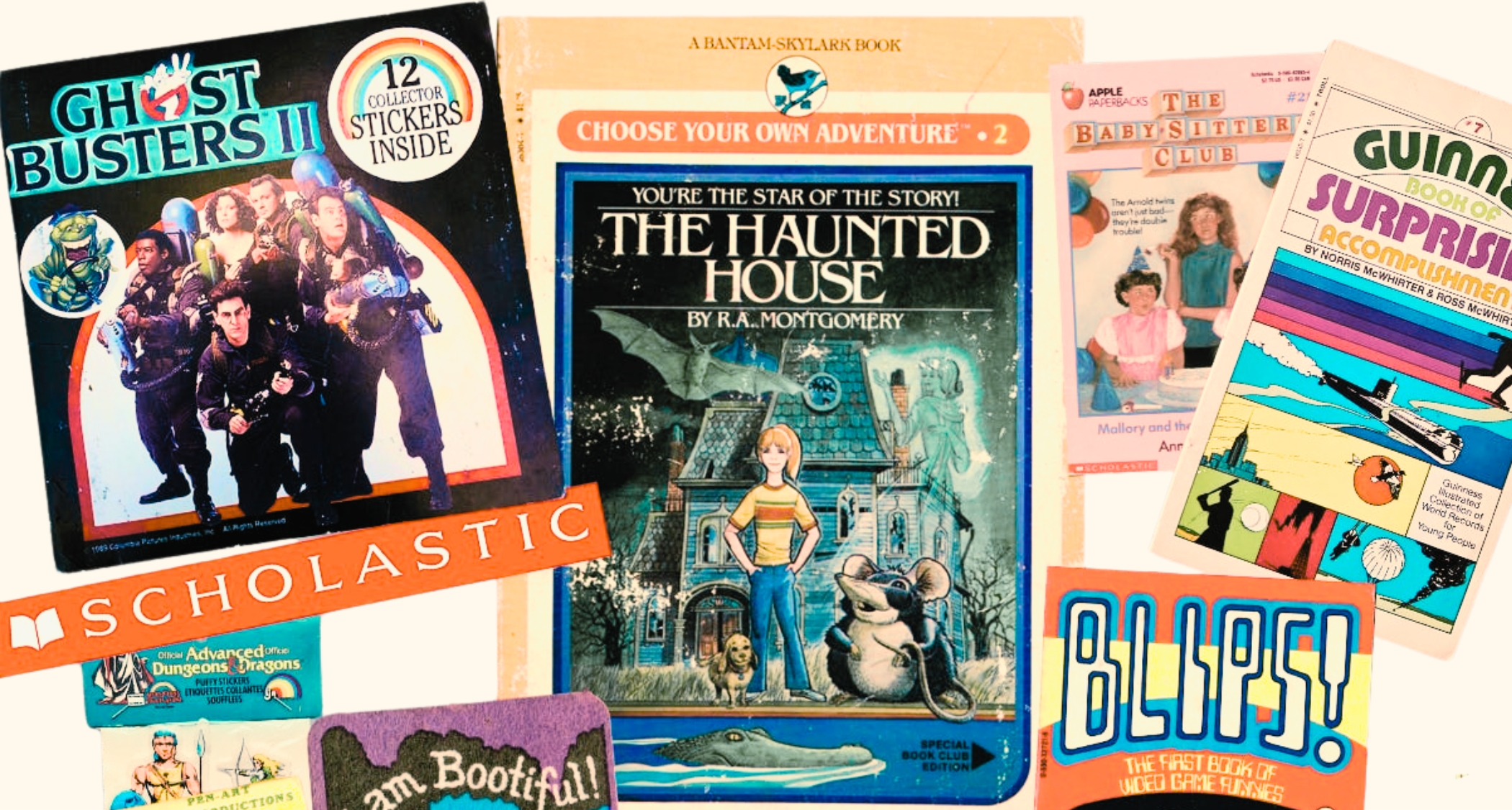
Oh, Scholastic Book Fair. If you made your way through a public school in North America anytime during the past half-century, you should recall that shiny catalog. That sudden, circus-like presence in the school library.
On Monday, the critic Michelle Cyca argued as much in an evocative piece for The Walrus. Cyca remembered the fair, with its order forms and Animorphs box sets, as a key Millennial touchstone. But when her young daughter brought a current catalog home, sorrow usurped nostalgia.
Cyca was distressed to note that many of today’s fair offerings are mere “extensions of toy or TV franchises,” like Lego, Pokémon, or Paw Patrol. What’s worse, these offerings seem “to be marketing themselves not on the merits of imaginative storytelling but on their proximity to more stimulating entertainments.”
But what does it mean—especially considering this national reading crisis we keep hearing about—if the fair of yore is dead? Is this one more win for the baddies? Or a case of rose-colored glasses?
*
First, some context. Scholastic launched its first teen-targeted book clubs in 1948. Their Pocket Book program allowed students to access affordable books by ordering them from magazines stationed in the classroom.
The book fairs kicked off in 1982. Early iterations gave Scholastic titles—like the Clifford series—space to do gangbusters. In subsequent eras, the fair proved crucial to the growth of other YA properties, like The Hunger Games or Goosebumps series.
Neither spin-off books nor merch are new to the fair. And franchise offerings are something we can trace back to at least 2002.
In addition to fanning a love of reading, the fair has always claimed a fiscal purpose. In North America, it offers a supplemental funding pipeline for under-resourced schools. A Scholastic rep told Fox 13 that book fairs have helped raise more than $2 billion for American schools in the last decade alone.
Hard yums to yuck, in this economy. Even if the quality in the stacks has been compromised. But to Cyca, that earlier fair was most important for its purity.
“The order form elicited a buzz of permissible, wholesome consumerism,” she wrote, of the famous catalog. “[A]nd I loved the freedom of penciling in my choices after careful deliberation: Animorphs, Scott O’Dell novels, R.L. Stine series that would give me nightmares for weeks.”
Like a Proustian madeleine, I remember those Animorphs. But as another piece of IP that spawned its own TV drama, I’m inclined to question my instinct to distinguish K.A. Applegate’s series from the Paw Patrol or Minecraft novels—at least on the object level.
Anyway, neither spin-off books nor merch are new to the fair. And franchise offerings are something we can trace back to at least 2002, a year when the Arrow Top 10 bestseller list included… a Pokémon guide.
At my American public school, the fair’s consumerism was less wholesome, more class stressor. Some kids had wads to throw around on Snoopy backpacks. Others had lunch money, which could really only translate to a sticker sheet or two.
If you couldn’t afford anything—or if your parents hadn’t been briefed in the ways of this strange social dance—the fair could be a torturous rite. If one hadn’t banked enough points or ducats to buy that copy of Little Women with Winona on the cover, one could easily wind up like Amy March: Crying in the snow over limes.
*
Danika Ellis, a Book Riot editor and former bookseller, told CBC that she’s long been skeptical of the fair for just this reason.
We have kids who are walking away with huge stacks of books and posters and toys, and then kids who can’t have anything or have a lot less. If the goal is to celebrate books and reading and get kids excited… is a for-profit book fair the best way to do that?
This observation underlines the fair’s original sin, and standing paradox: buying books has never been the same as reading them.
To be fair, Cyca has the same compunction, and notes in her elegy that the program has always escalated “micro and macro inequalities.” But if we all agree that the fair has always been imperfect as educational tools go, then doesn’t that force our nostalgia into a mostly aesthetic critique?
Fine if so, natch. I miss the analog library aesthetic as much as any other self-respecting Pen-15 fan. But purely aesthetic nostalgia can sometimes raise unwelcome dead—like low-rise jeans.
And if I’m being really honest about my fair? It was never about finding the “best” books. The un-classy offerings, or the aesthetic objects marketed to me “on their proximity to more stimulating entertainments,” were just as important as Bud, Not Buddy. The greatest thrill, in fact, was often buying something your parents would never buy you in the first place.
I circled Garfield and The Babysitter’s Club and the Teenage Mutant Ninja Turtles books in my catalog. Even though—or, perhaps because?—you could also catch the live versions of those stories during peak latchkey hours.
And I doubt the high of coveting a Star Wars spin-off or a New Kids on the Block poster book was purer than the high of coveting whatever a squishmallow is. Assuming some kid somewhere does.
Though I won’t speak for others, my fair was never about refining literary taste or honing a pure love of reading. The sheer amount of shiny objects for sale made sure of that. For better and worse, coveting was the exercise and the education. Because the fair was never ever fair.
*
At its core, Cyca’s (highly nuanced!) critique is less about the fair’s modern offerings or function than its vibe. The way it’s become embroiled in a larger sense of cultural degradation. Which brings me to Cory Doctorow’s handy term, “enshittification.”
Referring to the process by which a user experience degrades sharply as value is extracted from said user, enshittification is a symptom of late-stage capitalism.
Doctorow has lobbed the charge hardest at Silicon Valley, where the dominant business model requires catering to (read: sucking data from) individuals only to abruptly change lanes and prioritize corporations.
Enshittification, he argues, can account for why our digital feeds are sludged up with ads and AI slop. But the term has since proven portable for many businesses, beyond tech.
The drive to prioritize mega-corps over the consumer can also explain why lots of experiences and products—including certain other Millennial aesthetic touchstones—just feel worse these days. Even if we can’t always say how.
As Kyle Chayka noted in a shrewd review for The New Yorker, this coinage is satisfying. But an explanation does not a solution make. Not least because crying “it’s all gone to seed!” goes hand in hand with nostalgia.
But lamenting the earlier, better object can be a distraction. A detriment to action, when what we ought to be doing is railing against the whole economic system that led a squishmallow to exist.
Doomerism is a risky effect of rose-colored glasses. “Perhaps the worst outcome of enshittification is that it drives us to expect things to be bad,” Chayka wrote, “and to assume that they will only get worse.”
When it comes to the thing of the Scholastic Book Fair, I’m personally still on the fence. There’s good, there’s schlock, there’s capitalism. Maybe it was always the exact same fraught frenzy. And it’s just us readers who are finally growing up.

Brittany Allen
Brittany K. Allen is a writer and actor living in Brooklyn.