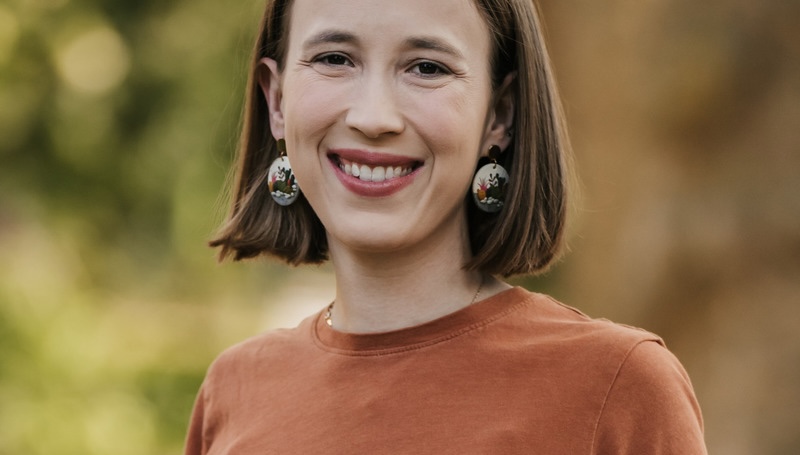
Hannah Thurman on Writing a Family Drama Set in a Mental Hospital
Jane Ciabattari Talks to the Author of Mercy Hill
Hannah Thurman’s Mercy Hill, is an emotionally nuanced coming-of-age story set within the confines of an aging mental institution in Raleigh, North Carolina, told from the point of view of the youngest of four gifted daughters of the hospital’s head psychiatrist, a woman who has championed the rights of those with mental problems since the death of her own mother by apparent suicide. Thurman, already honored with a 2024 NYSCA/NYFA Artist Fellowship and a 2023 Florida Review Editor’s Prize for Fiction, has a masterful command of her subject matter and the complexities of a family drama in her first novel.
In her acknowledgments, she credits her mother, Rita Thurman, for “the initial inspiration to set a novel on a fictionalized Dix Hill (with a very different family from our own.)” What was the seed that evolved into this novel? I asked her.
“My mother briefly worked as a speech therapist at Dorothea Dix hospital, the state-run psychiatric facility I grew up near in Raleigh,” she explained.
She mentioned to me once that when she had been working there, she was offered housing on campus, and I always thought, Wow, what a different life that would have been to grow up there! That was really the seed of the story, but what diverges the novel—greatly—from my own childhood, is the question: what would it have been like to have a mother who took that opportunity? She would have been utterly unlike my own mother, and in exploring that character, I created Lisa Cross. Now, of course, I’ve got this book out that is set in Raleigh where I grew up and in a public school that is similar to the one I went to, with this mother main character who is in some ways a total jerk…and everyone of course is asking if any of this is real (AKA, was my own mother kind of a sociopath?) So I made sure to include that note in the acknowledgements so that people know where my own story stops and where this one begins.
*
Jane Ciabattari: Is there a real “Mercy Hill,” a state mental hospital in Raleigh, North Carolina, plagued with funding cuts and shutdowns?
Hannah Thurman: So obviously this is a work of fiction, but I did base a lot of my research on Dorothea Dix Hospital, which was and is a real place in Raleigh close to the neighborhood in which I grew up. Its closure was in the news during the 90’s and 00’s when I was growing up, and the book Haven on the Hill: The History of North Carolina’s Dorthea Dix Hospital (Marjorie O’Rorke) helped my research greatly. Now, Dix Park, where the old hospital used to stand, is a central feature of Raleigh; I go there to play on the playground with my daughter when I visit home.”
Denise is a quiet observer, which I think would also come along with being the youngest of four, and that observational power was helpful to show the cracks in the family and Mercy Hill itself as the story went along.
JC: What sort of research was involved in describing the wards, the patients, the staff, the location—especially during that time from 1999-2004 when the four Cross sisters are growing up on the campus, witnessing their mother’s work, even working as volunteers themselves on Ward B?
HT: So as I mentioned above, Haven on the Hill was a huge book for my research; I also read three other books about the deinstitutionalization process in general: American Psychosis: How the Federal Government Destroyed the Mental Illness Treatment System (E. Fuller Torrey, MD), Bedlam: An Intimate Journey Into America’s Mental Health Crisis (Kenneth Paul Rosenberg, MD), and Mad in America: Bad Science, Bad Medicine, and the Enduring Mistreatment of the Mentally Ill (Robert Whitaker). I have a friend who at the time I was writing Mercy Hill was in her residency for psychiatry and ended up working at a few state mental hospitals as well. I had her read some early drafts of the book to make sure it was accurate. I also would be remiss if I didn’t mention a lot of the research I did about various antipsychotics and other psych medications. That was more just googling various FDA approval dates, top-grossing drugs at a certain time, side effects, etc. I wanted to get things as accurate as I could.
JC: How did you develop the characters for each member of the family in Mercy Hill—Dr. Lisa Cross, director of psychiatry for the hospital; her husband Tucker, and her four daughters—J.J., Caro, Mimi and Denise, aged nine through thirteen as the novel begins?
HT: While Dr. Lisa Cross’s personality was pretty consistent throughout drafts of the book, it took me a while to solidify the four sisters. There were many times early readers asked, “Couldn’t you combine Caro and JJ? Couldn’t you cut Mimi? etc etc,” and I was tempted; it is hard to keep a handle on four siblings who share a lot of qualities but must be differentiated enough for readers to keep straight. But I kept repeating to myself “Poisonwood Bible had four daughters, Virgin Suicides had five, YOU CAN DO IT!!!!!” And in each draft I made sure that each character had a focal element that changed as they grew up but kept them separate.
JC: Why did you choose Denise as the primary narrator?
HT: Functionally, it was easiest to have the youngest narrate because she left home last. If she had been in the middle or the eldest, there would have been sisters left at home after she escaped Mercy Hill’s pull. But I also think from a narrative perspective, Denise is a quiet observer, which I think would also come along with being the youngest of four, and that observational power was helpful to show the cracks in the family and Mercy Hill itself as the story went along.
JC: After the prologue, your first sentence—“Mimi’s branch snapped like a gunshot, and all four of us began to scream”—introduces a dramatic scene in which the four sisters are climbing a magnolia tree overlooking the yard of the highest-security ward—“the men inside this fence arrived on the Hill in police cars and left in prison transport vans”—to spy on a man they call Scarecrow, who “made even the biggest longtimers….shy away, and we wanted to know why.” Ten-year-old Mimi falls. The Scarecrow comes to her aid, but his intentions are misinterpreted by the staff. How did this opening scene evolve?
HT: Hah! It’s such a stereotype of the editing process that people tell you to “cut the first x pages, start with the action.” Well, I am a victim/beneficiary of this advice. Over and over, early readers would say, we need to get to the action faster (or presumably I’d never find an agent, never find a publisher, never find readers). And I was always like, that’s stupid, you’re wrong, I can start however I want to start. But they ended up being right. It’s a strong scene and previously it had been like a million pages too far in.
JC: Dr. Lisa Cross’s life path was inspired by her own mother, who “had seen shadows, ones that seemed real enough that she cut her skin when they touched her,” shadows that “drove her car off the road and into a tree” when Lisa was nine. (Your explanation of Lisa early on is so powerful: “A type of love so entirely intermixed with a desire for control that you couldn’t separate the individual parts. It drove her like gasoline.”) She wants to pass on her own mission to her daughters, which means she drives them relentlessly to pursue academic achievement, perfect SATs, Ivy League colleges, medical school, and jumps them ahead several grades in school. How did you sort out Lisa’s blind spots? The ways in which she distorts the world for her daughters? As Denise puts it in the prologue, “it’s taken me years to untangle myself from her version of the truth.”
HT: I think Lisa’s perspective is in some ways the easiest for me to enter because she is so single-minded. She had this traumatic upbringing and decided to devote every ounce of her energy to creating and controlling the world that she desires. Other characters may prevaricate, they may ask themselves if what they’re doing is the right thing (especially Denise! it’s one of the main ways she deviates from her mom). But Lisa? Up until almost the very end, she is so sure she is doing the right thing that she just bulldozes ahead, blinders on.
JC: How did you create a plotline that details the shifts in the power dynamic in the Cross family—including the alliances among the sisters and the controlling role of each parent—in the course of the novel?
You should see the deranged scraps of paper I used to track the characters’ ages; playing around with time when you have four close-together siblings as characters is not for the faint of heart!
HT: With great difficulty. LOL!! But truly, this was the first project I’ve ever used Scrivener for—Scrivener allows you to move pieces of the draft around more easily than MS Word and helps show you what a certain element of the story could look like if you move it from one time frame to another. And it was so crucial here because I wanted to have this overall arc of course, the closure of the hospital, but each of the sisters and each of the parents also had to have their arcs too. (Even Daddy, who I know gets a little bit of a short shrift but that’s kind of his personality, to be in the shadows.) So each time I rewrote Mercy Hill, I tried to keep each of these arcs in mind, and if they weren’t working, I moved stuff around in Scrivener. You should see the deranged scraps of paper I used to track the characters’ ages; playing around with time when you have four close-together siblings as characters is not for the faint of heart!
JC: Throughout the novel, you make clear the bias toward those with mental illness, the ways in which families hide it, the intergenerational repercussions of living with family members with mental illness, and the damage that can be done by lack of care or confined care. What motivated you to write about mental healthcare in the U.S. in the late 1990s and early twenty-first century?
HT: I suppose there are many eras with unique perspectives on mental health and mental illness, but I truly think the deinstitutionalization process (which did begin in the 70’s and 80’s but was nearing its middle-end by the turn of the millennium) was a rich one to focus on. In many ways, we are still living with the ramifications of the defunding of state-run institutions, the well-intentioned attempts to give more freedom and more choices to those with SMI (severe mental illness) coupled with a devastating lack of resources to help support them.
JC: Which literary authors and/or books influence you most?
HT: One of my all-time favorite writers is Lauren Groff. I just finished her latest collection, Brawler, and have been following along as my husband reads her recent novel, Matrix. She’s just so incredibly talented at pulling out the drama of a scene and getting you to immediately care about the characters on the page.
I would be remiss if I didn’t mention Ann Patchett, whose book The Dutch House I close-read and annotated while I was writing Mercy Hill. Her use of retrospective in that book was a masterclass in and of itself!
JC: What are you working on now/next?
HT: My next book, out in 2028 if I can get my butt in gear on the edits, will be forthcoming from Doubleday as well. It’s called Thin Skin. (More on that here) A novel-in-stories set in and around a public high school, Thin Skin focuses on public education in America. Examining the American high school the way I did the American mental hospital, I explore another institution’s racial and economic history, and highlight both why it’s inadequate and why it’s essential.
____________________________
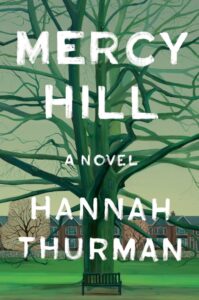
Mercy Hill by Hannah Thurman is available from Doubleday, an imprint of Knopf Doubleday Publishing Group, a division of Penguin Random House, LLC.
Jane Ciabattari
Jane Ciabattari, author of the short story collection Stealing the Fire, is a former National Book Critics Circle president (currently on the Advisory Board ) and a member of the Writers Grotto and Page Street. Her reviews, interviews and cultural criticism have appeared in NPR, BBC Culture, the New York Times Book Review, the Guardian, Bookforum, Paris Review, the Washington Post, Boston Globe, and the Los Angeles Times, among other publications.