I’ve wanted to be a mother for as long as I can recall. As a child, I had no friends my own age. At school, I preferred to play imaginary games with the younger kids in the playground. I’d be the kind matron of an orphanage, or the babysitter of a giant rabble. The little ones loved the attention of an older girl; they’d run up to me asking to play. I’d give them sticks and pebbles for their dinner, then put them to bed in the sandpit. It interests me, now, that I never played at being their mother. At nine years old, I liked to imagine myself as a gorgeous woman in my twenties, dressed in flared jeans with stars on the pockets and red cowboy boots. I didn’t think it was possible to look that way and to have also carried a baby. Perhaps deep down I knew that my body would never become pregnant anyway, because of the three miscarriages my mother suffered, in quick succession, the year I turned six. In my child’s mind, I was unable to separate that word—pregnant—from the image of a toilet filled with blood.
What was it that I liked about small children, when I was still a child myself? There were a few things. I found them cute, with their wispy hair, their cheeks full and springy as water balloons. I was heavy and thick-limbed, with coarse curls that stood outwards when my mother brushed them. I prized myself on my neat handwriting, and I enjoyed finickity hobbies, like cross-stitch or intricate colouring. I gravitated towards things and people that I found small and beautiful, as a kind of outsourcing. Another reason I liked babies and young children was because they liked me. I understood even then that we are born real, socialised over time to be polite. Therefore, it seemed obvious to me that being liked by younger kids meant something deeper than being liked by older ones. I had a knack for making the little ones laugh, for coming up with games that they enjoyed. I never felt more popular than when walking across the playground, swishing my hips in my imaginary flares, a line of small children following me like ducklings.
It should be said that kids my own age never thought much of me. I was slow at sports and shy in conversation, an only child of overprotective parents. Perhaps it was for this reason, initially, that I set my sights on the little ones, too proud and self-conscious to chase after friends who showed no interest in me. I was lonely at home, and wanted to feel myself surrounded. My parents loved me deeply, they love me still, but the main purpose I served as their child was to need them, was to make them feel capable. I noticed the rush of energy my mother got when I was sick, or when I’d had a bad dream. I remember her cold hands on my hot face, the mug of warm cinnamon milk she’d give me in the night. But I too needed a chance to prove that I was capable, that I was a person who could provide as well as receive. The little children allowed me to play this role, if only in our joint imaginations, if only for an hour.
After school, my parents would create small issues, just so that they could parent me. I hadn’t drunk enough water that day; I had tight hamstrings; I was anaemic. They were constantly fussing over my diet, over my sleep. Though they were never pushy. If anything, they had low expectations of me. They required nothing outside the realm of normal. The problem was that normal could feel like a very tight space, and it only became tighter as I grew. My parents’ love was like a smoke-filled room, the walls closing in. I’m aware that they never intended to make me feel this way, that any knowledge of this would hurt them. Simply, their identities—particularly my mother’s, but my father’s too—were so greatly consumed by being parents that they couldn’t bear to set me free in the world. If I grew up and no longer needed them, who would they be?
But I did eventually find myself an adult. Desperate to claim my independence, to prove that I was grown, I ripped myself away.At eighteen, I moved from the suburb of Portslade into Brighton, renting a room in the house of a youngish couple with a daughter. My parents had hoped I’d go to university, but I knew that if I did I’d likely have to return home for the holidays, and this put me off. I could no longer stand the concern on their faces.The way that, on the rare occasion I went out at night, they’d leave their bedroom door ajar.When I got in, I’d find my mother sitting upright in bed with her glasses on. The light was honeyed, her face in it creased with worry. My father was a lump under the covers, snoring a thick growl. When I think of my mother, this is still how she appears to me: waiting up for me always, her door held permanently ajar in preparation for the inevitable moment when I should somehow fall out of my own life.
Instead of university, I got a job in recruitment. I’d found the work of trying to get a job so boring that I’d settled for the first thing I was offered, and now it was my work to find jobs for other people.The mundanity was excruciating, but I liked speaking to my clients on the phone. It emboldened me that they never saw my face. I’d comfort them about their struggles to find work, I’d reassure them that these days it was increasingly common. I’d put on an accent that was posher than my usual, and after I hung up I’d wonder if they imagined me as older than my eighteen years.
In the evenings, I’d spend time with the little girl I lived with. Her name was Connie. She’d taken an immediate liking to me, as children often did. I didn’t play at looking after Connie, as I’d done back in the school playground. I was an adult then, and no longer in charge of the imagining. Connie controlled our games, and in them she treated me like an oversized doll. I’d lie down on the rug in her bedroom and she’d fasten every one of her hairclips into my hair, or draw all over my face with the smooth nibs of her felt tips. Sometimes she’d wrench my chin until my mouth opened, and then she’d push objects inside. A cold marble, a coin she’d shaken from her piggy bank.
Take your pills, she’d whisper to me. Take your pills and you’ll be all better.
If I tried to speak, she’d silence me immediately.You can’t talk, she’d say.You’re almost dead.
Sometimes, in my evenings lying on the floor for Connie, I’d find tears sliding down the sides of my face, blocking my ear canals so I could hardly hear her shuffling around her room, gathering up supplies for our game. I didn’t know why I was crying, and I didn’t spend long considering it. The crying refreshed me somehow, and that was enough. It was a kind of nightly cleansing. Afterwards, Connie’s parents would call her to the bathroom to brush her teeth, and I’d go downstairs to boil myself some two-minute tortellini. Now, when I think back to my very early adulthood, these moments with Connie strike me as some of my happiest. It seems to me that I was crying out of relief, rather than sadness. Relief to return, just for a moment, to a time in which I had no agency, no responsibilities for myself at all. Being with Connie resembled being with my parents, in that way. Lying on the floor while she drew over me like a piece of paper, I could give up on my tussle for independence. I could rest.
I spent three years living with Connie and her parents, then another five living alone in a rented studio flat above a chicken shop. For the most part, I remained the child I had always been: that unhelpful combination of proud and self-conscious; drawn to youth and beauty; prone to measuring my own success in terms of how useful I felt, how needed. It seems to me now that adults are just the children they once were, grown-up life not so different to the playground.Yet of course the stakes get higher.
__________________________________
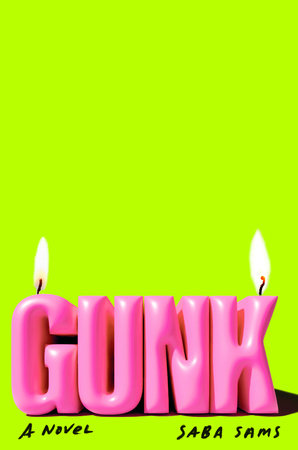
From Gunk by Saba Sams. Copyright © 2025 by Saba Sams. Excerpted by permission of Alfred A. Knopf, a division of Penguin Random House LLC. All rights reserved. No part of this excerpt may be reproduced or reprinted without permission in writing from the publisher.