Growing Up Alawite in Assad’s Syria
Loubna Mrie Explores the Intersections of Family, Faith and National History Under Authoritarianism
I slip off my shoes and leave them on the cement as my grandmother Wadia, my mother’s mother, leans into a rough wooden door with all her weight until it opens. She leads me into a dim room, the only source of light a tiny window, a brass plate of frankincense burning on its sill. It takes time for my adjust. The walls are cracked, and their whitewash has faded to gray. A dark wooden bookcase occupies one corner. A dozen people sit cross-legged on a frayed rug, humming and whispering indecipherable prayers. Some are leaning back against the wall, their eyes closed. Others sway back and forth as they read texts from the pages of books cradled in their laps.
Grandmother’s eyes draw close to mine. “This,” she whispers, “is the sheikh’s tomb.” She nods toward the center of the room. There, layers of light green cloth cover a stone sarcophagus. She’s brought me to dozens of tombs like this—tombs of sheikhs, God’s messengers, who know the secrets of the Alawite religion, and whose burial chambers are sacred. She takes me toward the sarcophagus and drops to her knees. Eyes tightly shut, she bows over the cloth, touches her lips to it. Then she rests her forehead on the spot she’s just kissed. The palms of her hands pressed against the sides of her head, she starts to whisper. I move closer and struggle to hear what she is saying. I go down on my knees. I lean my body against hers. She is silent.
I grew up steeped in reverence for my faith and the president, the great man who had delivered us from the fringes of Syrian society to the very center of the nation’s politics.
I bow my head close to the fabric, imitating her gesture, and catch a sharp, terrible odor, the smell of old socks soaking in water. All those lips. All that human saliva and mucus, absorbed and dried into a rough crust. My fingers pinch the edge of the cloth and I draw it away to kiss the stone.
Grandmother grabs my hand and squeezes until it hurts. “It is forbidden even to lay eyes upon the bare stone,” she warns. “It will blind you.” I freeze. The thought of kissing the cloth is revolting. I close my eyes, hold my breath, and barely touch the harsh fabric with my lips. Then I place my forehead against it, cool from the stone beneath. Shivers pass through my body. I keep my eyes closed. I draw a deep breath and try to think of something to ask of the sheikh, lying there, cold under the hard stone. I cannot ignore the smell. I feel nauseous. I fear my grandmother will notice, and that I will suffer punishment—both from her and from God—for getting grossed out in a place of worship.
Grandmother takes a small pair of scissors from her bag and snips a swatch from the green cloth, then slips it into her pocket. Before I have a chance to wonder why she’d steal a piece of the stinky fabric, she commands: “Stay here. I’ll be back.”
She rises from her knees and walks toward the exit. I follow her with my eyes and spot a picture hanging above the wooden door. It’s a printed portrait of Imam Ali. Ali is the son-in-law of the Prophet Muhammad and a martyr to Shi’ite Muslims.
The low sound of a woman weeping flows through the heavy silence that otherwise fills the room. I try to find its source. The sheikh’s tomb blocks my vision. The weeping grows louder. I stand and move toward the bookcase. On its shelves are various editions of the Quran and other books. I take one about the size of my hand, open it, and scan the room. I see a woman dressed in black, a white funeral scarf covering most of her head, her back against the wall. An open Quran rests on her lap. But she isn’t reading. Her eyes are closed. She is sobbing.
I sit down on the floor in the opposite corner of the room and try without success to focus on my Quran. I stare at the woman. My heart aches. She opens her eyes and speaks toward the tomb in whispers. Minutes later, she wipes her face with her scarf, puts the Quran aside, stumbles to the sarcophagus, kneels down, and places her hands upon it. She speaks to the tomb, as Grandmother did. I can’t make out her words. She kisses the tomb, takes something from her coat pocket, and pins it to the bottom of the green cloth. Then she kisses the fabric again, stands, and walks away.
When she’s gone, I put the Quran aside and go to where she knelt in front of the sarcophagus. Steeling myself against the smell, I, too, kiss the cloth. Pressing my forehead to the spot I kissed, I lift one layer of the cloth to see what she has pinned to it—a small picture. A girl with two braids, no older than ten. Keeping my forehead against the tomb so none can see what I’m doing, I lift the second layer and discover more pictures. Women and men. Young and old, and everything in between. I lift layer after layer, looking for more. Until suddenly I see the dark, bare stone. I close my eyes. My heart drops. “Please don’t make me blind,” I whisper, and run out of the shrine.
I search for my grandmother, but the courtyard outside the shrine is empty. I start to cry. I wish I’d never come.
“What’s wrong? What happened?” It’s Grandmother’s voice. Whimpering, I hug her and tell her about the child in the picture. “She is my age,” I say. “She is dead,” I say. “There were so many pictures.”
“Not all the photographs are of the dead. Next time remind me to bring yours. People also bring photos of their loved ones so that they can be watched over and blessed by Ali. But for now, you can wear this.”
She takes the green swatch of cloth from her pocket and rolls it into a cylinder. “Give me your hand.” I watch as she ties it around my wrist.
“Don’t take it off. It will fall off when it’s worn out.” As we make our way home, our driver navigates sharp turns that tempt me to reach out and brush against the bushes lining the roadside; the landscape shifts from the olive groves and pine-scented coolness of the mountains to the flat expanse of Jableh. Here, mismatched buildings sprawl under the heavy stench of diesel and rising humidity. I can’t stop thinking of the bare stone I dared to lay my eyes upon—twice—and whether I will be struck blind. Suppressing the urge to ask my grandmother if anyone suffered blindness from it, I remain silent. I know she will caution me to “shorten my tongue”—a polite way of saying “shut up” in Arabic—and discourage questions about our faith. “A good Alawite must obey,” she often says. “No questions.”
*
The Alawi faith is a branch of Shi’a Islam that traces its origins to the early Islamic period and the teachings of Ibn Nusayr, a Shi’a scholar who lived and worked in what is now northern Iraq during the late eighth and early ninth centuries. The term “Alawi” means “those who adhere to the teachings of Ali.”
Alawite theology is syncretic, incorporating elements from Islamic, Christian, and Jewish traditions, as well as influences from Persian, Indian, and Greek (Neoplatonic) philosophies. Alawism emphasizes the importance of esoteric or hidden knowledge, which the faith holds was revealed by God to the imams, the Prophet Muhammad’s successors.
This manifests in the form of rituals that are often more private and secretive than those of mainstream Shi’a Islam, scriptures in addition to the Quran, and the belief in tajyeel—reincarnation. Our deeds in one life determine how we are reborn in the next, allowing us to rise upward until we reach the highest levels of heaven. We can be reborn as holy figures, our dead bodies enshrined, our mausoleums sites of pilgrimage and worship, where we come for prayer and spiritual blessings. Local cultural practices and historical contexts also influence dress, another sign of the sect’s broader divergence from mainstream Islamic practices: Unlike many Shi’a and Sunni Muslim women, Alawite women do not cover themselves with the hijab.
A religious minority in Syria, Alawites faced persecution for centuries under various ruling powers. Growing up, I felt proud listening to my grandmother as she explained how Zaman Awal, our ancestors, survived under the Ottomans—Osmanli—who ruled Syria from 1516 to 1918. Every time she cooked rice, she would tell me and my older sister, Alia, that we should be grateful; most of Zaman Awal lived and died without ever tasting it. “Why, Grandma?” I would ask, though I knew the answer.
She would pause over the steaming pot. “Burghul—bulgur—was all they had. Rice, in Ottoman Syria, was for city dwellers only: Christians and Sunnis. You and I, we were not allowed in cities. The Ottomans hated us.”
The Ottoman Empire was the seat of the Sunni caliphate, and viewed Alawites as mysterious and suspicious because of their distinct religious beliefs and practices. Unlike Sunni Muslims, Alawites do not pray in mosques but instead have their own places of worship; in addition to not requiring women to wear the hijab, the Alawite sect also does not have any dietary restrictions and does not prohibit alcohol. These differences contributed to the distrust and disdain the Ottomans held toward the Alawite community, highlighting broader sectarian tensions between Sunni and Shi’a groups within the Ottoman Empire.
Grandmother would tell us that rumors had swirled around the Alawites for centuries. Some Ottomans believed that Alawites were possessed by devils. Sunni imams issued fatwas, legal condemnations by Islamic religious leaders, against us infidels. The most famous fatwa was issued by Ibn Taymiyyah, a fierce Sunni jurist of the fourteenth century, who preached a rigid interpretation of the Quran and strict adherence to the cultural habits of the great deserts of the Arabian Peninsula. Though Alawites considered themselves a subset of the Shi’a branch of Islam, their beliefs and practices have long been viewed with suspicion by Sunni orthodoxy. Ibn Taymiyyah denounced them as “greater disbelievers than the Jews, Christians, and Indian idol-worshipping Brahmans”—a fatwa that laid the foundation for centuries of marginalization and sectarian hostility.
What I did not know, as we drove home from shrine that day, my hands tingling from brushing against the bushes out the car window, was that when his family’s power would come be challenged, my life would be changed forever.
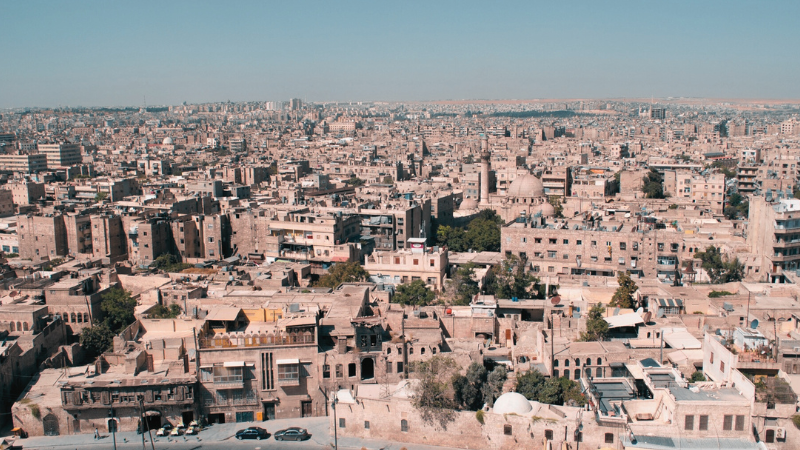
All Alawite children have had the experience of going to bed afraid after hearing horror stories of the violence under Ottoman rule. Of all the stories my grandmother shared, one especially struck fear into my heart: an episode called the Piles. In the late fifteenth or early sixteenth century, the Ottomans raided Alawite houses in Aleppo and killed everyone they found. More than ten thousand Alawites were slaughtered with knives and swords, their severed heads stacked in pile after pile near the Aleppo citadel. Flies swarmed on blood as it was drying in the alleys around the citadel for days afterward. The few Alawite religious leaders who dared to remain in Aleppo and resist were captured, impaled on metal spikes, and displayed in public squares. Some Alawites hid among the Christians in their quarters of the city, but most fled into the coastal mountains overlooking the Mediterranean Sea.
This region, which became known as the Alawite mountains, is where the Alawites would live for the next three hundred years, and it is where my own ancestors took refuge, surviving off whatever the soil would yield. Whole wheat was the only grain available to plant, Grandmother told us, and they would harvest it, winnow it, and crack it using two rounded stones to make burghul. Then they would boil it with tomatoes and white onions from their vegetable patches and eat it with the oil of the olives they collected in their groves. Sometimes, they would soak the burghul with lemon, olive oil, and tomato juice and consume it that way. To this day, Alawites eat burghul on the first day of Eid and consider it a gift from God. Salt was another luxury for the impoverished migrants. Alawites trekked for miles to the seashore, bringing home jugs of seawater to fashion salty dough for bread.
In the aftermath of the First World War and the collapse of the Ottoman Empire, France established a mandate over Syria and Lebanon under the League of Nations mandate system, which, on paper, installed France as a trustee until the countries’ inhabitants were considered eligible for self-government. The French administration restructured the region, creating administrative divisions, which included an Alawite-dominated enclave along the coast. As a result, Alawites experienced relative stability for the first time in generations and began to gain political prominence. During the 1930s and 1940s, Syrian nationalist movements grew stronger, pushing for independence from French rule, which was achieved in 1946.
The early years of independence were tumultuous and marked by political instability, as Syria underwent several military coups and changes in leadership. In 1963, the socialist and pan-Arab Ba’ath Party seized power and established a new government. But another revolution was on the horizon: In 1970, a prominent Ba’athist military leader staged a coup known as the Corrective Movement, consolidated power, and became the president of Syria. His name was Hafez al-Assad, and he was Alawite—the first Alawite president in Syrian history.
I always felt a strong link to my ancestors, and proud to belong to a community that had survived despite centuries of adversity. But as I grew older, I realized that my grandmother’s admonishments to “shorten my tongue” weren’t just a consequence of my youth: As a woman, there were limits to the questions I was allowed to ask about our faith. In Alawi tradition, women are considered spiritually subordinate to men. Alawites maintain that women cannot be entrusted with the core beliefs of the religion, which are passed down from one generation of men to the next. When a boy turns sixteen, he is assigned a sheikh from his hometown and studies with him in a local prayer room at the shrine every weekend. After two years, on his eighteenth birthday, if he completes his course of study, he is accepted as a fully matured, devout Alawite man. Even in my youth, this struck me as unfair: I never felt less Alawite than any man despite being forbidden to ask about the mysteries of our faith, let alone instructed in them.
Regardless of these frustrations, I grew up steeped in reverence for my faith and the president, the great man who had delivered us from the fringes of Syrian society to the very center of the nation’s politics. He deserved our gratitude and devotion; I’d known since I was small. What I did not know, as we drove home from shrine that day, my hands tingling from brushing against the bushes out the car window, was that when his family’s power would come be challenged, my life would be changed forever.
__________________________________
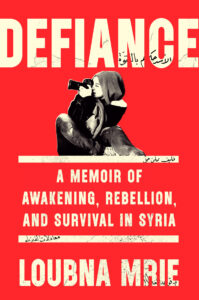
From Defiance: A Memoir of Awakening, Rebellion, and Survival in Syria by Loubna Mrie. Copyright © 2026. Available from Viking, an imprint of Penguin Publishing Group, a division of Penguin Random House, LLC.

Loubna Mrie
Loubna Mrie is a Syrian journalist, photographer, and writer, and a frequent commentator on Syrian and Middle Eastern affairs. The recipient of fellowships and residencies from Magnum Foundation, Ucross Foundation, and MacDowell, she has published work in The Atlantic, Rolling Stone, The Nation, Time, and the London Review of Books, among others.