







Gratitude for Gloria Steinem
Noëlle de Leeuw Reads An Unexpected Life
Gloria Steinem was booked up. There had been luncheons and interviews scheduled for the fall; a high-profile conversation with Katie Couric at 92NY and a prominent place in The New Yorker Festival’s lineup. She left appearances unfulfilled, interviews unaired, an essay unpublished and a forthcoming book. In short: Gloria Steinem was, at 92, far from done.
That energy is palpable in that very book, her memoir An Unexpected Life, published on September 22, in which she states that she planned to live to at least 100. Although she was “older than [she] ever imagined,” mortality didn’t really cross her mind much. Any why would it, when she was also “happier than [she] ever imagined” and her calendar was bursting at the seams? Part memoir, part manifesto, part consciousness raising group, An Unexpected Life is a collection of essays in which Steinem reflects on her life, lays out her worldview and looks towards the future. And just as she was in life, on the page she radiates a matter-of-fact conviction and an unflinching clarity—the result of more than sixty years spent organizing a movement.
Her story begins long before she would become the most prominent face of second-wave feminism (although Steinem would reject this label), with a bruised childhood in Toledo, Ohio. She spent stretches of her young life on the road, until her father left when she was ten years old, leaving her in a rat-infested home caring for her increasingly mentally ill mother. With a childhood spent longing for warm kitchens and cookie cutter family units, it is striking that Steinem would grow up to spend so much of her adult life traveling around the country, more often than not living out of a suitcase. But even more formative than her earliest years, perhaps, was the time spent in India in her early 20s, an experience that would become the very foundation of her feminism.
Although mortality was far from Steinem’s mind, it is apparent in these pages that she was hyperaware of her legacy. “At my age, in this still hierarchical time, people often ask me if I’m ‘passing the torch,’” she wrote in her 1983 book Outrageous Acts and Everyday Rebellions. “I explain that I’m keeping my torch, thank you very much—and I’m using it to light the torches of others.”
She is doing just that in An Unexpected Life, a text bursting with a kind of hopeful exhilaration about what could be. “Nothing is more exciting than making the invisible visible. It’s like finding the end in a ball of yarn,” she wrote. “Pull on it, and gradually the whole of patriarchy unravels.” At times, she gets as literal as bullet-point lists on how to best organize a feminist movement. There are glimmers of the—often cited—shortcomings of the women’s movement that she was at the helm of herself. “Insist on multiracial women who represent the movement,” is one such takeaway of Steinem’s. “Otherwise, people will have a distorted view.” There is an added poignancy to the essays upon her passing; a book that is as much about her life as it is a handbook for movement building. “Whatever my story might be to other people,” Steinem wrote, “I hope something has ripple effects that I myself may never see.”
One such ripple effect concerns her beloved home, an apartment in a brownstone building on the Upper East Side of Manhattan. “If time and ingenuity allow,” Steinem wrote in the book’s prologue, “I hope to acquire the other floors in this house and leave this whole building as a refuge for diverse women who need a place to stay or just to meet.”
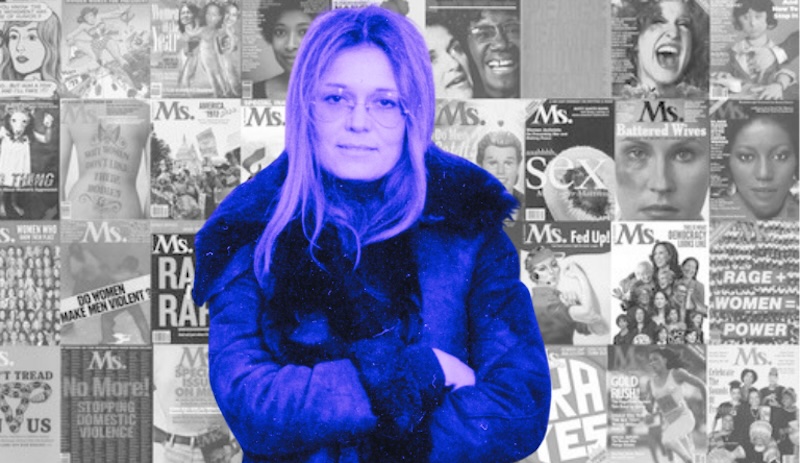
Steinem first moved into her apartment in 1968, together with a roommate. Throughout the years, the apartment grew not only in square footage but in function. The single unit became an entire floor, which became three floors. Her living room had been a meeting place for over fifty years, where she hosted gatherings and talking circles up until this very year. She held meeting on topics ranging from women’s health to misinformation in the media—a meeting in that very living room had led to the founding of Ms. Magazine in 1971. On September 3, Gloria’s Foundation announced that her brownstone would continue to be a feminist sanctuary; a place for women to father and organize, to discuss and seek shelter.
*
Lingering in the background of these pages is Steinem’s time in India. The years spent there upon graduating from Smith College made such a deep and lasting impression on Steinem, it not only ignited her activism but it is where her ideology was rooted throughout her life. In her final essay, published in The New Yorker following her passing, she wrote that it was where she realized that “white people were a very small minority in the world. In India, I got accustomed to, and began to value, racial diversity.” The open, nonviolent M.O. of Ghandi and his followers captivated her, perhaps not in the last place because she learned that his peace movement was once inspired by India’s women’s movement. “I think culturally women are drawn to nonviolence,” Steinem wrote in her final essay. “Probably because we are the major victims of violence, we become the major movers of peace.”
There is an odd comfort in having Gloria Steinem insist that it really, truly, believe her, has been worse.
That multiracial point of view is woven through her philosophy. Steinem could not conceive of a world where sexism existed without racism, and vice versa. The assertion, perhaps, also stems from how juxtaposed it is from the image of the women’s movement, especially the lingering one that it overwhelmingly served white middle-class women. After all, the women’s movement has since been criticized all too often for alienating Black women, working-class women, and LGBTQ+ women. Many of these women were exactly the ones who most often weren’t in the position to break free from the home and chase careers—they had been forced to work for decades. From her words, it’s evident that Steinem did not stand for such “white feminism.” “Systems of dominance—racism and sexism—are rooted together, and must be uprooted together,” she wrote. It is a stance that is progressive even by today’s standards. “To stop racist systems,” she wrote, “women especially must be free.”
*
There is an odd comfort in having Gloria Steinem insist that it really, truly, believe her, has been worse. Looking around, from the global rollback on women’s rights to the bizarre cultural yearning towards traditionalism to, in extreme cases, calls to eliminate women’s right to vote, it’s not so farfetched to spiral into scenarios of absolute doom. Doom, however, was not for Gloria Steinem. “My role as an older person is to remind us how far we’ve come,” she wrote. She harkens back to the early days of Ms. Magazine, when even a publication built around the feminist ethos had difficulty platforming female photographers. Women photographers often couldn’t even afford studio space and the equipment necessary for shoots at such a scale. Today, some of the most prominent magazine photographers are women. Although women still earn 85 cents to a man’s dollar, we’ve climbed from 55 cents in 1970. “I will always prefer to be plotting present or future change over living in the past,” Steinem wrote. That optimism is, indeed, even more apt in this current moment. “We need to remember that hope is a form of planning,” Steinem said in an interview to Vanity Fair on her 92nd birthday, announcing the release of this very book. “If you’re not hopeful, you’ve given up.”
“The very idea that women could be writers was still rare when I was growing up, as was the belief that women could be complete people, not limited by the presence or absence of men.” As I’m writing this essay, it’s not lost on me that I am doing so in an apartment in which I live by myself, on a laptop which I bought with a credit card in my own name. My own existence as a writer, a career path so steadfastly chosen by me, is far from rare anymore—something to which I owe Steinem my gratitude. Every woman who chose to have a career instead of marrying one, has Gloria Steinem to thank. “This is one of the gifts of age: the reward of knowing that flowers of change came from seeds you once planted or watered or carried from place to place,” she wrote.
Gloria Steinem, in her nineties, felt free, she wrote in An Unexpected Life. When the book was announced, on her birthday, in that Vanity Fair spread, I considered the publishing of it as nothing but a celebration of her life, of her decades spent fighting the fight. I never considered these words would, essentially, be her last. They are steeped in optimism and hope; a book to be picked up by future feminists who want to continue that very fight—which would be the best way to honor her legacy. “I count myself lucky that not only have I been free,” she wrote, “but I have seen so many other women who are, too.”

Noëlle de Leeuw
Noëlle de Leeuw is a writer based in New York. Her work has appeared in The New York Times, Vogue, The Washington Post, and ELLE. She holds an M.A. from Columbia University and a B.S. from the University of Amsterdam.